Santiago’s Grand Camino Finale
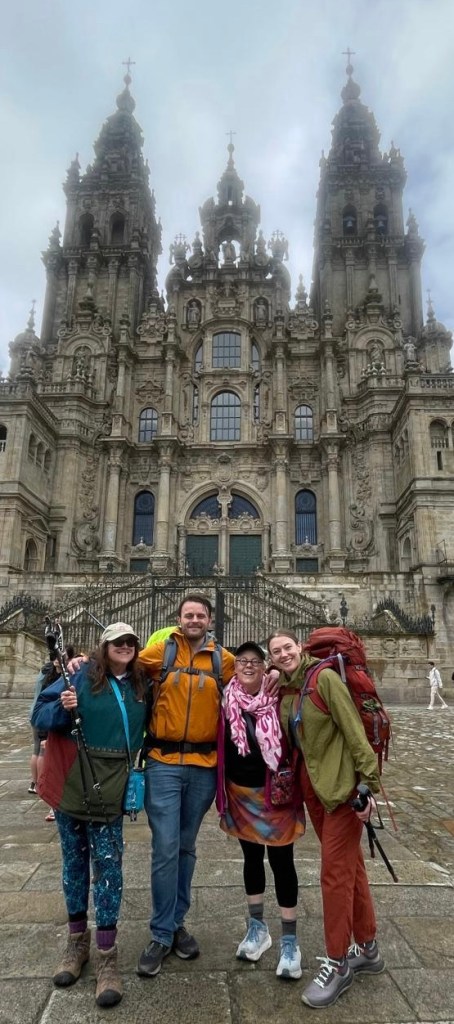
The ending point of our Camino Portugués is the Cathedral of Santiago de Compostela in Galicia, Spain. This magnificent cathedral is the traditional final destination for all routes of the Camino de Santiago, as it is believed to be the burial site of Saint James the Greater, one of Jesus’s apostles.
Santiago is a beautiful, historic city full of charming narrow streets, excellent Galician food and other pilgrims celebrating the end of their journey.
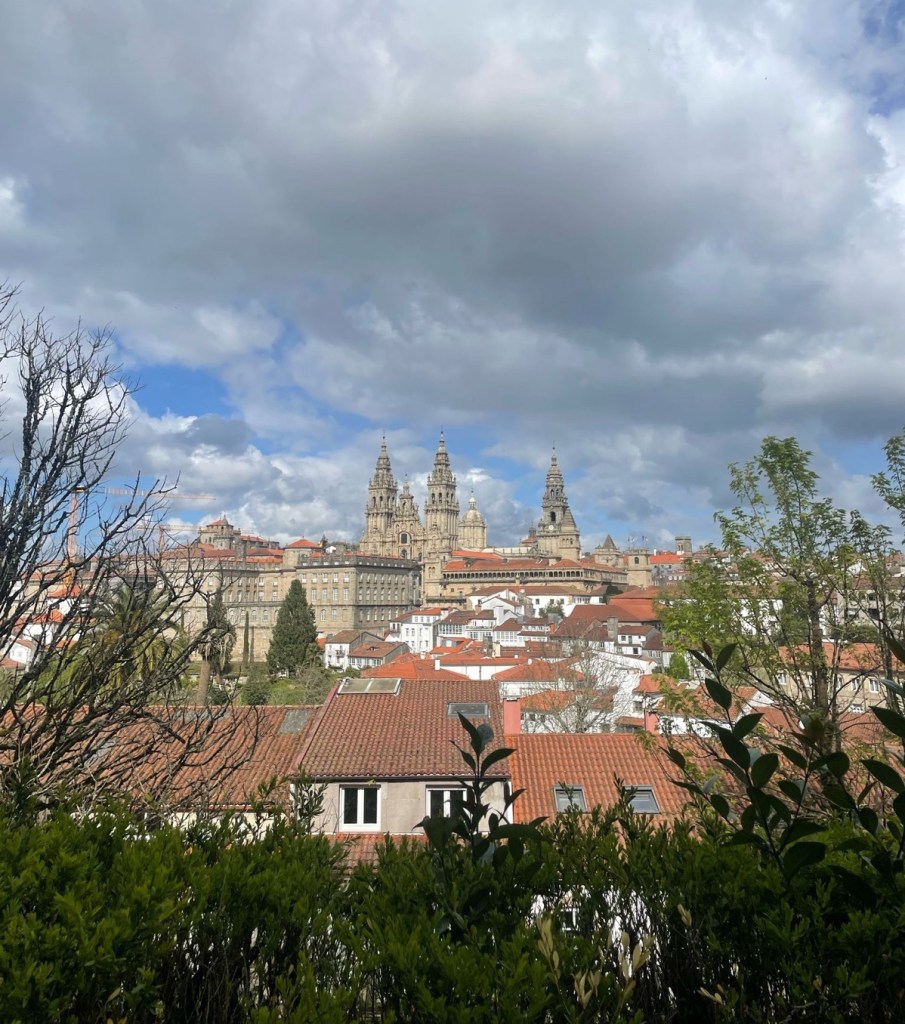
Our Camino journey may end here in Santiago, but the memories will stay with us forever. We’re lingering on a few more days to experience the beauty and tradition of Holy Week, with its unforgettable Spanish processions.
Holy Week in Spain is one of the country’s most storied and visually striking religious-cultural traditions.
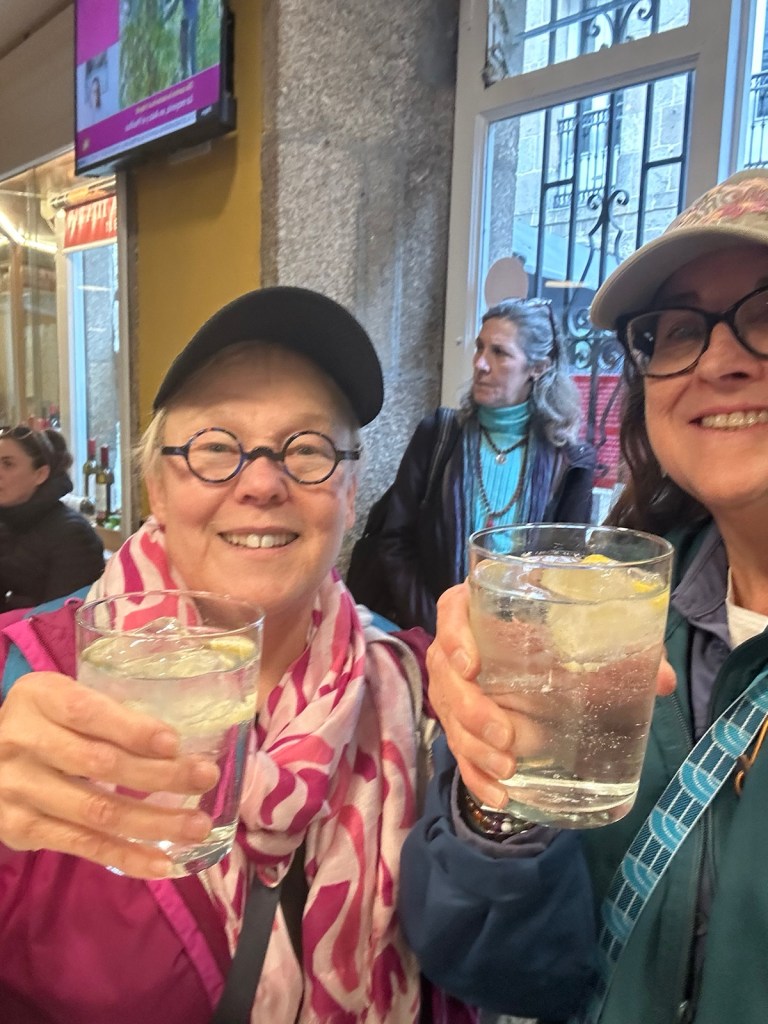
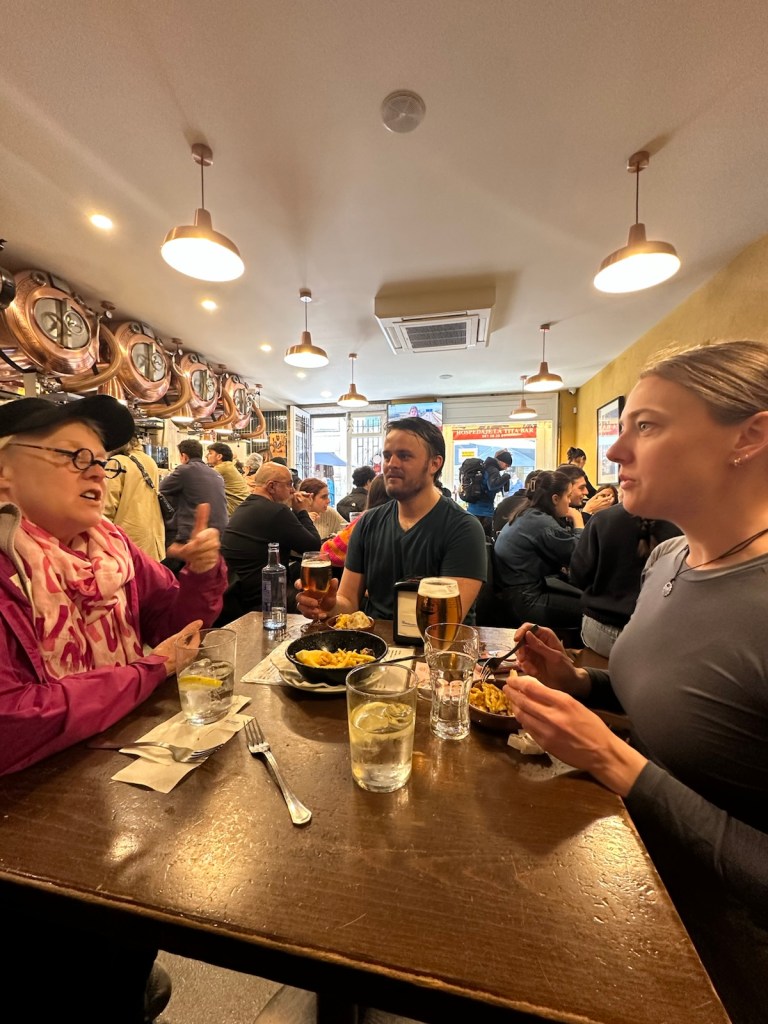
First, we’re celebrating at one of our favorite Santiago spots—Bar Latita. The tapas here are irresistible, and the atmosphere is just right for toasting the end of our journey.

Next, we make our way to the Cathedral—joining the quiet line into the crypt to see the resting place of St. James, then climbing the stairs behind the altar to pay our respects to San Tiago (St. James) himself.
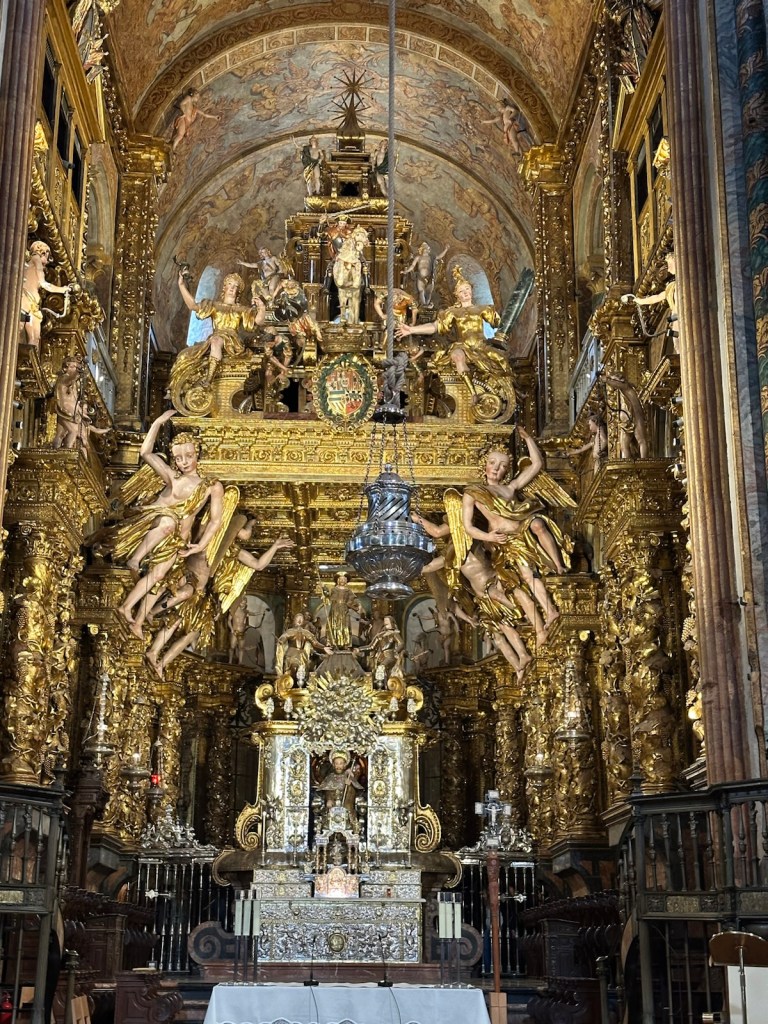
Since the processions don’t begin until evening, we have the afternoon free to wander around Santiago. Theresa and I have visited several times before, so we each have our own favorite spots to return to. There’s a chance of rain, though—and if it comes, the procession may be canceled.
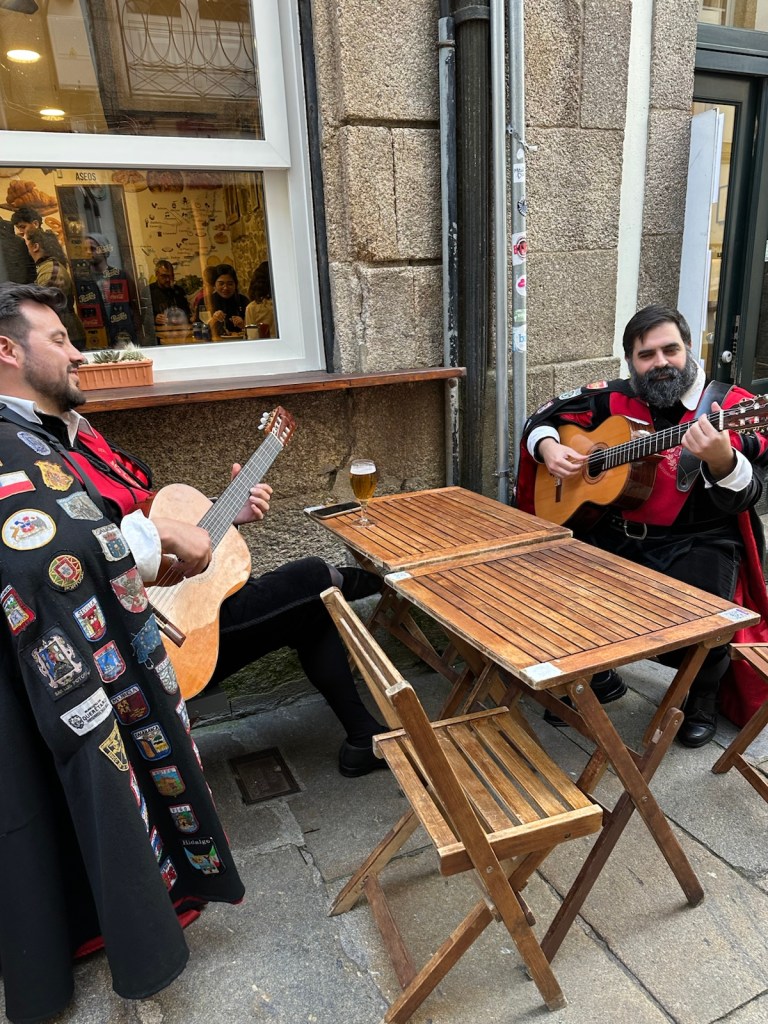
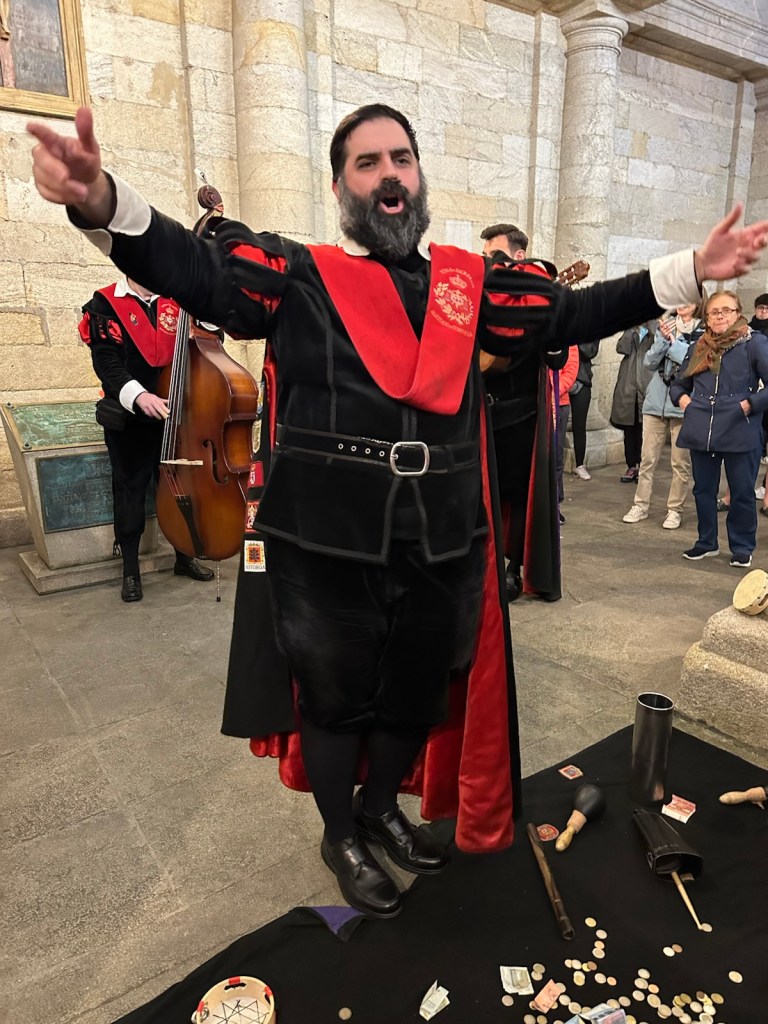
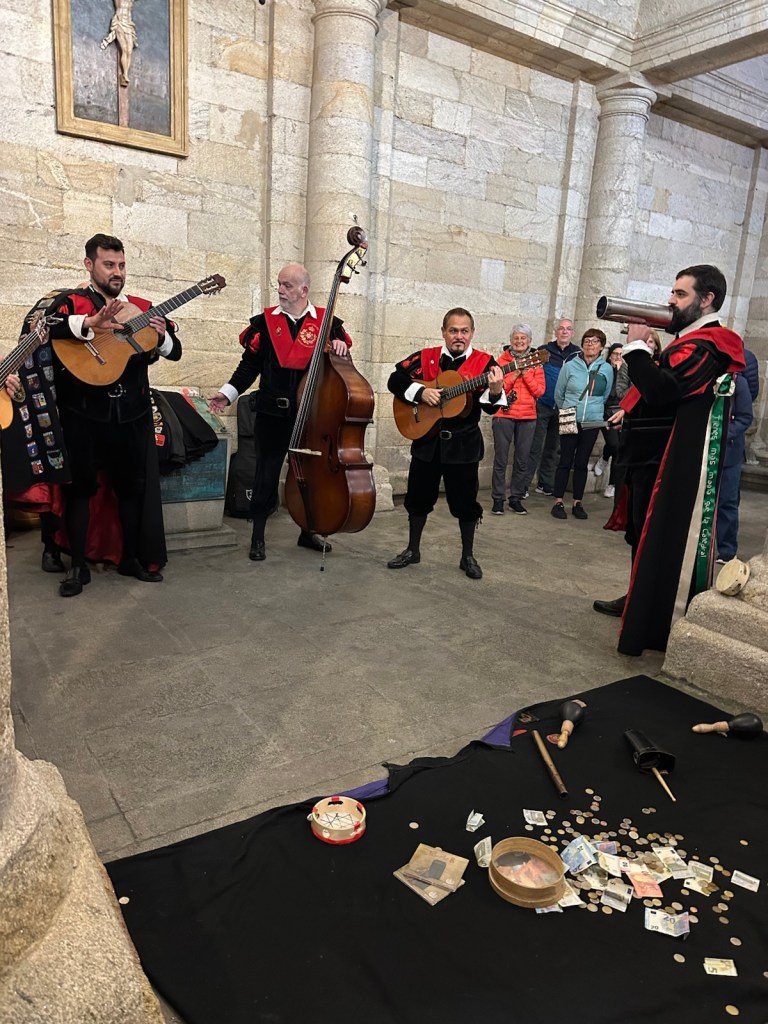
As night falls, you’ll often hear guitar music and heartfelt singing echoing off the stone walls of the plaza. It’s the Argentine troubadours, beloved, informal musicians performing around the grand square in front of the Cathedral. These musicians are typically traveling performers from Argentina (and occasionally other Latin American countries), often pilgrims themselves, who bring a unique spirit to the Camino’s endpoint.
Many of these musicians walk the Camino themselves and perform as a way to connect, reflect, and give back. Their presence is a reminder that the Camino is as much about community and shared experience as it is about the path itself.
It’s the perfect soundtrack for a Santiago evening—nostalgic, soulful, and filled with the spirit of the journey
It had been a long day, with rain coming and going. Theresa and Helen had already returned to the hotel, while Kyle and I lingered near the Cathedral, listening to the troubadours as we slowly made our way back. We assumed the procession had been canceled due to the weather— but then, to our surprise, we caught a glimpse of one of the floats emerging through the misty evening.
We hurried up the steps to the Cathedral as the procession approached the great doors. In a moment of quiet drama, everything seemed to pause. Then, slowly, the massive door creaked open, and the procession entered. We stood in awe, moved by the solemnity and the haunting beauty of the scene.
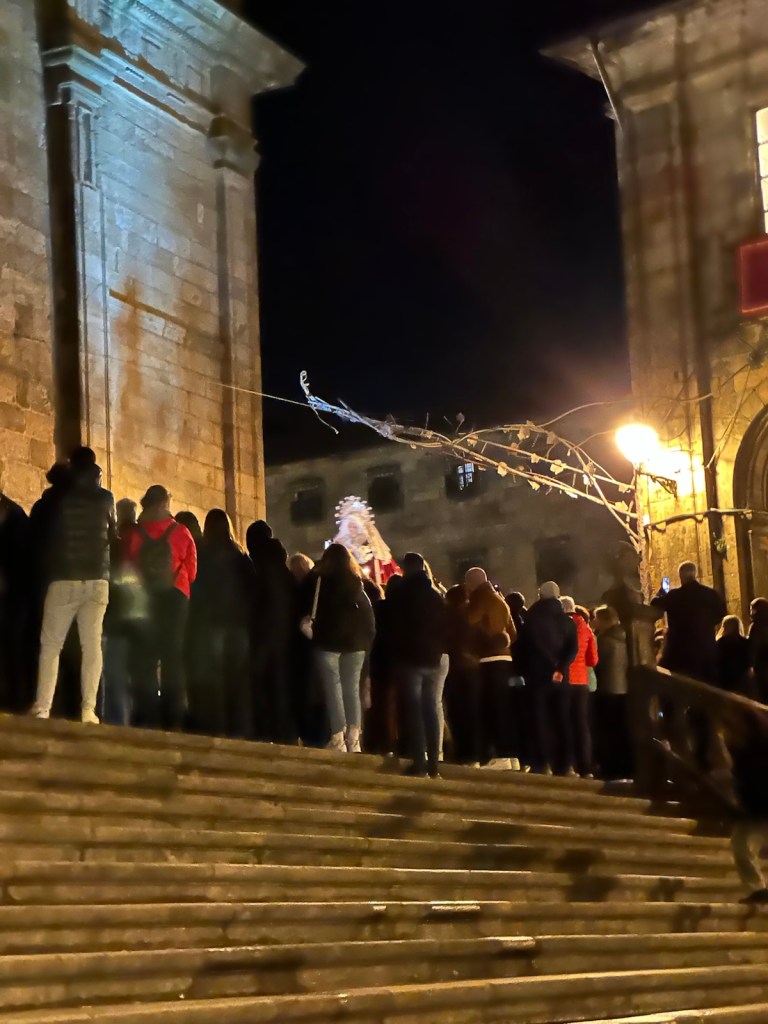
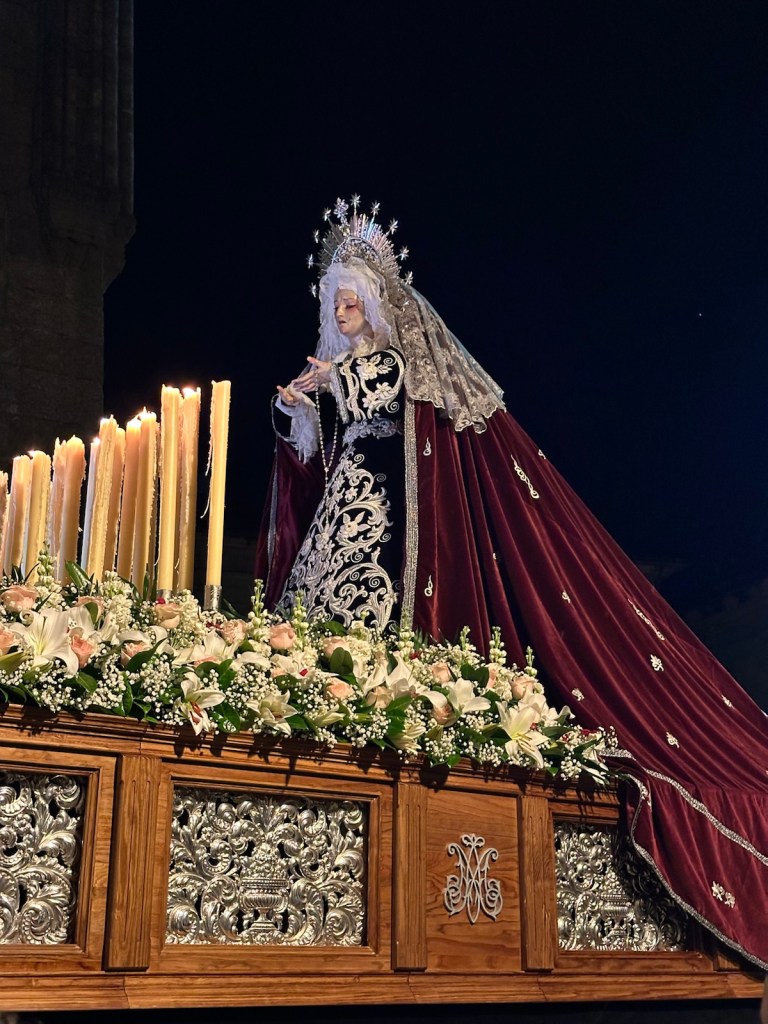
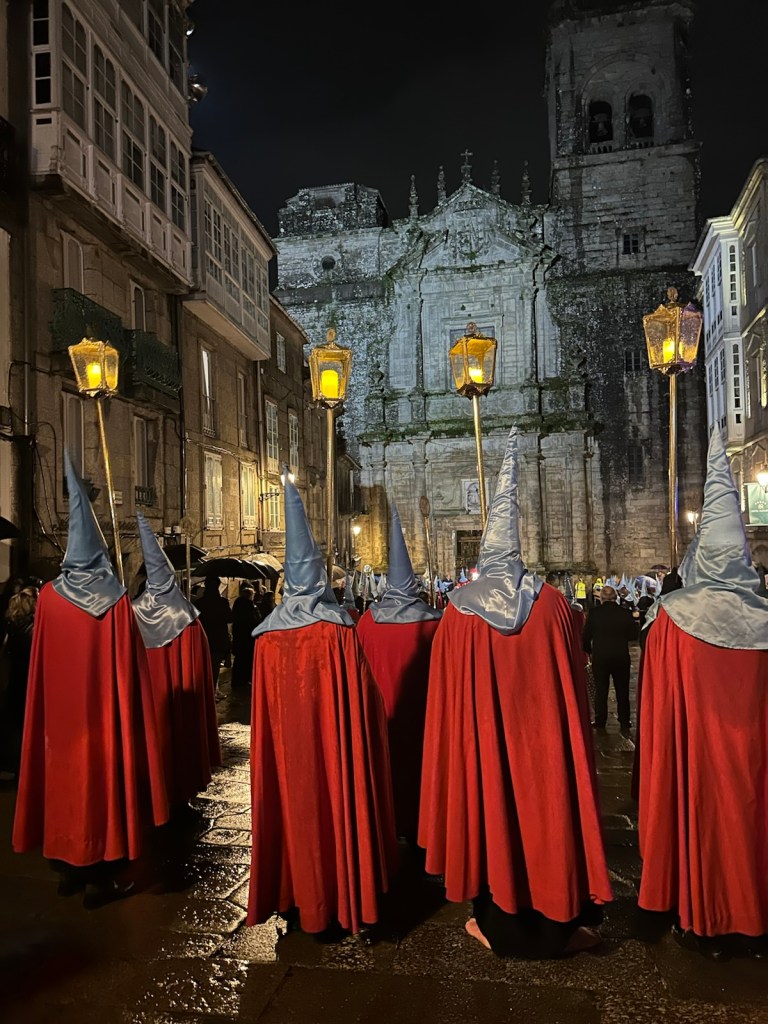
The conical hoods and robes you see are called capirotes (pointed hoods) and are worn by Nazarenos (penitents) as a sign of humble anonymity and spiritual “lifting” toward heaven. Though they resemble KKK garb at first glance, they have an entirely different origin and meaning: their attire is about centuries-old acts of penance and faith — nothing to do with the Klan.
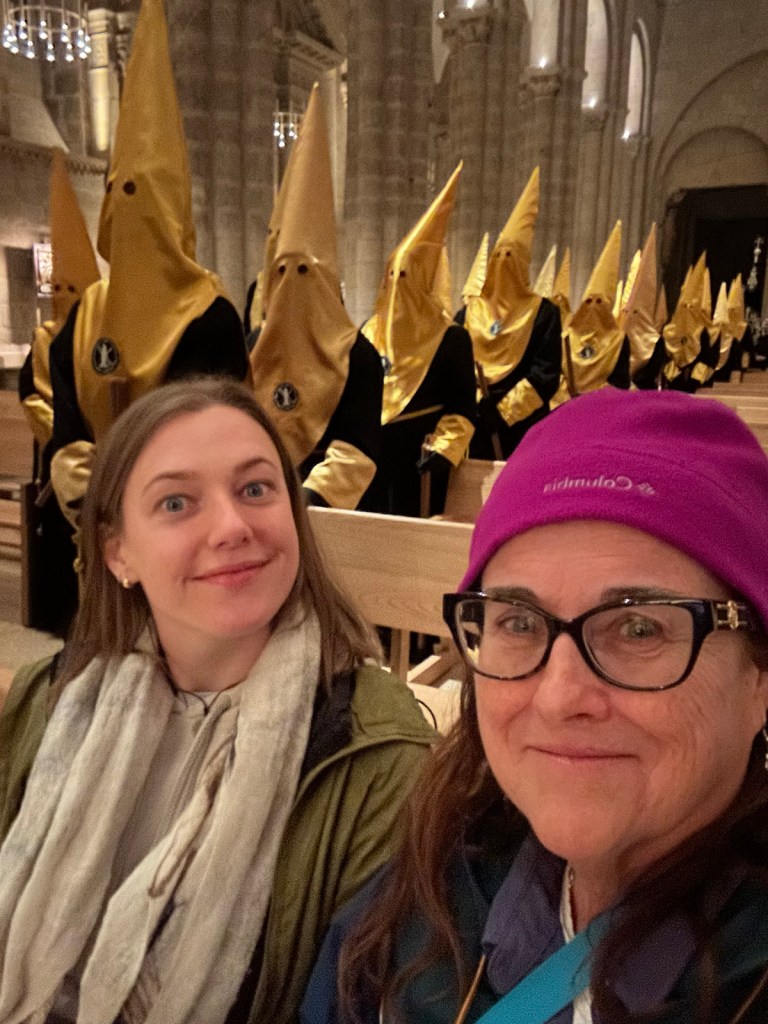
The entire procession enters the Cathedral, the penitents skillfully guiding the heavy float through tight corners with remarkable precision. Once inside, they form solemn lines, joined by observers and the faithful who quietly follow behind. A ritual of prayer begins, punctuated by moments of profound silence. It’s now close to midnight, and we’ve reunited with Theresa and Helen, who came after hearing the commotion outside.
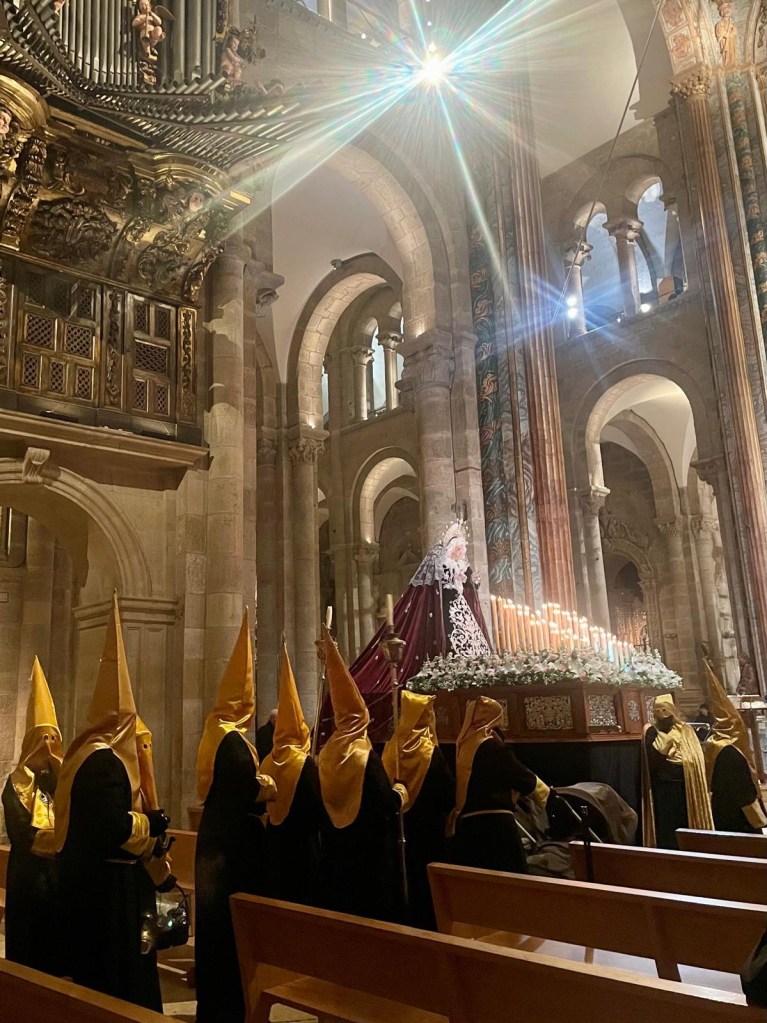
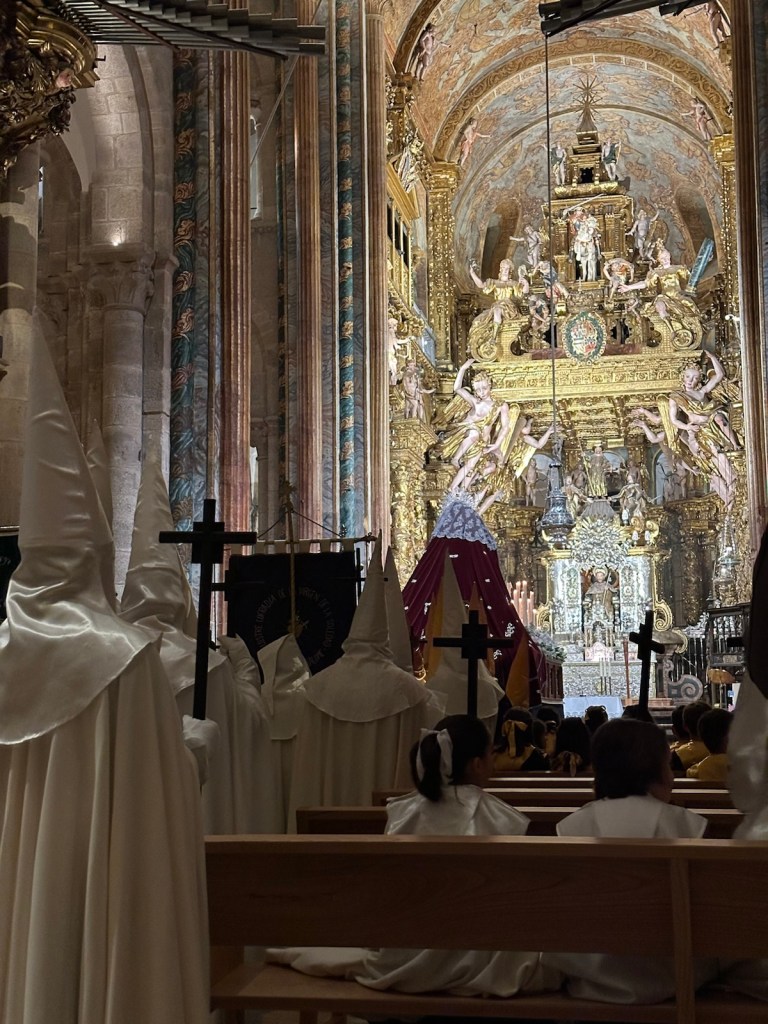
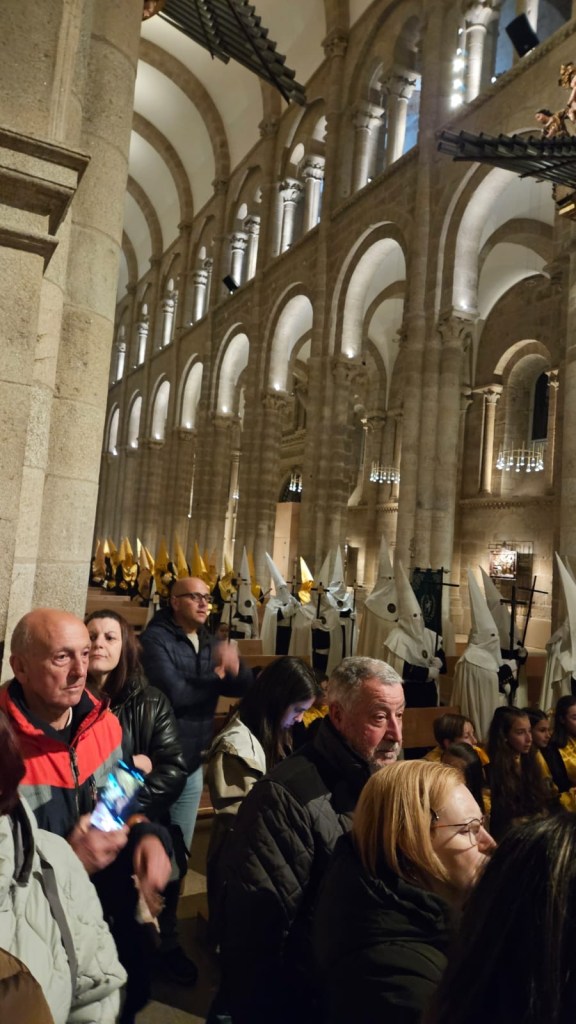
Just as dramatically as it had arrived, the procession made its way out of the Cathedral, continuing on to its next destination. The experience was powerful — and for first time viewers, almost overwhelming in its intensity. We followed for a while, caught up in the moment. A long day was gently unfolding into a long, unforgettable night.
The End of the World— Finnistere
Many pilgrims stay a few extra days to rest, reflect, or explore nearby areas like Finisterre or Muxía — places traditionally considered “the end of the world.”
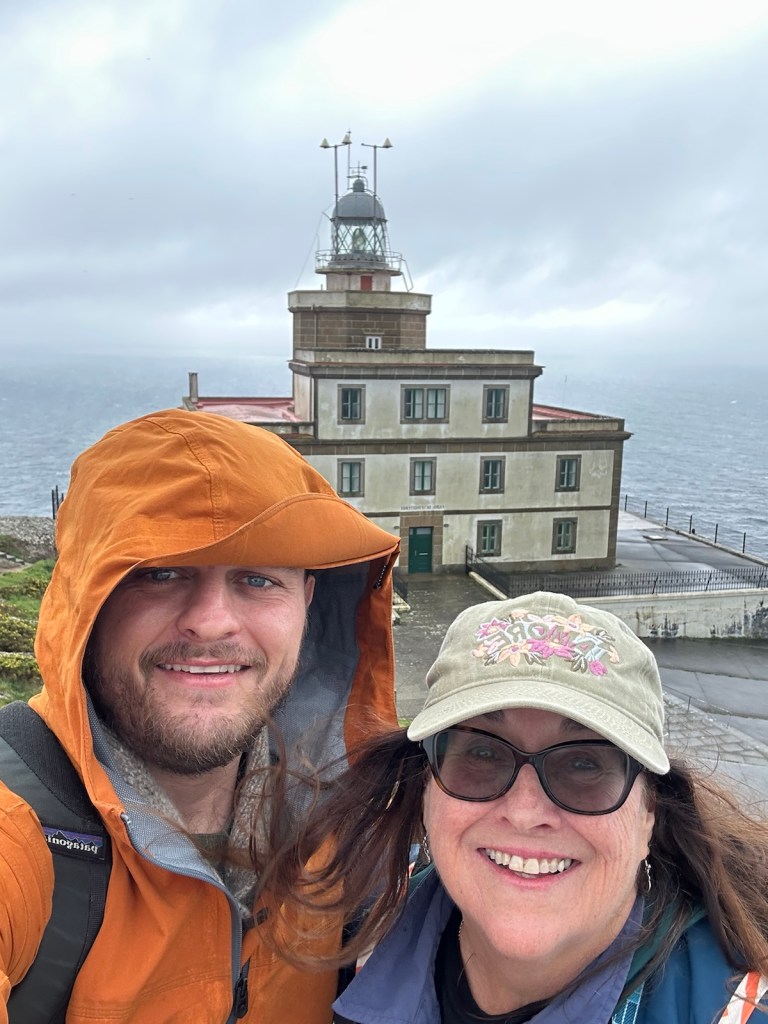
It rained most of the next day. We took a two-hour bus ride to Finisterre (or Fisterra in Galician) which is often called “the end of the world” because in ancient times, it was thought to be the westernmost point of Europe — the farthest reach of the known world before the discovery of the Americas.
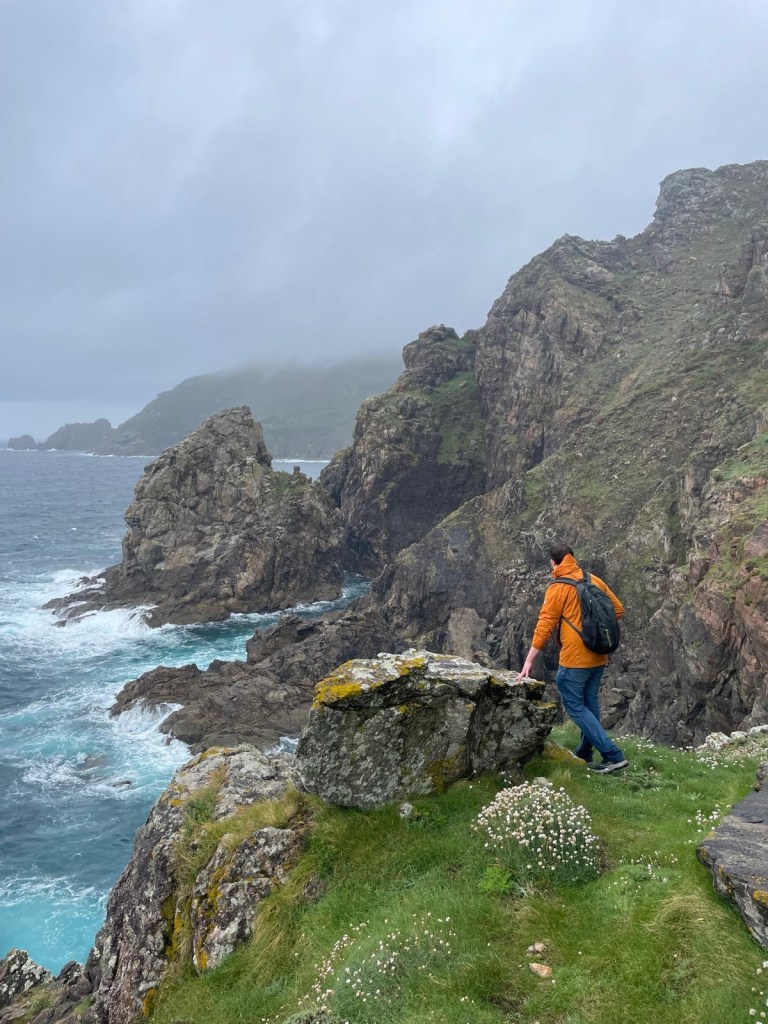
The dramatic cliffs, roaring ocean, and open horizon offer a powerful space for closure, solitude, and the sense of a journey fully completed.
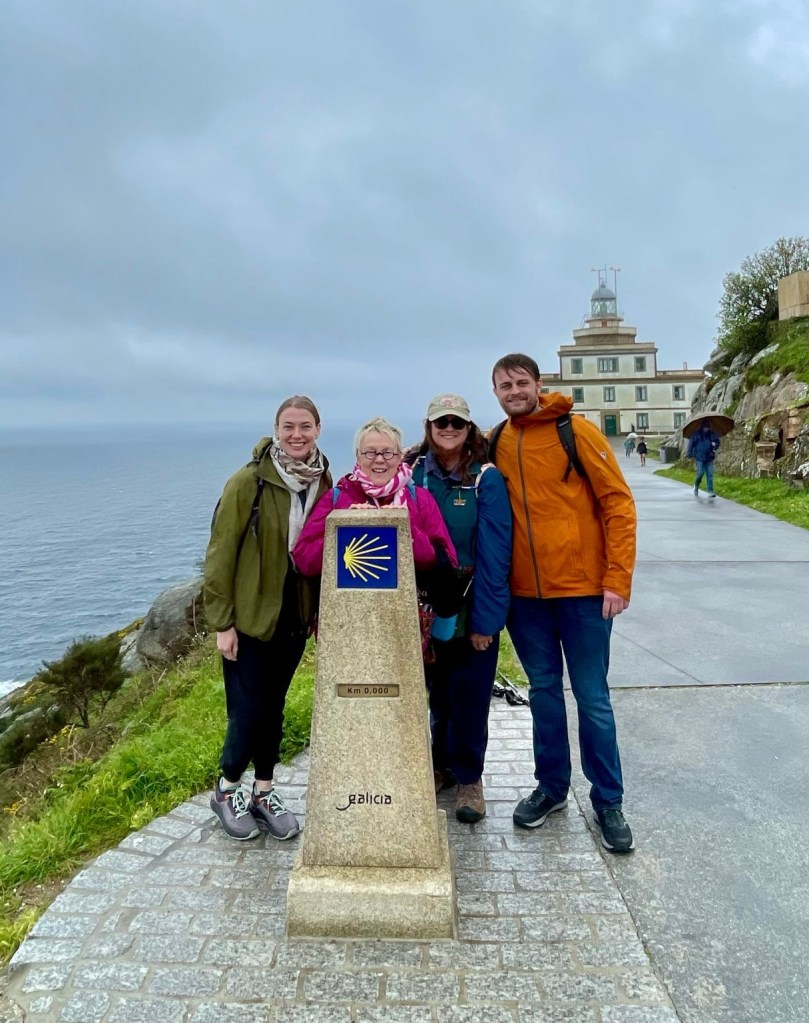
Although the official Camino ends in Santiago de Compostela, reaching the Km 0 marker at Finisterre feels like the ultimate finish line — the place where land ends and the ocean begins. It’s a spot for closure, gratitude, and sometimes transformation.
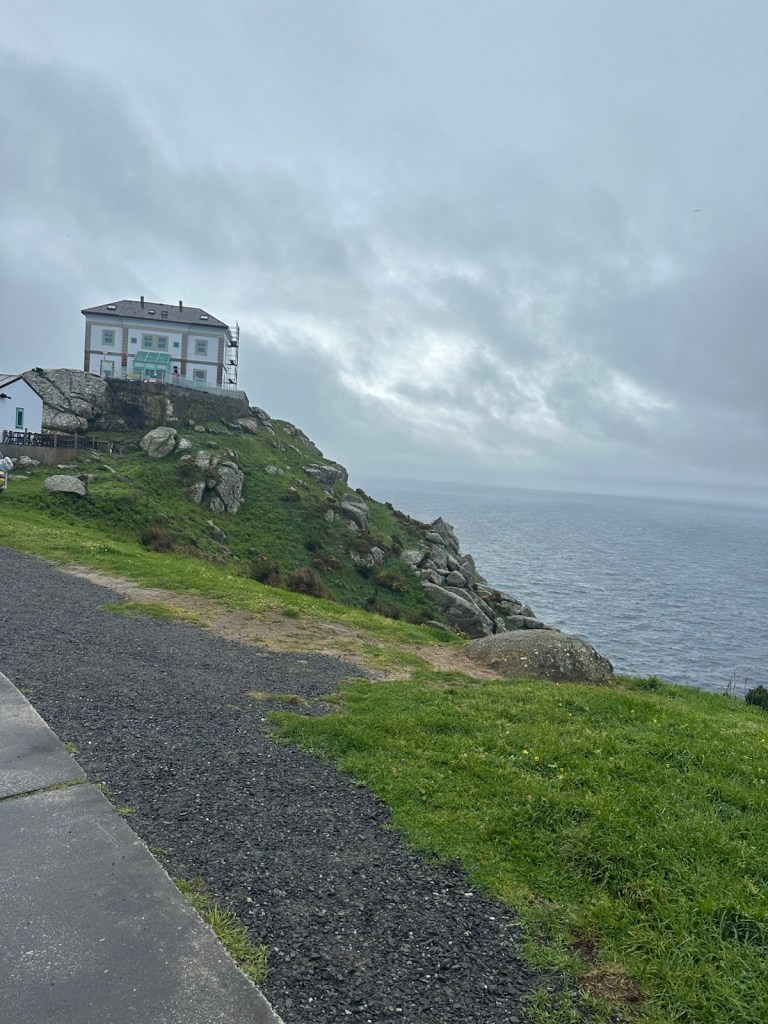
While Helen and Kyle set off on a long hike, Theresa and I chose a more relaxed route — returning to the lighthouse hotel for a drink, a ritual of ours. On many of our past Caminos, we’ve watched the sun set over the sea from this very spot. But this time, the rain had its own agenda, and we were beginning to feel its weight.
Before boarding the bus back to Santiago, we had one last ritual to honor — a seafood feast at one of our favorite Finisterre restaurants, a celebration of the sea and the journey behind us.
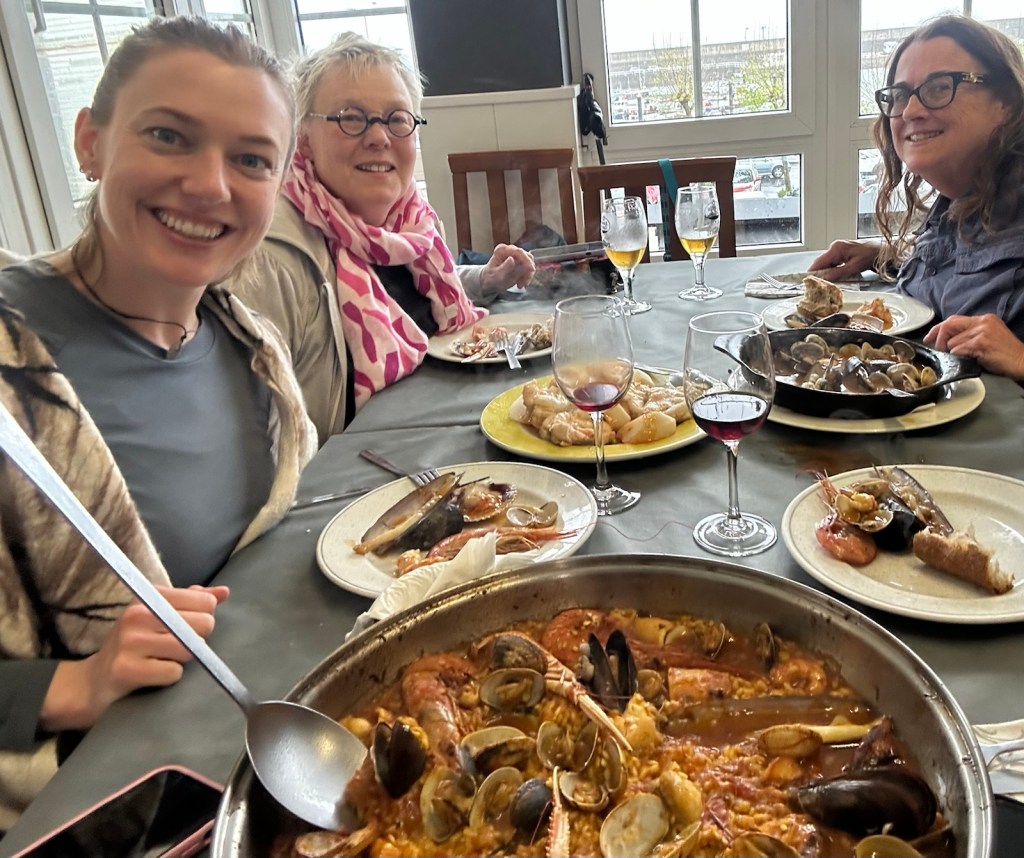
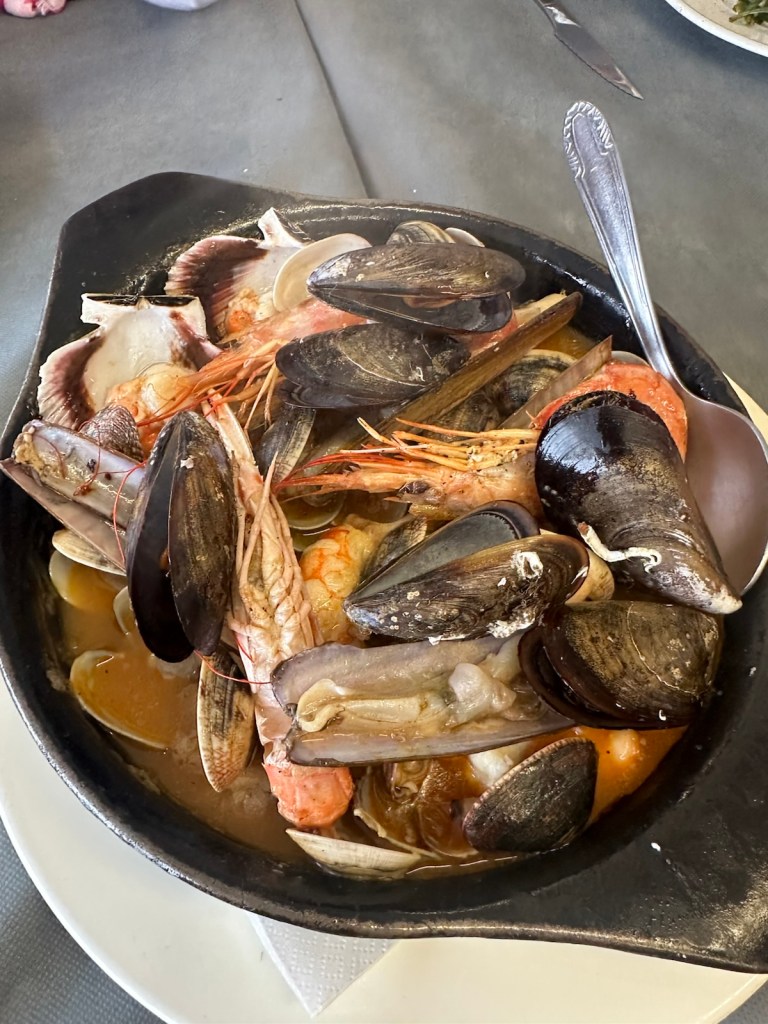
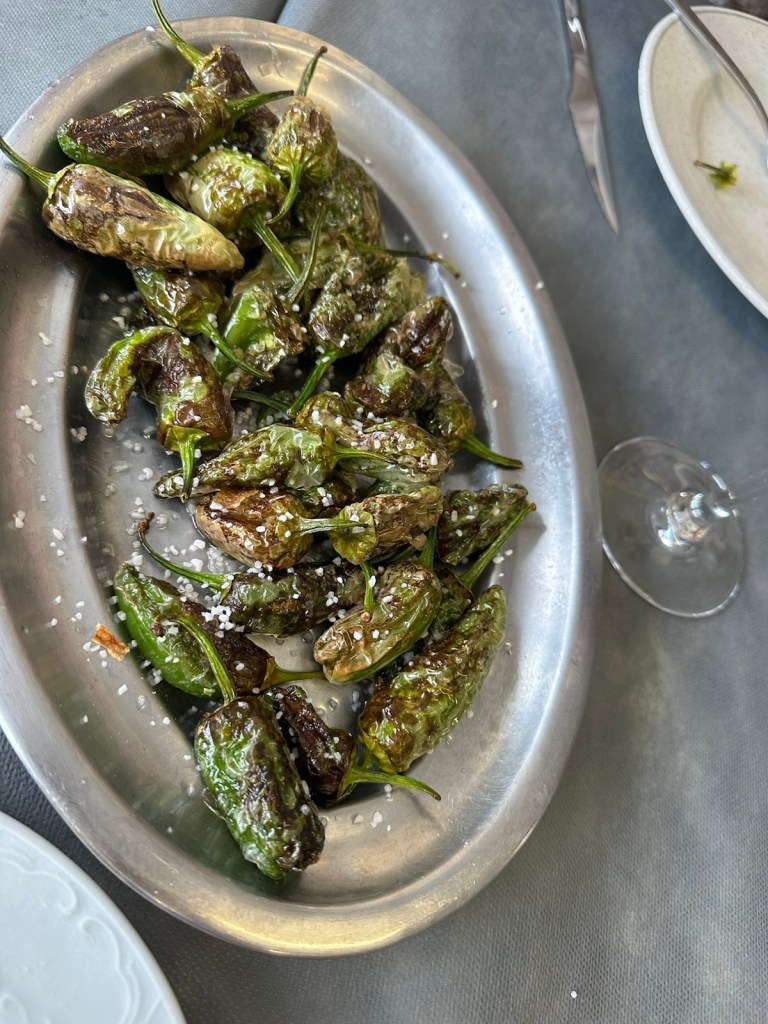
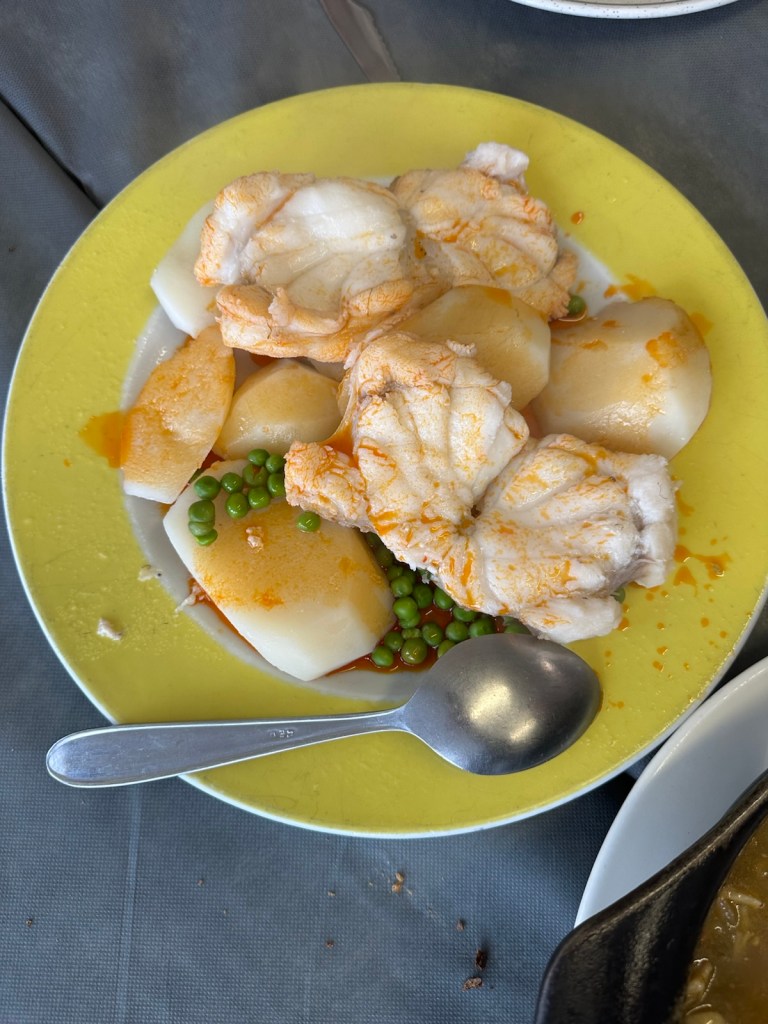
After a long, rainy day and several hours on the bus, we returned to Santiago — where the rain was still falling. We assumed the 11:00 pm procession would be called off. Theresa and Helen turned in for the night, but Kyle and I decided to venture out and see a bit of Santiago’s late-night scene.
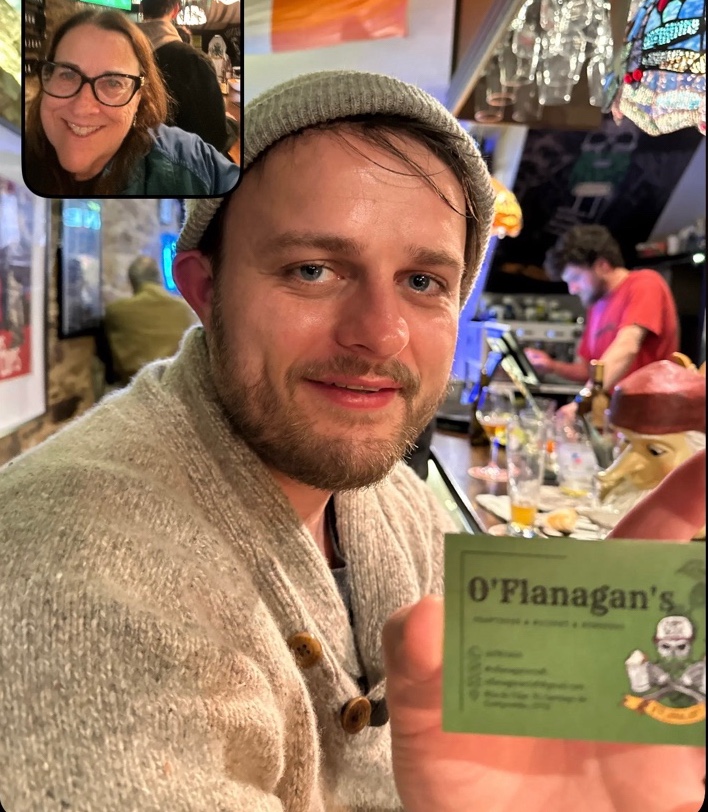
We ended up at a nearby pub called O’Flanagan’s — too tempting to pass up. Over drinks, we chatted and unwound, and by midnight we were ready to call it a night. But just as we were about to leave, the pounding of drums echoed through the street — the procession was passing right outside. We quickly paid the bill and rushed outside.

Once again, it was a haunting, midnight scene, the figures moving solemnly through darkness and light rain. We watched in silence as the procession passed, then, unable to resist, hurried ahead to catch a second glimpse as it made its way through the city.
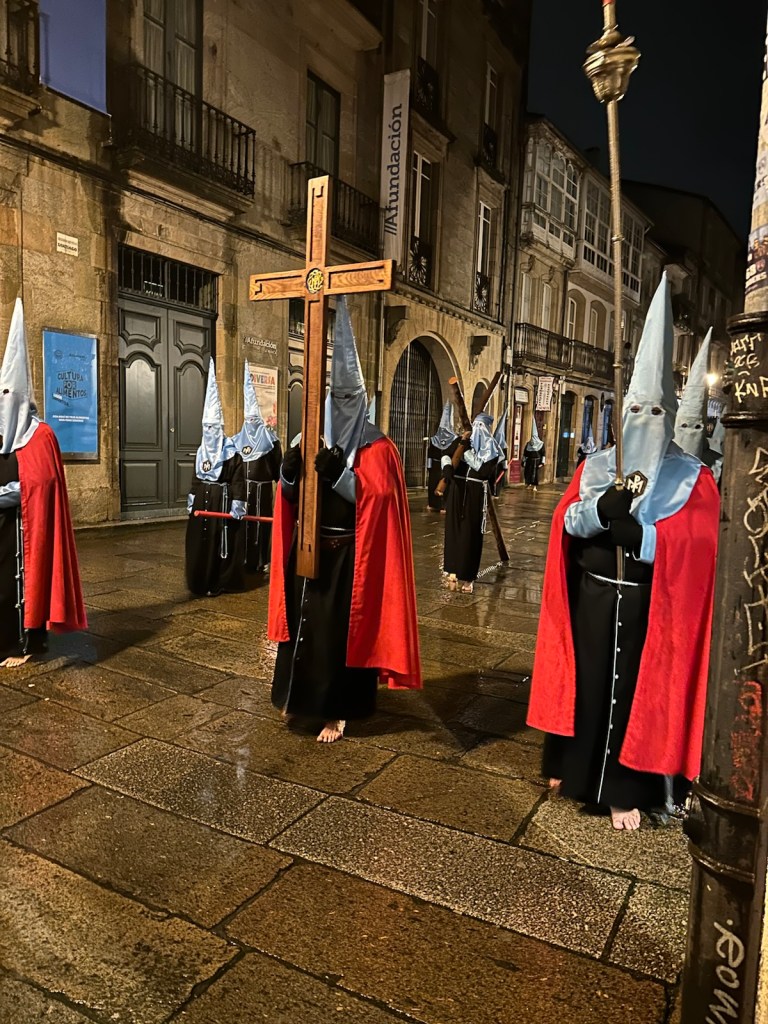
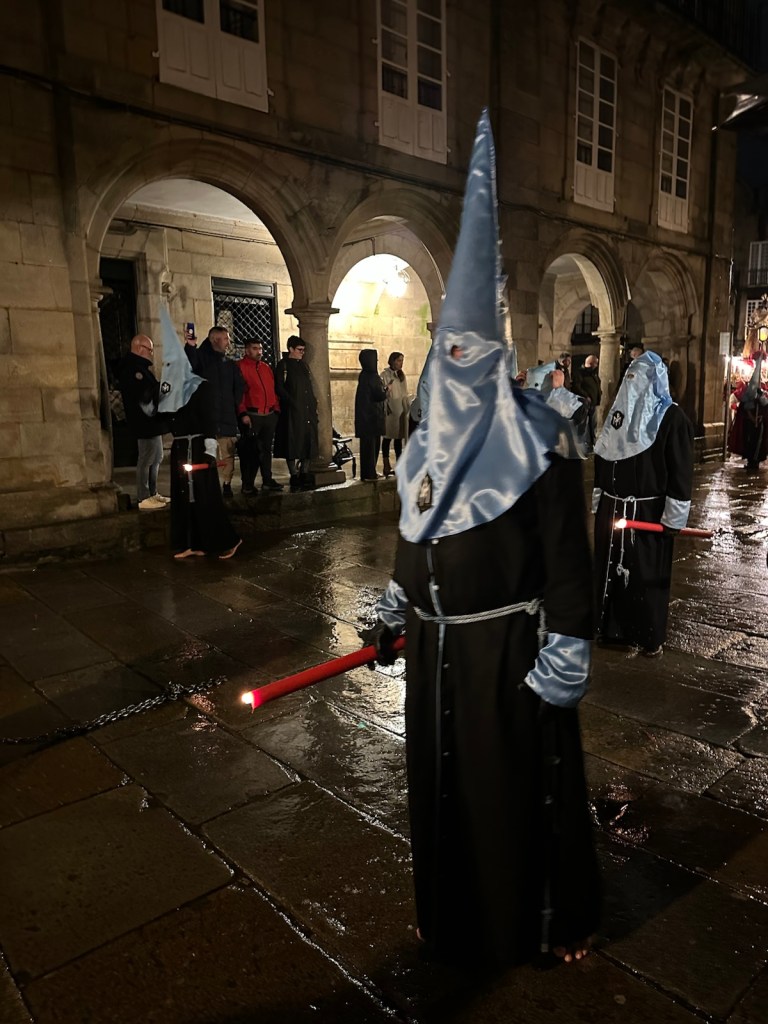
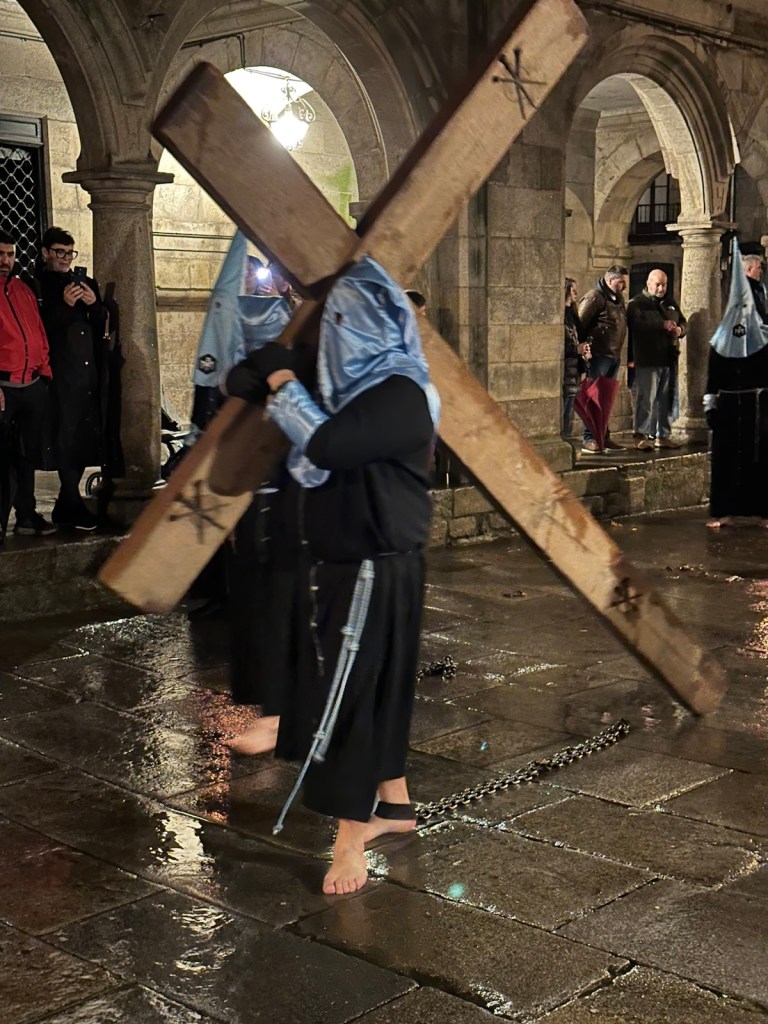

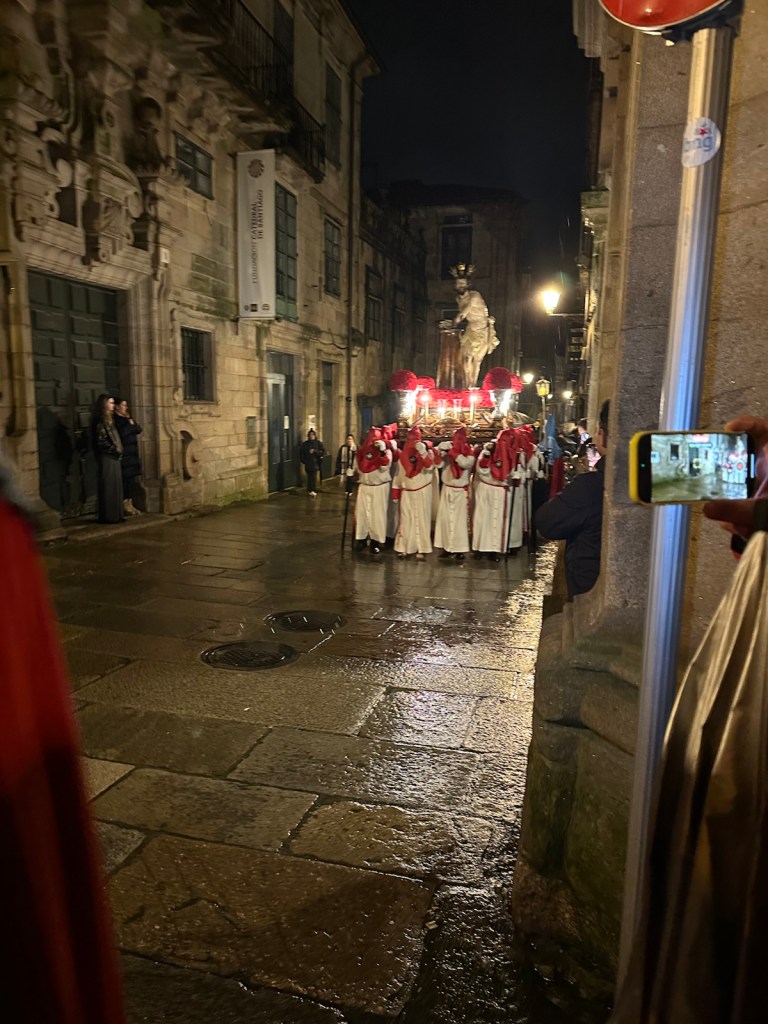
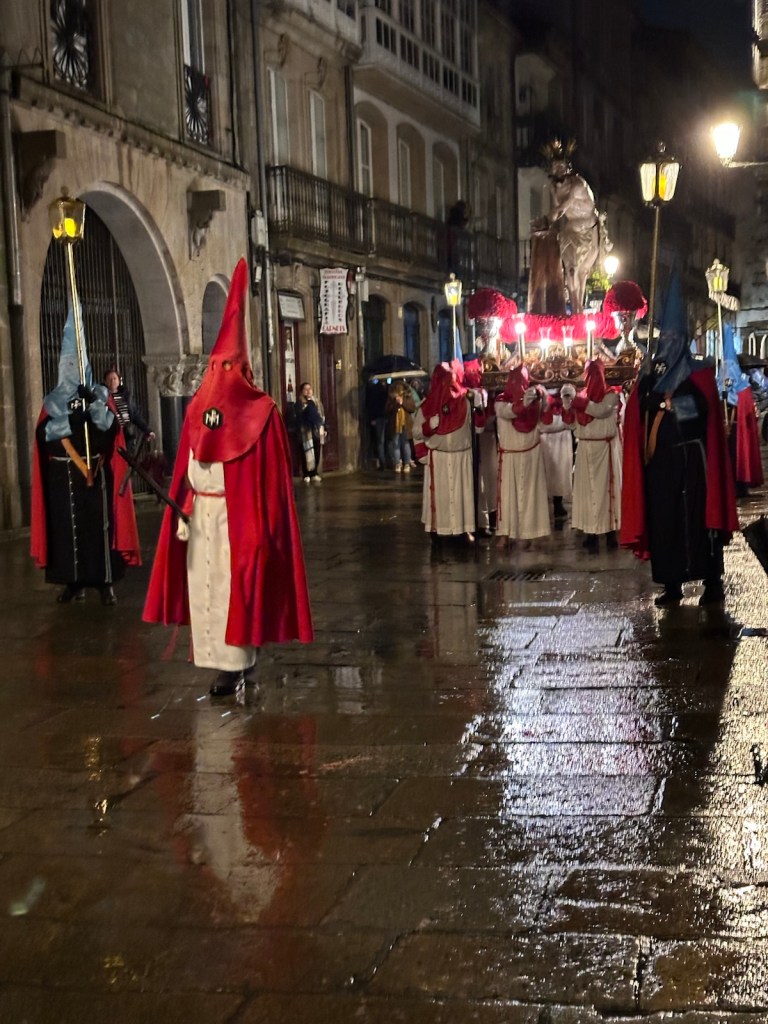
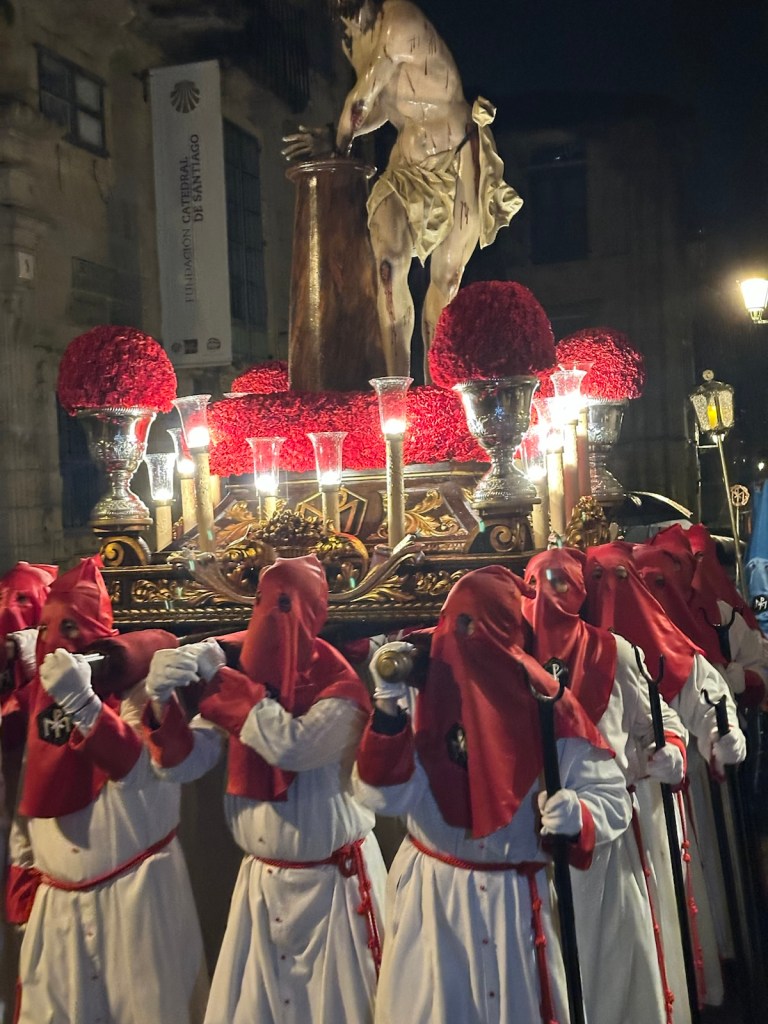
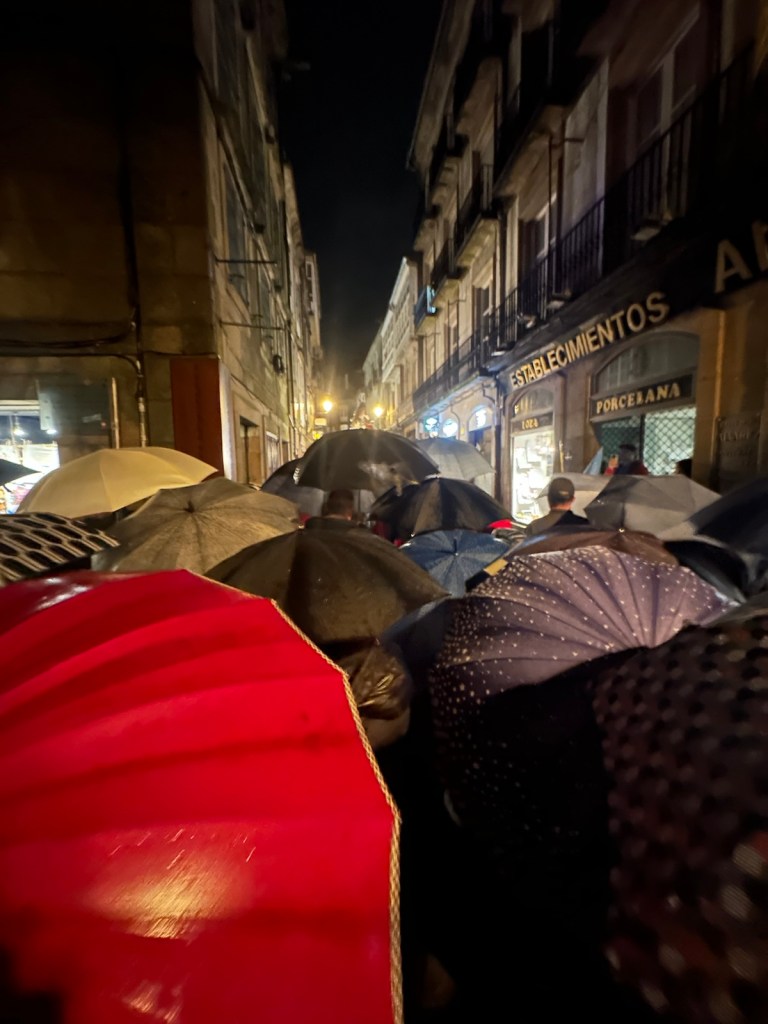
A crowd of followers, umbrellas in hand — ours included — trailed behind the procession as it wound its way through narrow streets, between ancient stone buildings and around shadowy corners.
Everything came to a halt in front of an eerie old church, its facade draped in moss and speckled with barnacle-like flaws. Even the birds circling overhead added to the uncanny atmosphere. The drama was thick in the air, and we waited, intrigued, to see what would unfold next.
There were ritual gestures, murmured prayers, and then the floats and penitents slowly moved into the shadowy old church. We followed along with the rest of the crowd, but just as the last of the procession disappeared inside and we reached the doorway, a solemn group of four penitents stepped forward and blocked the entrance. That seemed to be our cue — it was time to head back through the quiet streets and make our way to the hotel.
Good Friday: Our Last Day in Santiago
Once again, we woke to the sound of rain. We allowed ourselves a slow start, sleeping in a bit and easing into the day. It was Good Friday, and the streets were noticeably more crowded than usual. We had to wait a while for our first cup of café Americano and a bite to eat.
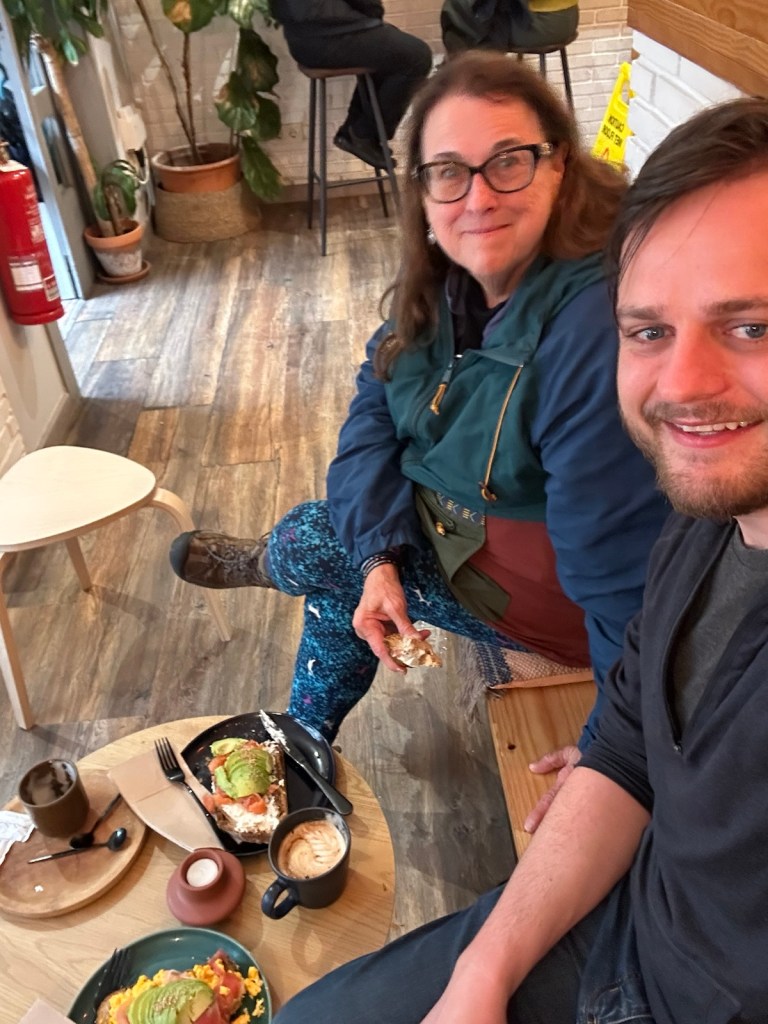
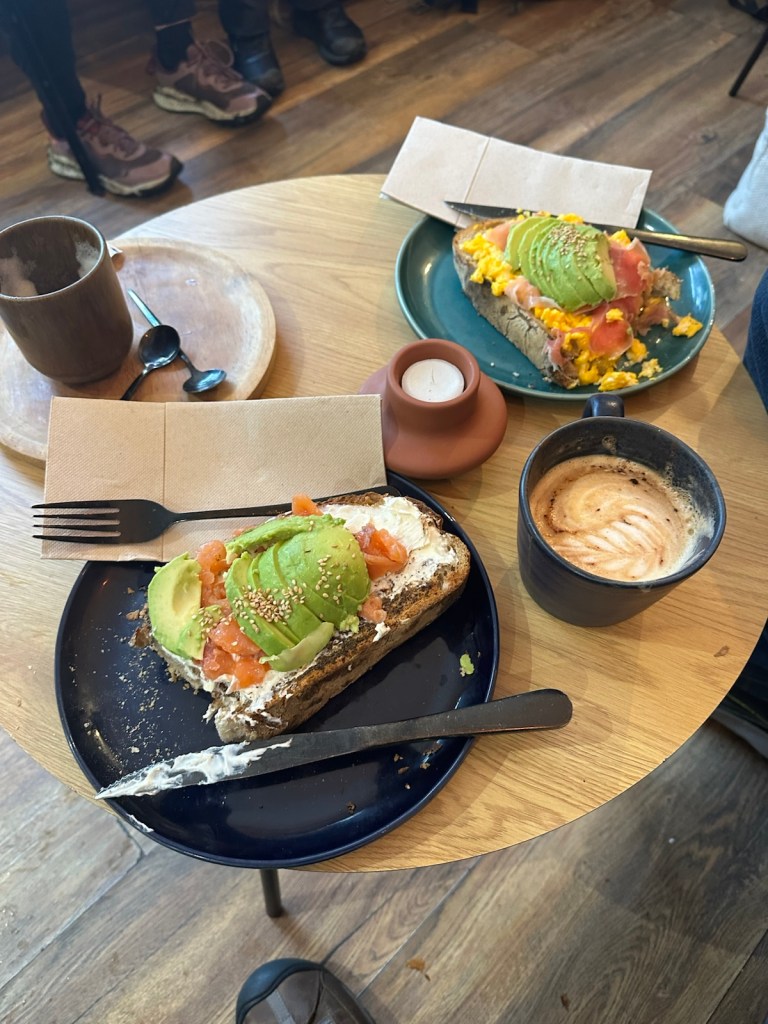
After regrouping, Kyle and Helen set off on one of their fast-paced explorations, while Theresa and I opted for a more relaxed wander.
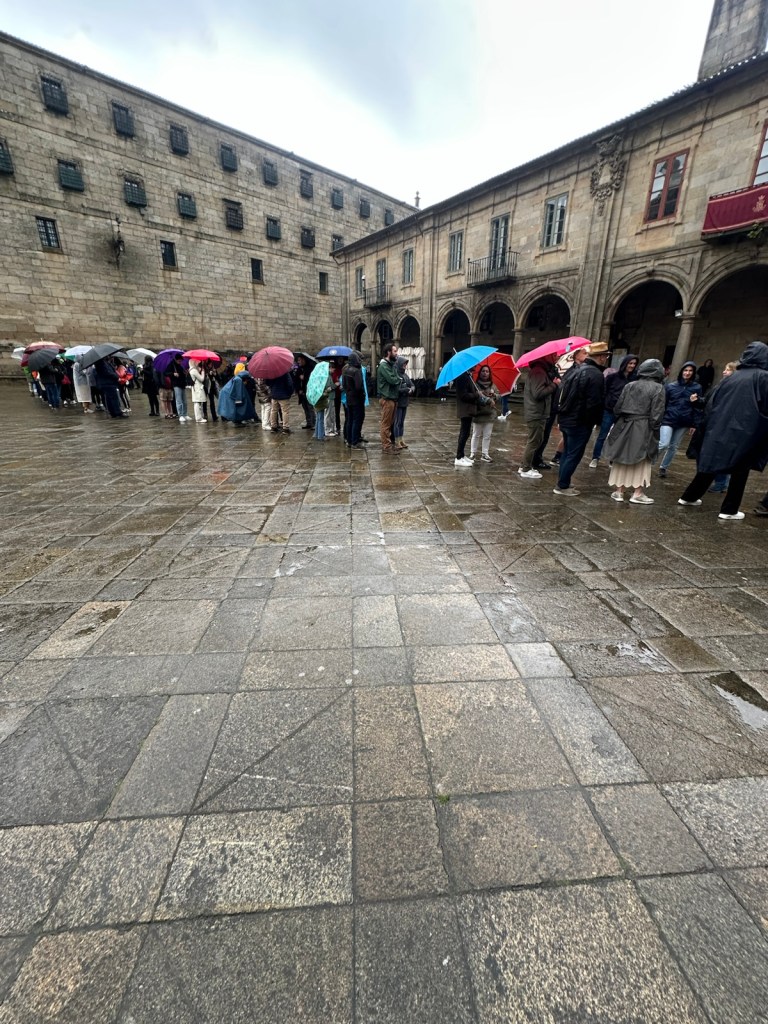
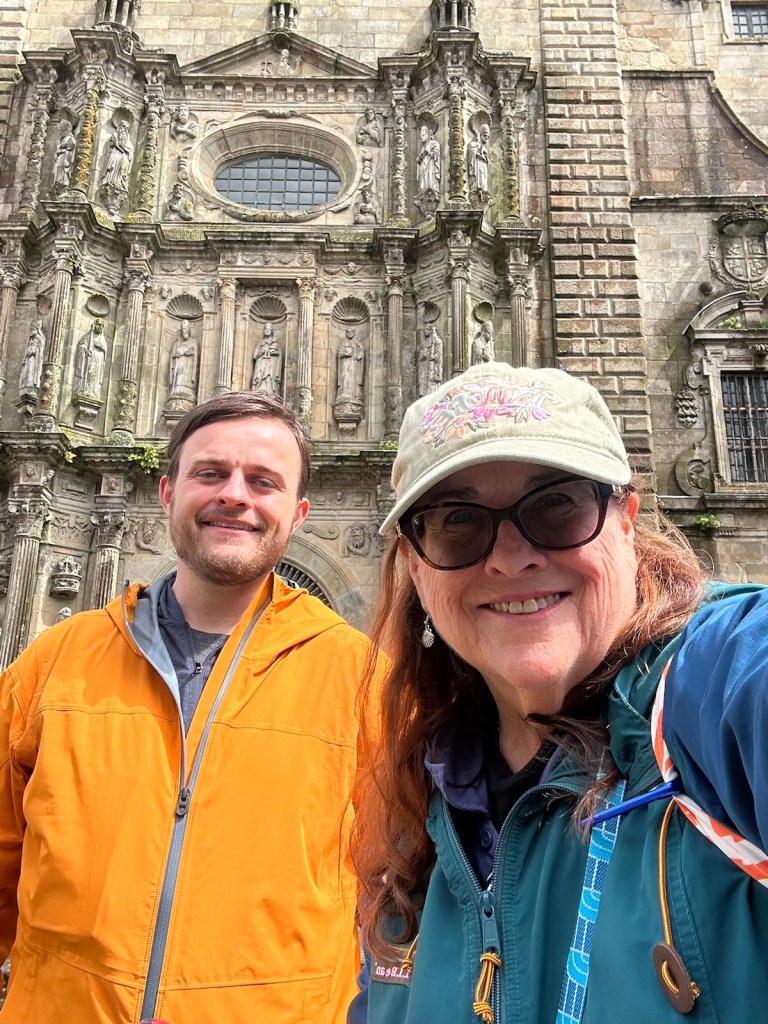
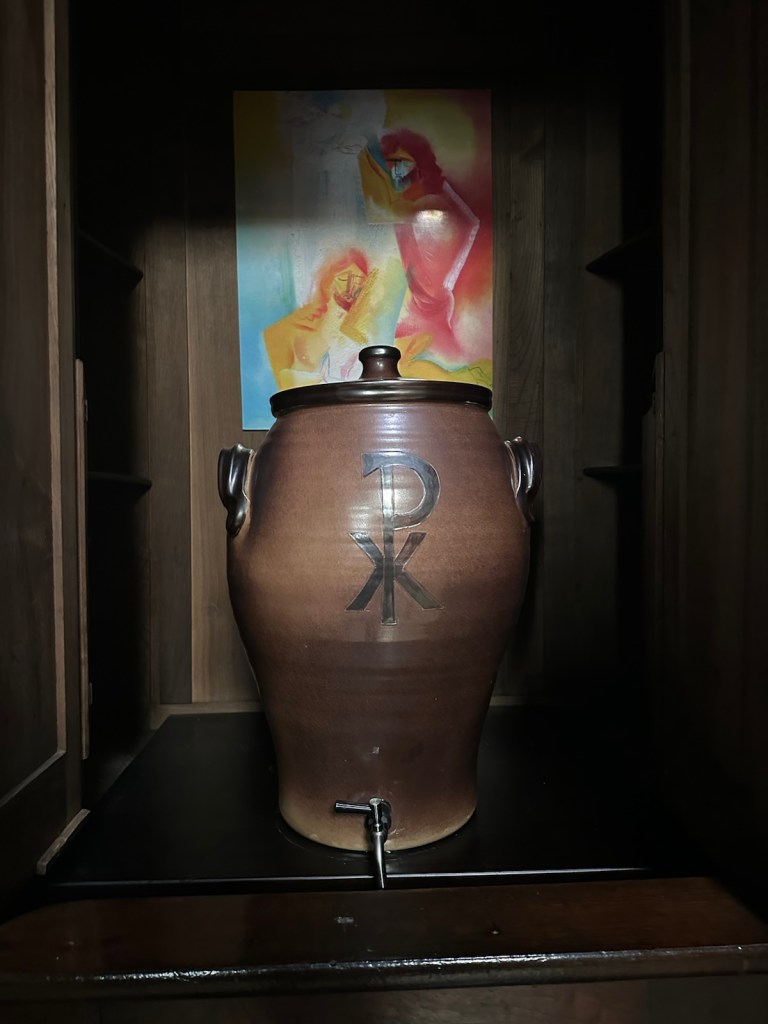
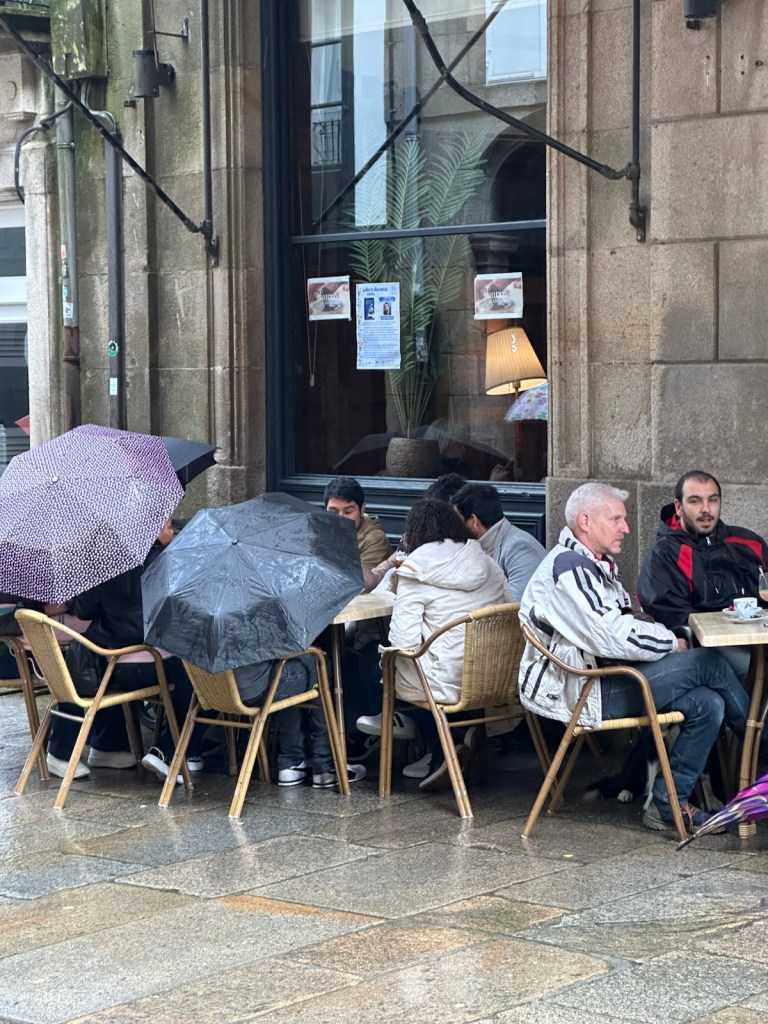
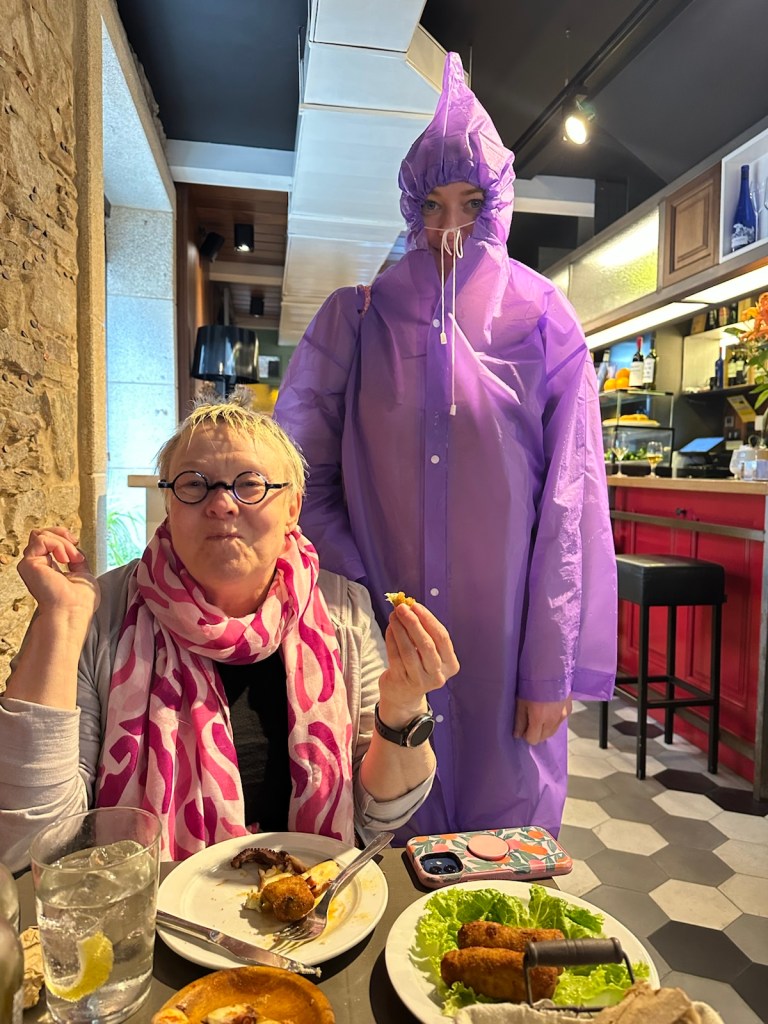
The day slipped by quickly, and we hoped to close out our time in Santiago with a dinner at a pulpería and, if the weather allowed, one last procession.
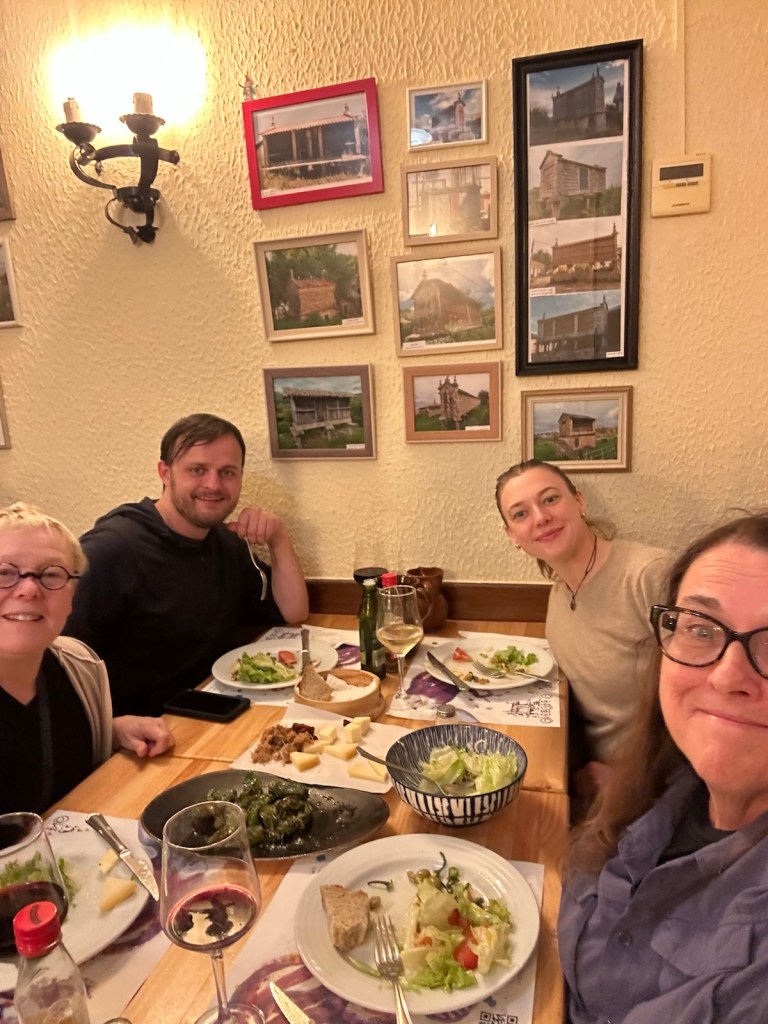
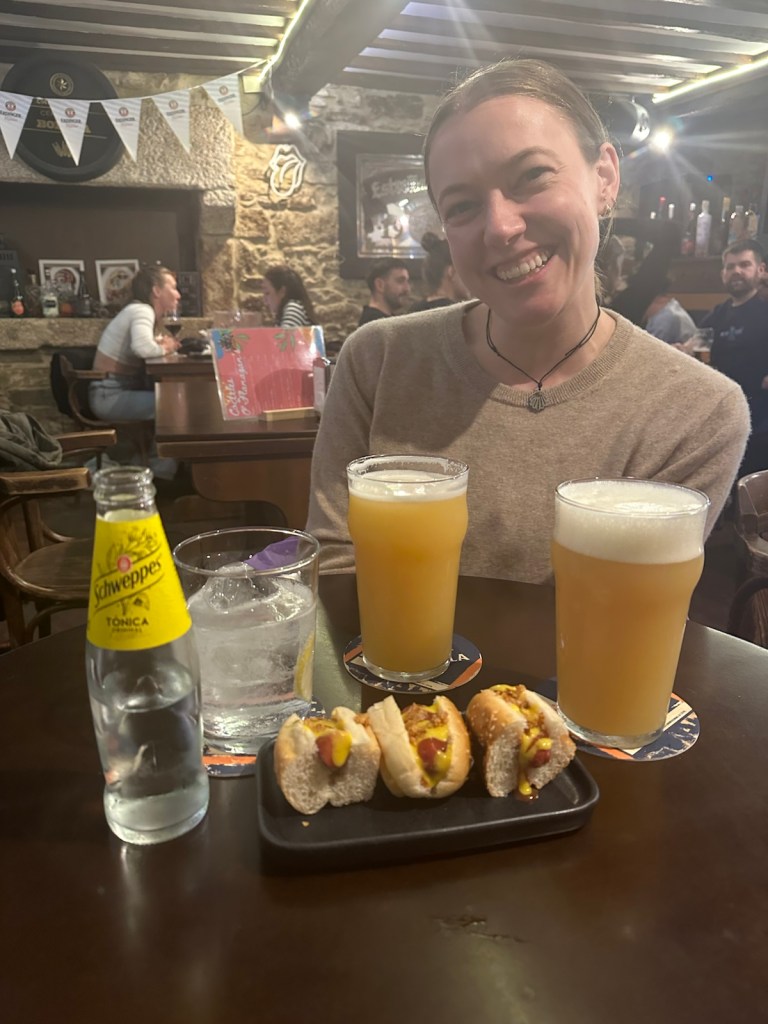
Theresa couldn’t keep her eyes open and called it a night. Helen, Kyle, and I headed back to our favorite Irish pub, where we were treated to some lively traditional music. Galicia, with its Celtic roots, has a natural affinity for all things Irish.
We weren’t sure if tonight’s procession would happen, given the weather, but we were thoroughly enjoying ourselves listening to the Irish music at O’Flanagan’s.
Then, like a bolt of lightning out of the blue, the sound of drums cracked through the night. We sprang into action and rushed into the streets — where we were met by a powerful wave of sound. A thunderous group of drummers was marching past, pounding their rhythms with fierce intensity. We watched in awe.
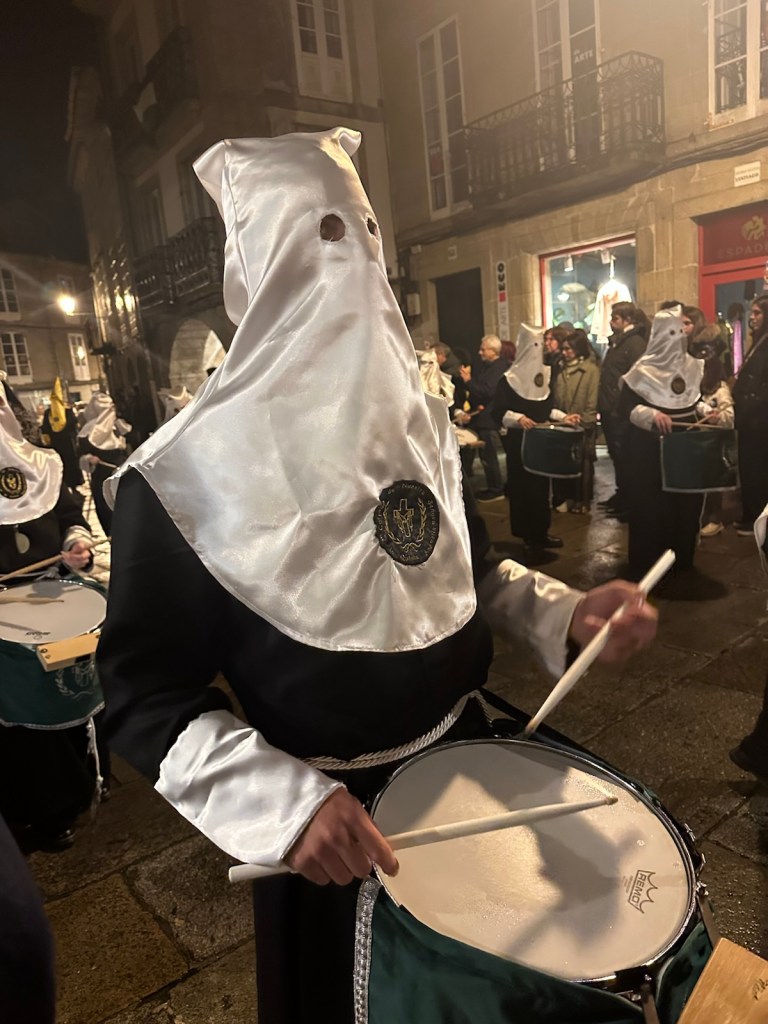
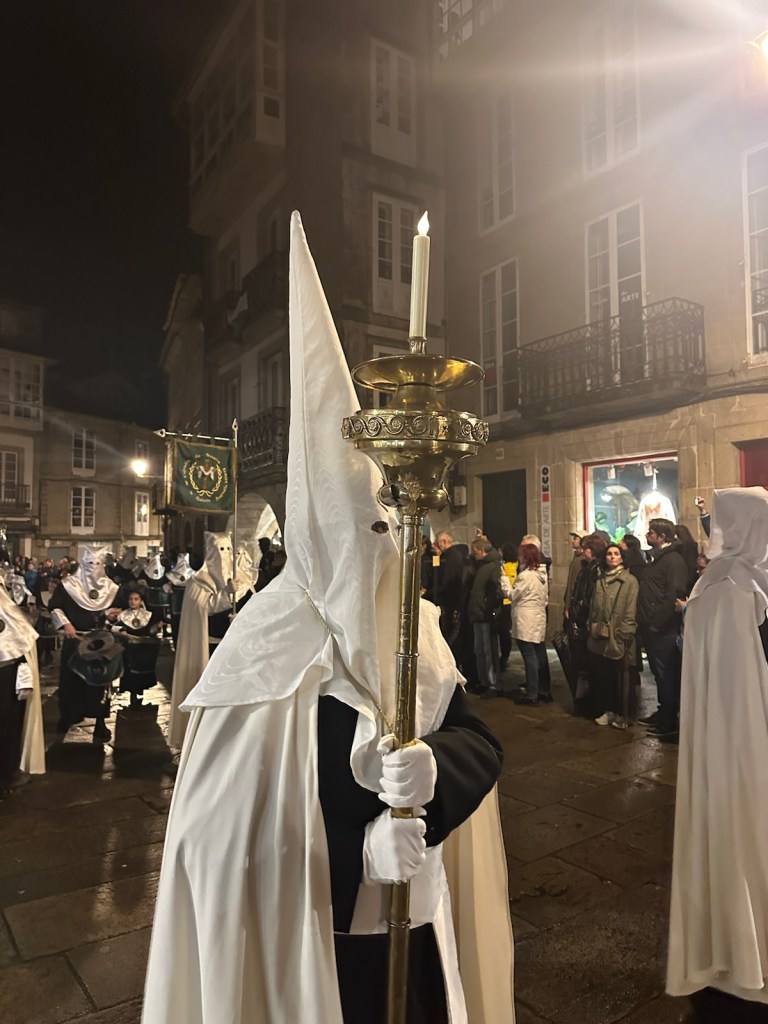

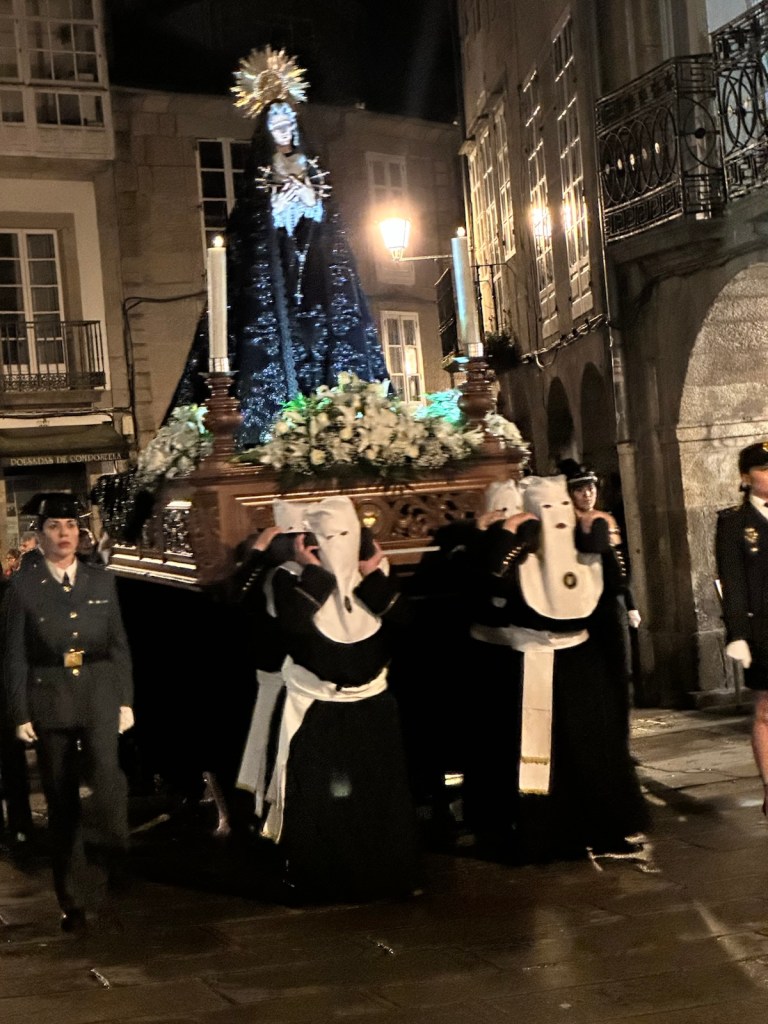
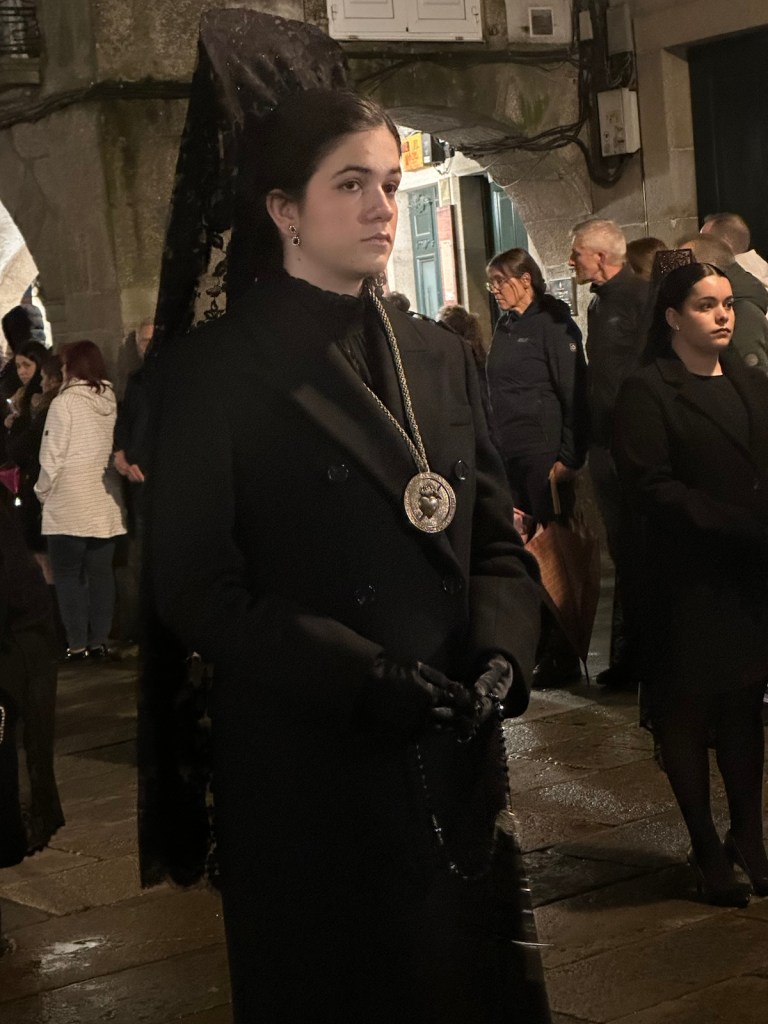
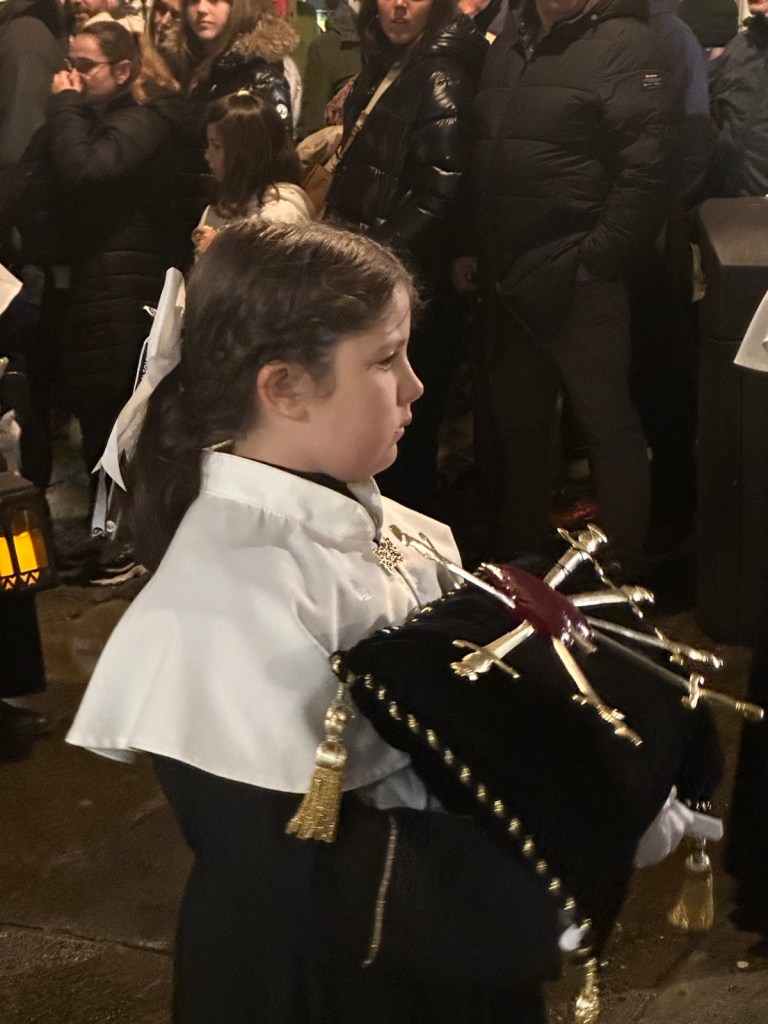
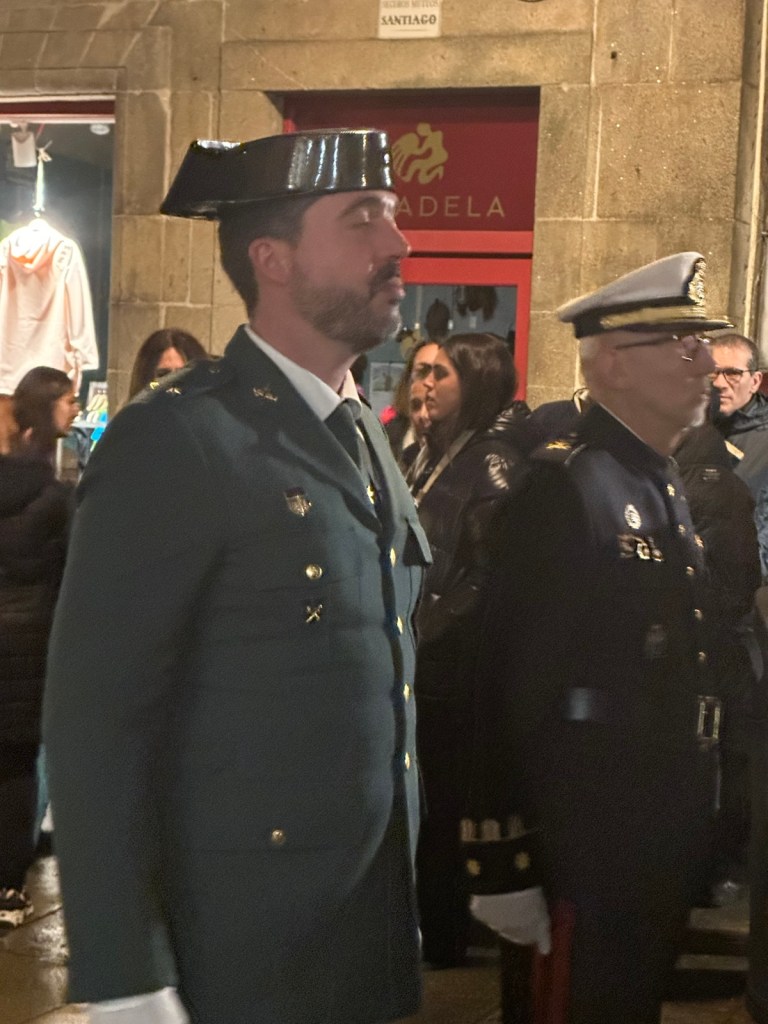
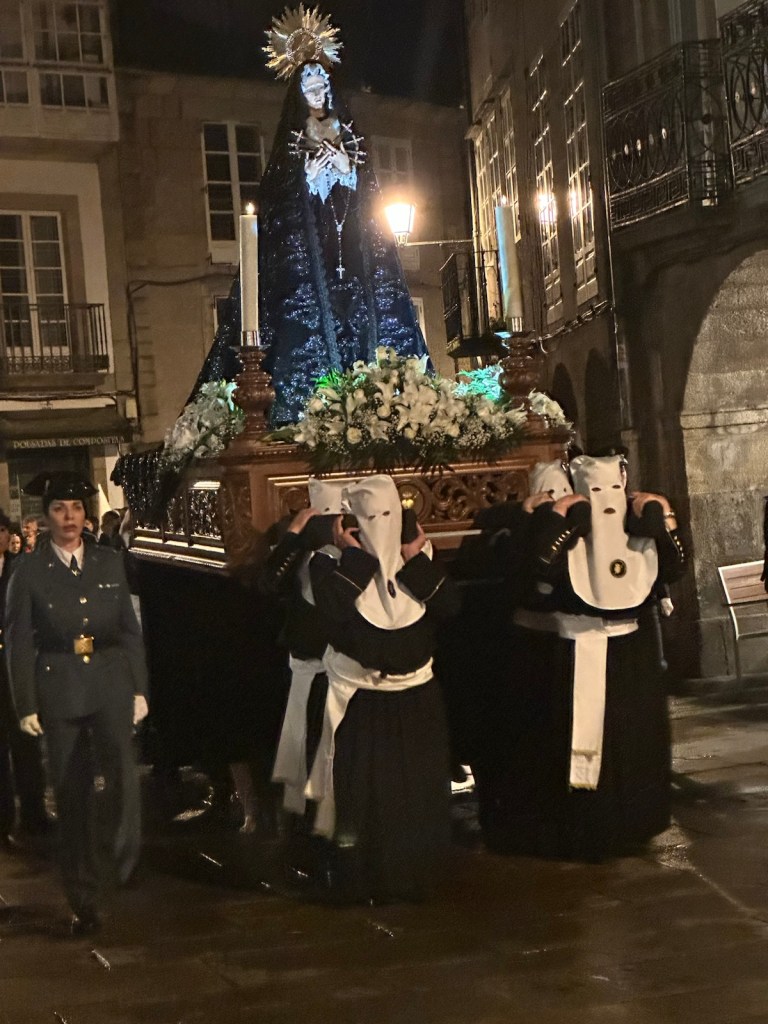
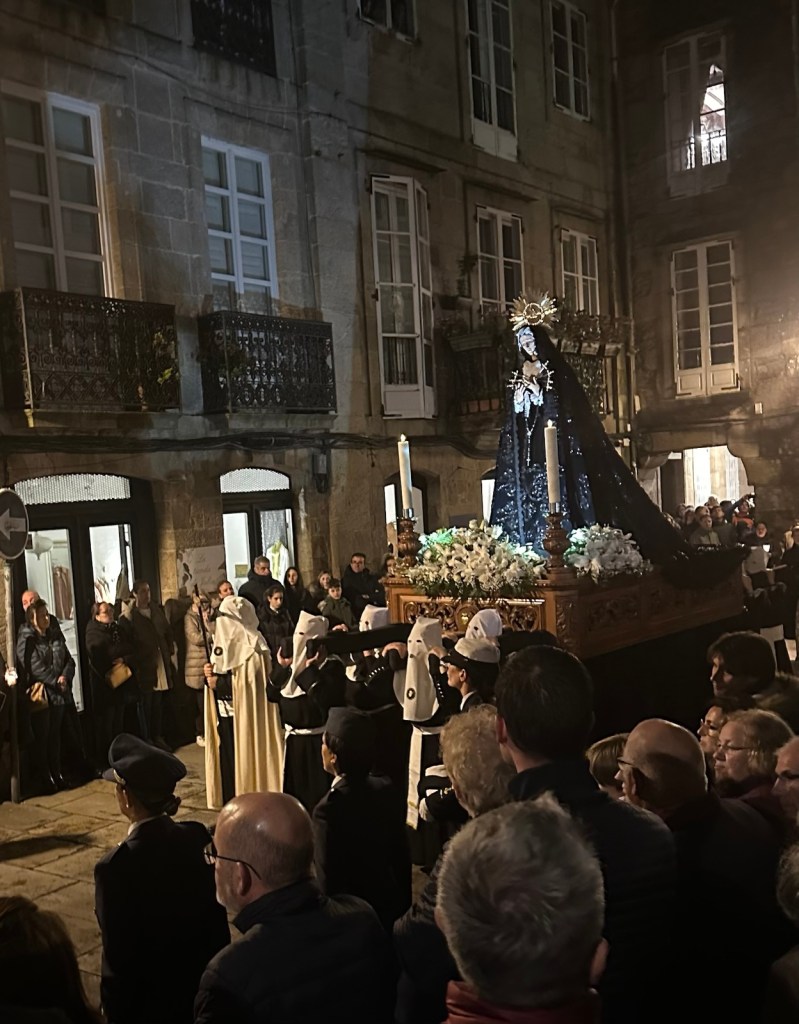
The thunder of the drums was so intense it could’ve woken the dead — and it did. Even Theresa, fast asleep on the third floor with earplugs in, was roused by the pounding rhythms. Like a scene from the resurrection, she emerged and made her way down to street level (in her PJs) to witness the procession which was inches away from her.
Once again, we found ourselves following the procession through the winding streets and toward another church. The experience was deeply moving — powerful, atmospheric, and unforgettable.
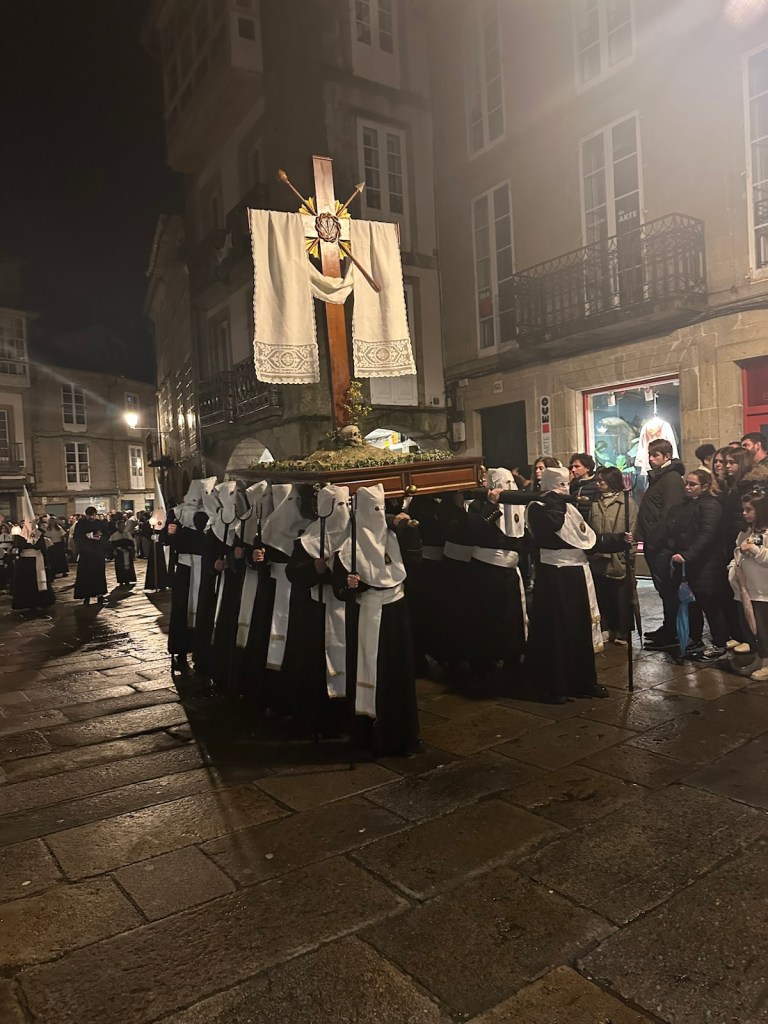
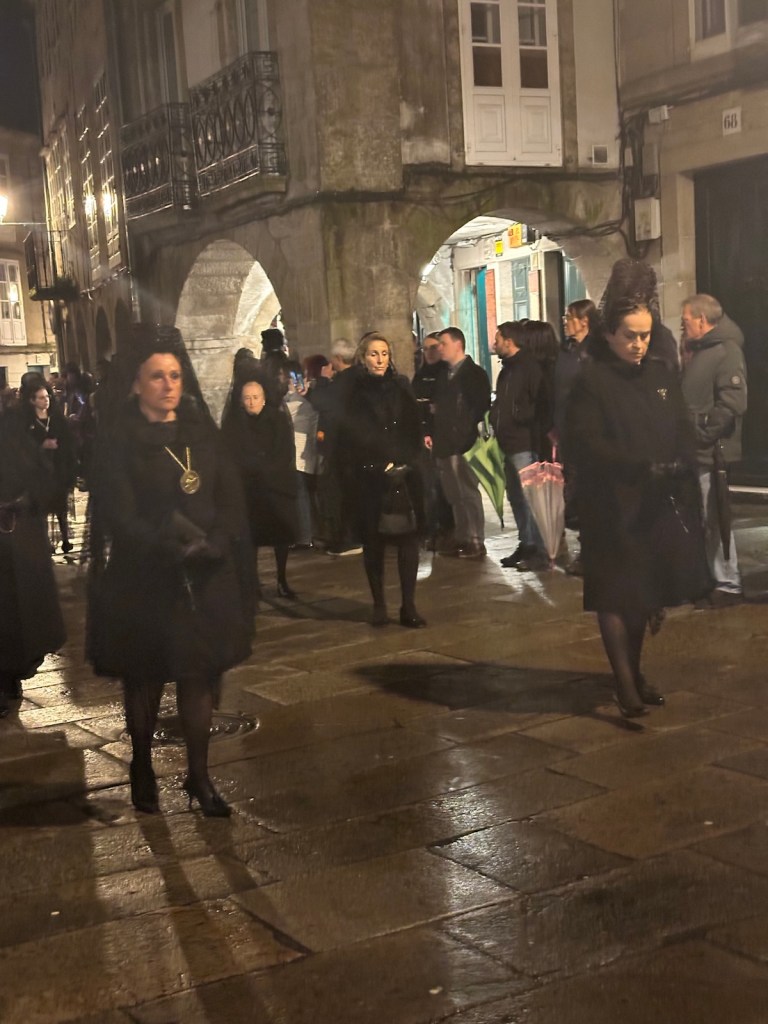
After soaking in the procession, we drifted to a nearby bar for a nightcap and to bid Helen farewell. Her train to Madrid was departing in the early hours, and by Sunday, she would be heading back to the United States. Meanwhile, Kyle, Theresa, and I were preparing for our next adventure — boarding a flight to Tenerife.
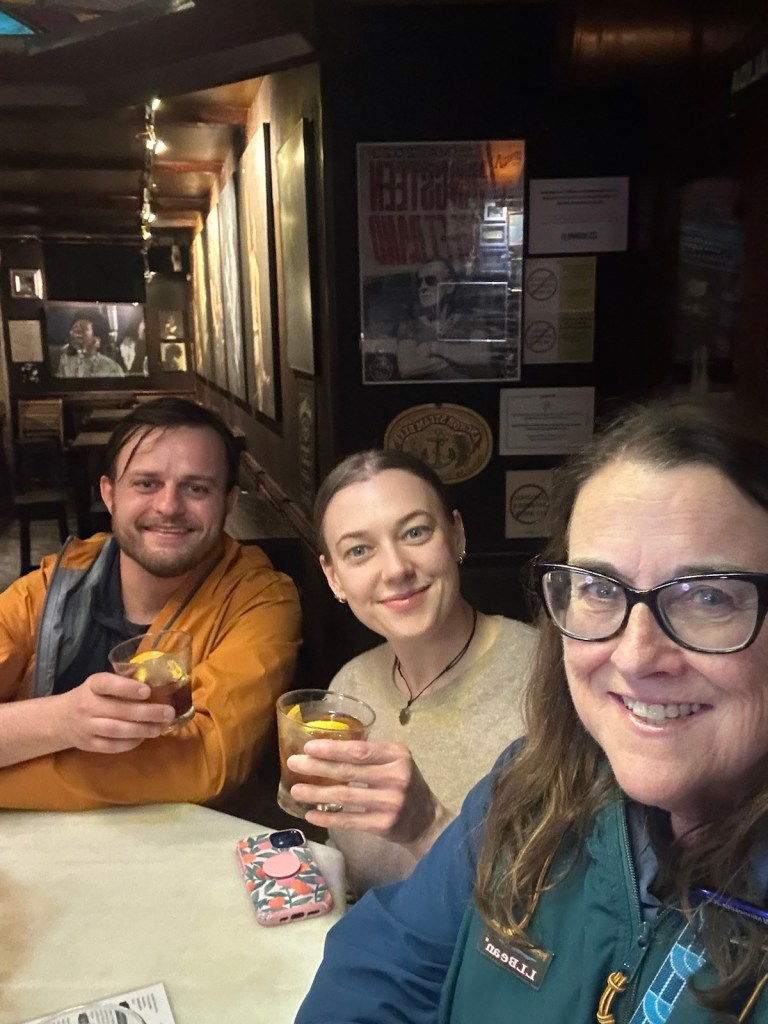
This ends our three-week Camino adventure but stay tuned … we’re heading to the Canary Islands where we will be joined by two more visitors.
Buen Camino!
 Jane in Spain
Hi Bitty!, Well it sounds like you have managed to see many of the fantastic processions of Easter Week. Your descriptions and photos brought back my memories of our visit there in 2018. It was intense! I am so glad Helen and Kyle were there to experience it with you and Teresa.
LikeLike