Coming from the Midwest I rarely if ever use the word Pueblo. Arriving in New Mexico for the first time, I discovered that a Pueblo wasn’t exactly what I thought it was … specifically, some type of Adobe building. I needed to do a little research for clarification because it became more confusing as we explored New Mexico.
Pueblo Indians are North American Indian people known for living in permanent settlements called Pueblos. Some of the other tribes were more nomadic and and always on the move. Most Pueblo Indians live in northeastern Arizona and northwestern New Mexico.
Going back a bit in history, the Ancestral Puebloans, also known as the Anasazi, were an ancient Native American culture that spanned the present-day “Four Corners” region which includes southeastern Utah, northeastern Arizona, northwestern New Mexico and southwestern Colorado.
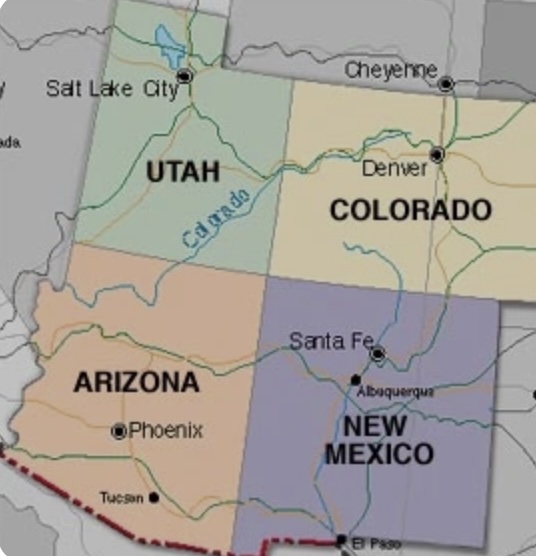
Pueblo is another word for an Indian village. A “reservation” is the same thing except that it is the legal term for land managed by a federally recognized tribe under the US Bureau of Indian Affairs. In New Mexico, most of the reservations are called Pueblos.
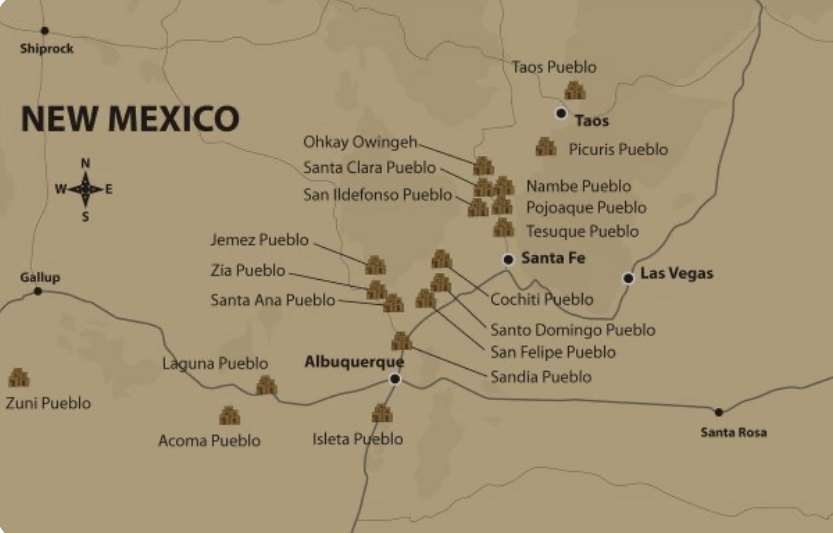
Typically, the Pueblo (people) still inhabit their ancestral lands and their culture has not undergone much change.
The word Pueblo is also used to describe housing. Traditional Pueblo architecture is found in the southwest, especially New Mexico. This type of structure is usually made of adobe and has multi-level buildings with rooms that touch each other or share a boundary wall. They have flat roofs supported by wooden beams called vigas which typically protrude beyond the building structure.
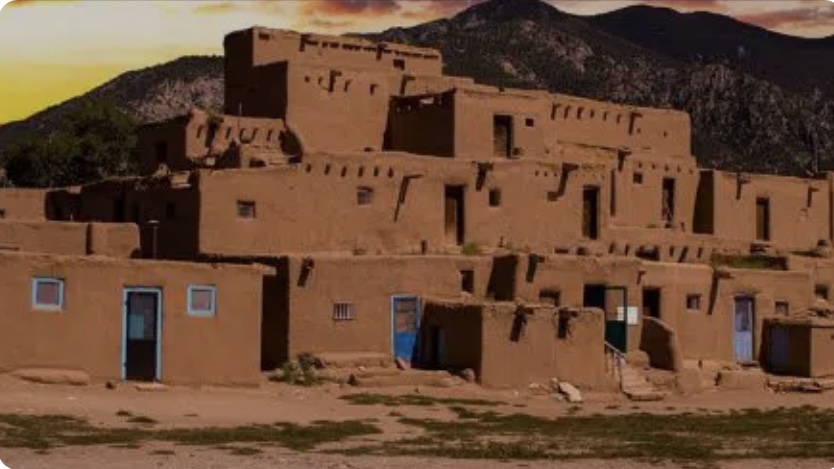
Some pueblos were very large with more than 100 rooms. The rooms were built in long rows and could house many families, kind of like an apartment complex. Today, most Pueblo people live in traditional houses in Pueblo villages.
To summarize the Pueblo world … the Pueblo people belong to various Pueblos and lived in Pueblo structures.
In the early years of the current era (1000 CE) the Puebloan people would build their village on a cliff-top Mesa (flat area) for defense purposes. High above the canyon floor, they could watch for raiding parties from the neighboring tribes. Rather than build a wall around their cities, the cliff dwellings relied on a single means of egress, a ladder or rope that could be pulled up in the event of an attack. Their agriculture assets would also be protected high on the cliffs. It is also theorized that this move to the cliffs was done as a way to shelter from wind in the winter and draw heat from the sun.
Archaeological evidence suggests that most of the region inhabited by the Ancestral Pueblo experienced a severe drought that lasted several decades at the end of the 13th century. This in turn made the traditional method of mesa-top farming unsustainable and they were forced to seek wetter areas elsewhere. This move to find more suitable living environments eventually broke the Ancestral Puebloans into the modern Pueblo tribes. **
More about ancient cliff dwellings to come in a future post describing a visit to the Puye Cliff dwelling in the Santa Clara Pueblo.
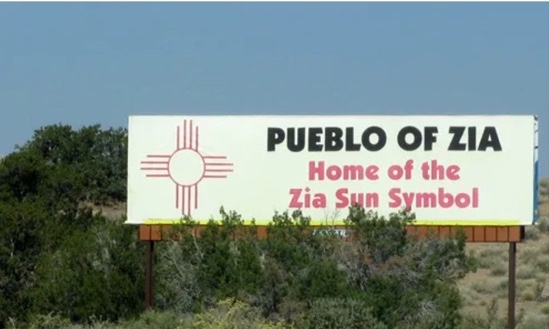
When arriving in New Mexico, I was also fascinated with a prominent symbol that shows up on many things. It’s a powerful red and yellow graphic which is even seen on the state flag and the license plates on cars.
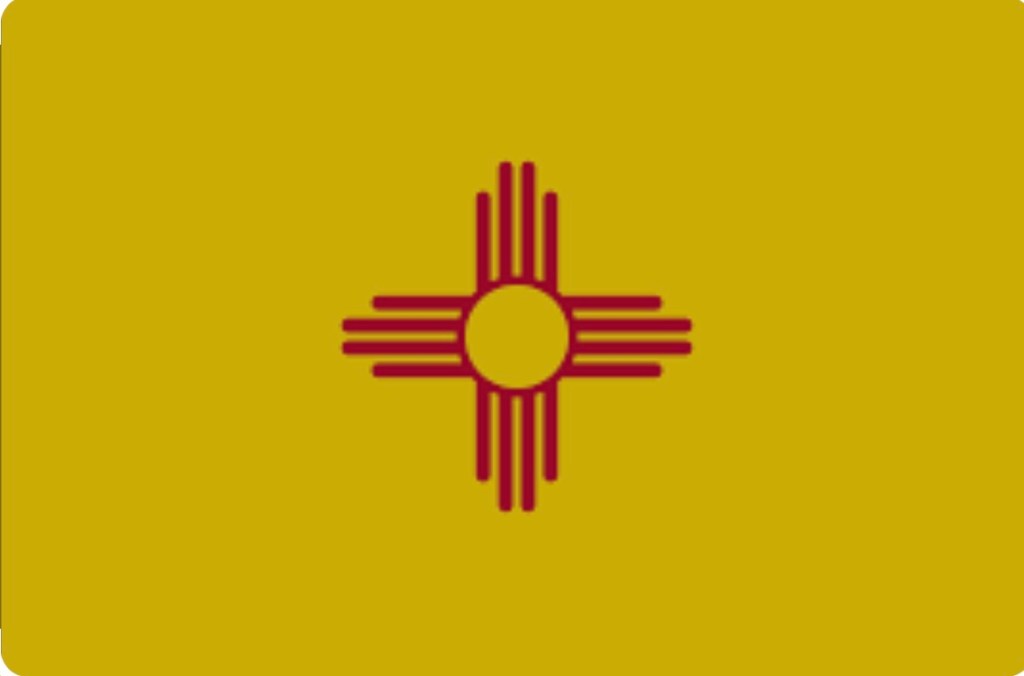
I learned that the Zia sun symbol is what I had been seeing throughout New Mexico. It represents the four cardinal directions, the four seasons of the year, the four periods of each day (morning, noon, evening and night), and the four seasons of life (childhood, youth, middle age, and old age) The center of the sun symbol stands for life itself.
I also learned that in 1925, the state of Mexico adopted a design for its flag featuring the sun symbol belonging to the Zia people. According to the tribe, the symbol was secret and stolen from the Zia, who lost both ownership and control over it, and were left to contemplate the sun symbol being widely used and sometimes desecrated. It later became public domain, still without consent from the Zia secret society which used it for healing and wellness processes.***
For a first time visitor to New Mexico, there is a lot of history to discover that makes the journey more compelling.
* Taos Pueblo photo taken from Advisory Council on Historic Preservation; Josemaria Toscano, Fotolia.
** Zia information and Zia Pueblo photo taken from an article by Catherine Saez, “Indigenous Knowledge Misappropriation: The Case of the Zia Sun Symbol Explained at WIPO.
*** Information taken from Mesas, Cliffs, and the Ancestral Pueblo by Luke Carothers. Also, csengineermag.com
 Jane in Spain