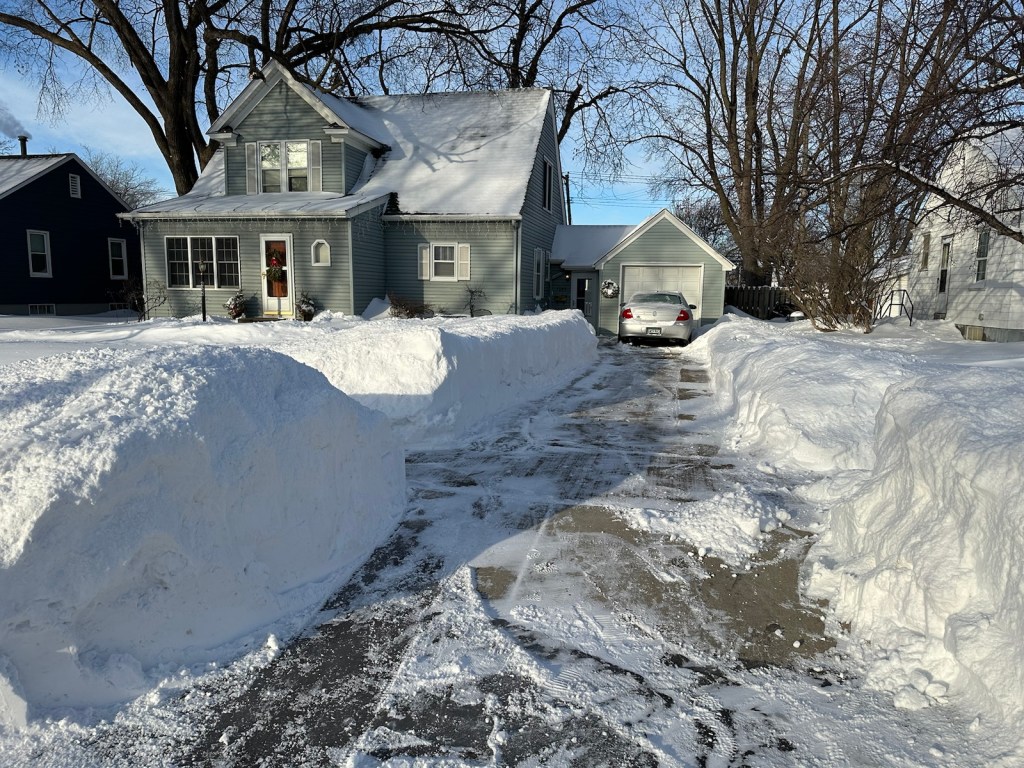
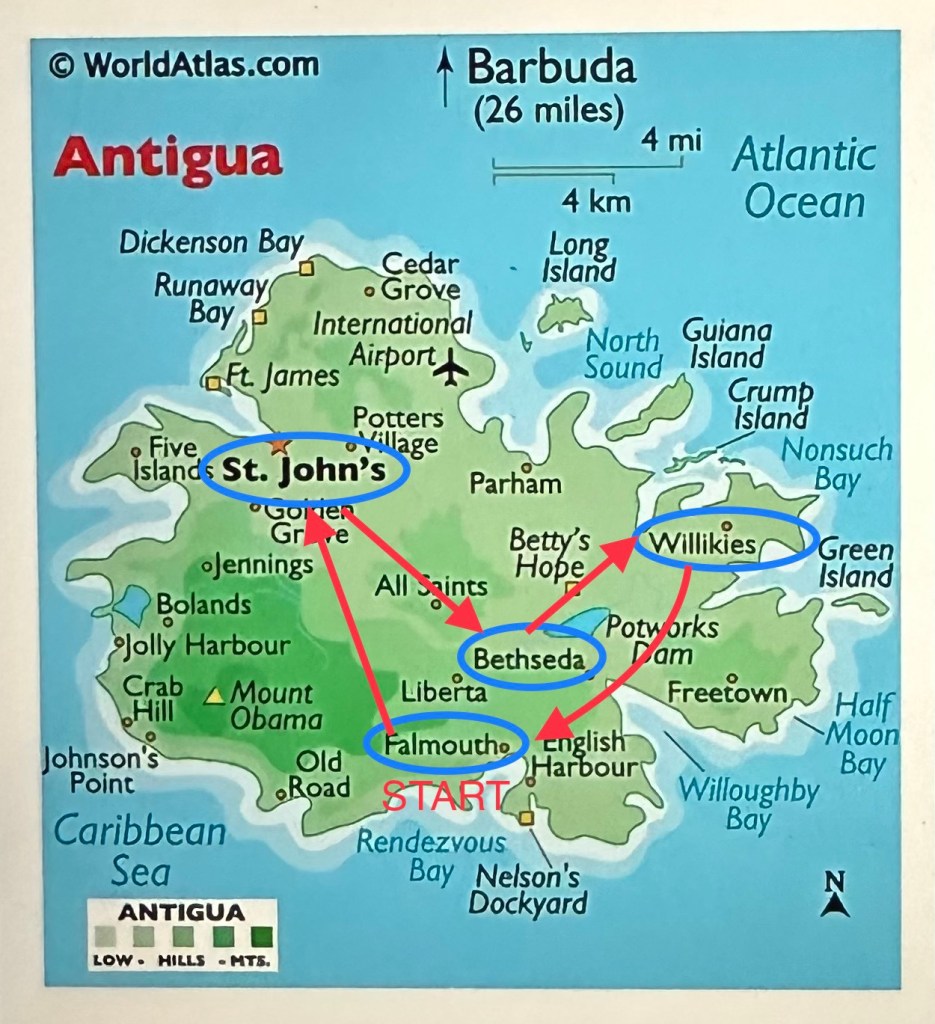
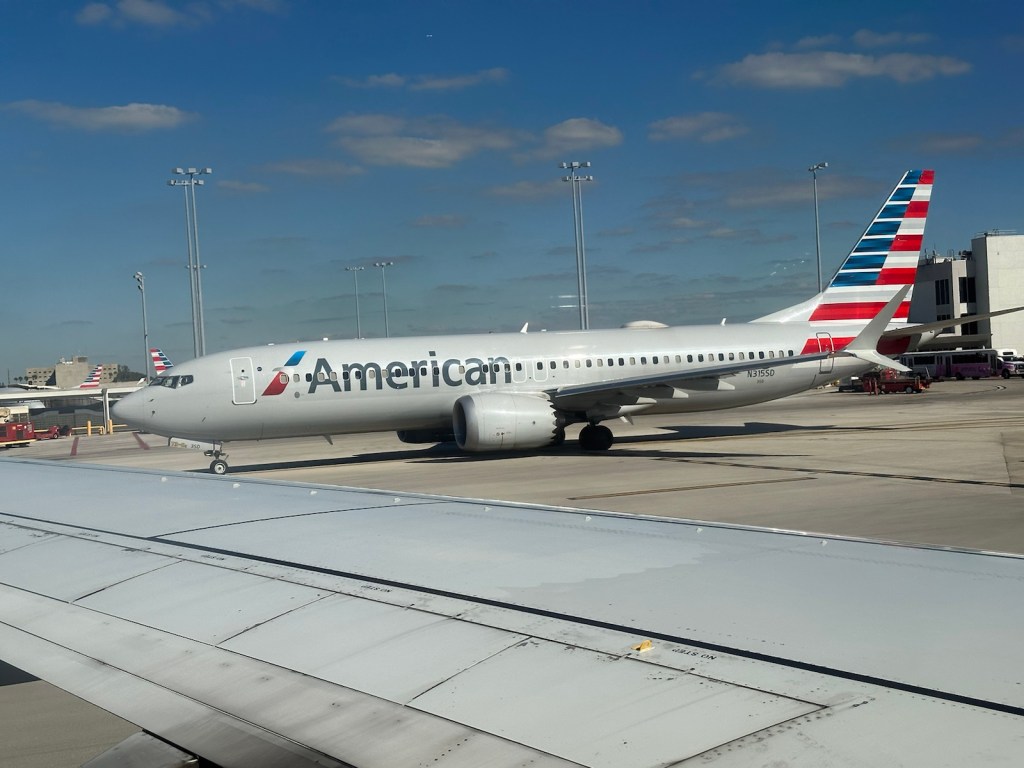
It’s the end of January and we still have about 20” of snow on the ground. And today, when I’m leaving for Antigua-Barbuda, it’s raining on top of the 20” of snow. Not a good combination. The temperature is above freezing so the 3:00 am drive to the airport shouldn’t be too treacherous.
Snow followed by rain = slush.In Miami, the sun was shining and it was warm enough for a Minnesotan to complain about being too hot.
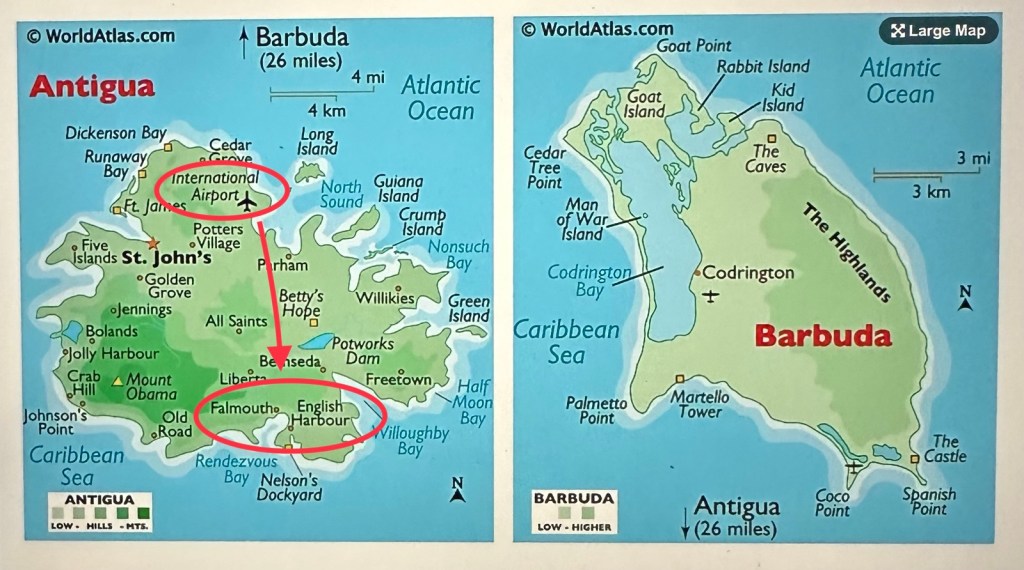
After taking off from Miami it’s about 1,300 miles to Antigua.
Leaving Miami … the dark path is the channel the cruise ships and big boats take out of Miami.Sky was clear so we were able to view several islands just outside of Florida.
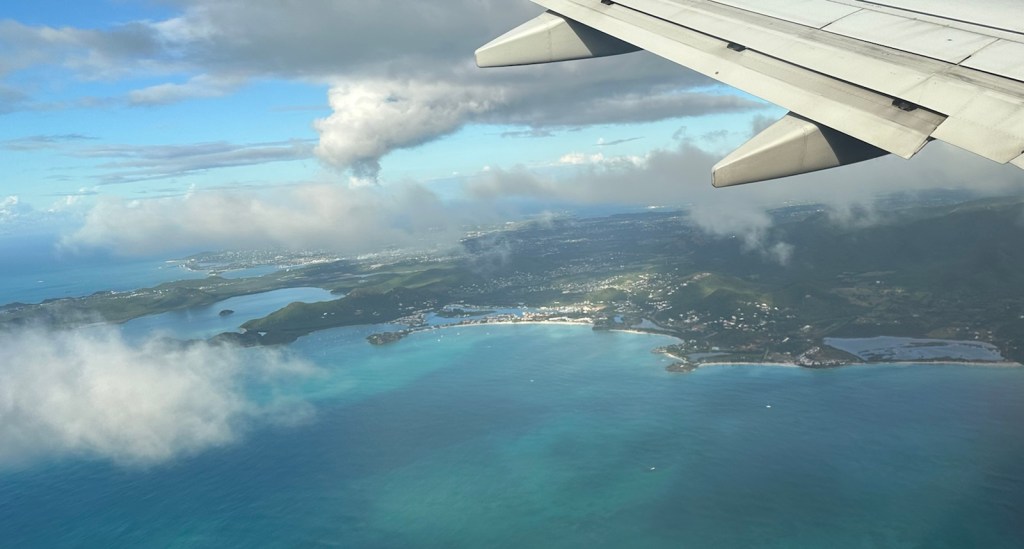
We flew over some inhabited islands and some that were not. Beautiful to look at with swirling shades of turquoise blue and soft sand colors.
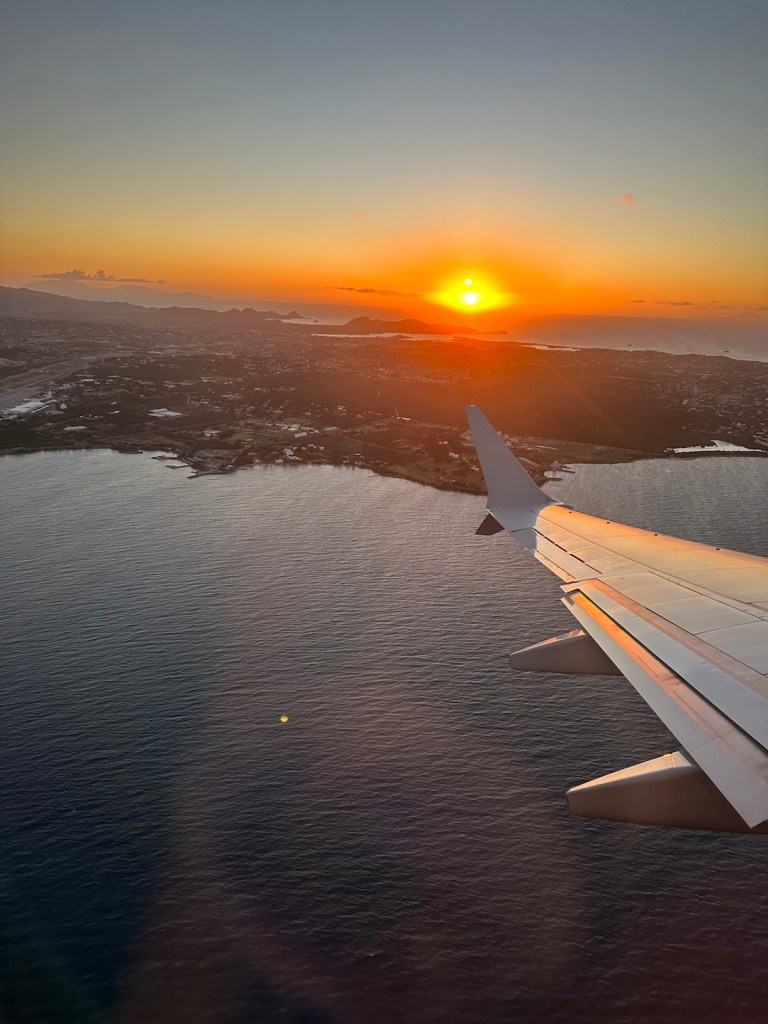
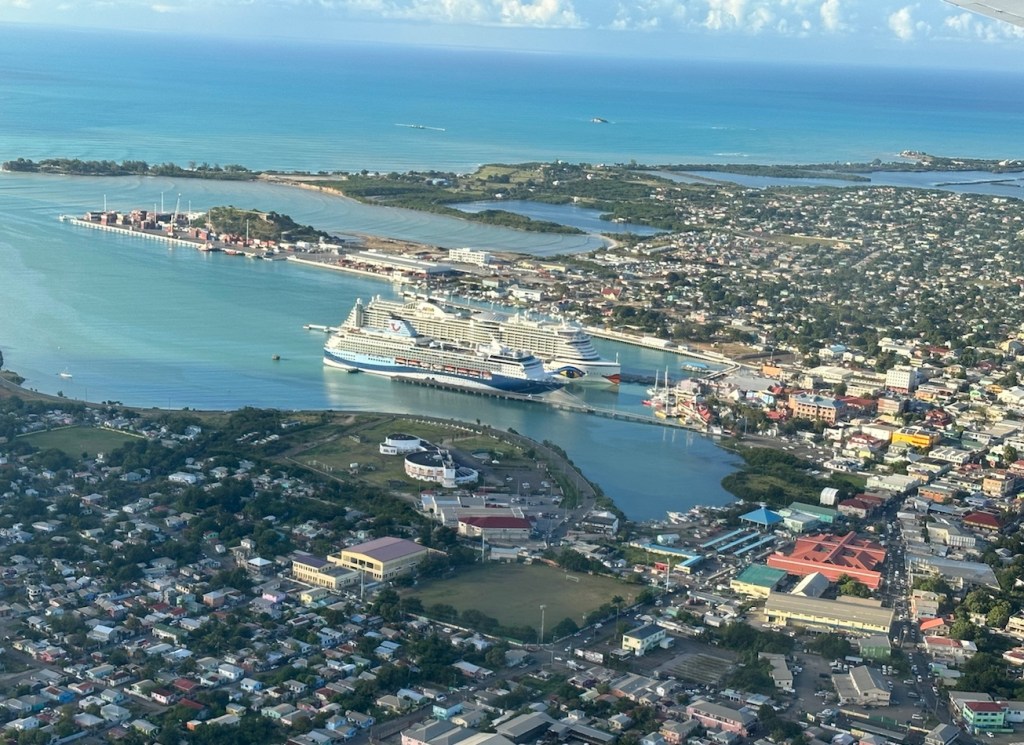
We circled a couple times before landing at V. C. Bird International airport and the view was spectacular. Pastel colored houses, the craggy shoreline, mountains, islands, beaches.
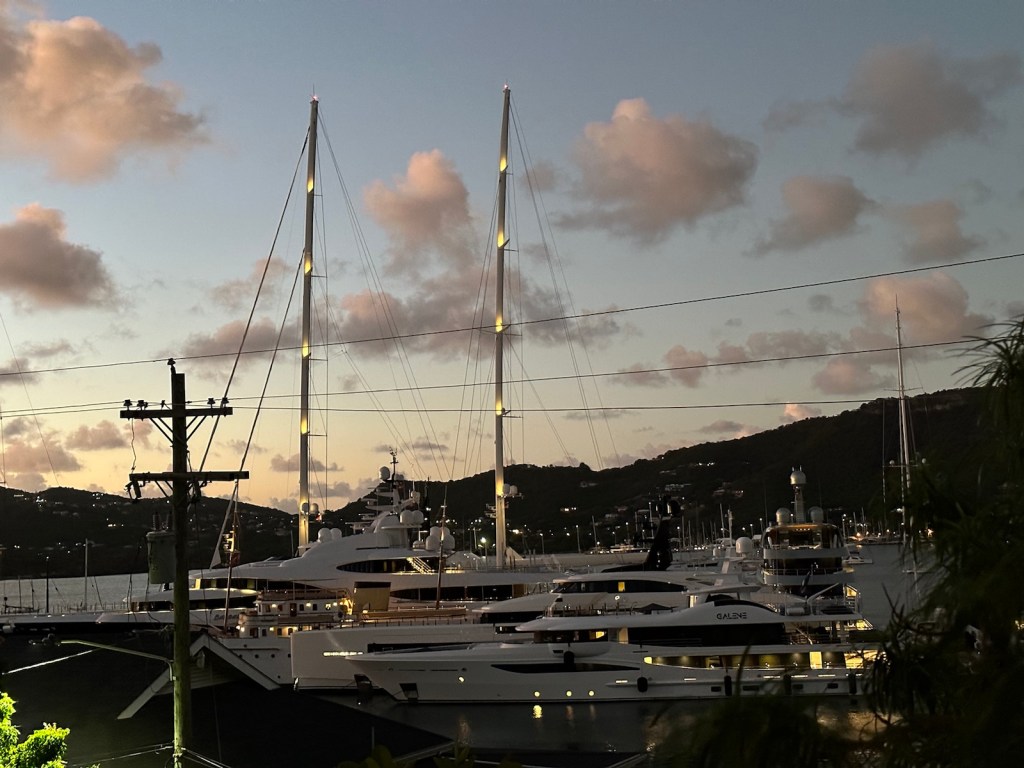
A view of the St. John’s harbor.
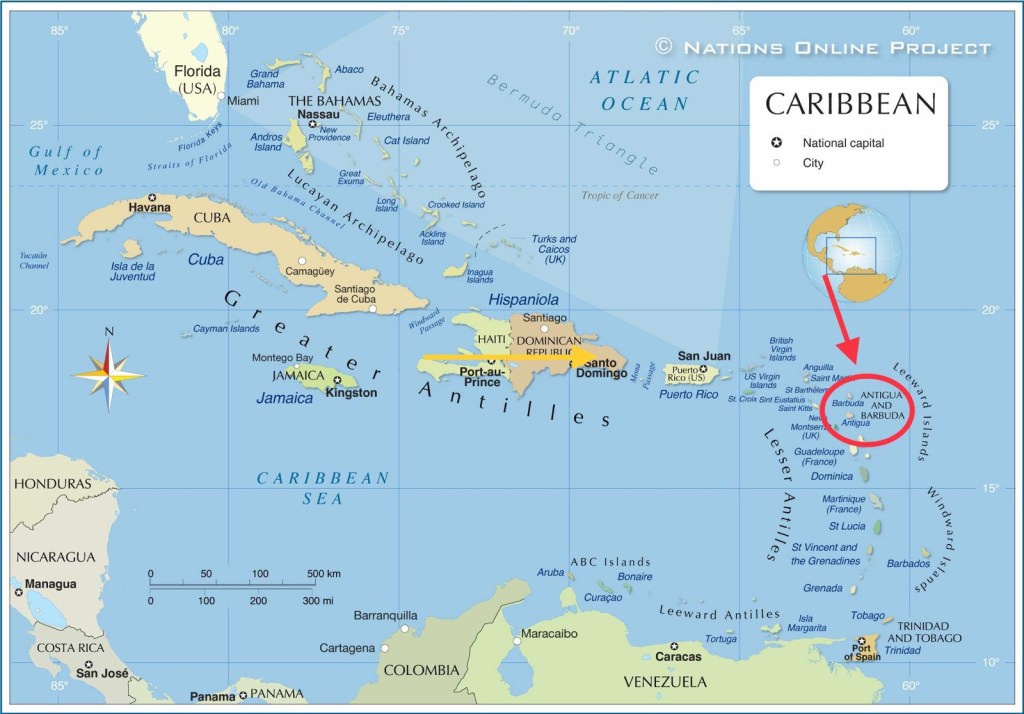
We have arrived! Arrived where? The official name of this country is “Antigua & Barbuda” a pair of islands described in many ways. They are the Leeward islands (a group of islands situated where the Caribbean Sea meets the Atlantic ocean), the Lesser Antilles (a group of Caribbean islands that are part of a long, partially volcanic island arc between Greater Antilles to the north-west and the continent of South America.) Also, you may hear it referred to as the “West Indies” (a combination of the Greater Antilles, the Lesser Antilles, the Bahamas and Turks and Caicos.) Some of these West Indies islands are not physiographically connected but have a common history and cultural ties.
The official name of this country is “Antigua & Barbuda”. Antigua is pronounced, “an·tee·ga”
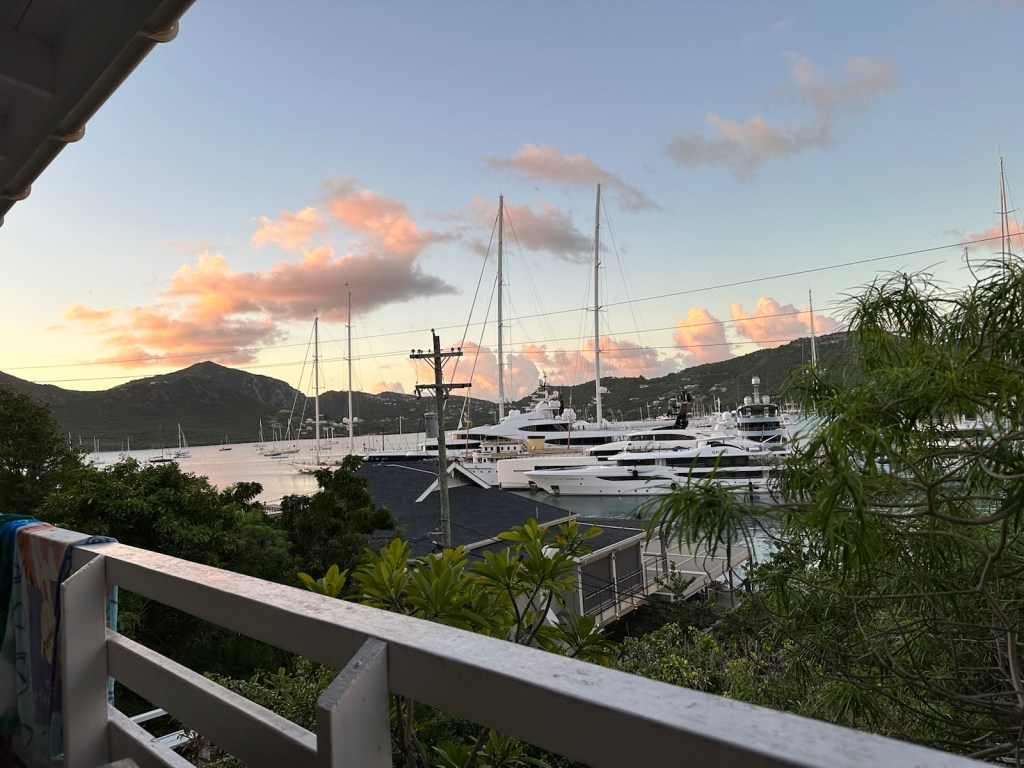
It gets dark around 6:00 pm and we drove across the island to our accommodations near Falmouth Harbor and the English Harbor.
After arriving at the airport we drove to the opposite end of the island.
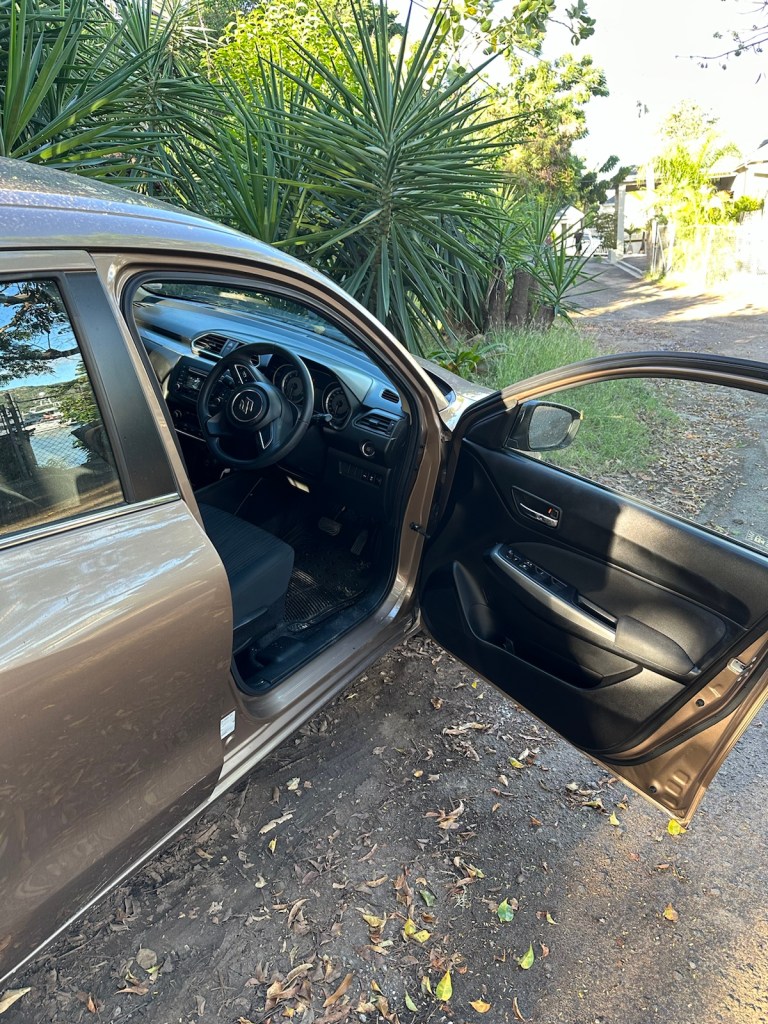
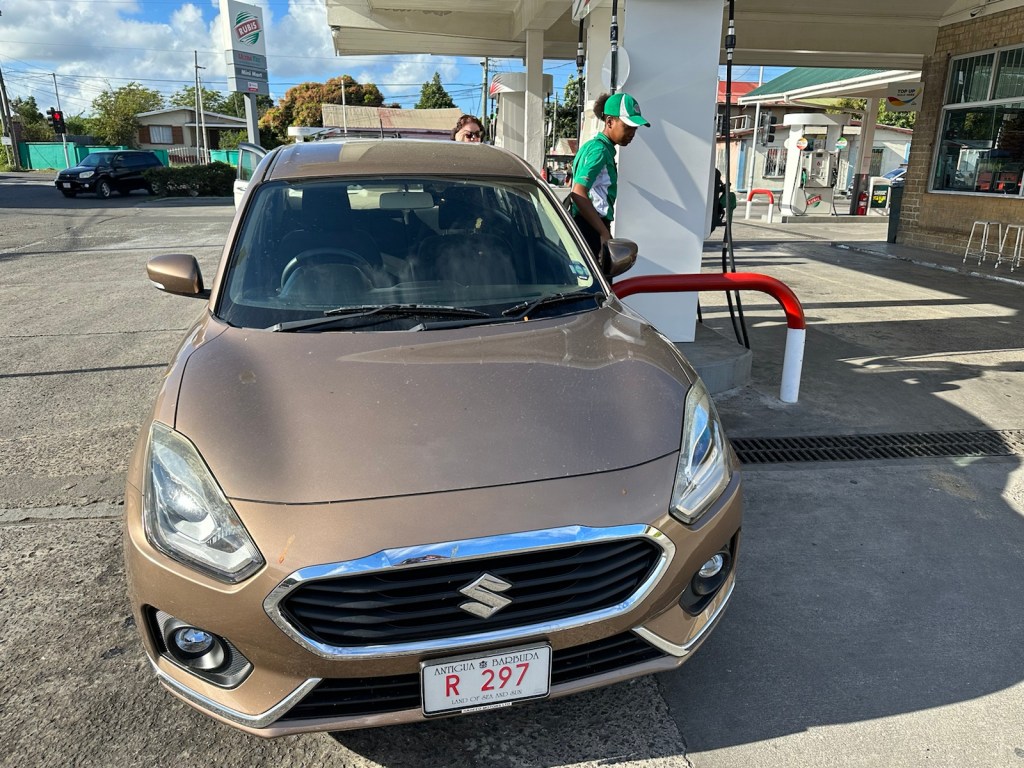
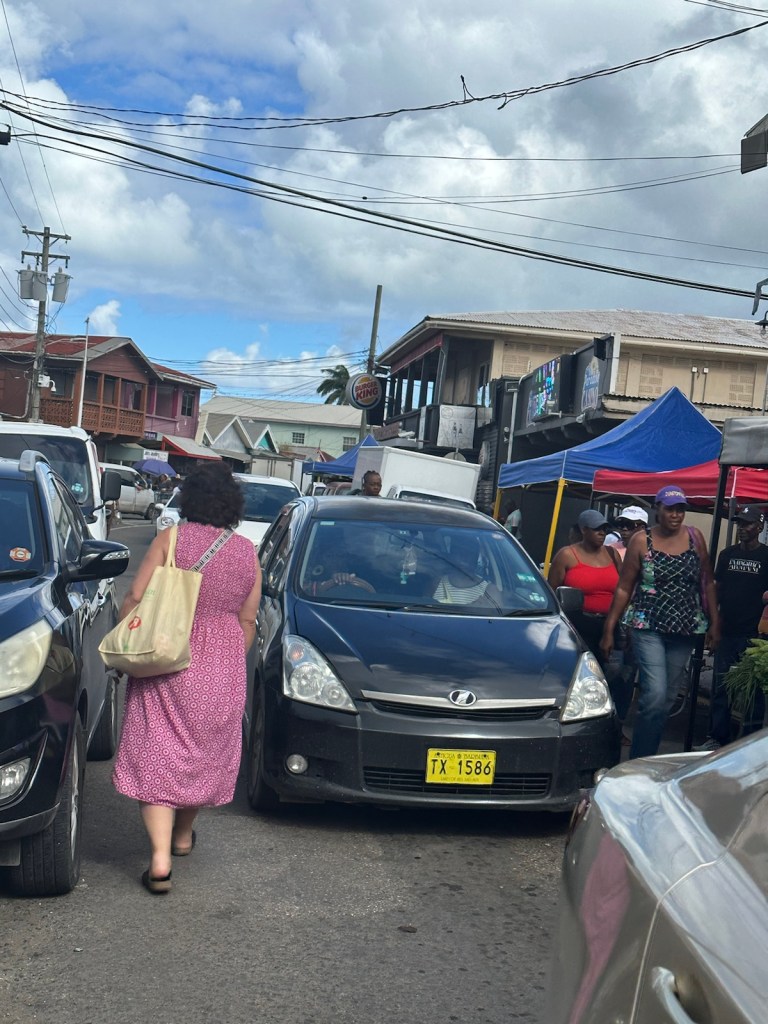
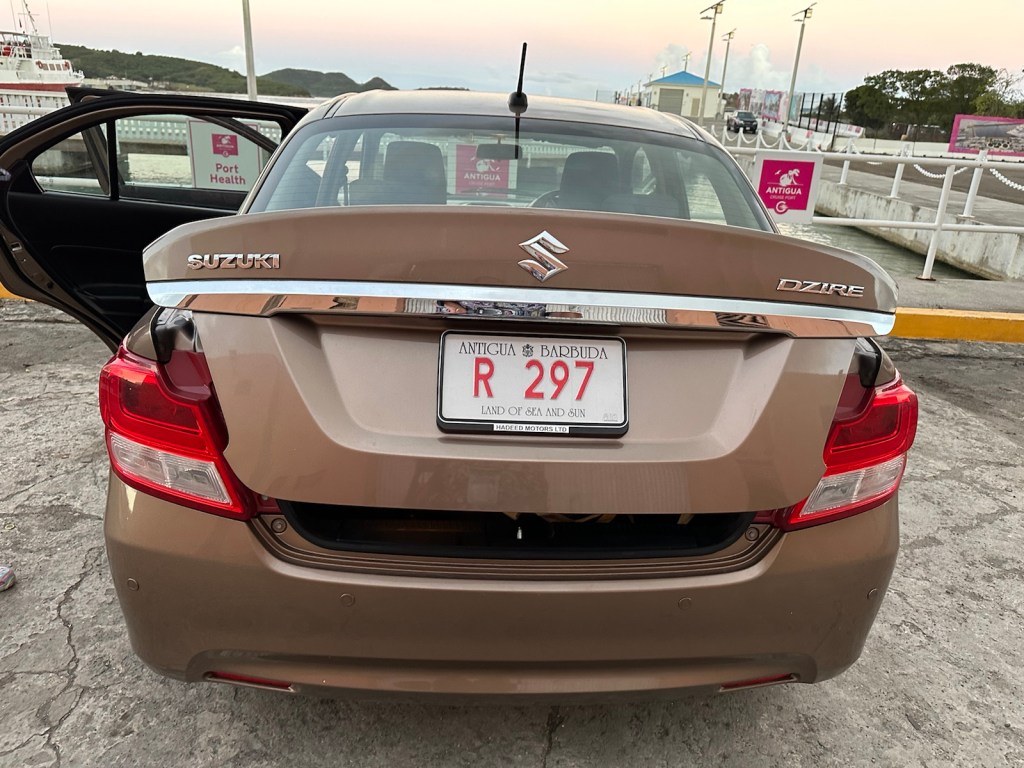
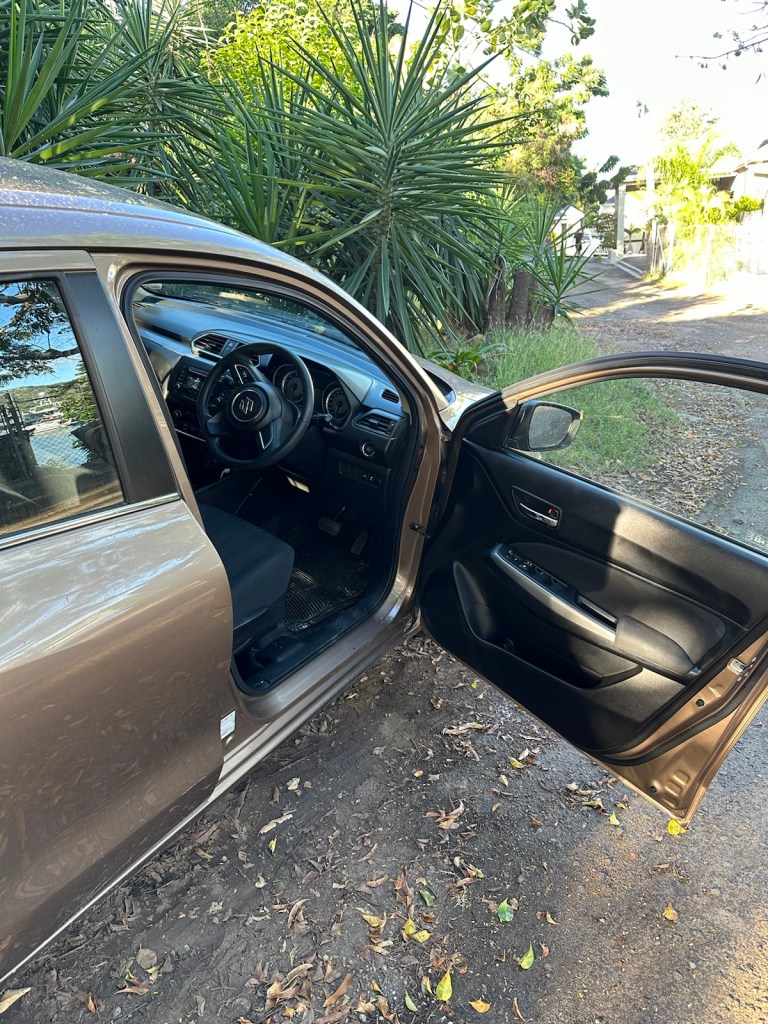
The island is only 12 miles long x 9 miles yet it took us forever (an hour) to reach our destination. Adding to the fun … we’re in a former British colony which means the car’s steering wheel is on the passenger side and we’re driving on the wrong side of the road. Lots of potholes, pedestrians, dogs, cats, cows and other distractions. It was a very long day.
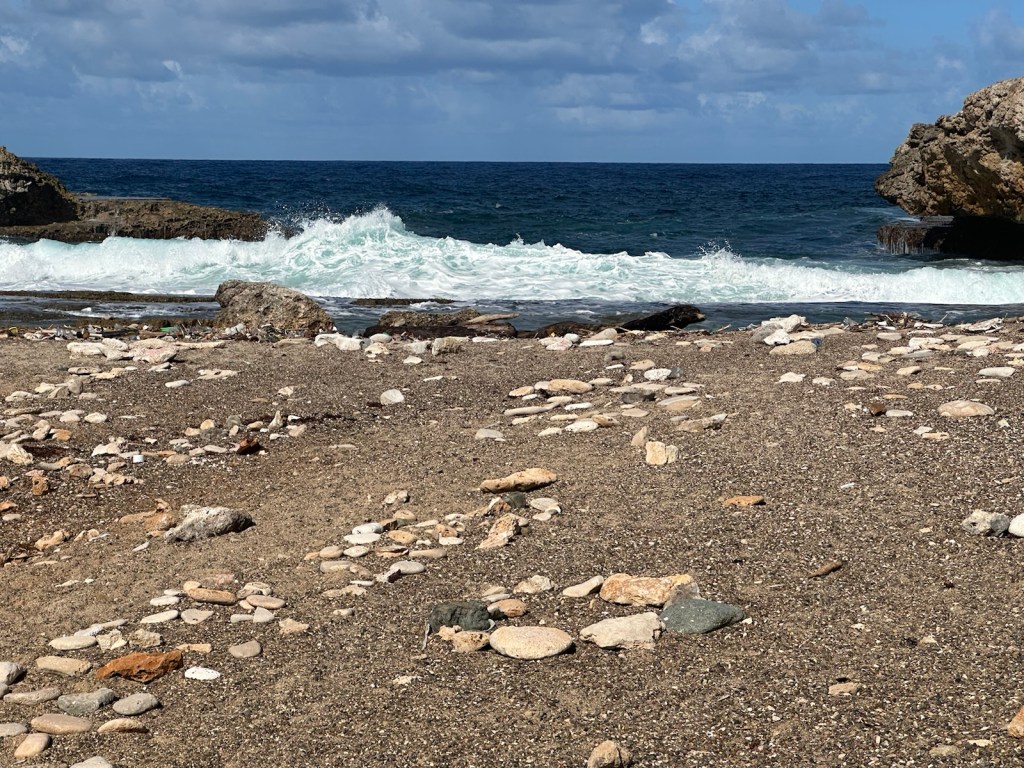
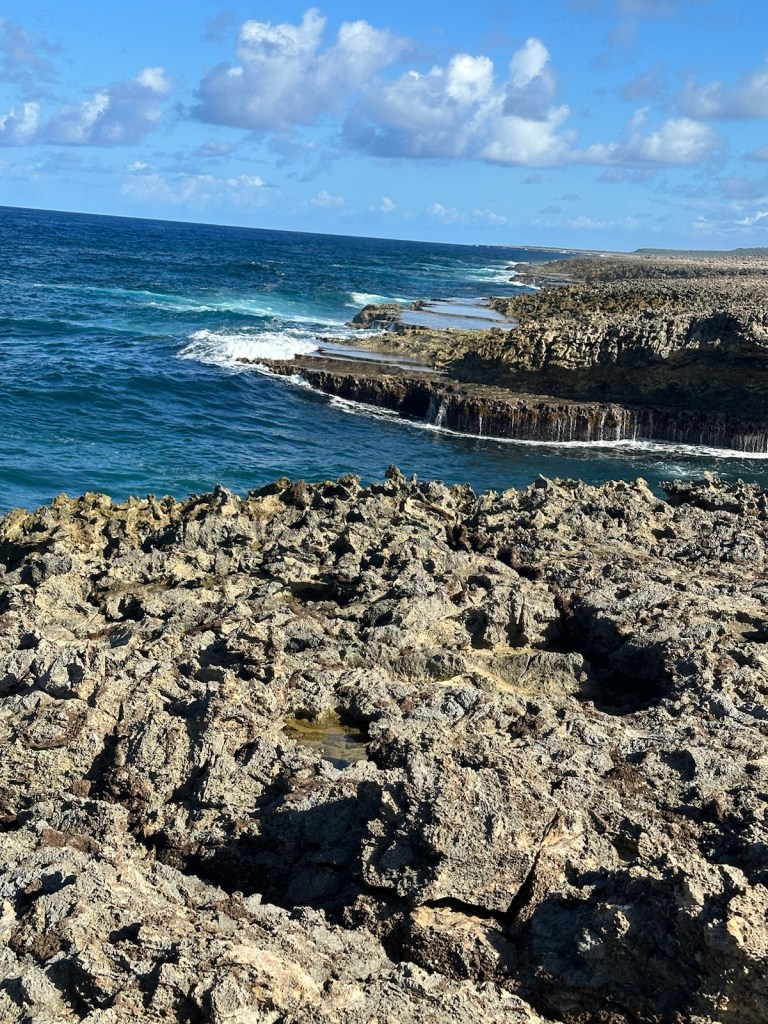
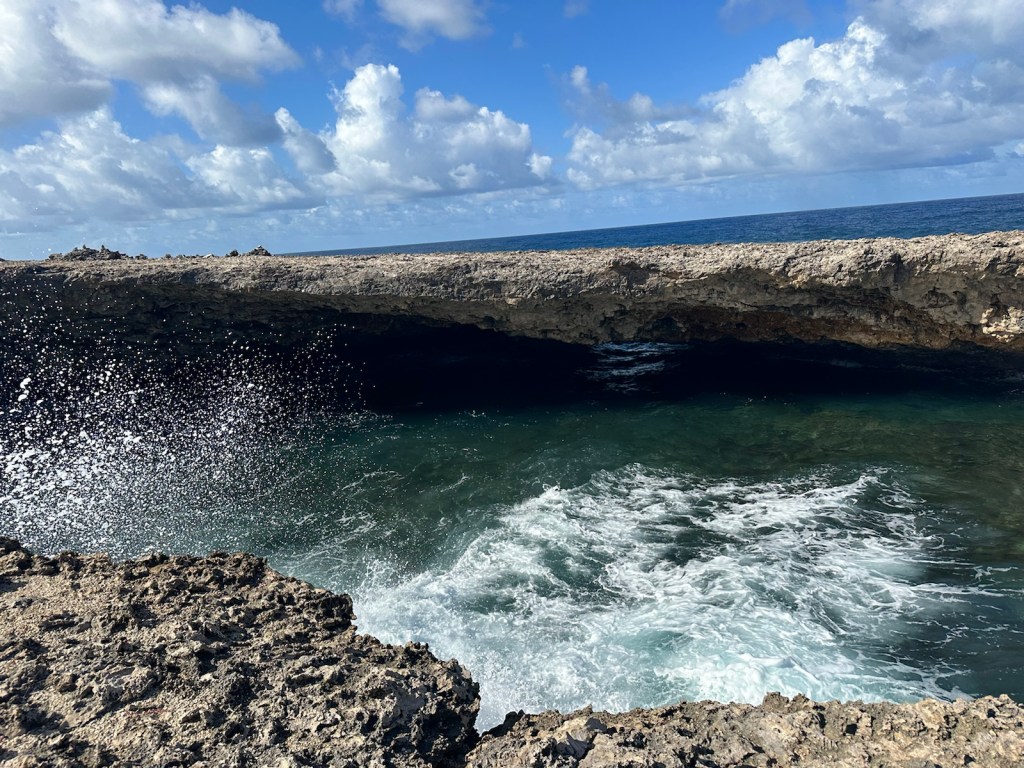
Today’s destination is Shete Boka which means ‘Seven Inlets”. The area actually has more than 10 Boka’s (inlets) where three species of turtles nest. Years ago, an environmental group arranged excursions in this area along seven bays. This is where the name came from, however, there are more than seven coves in this national park.
When we arrived at the entrance, the attendants were very discouraging. They said the road was full of potholes from the rain and dangerous to drive. So we said we would walk not realizing how far apart everything was.
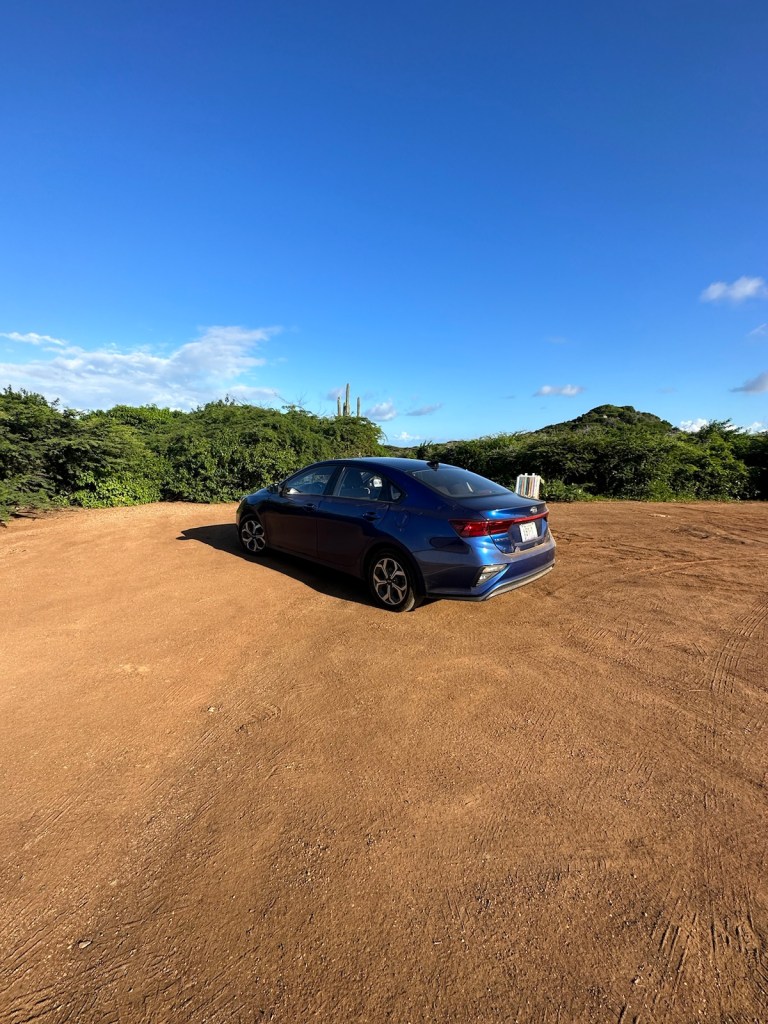
After seeing a couple cars off in the distance, we ended up driving. The attendants were right; deep potholes, puddles and mud slicks made maneuvering the “road” a challenge. But it was worth it.
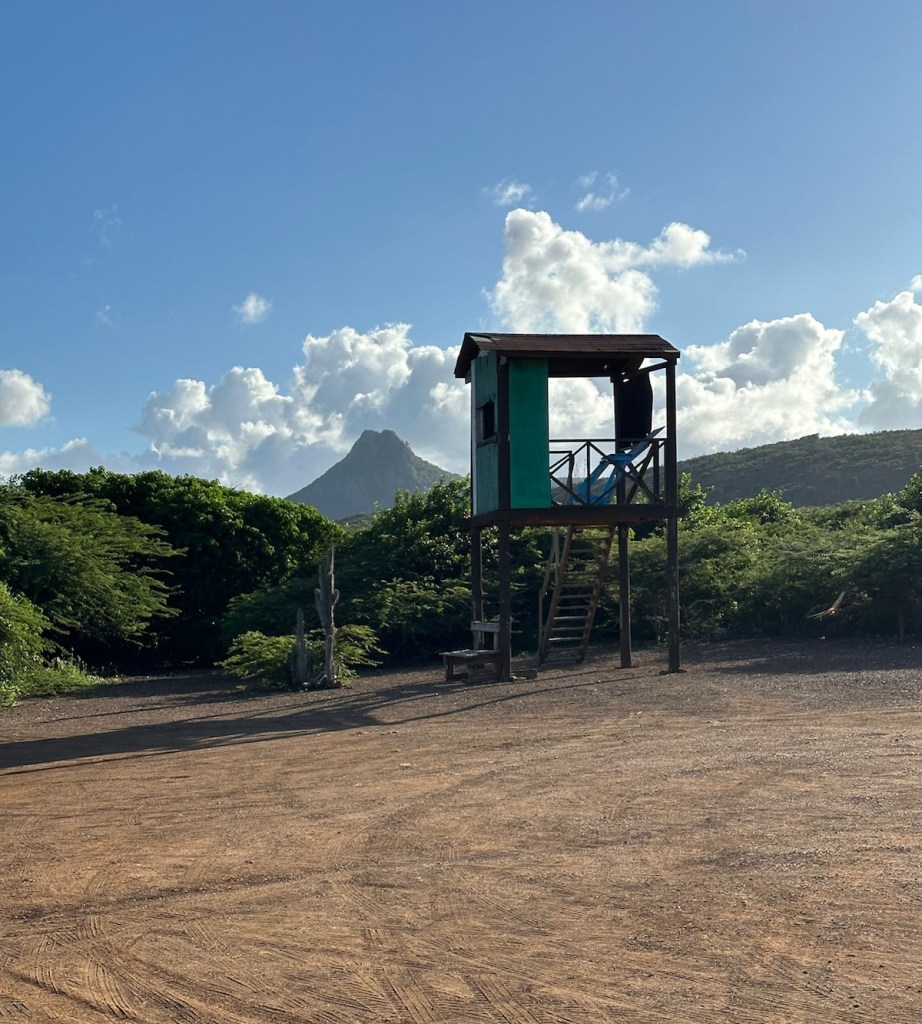
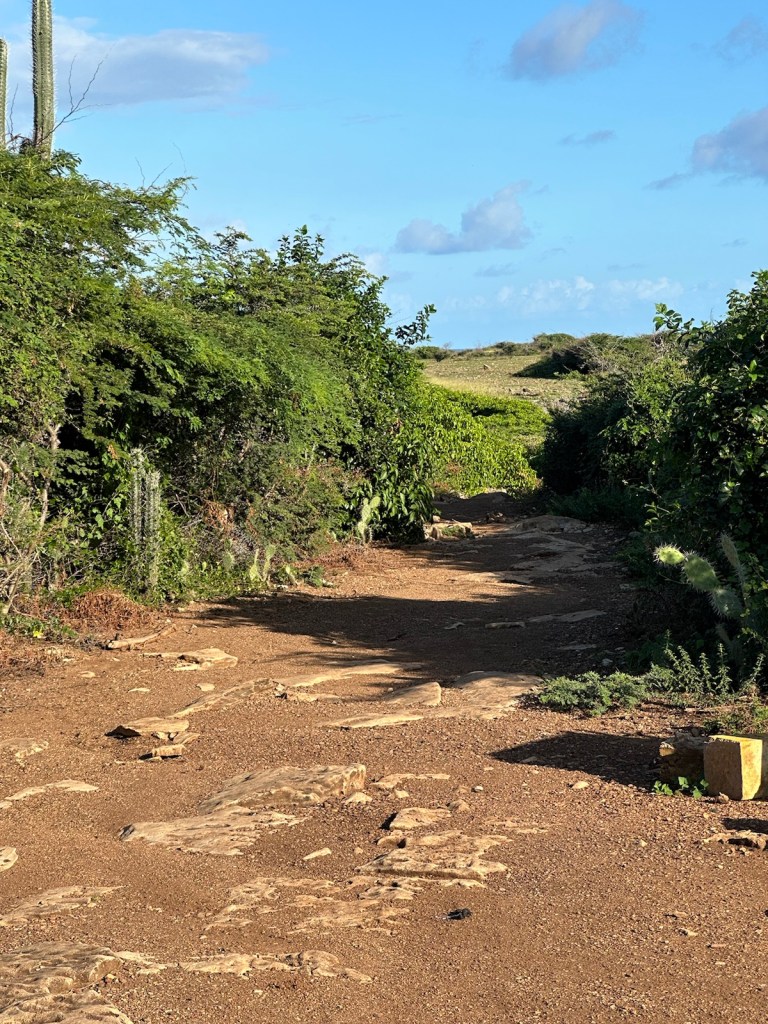
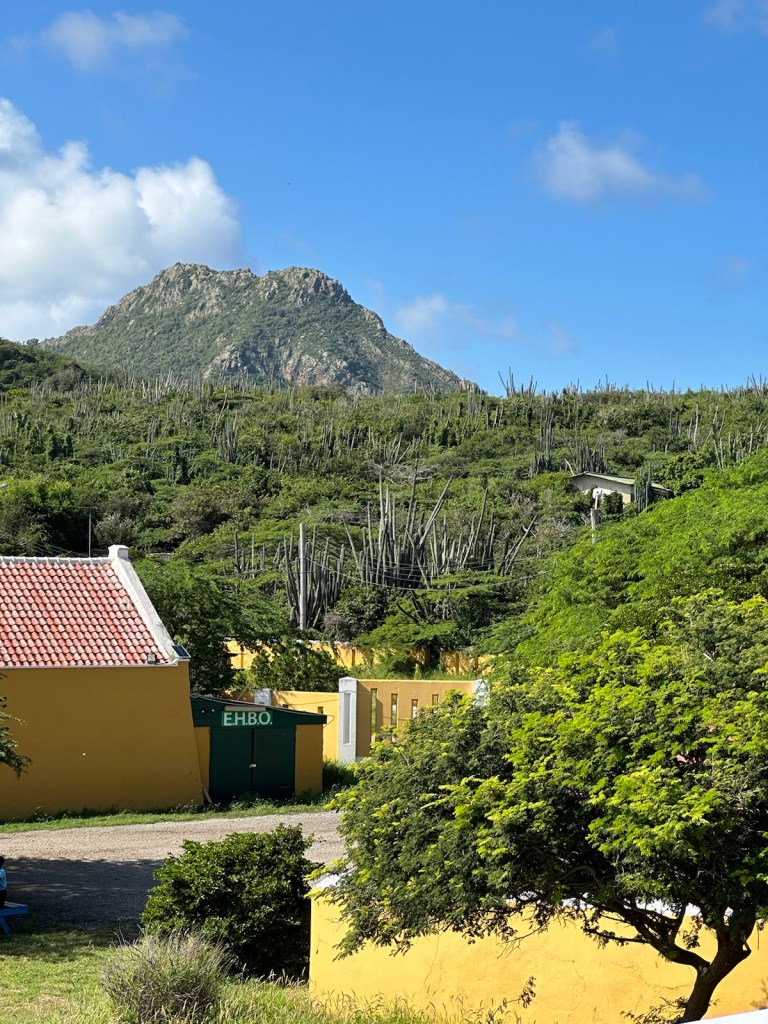
It’s about a mile drive to reach the Wandomi parking lot. Mount Christoffel can be seen in the background.
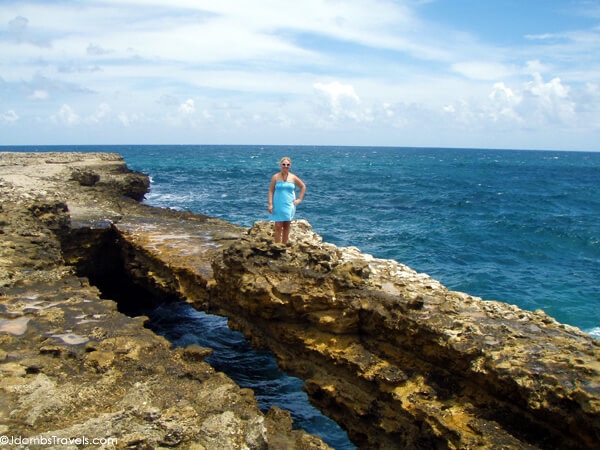
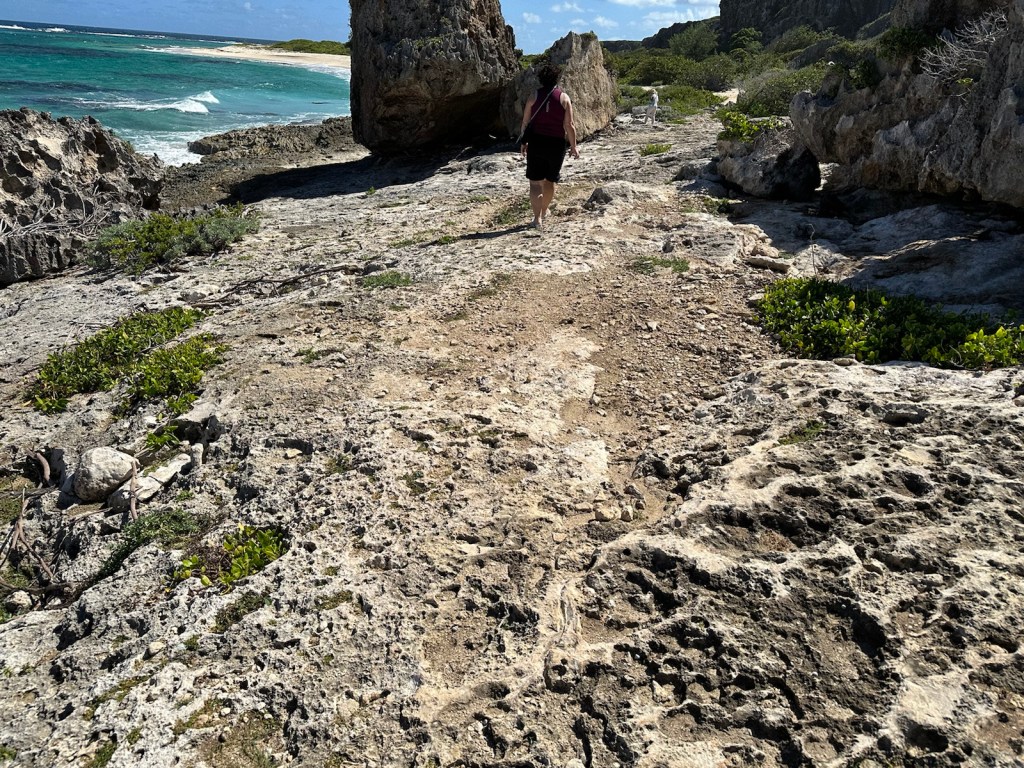
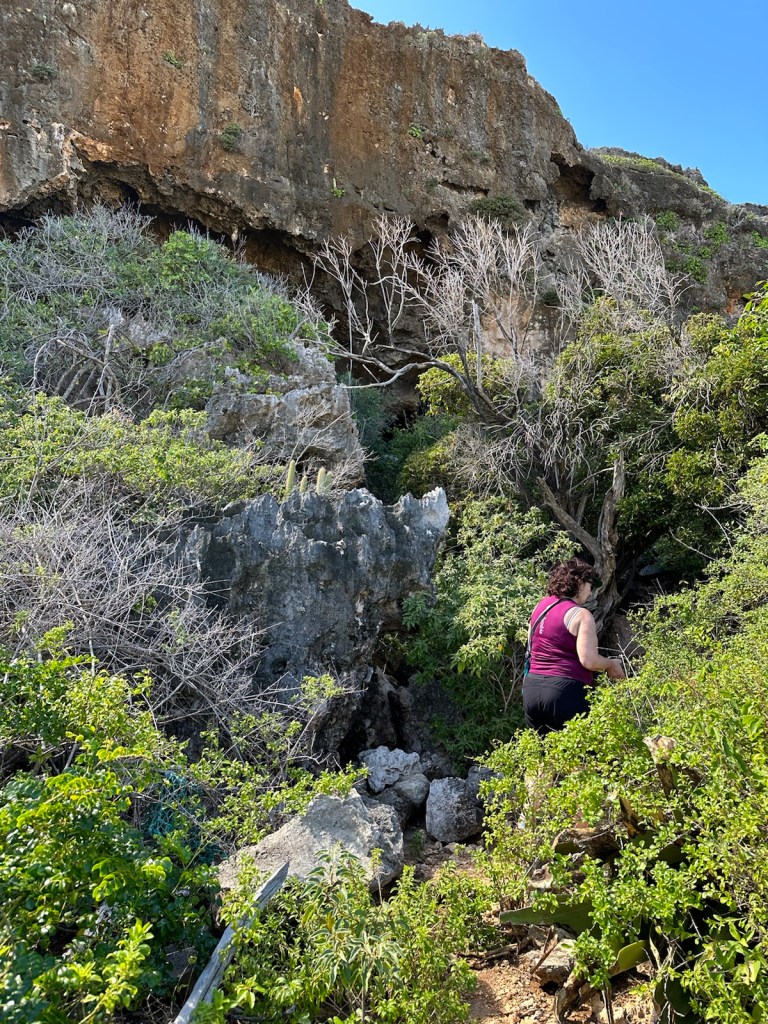
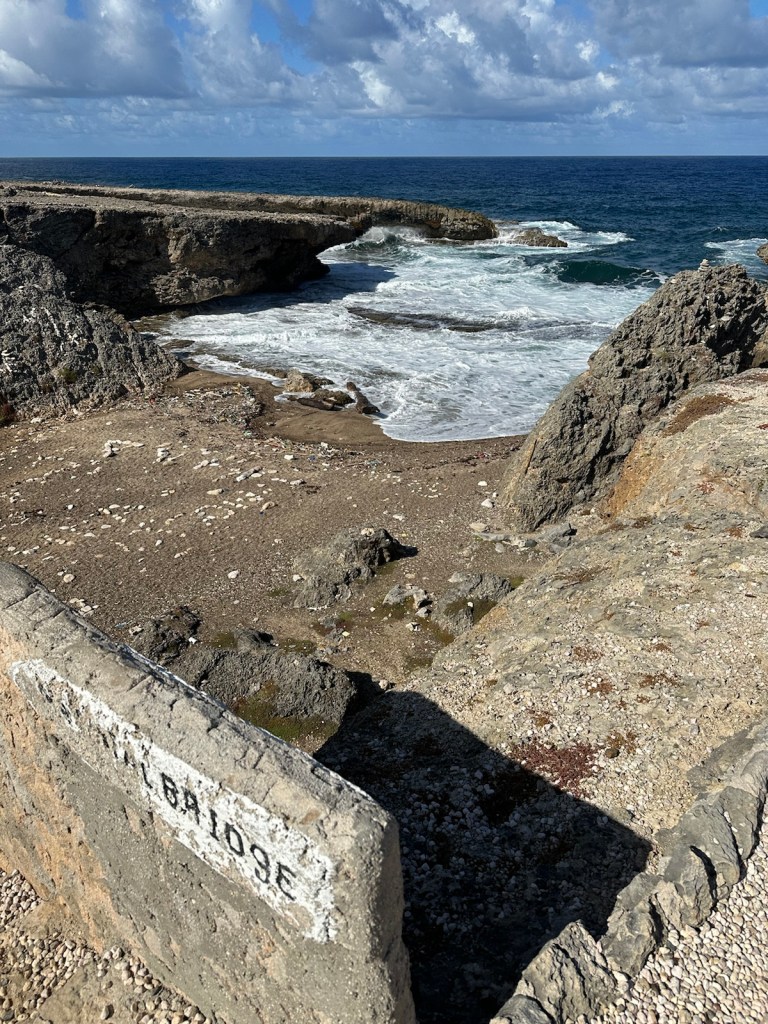
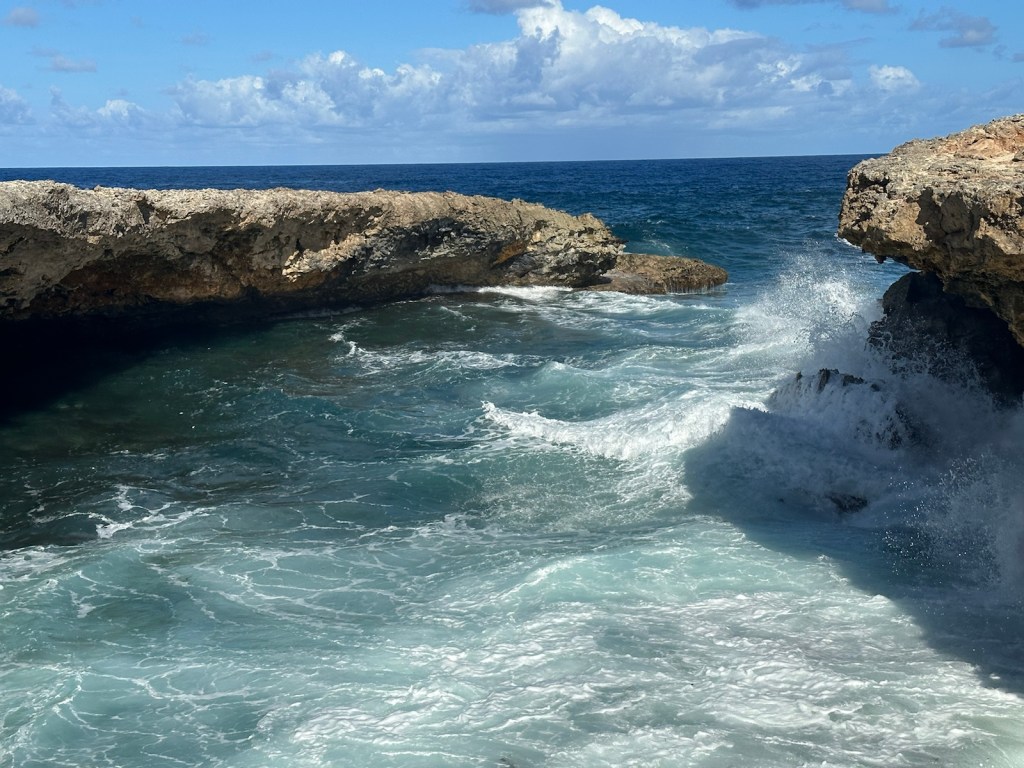
We began our hike to Boka Wandomi. The small dirt parking lot is monitored by a caretaker in a wooden tower-like structure. The final destination features a large natural bridge with lots of wave action.
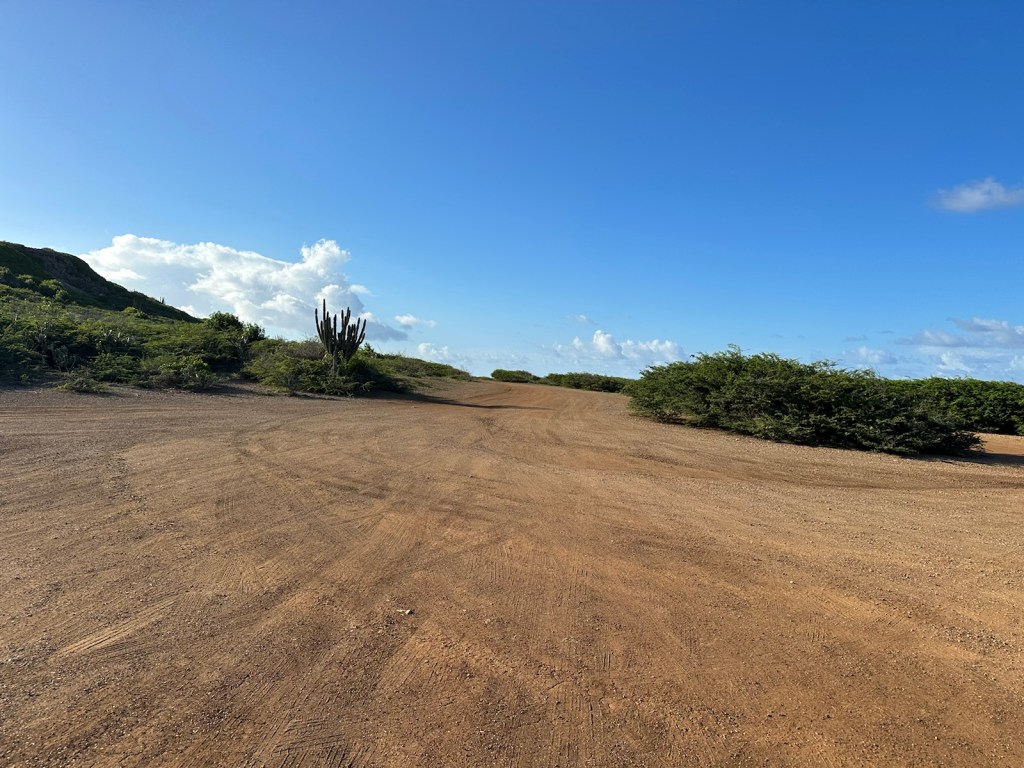
No shade here and lots of cacti. It’s a dusty walk to the edge of the coast.
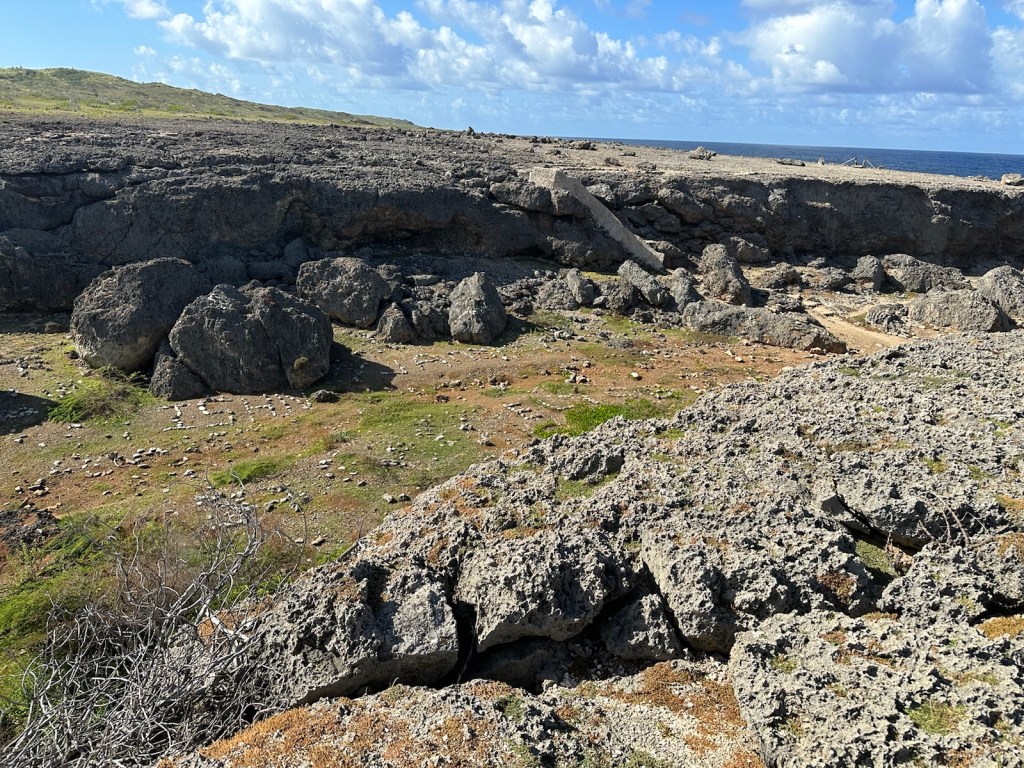
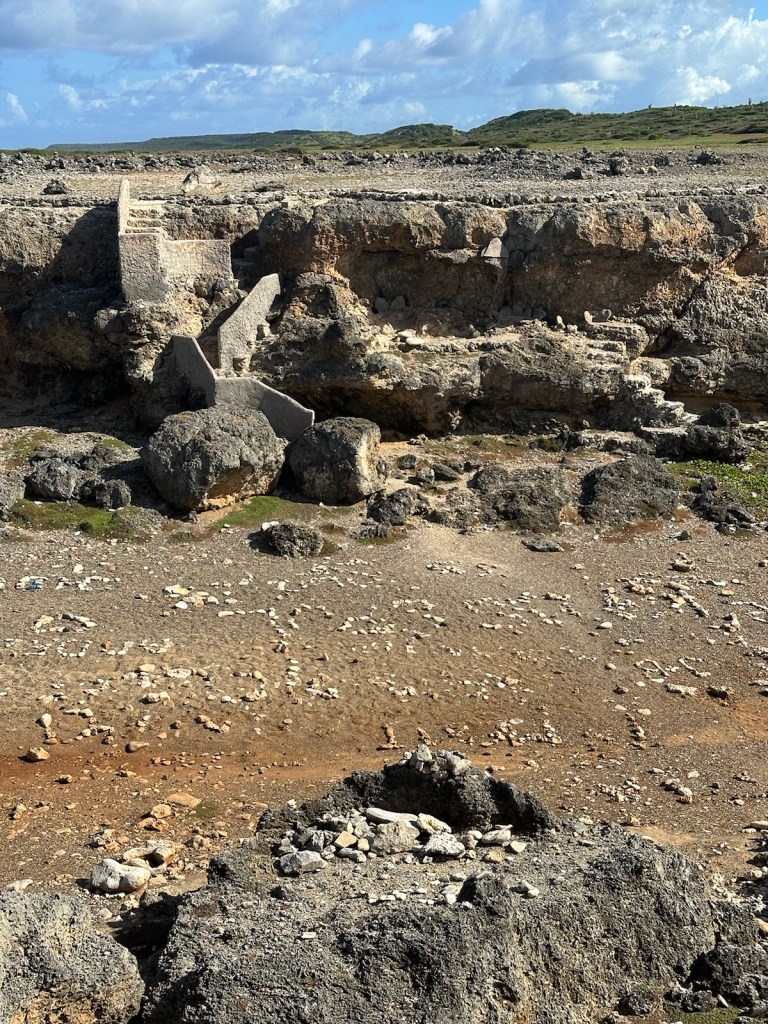
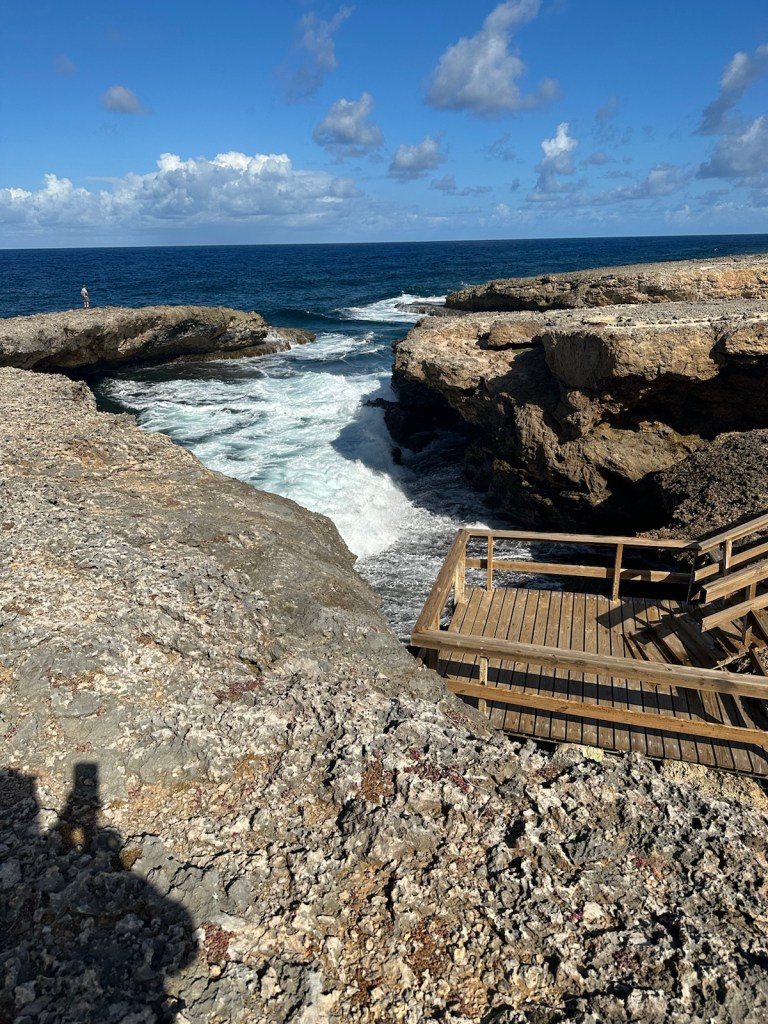
To reach the final destination, you need to hike down into a ravine and then hike back up the other side. The ravine has rocks that form letters, words, hearts, etc. Someone with a lot of energy and tolerance for heat created this open-air work of art.
The trail leads down a limestone bluff, through a ravine and up the other side.A pathway with steps leads down into the ravine.Slapping waves lick the shoreline.Intentional arrangement of stone … can’t quite make out what it’s spelling.The trail goes back up the bluff on the other side of the ravine. Rough terrain leads to an observation platform.It’s mesmerizing to watch the waves.The observation platform provides a lower look at the natural bridge.David walking over the natural bridge, Boka Wandomi.Lots of splashing wave action at the foot of the natural bridge.Amazing to watch the colors of the sea.
We hiked back to the car. The air-conditioning revived us. It was a very slow 2-3 mile drive to Boka Pistol parking lot at the other end. The heat along with the bad roads and time limitations forced us to be selective about which boka’s we hiked. The park closes at 4:00 pm.
We didn’t see any cruise ship excursion buses here and not many other tourists. The combination of heat, full sun and long hiking distances made it challenging.
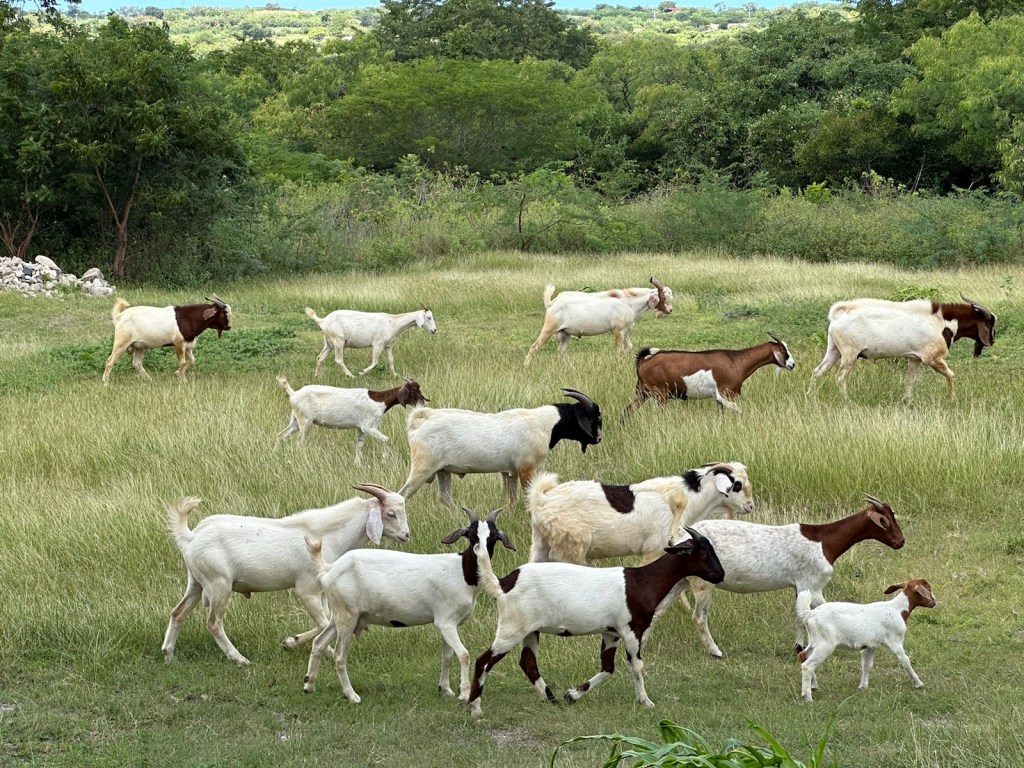
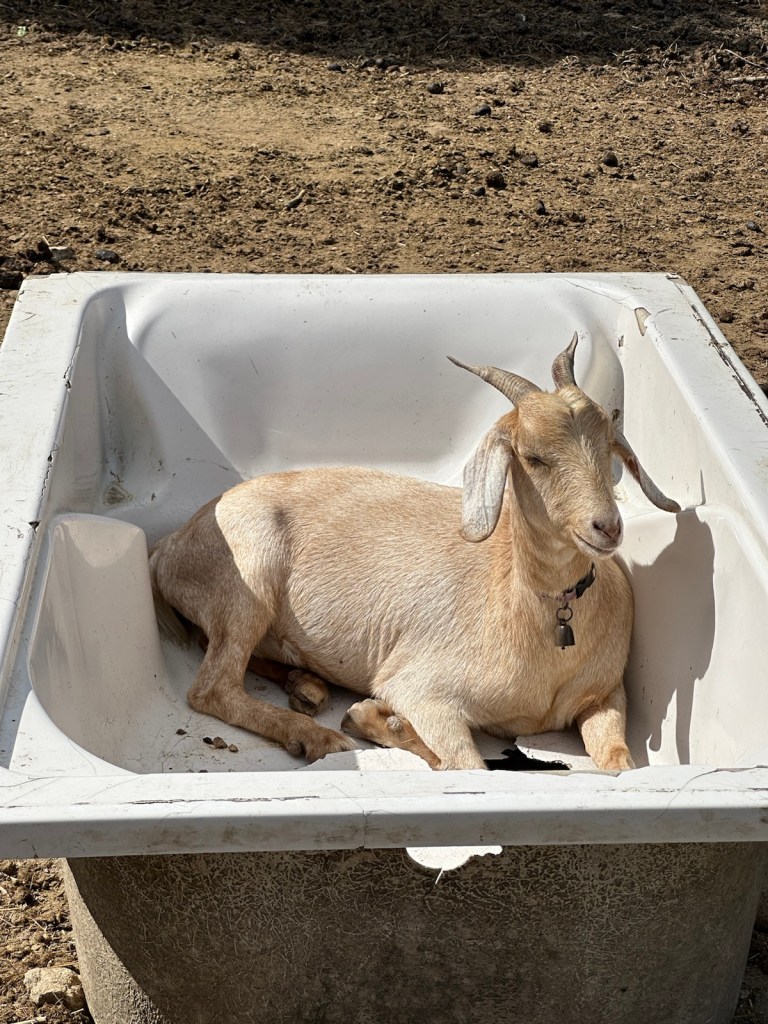
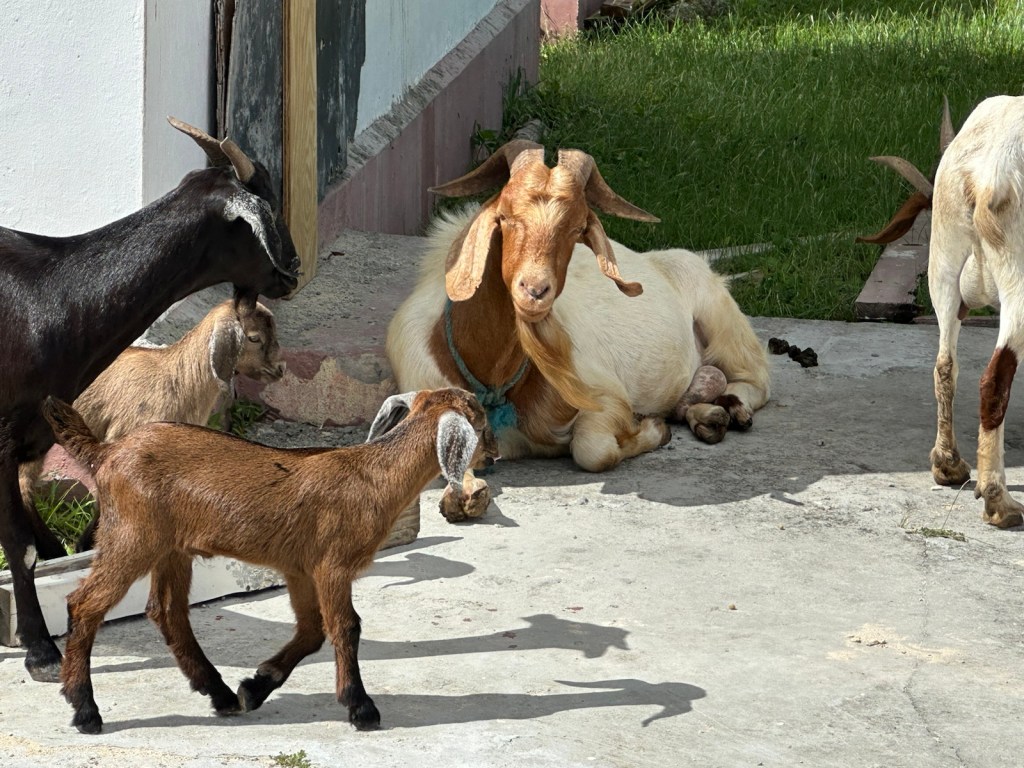
This was the good road … … followed by the bad road. Didn’t see many other tourists but we did cross paths with a herd of goats on our way to the next Boka.
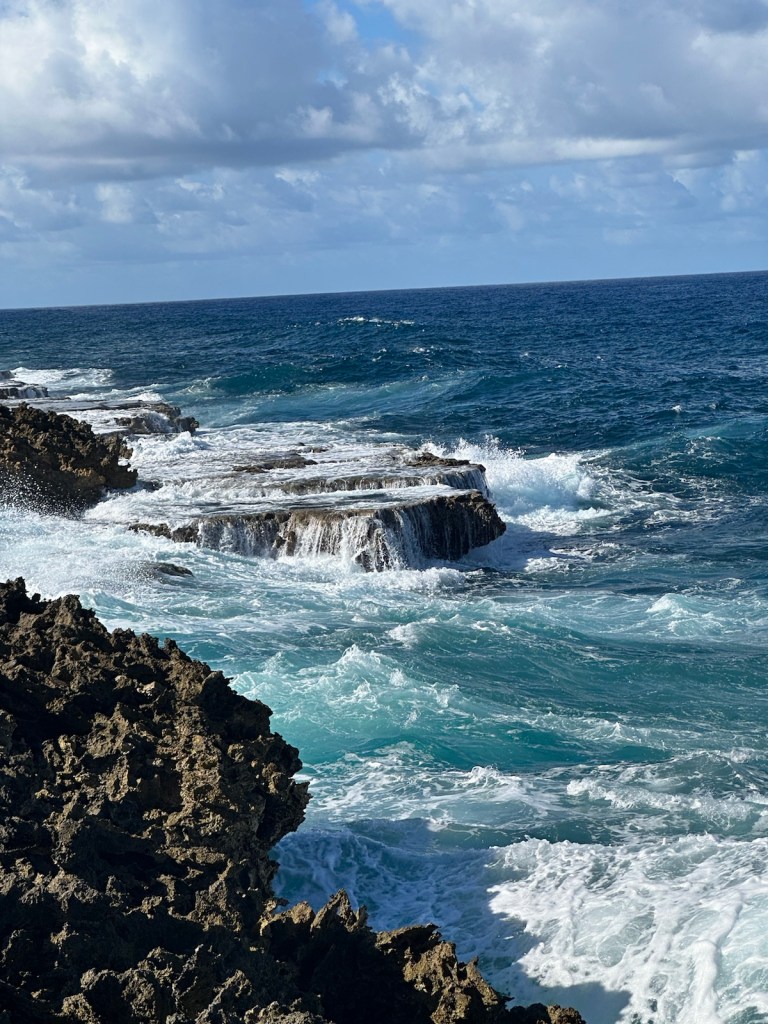
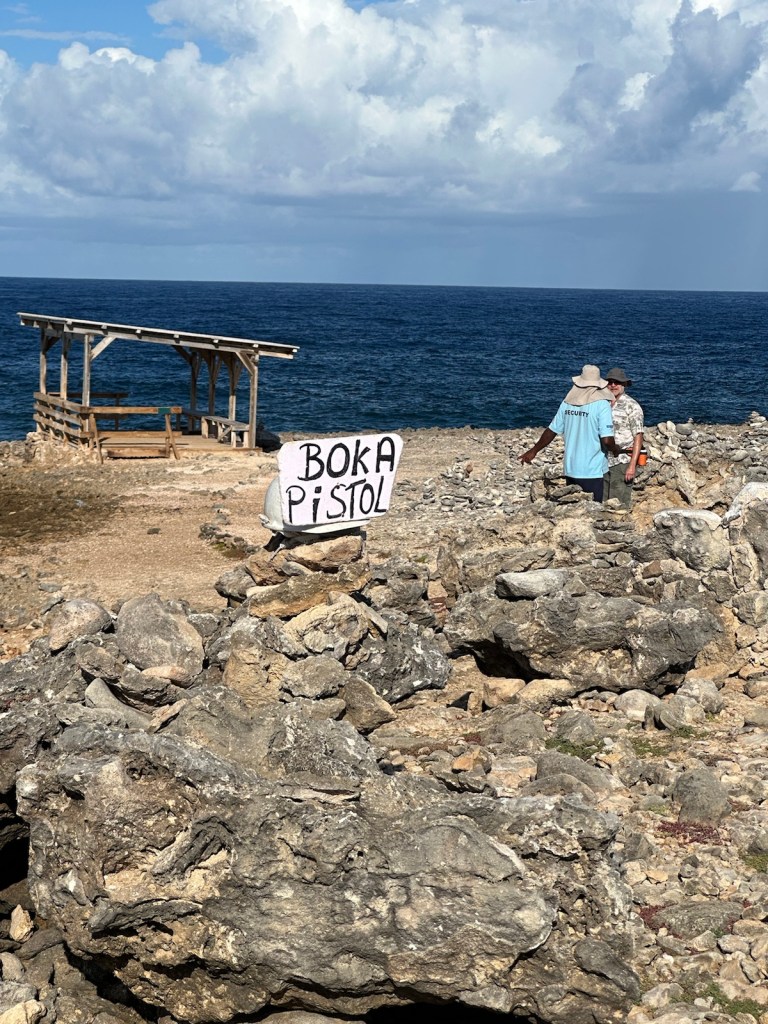
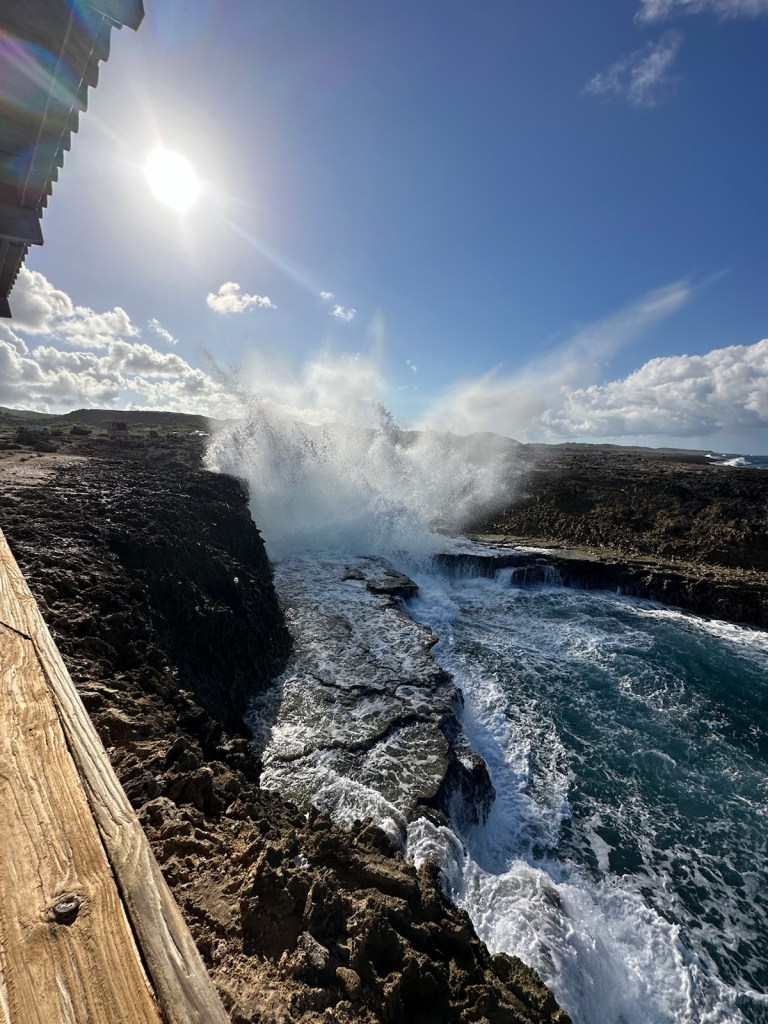
Next stop is Boka Pistol, so named because the waves crash into the cliffs so hard that they reverberate with a sound similar to the sound of a shotgun.
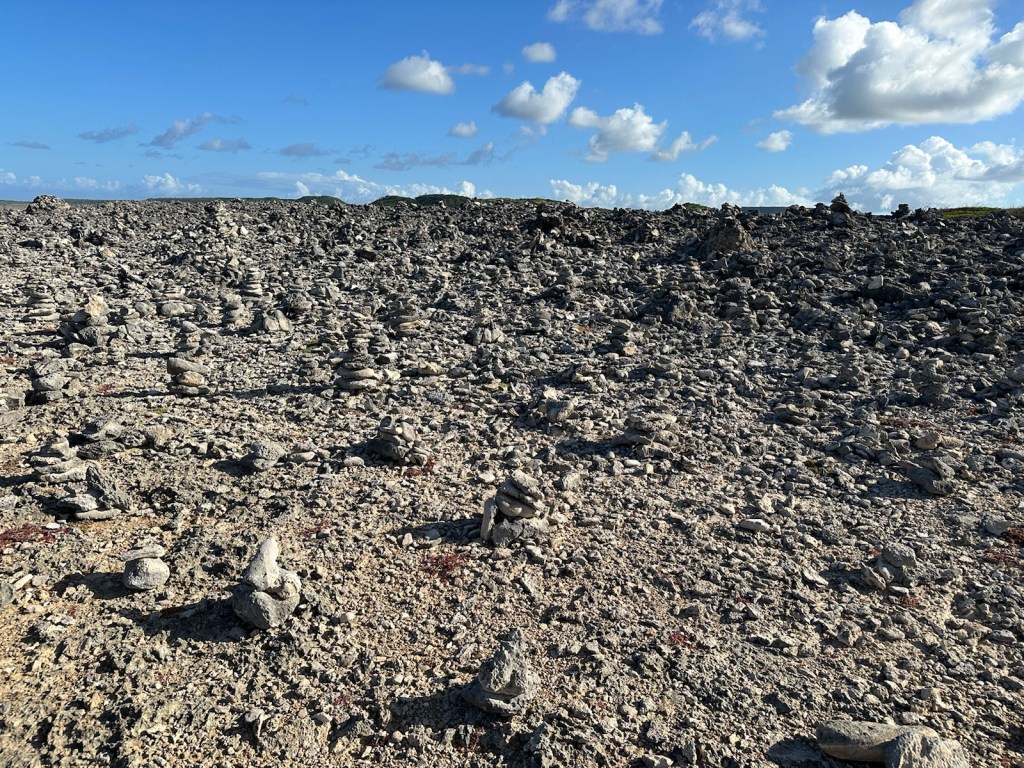
We have reached our destination. Security guard made sure we knew the park was closing in a half hour. Next to the Boka Pistol parking lot, there is a rock field camouflaged with hundreds of cairns.Boka Pistol without waves …Boka Pistol with waves … and the thundering shotgun sound.
Feeling dusty and hot, we changed into our swim wear in the isolated parking lot and headed to the beach. Tomorrow is our last full day in Curacao.
Our new accommodations were at a Scuba Diving resort in Westpunt. We came in late last night when it was dark, so it was exciting to see the natural beauty of this part of the island in full daylight.
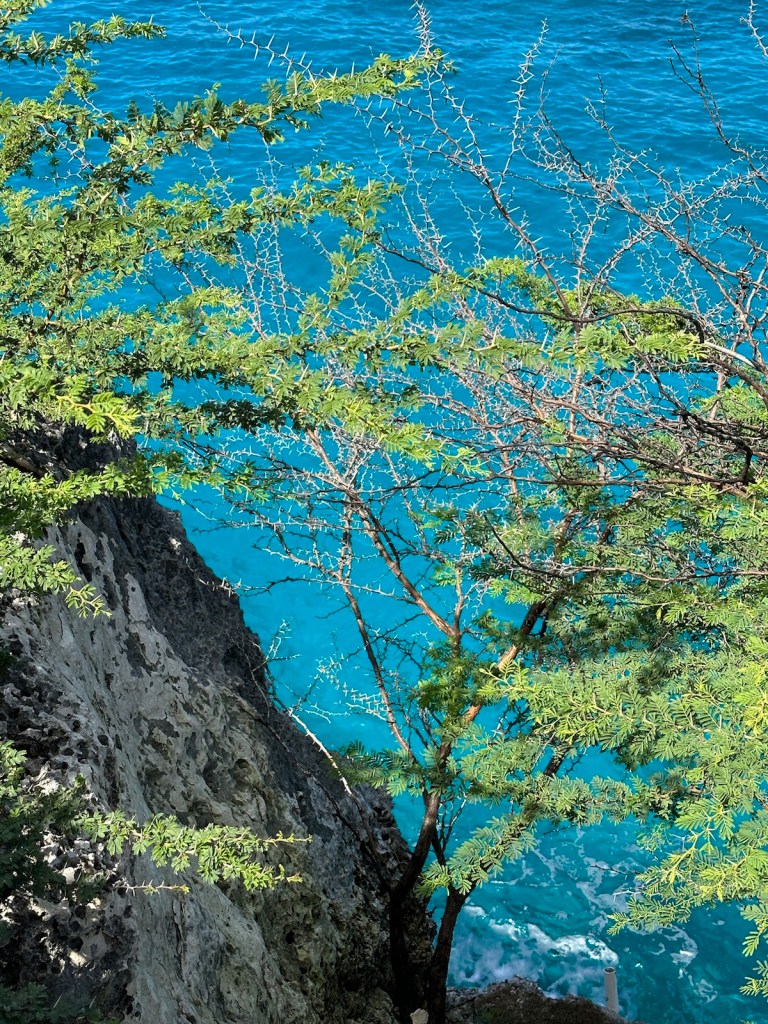
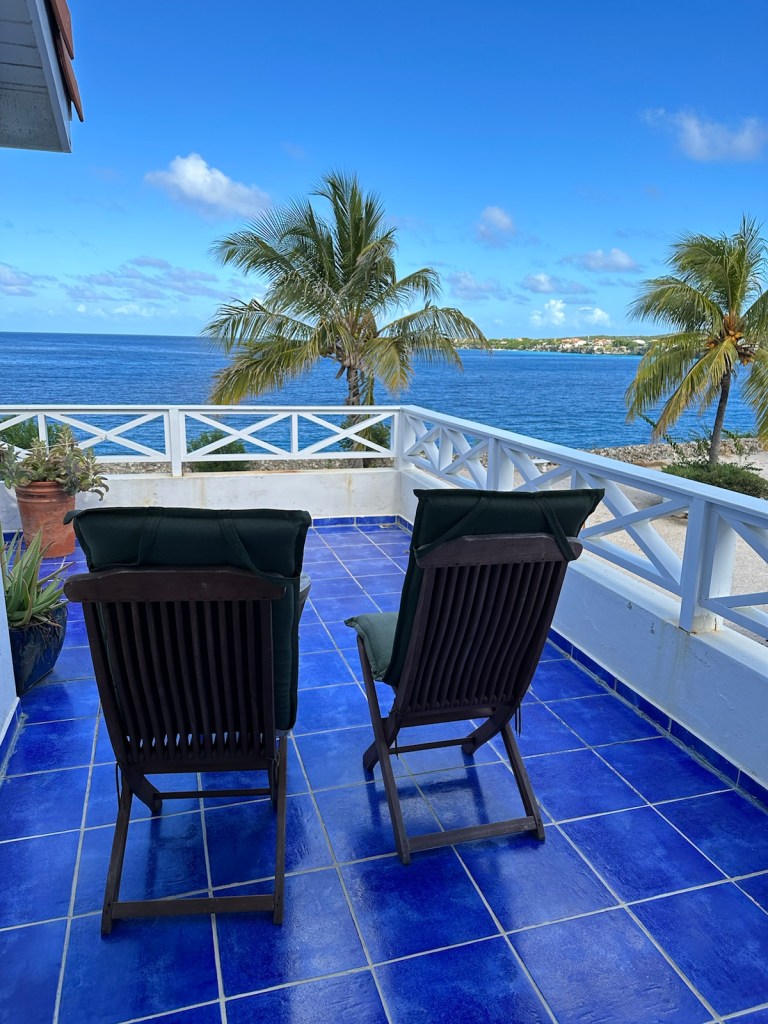
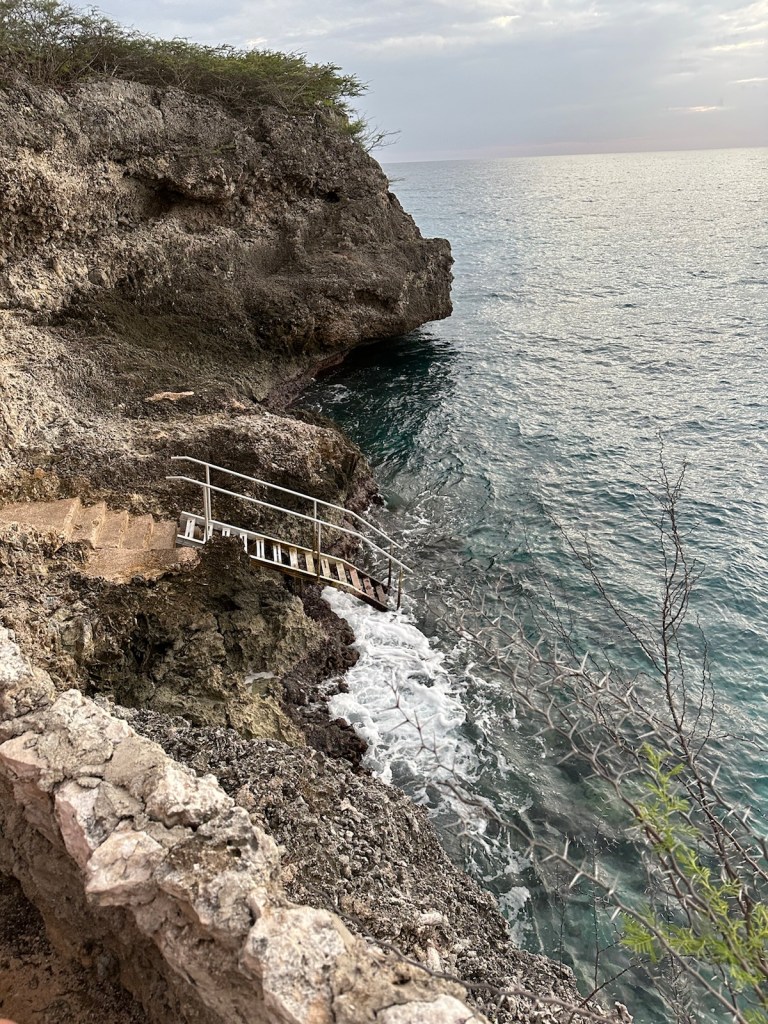
This resort is located on a cliff overlooking the amazing turquoise water.
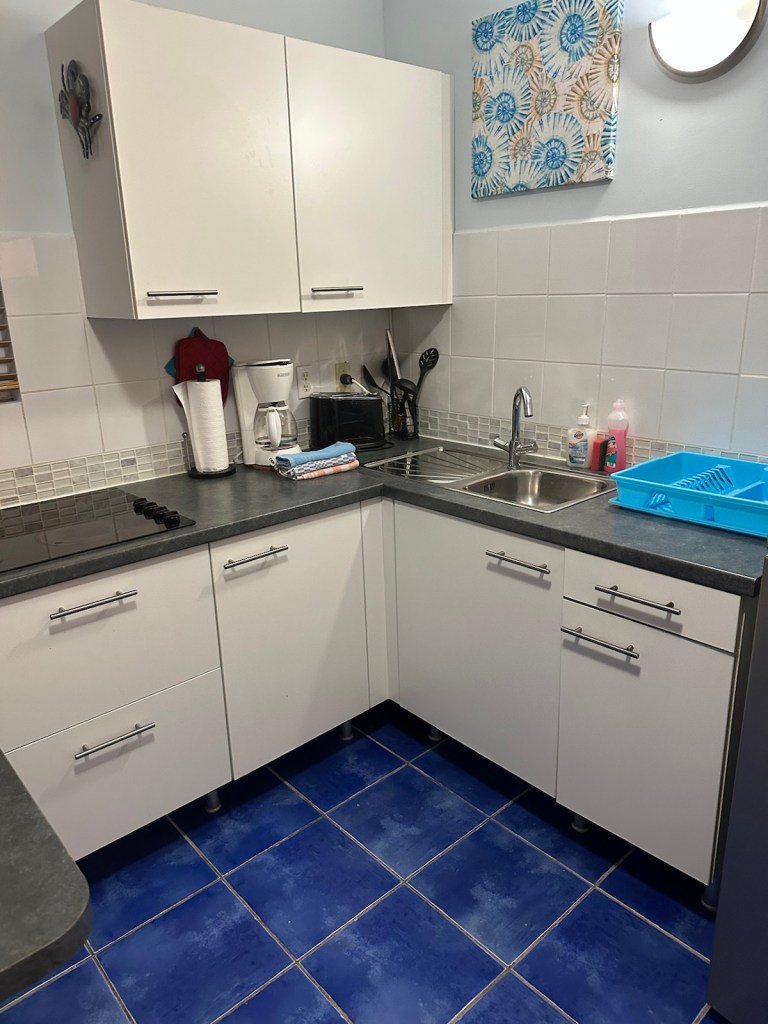
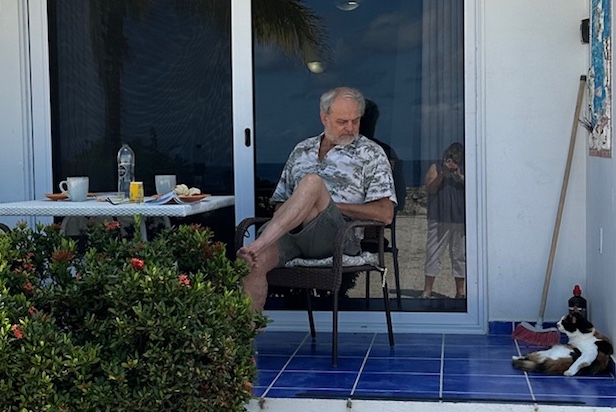
Looking over the cliff wall down on the beautiful turquoise water. Our accommodations are the left side of this building.The kitchenette was handy for morning coffee. By the time we were were done snorkeling, swimming and watching the sunset, the restaurants were closing.
It was about 7:00-ish by the time we got cleaned-up from the beach. Most of the restaurants close by 8:00 pm. We had cocktails on the patio until the mosquitos arrived followed by light suppers made in the kitchenette. I think the locals tend to watch the sunsets from the restaurants.
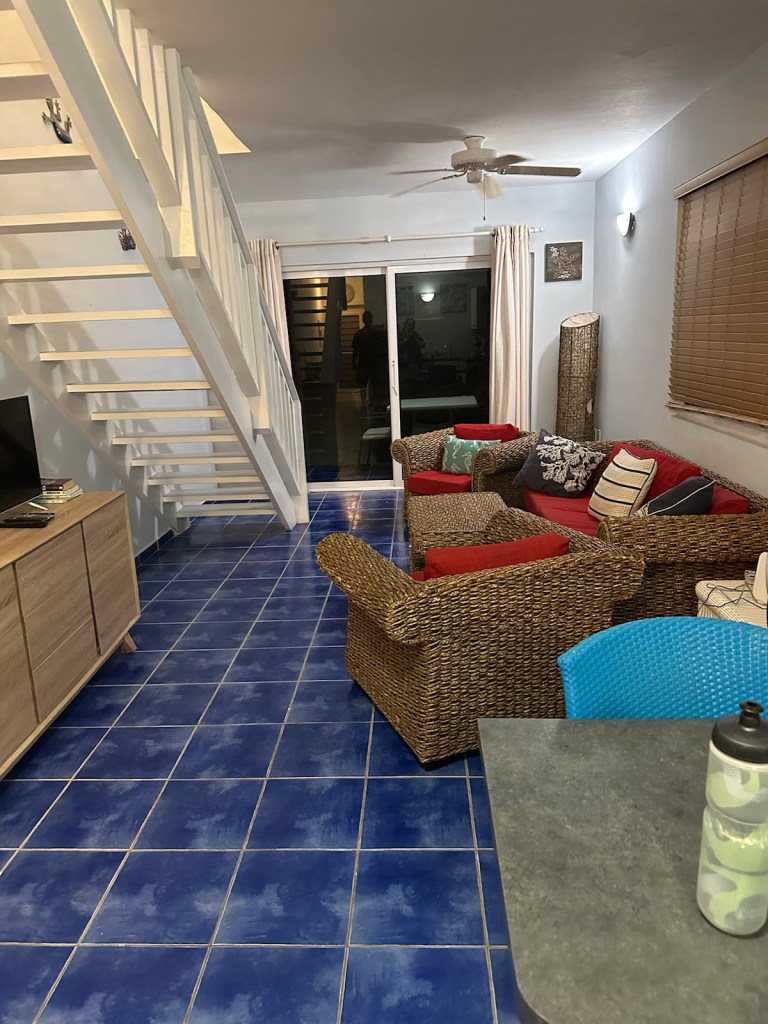
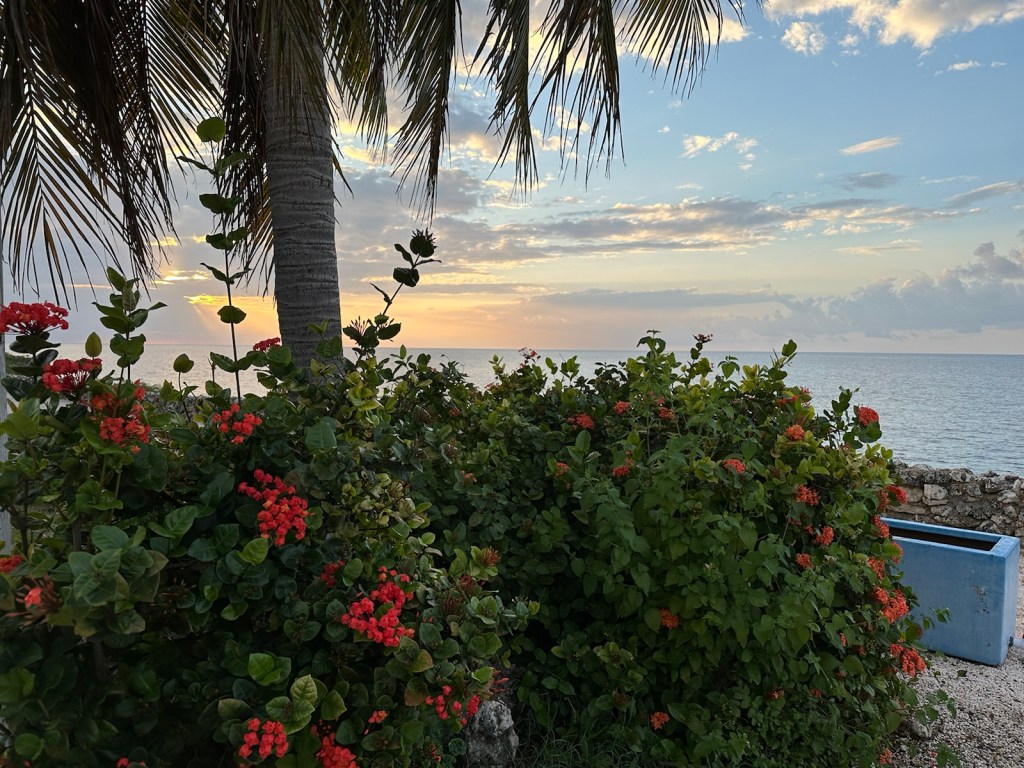
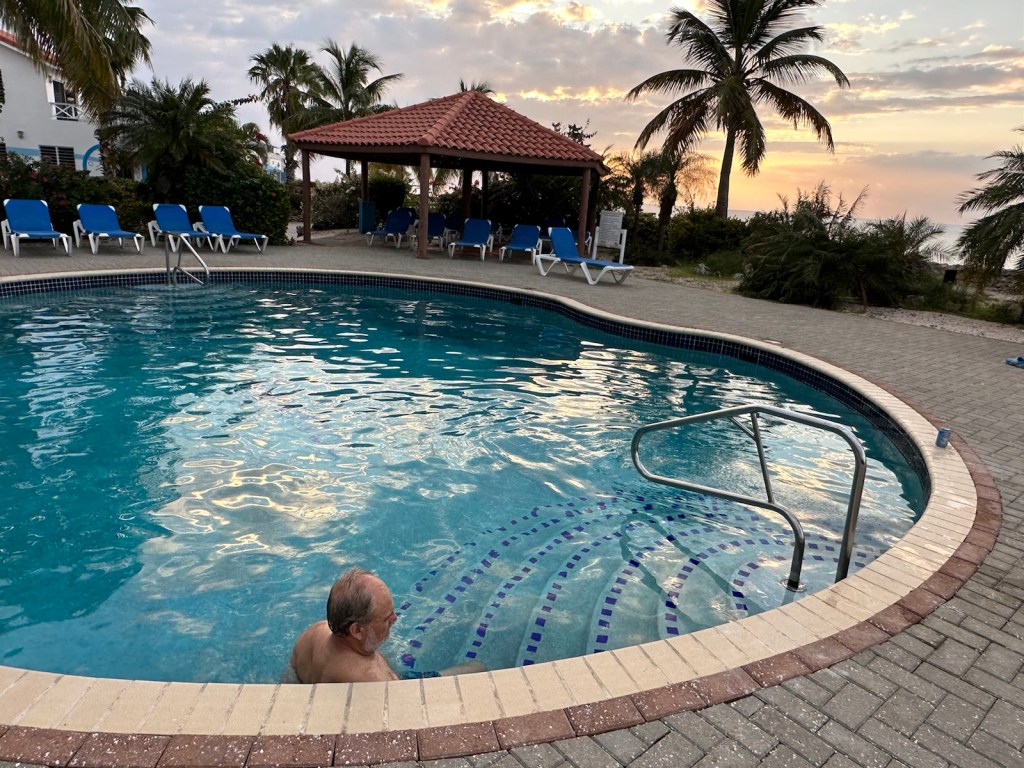
In the evening, the chameleons would cling to the ceiling above our patio table.We were really happy to have a comforter — ceiling air conditioner kept the room cool. It was also nice to have a second bath upstairs. Second floor terrace overlooking the sea.Main floor patio comes with a cat.Beautiful landscaping on the cliff The Iguanas like the view too. Look at the tail on this guy!From the resort, you could climb down the cliff to Scuba or snorkel.We did use the pool. After all the salt water it was nice to relax in fresh water.
Westpunt first appeared on maps of the Dutch West Indies Company around 1700. In 1849, land was donated to the Catholic Church by plantation Savonet to build a church and school.
A village appeared around the church in the 1860s inhabited by newly freed slaves following the abolition of slavery in the Kingdom of the Netherlands.
Westpunt remained isolated for most of its history due to the 22 miles to Willemstad. There is public bus service around the island. The bus stops are plentiful and most are decorated for the holidays.
The population density is low, and the number of inhabitants has been steadily decreasing. In 2002, the elementary school closed. Tourist resorts and holiday homes have appeared near the coast. To sum it up, let’s say it’s a very quiet but beautiful part of the island.
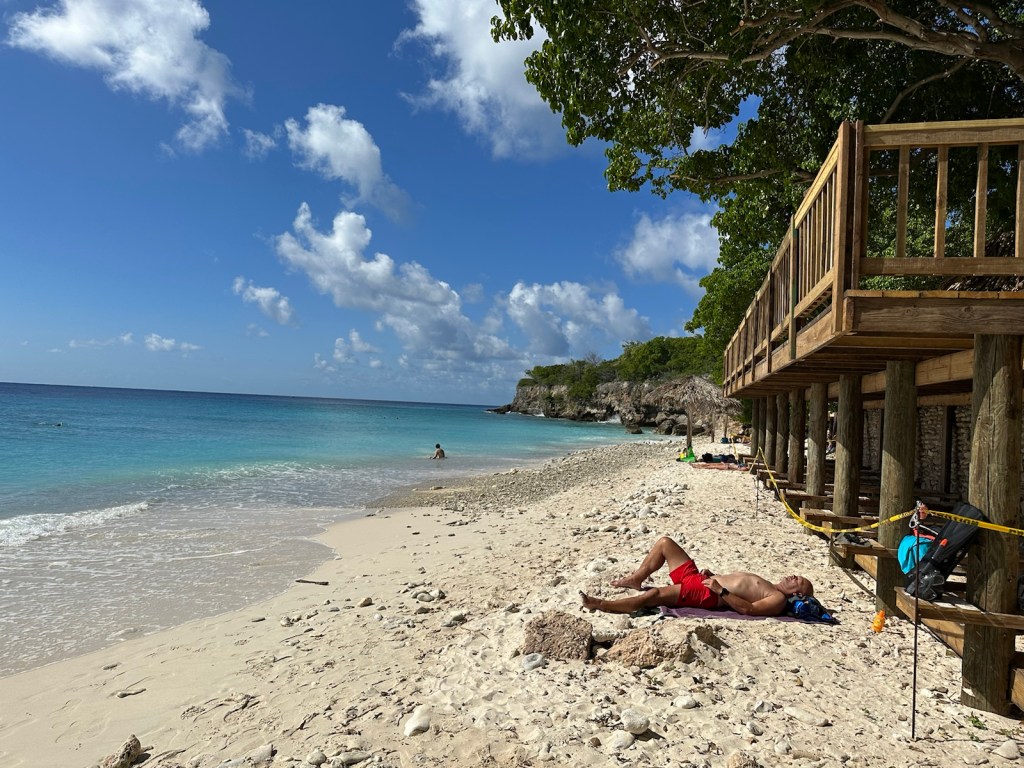
Westpunt is home to some of the island’s most beautiful coral sand beaches. Three were very near; small Playa Kalki, Playa Forti, and Playa Grandi (aka Playa Piscado and Sabana Wesport). Playa Grandi is the sales center for the local fishing community. The daily catch includes Barracuda, Mahi Mahi, Blacktail Tuna, Yellowtail Tuna, Red Snapper, Queen Snapper, Wahoo, Sailfish, Amberjack, Bluejack, Black Grouper, Lobster, Octopus, and Lion Fish.
We really wanted to try Lion Fish but it was always sold out.
Playa Kalki is a small, very uncrowded beach but it’s one of the best. Occasionally seahorses are seen here by snorkelers and divers.
Playa Kalki is also known as Alice in Wonderland due to mushroom-shaped coral formations. The name Kalki comes from the local Papiamentu word for the white coral rock and limestone, which is abundant on the beach and surrounding cliffs. You wouldn’t want to walk on this barefoot.
Playa Kalki and its surroundings are known for their good scuba conditions. There is a professional dive center located directly on the beach at Playa Kalki.
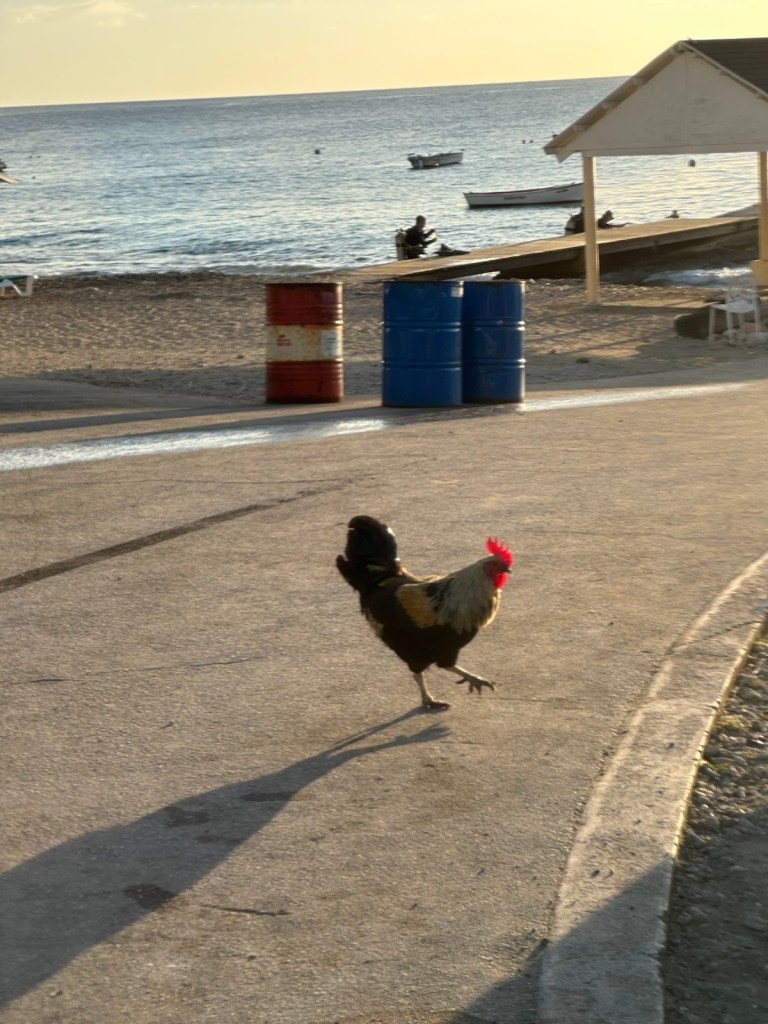
Our next stop, Playa Grandi. This is the first time I’ve seen roosters and chickens on a beach. This tiny fishermen’s beach is also popular for snorkeling and diving. Entrance to the water is somewhat rocky.
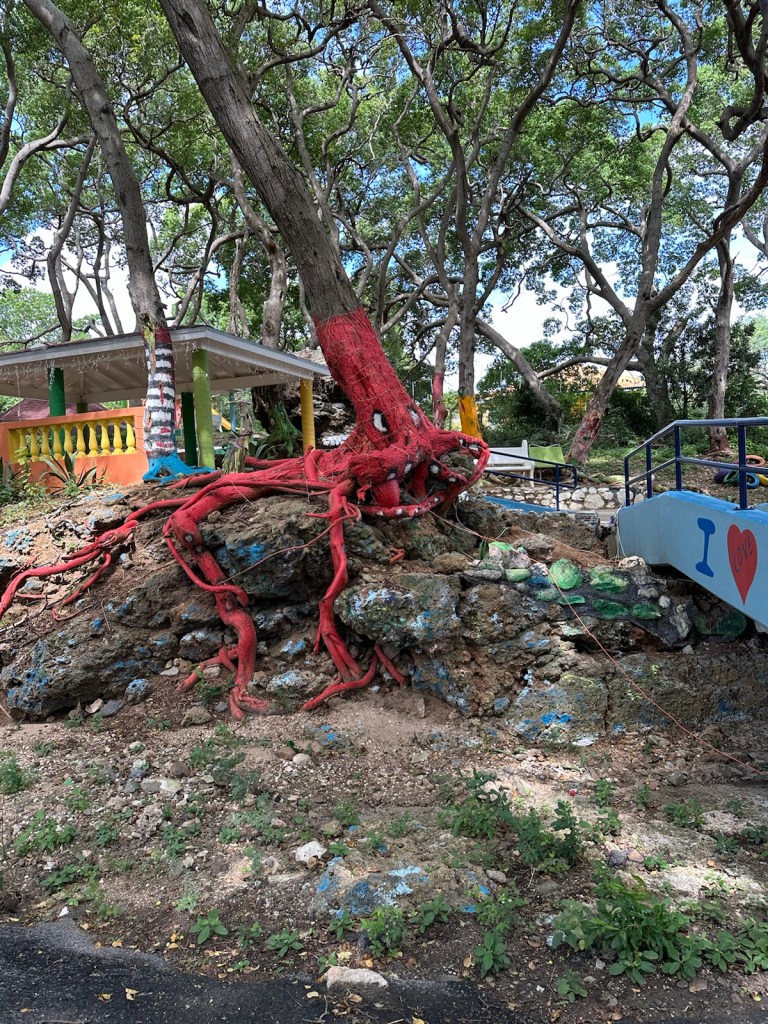
Why did the chicken cross the road? To get to the beach.Playa Grandi had a children’s playground. We especially liked the Octopus tree.
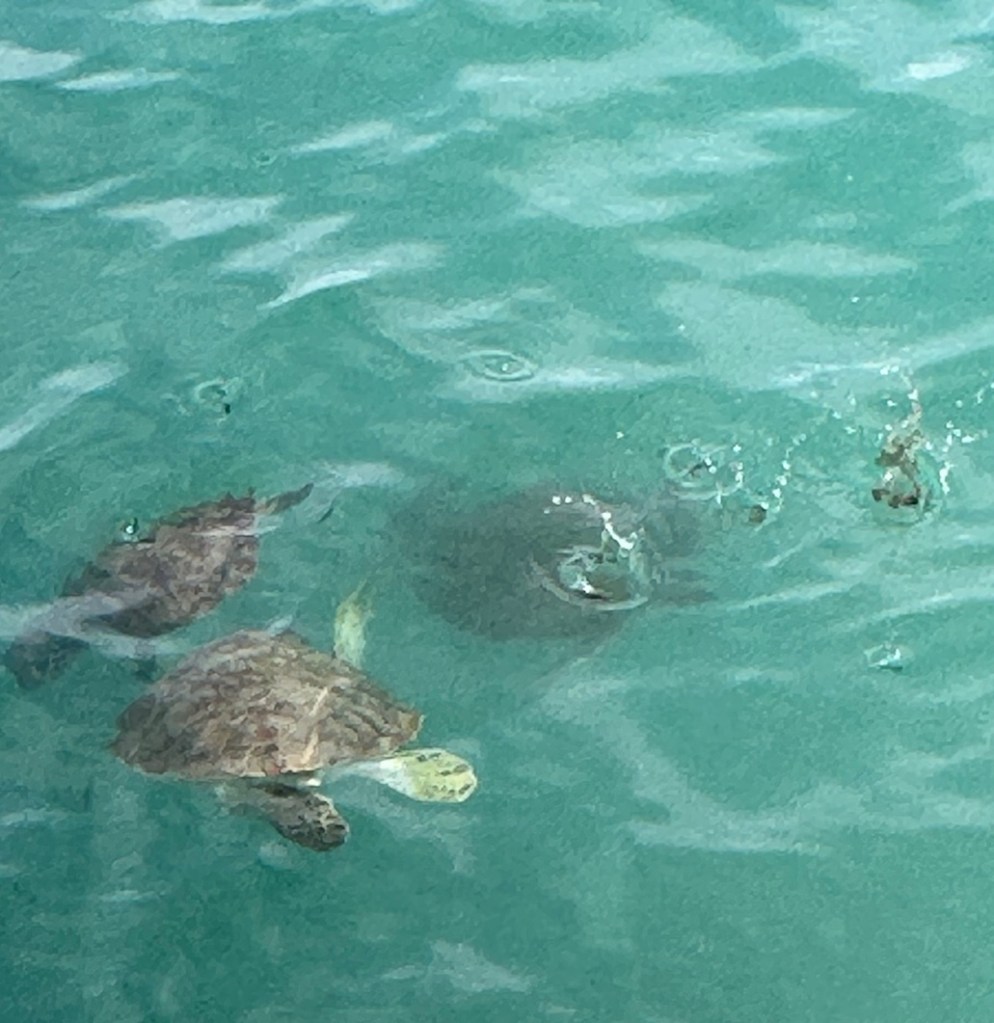
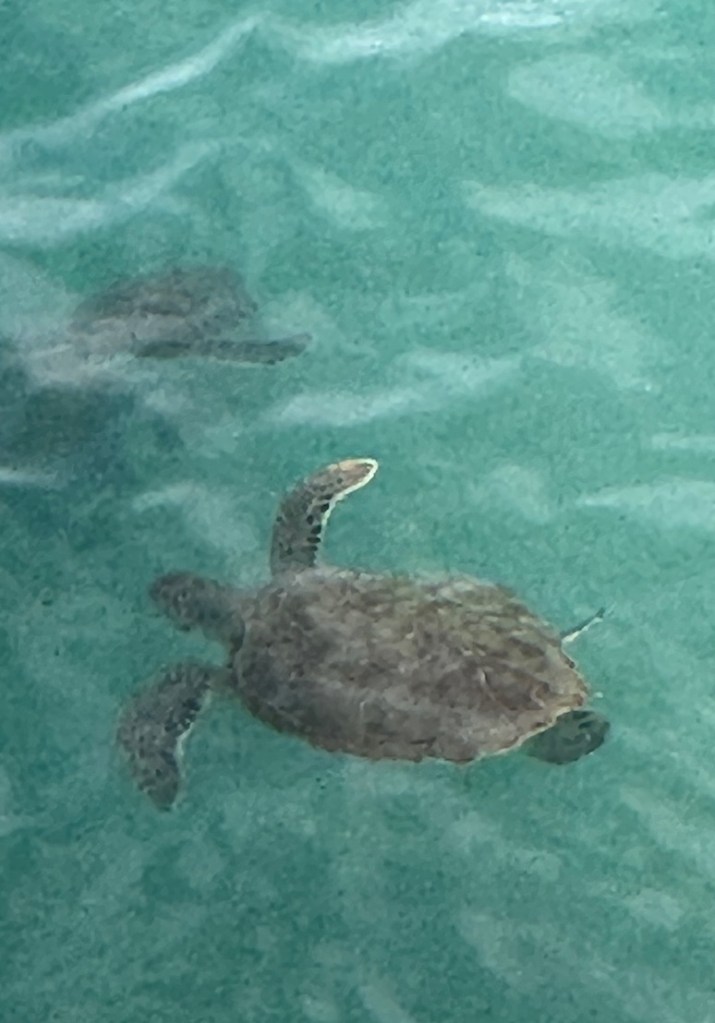
The Sea Turtles appear from 11:00 – 4:00 daily and so do the cruise ship excursions. The sea turtles come for the Fishermen’s scraps that get tossed over.
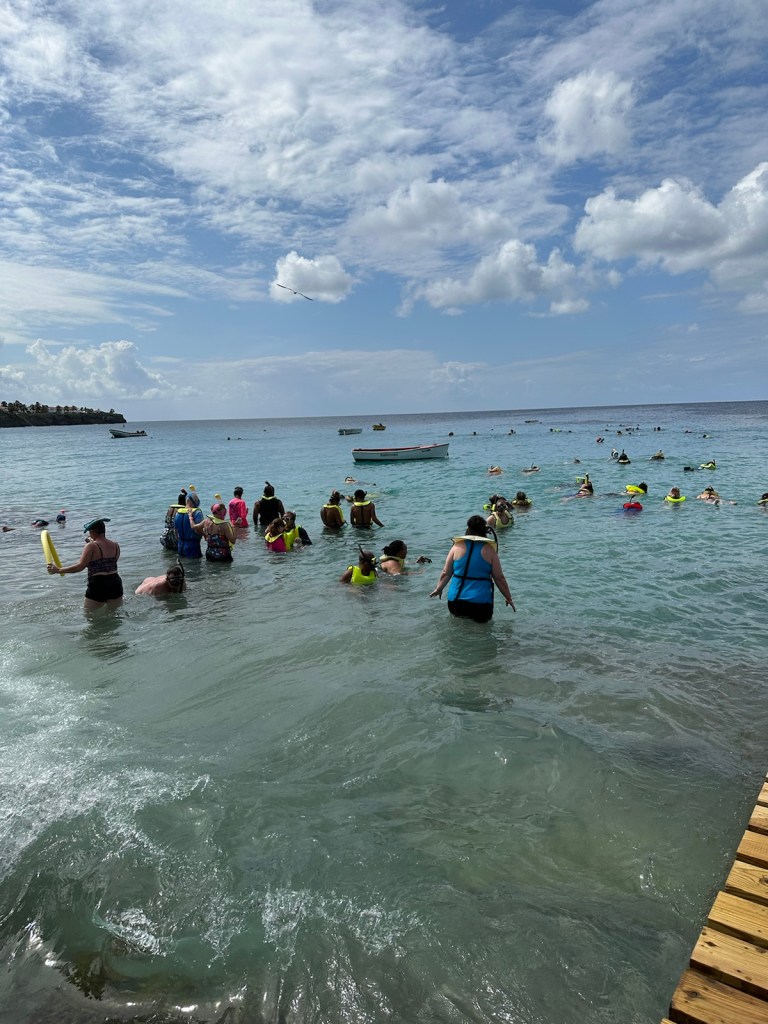
The cruise ship guests come to see the turtles. The ships are parked outside Willemstad, a good 40 miles away. This is probably a 6 hour tour with a few stops. The motor coaches pull up and the beach fills. The groups march into the water with life jackets and snorkel masks. The sea turtles are everywhere and quite easy to find.
A bus load of cruise ship tourists invade the beach.Sea turtles are plentiful and easy to find.
This is one of the reasons why we hit the beaches after 4:00 pm. We like to watch the sunsets too.
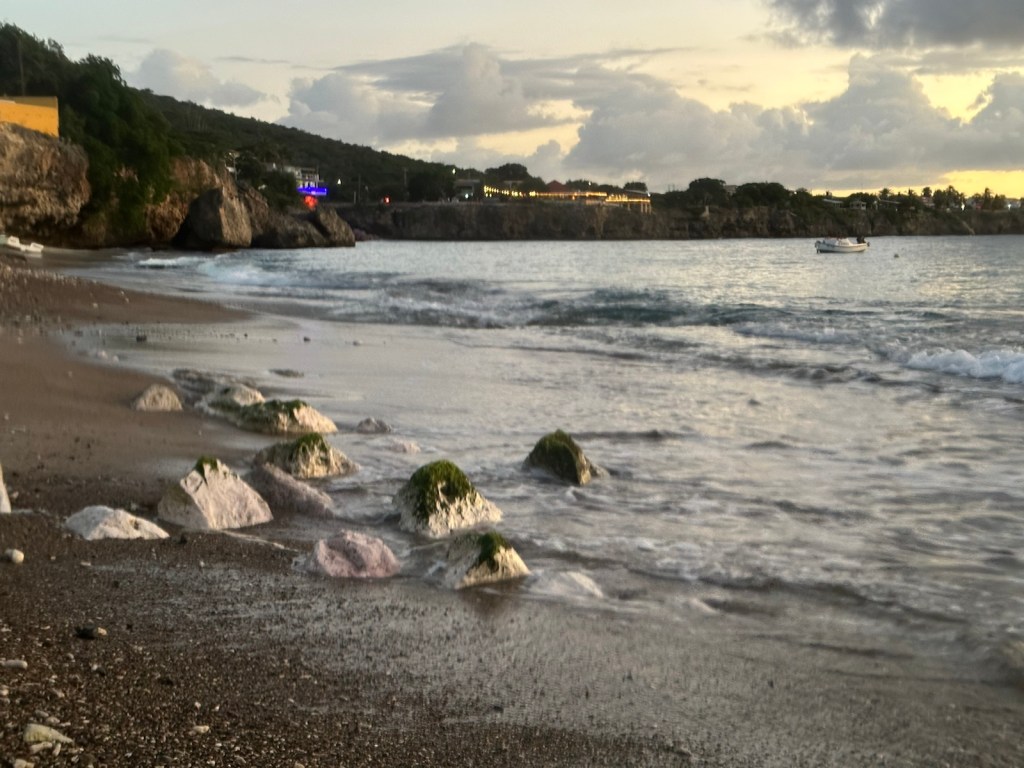
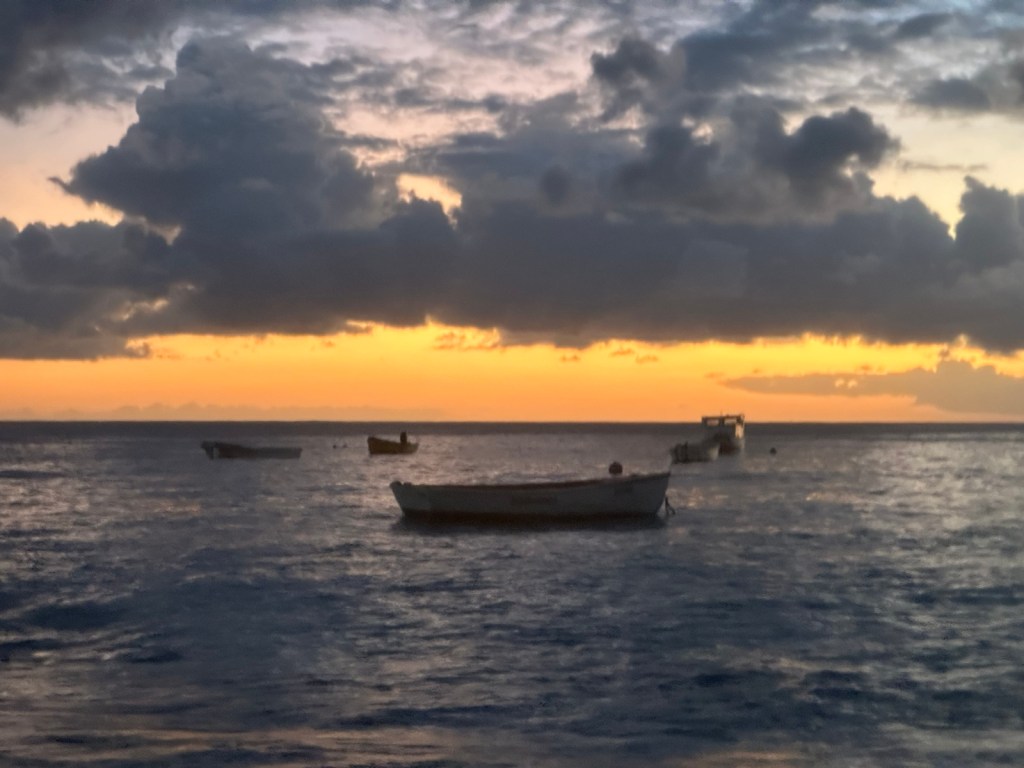
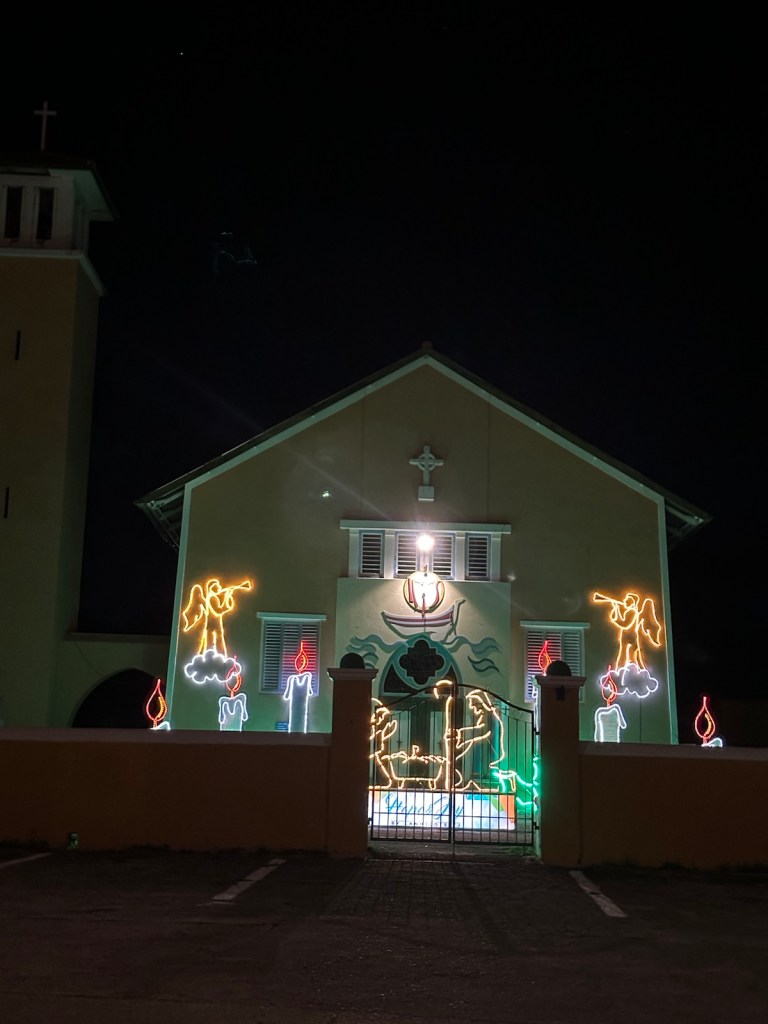
The beach has emptied. Rocky shoreline with a bit of an underwater rock shelf.It’s late afternoon and we have the beach to ourselves.The fishermen have parked their boats and ended their day.The turtles have gone back out to sea. The fish are found close to the reef and cliffs. Another beautiful sunset. It’s dark by the time we load up and leave. Across the road from the beach is a church. They are lit and decorated for the holidays.
We head back to the resort to finish off the evening.
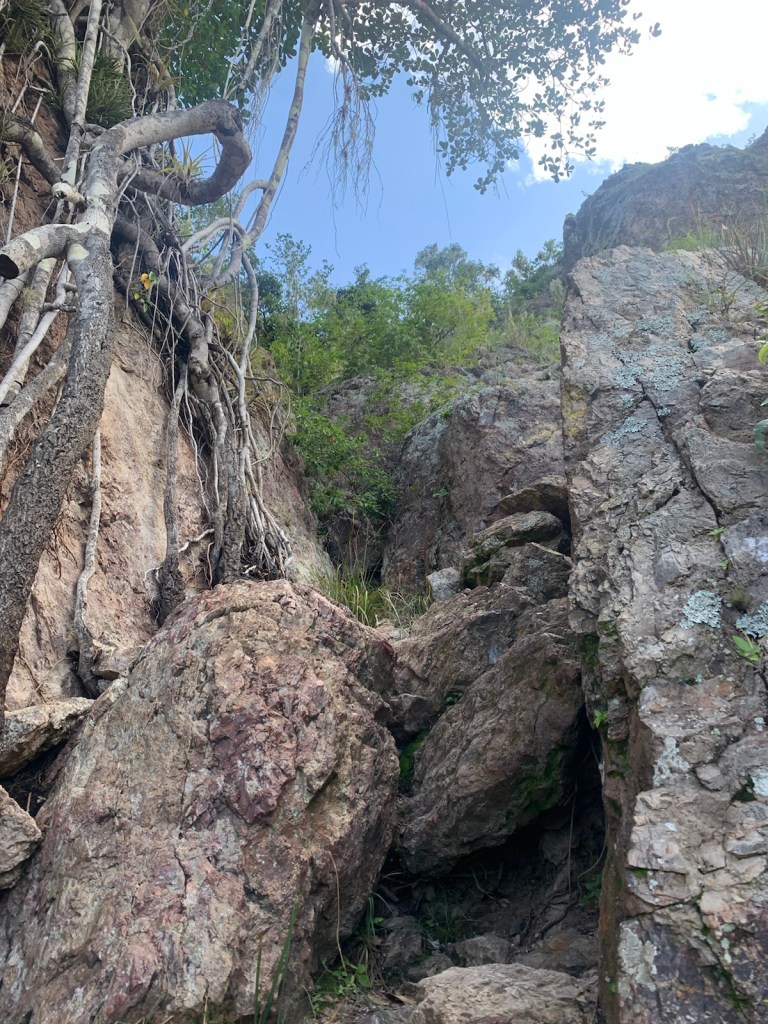
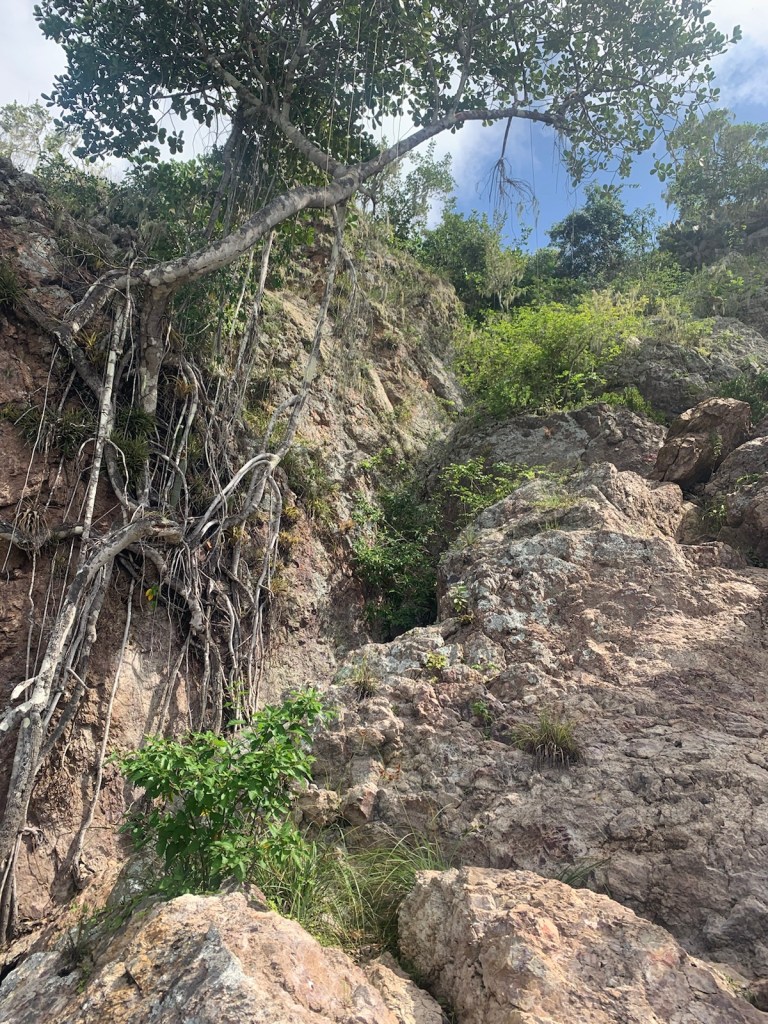
Today we are heading for Mt. Christoffel National Park. David is going to take on the mountain. Hikers need to register with the park office by 10:30 am or they are not allowed to climb. The heat and humidity become an issue later in the morning. The well travelled trail is pretty much one mile straight up the mountain with some rock scrambling toward the top.
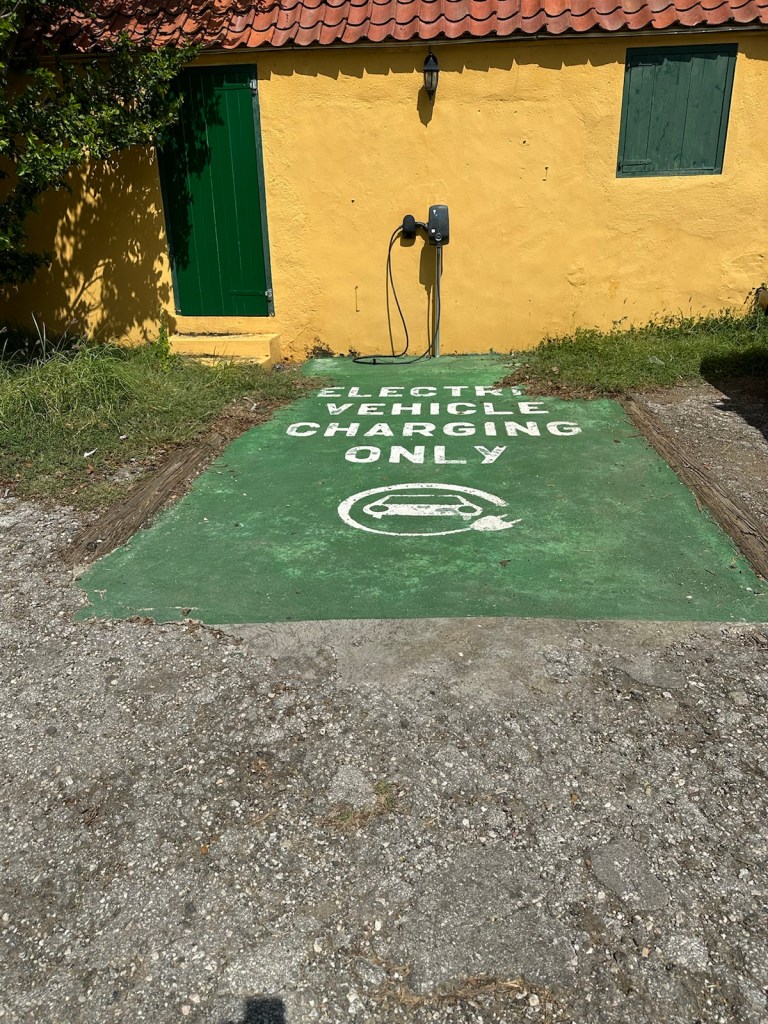
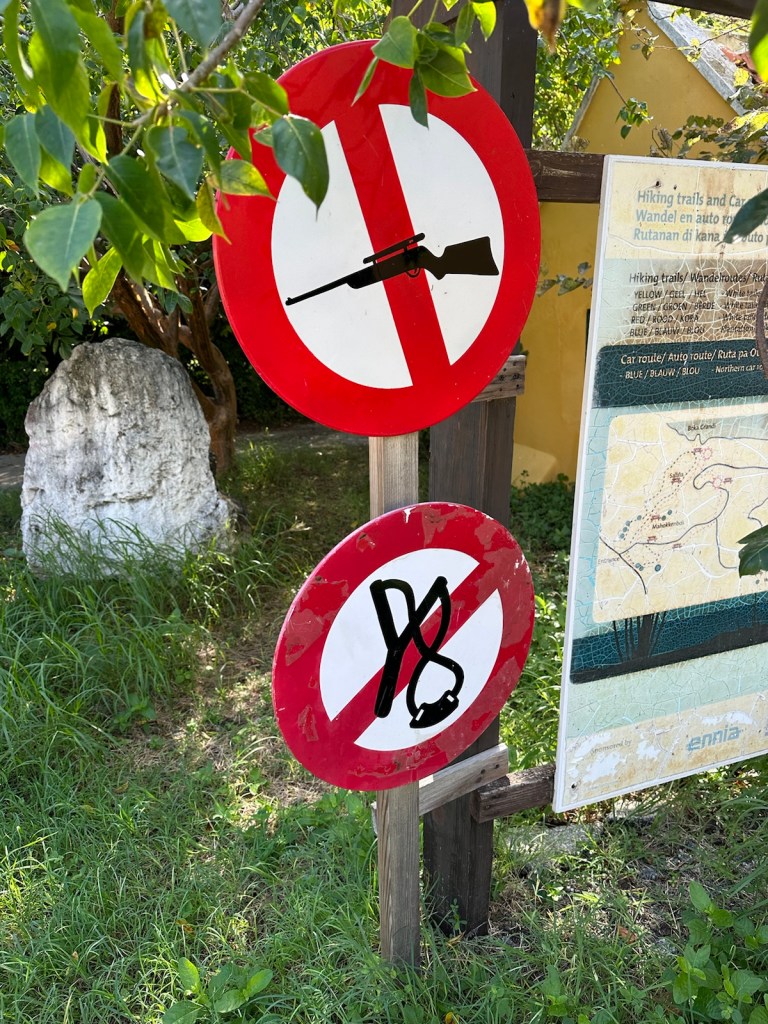
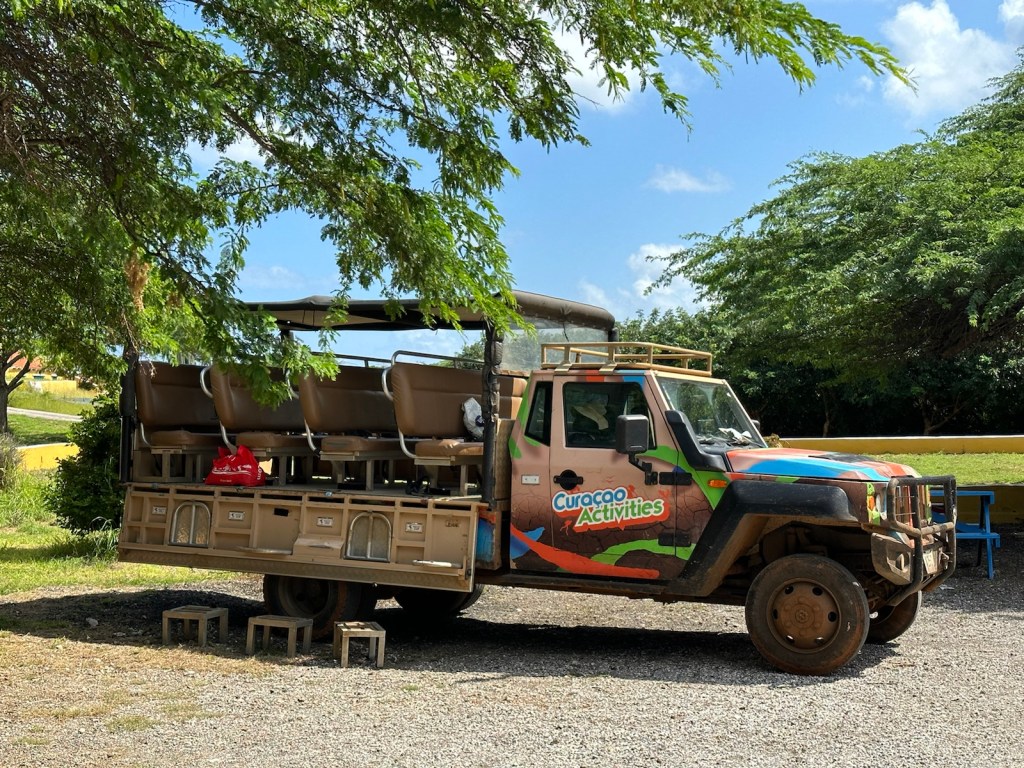
A view of Mt. Christoffel from the National Park parking lot. Hikers must register with the office by 10:30 am, pay $15 and carry a minimum of 2-liters of water in addition to signing waivers.I was impressed that the park had an e-car charging station. In addition to banning guns, the park ban slingshots too. Cruise ship excursions arrive in safari trucks.
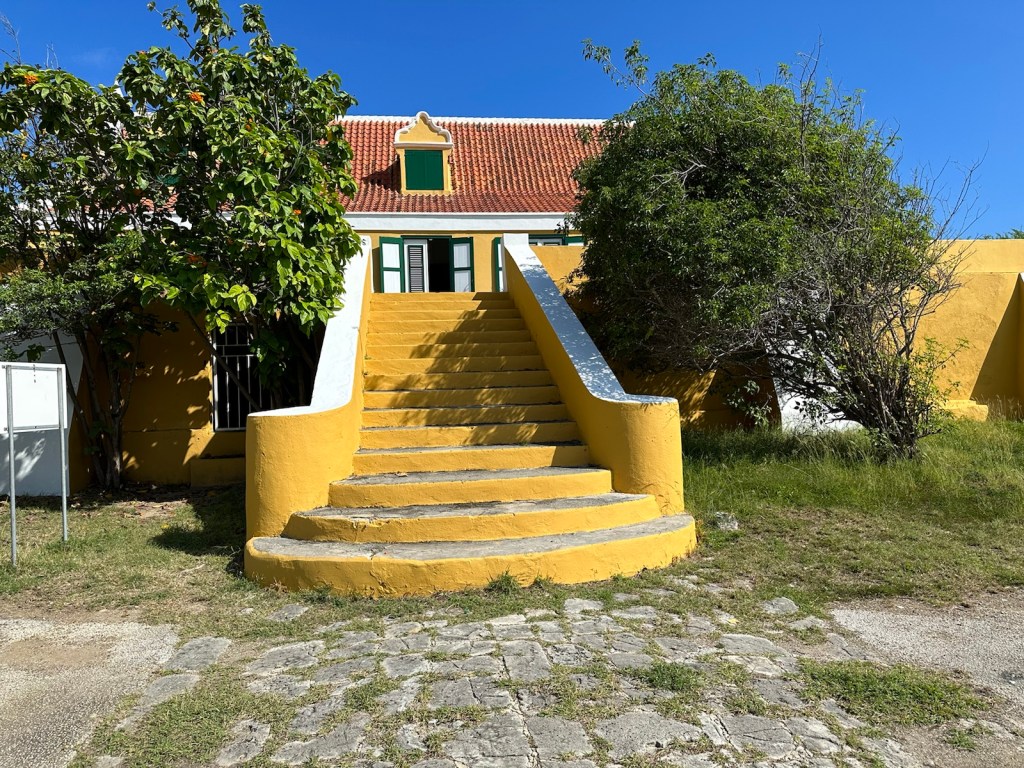
When David was on his hike, I toured the Savonet Museum located inside Christoffel National Park. This former plantation house built in 1662 is an important cultural site with its well-kept structures and artifacts.
Savonet Plantation at one time produced dairy products, wool, dye and was a popular place for cattle breeding. It has historic significance as the site of the slave rebellion of 1795.
Savonet Landhuis is a unique landmark that allows visitors to recount the social evolution of Curacao through the story of the island’s first inhabitants, the plantation’s owners, and the enslaved people. Different exhibits witness the situations of the distinct groups of the slavery period as well as the evolution of the civilization and customs following emancipation.
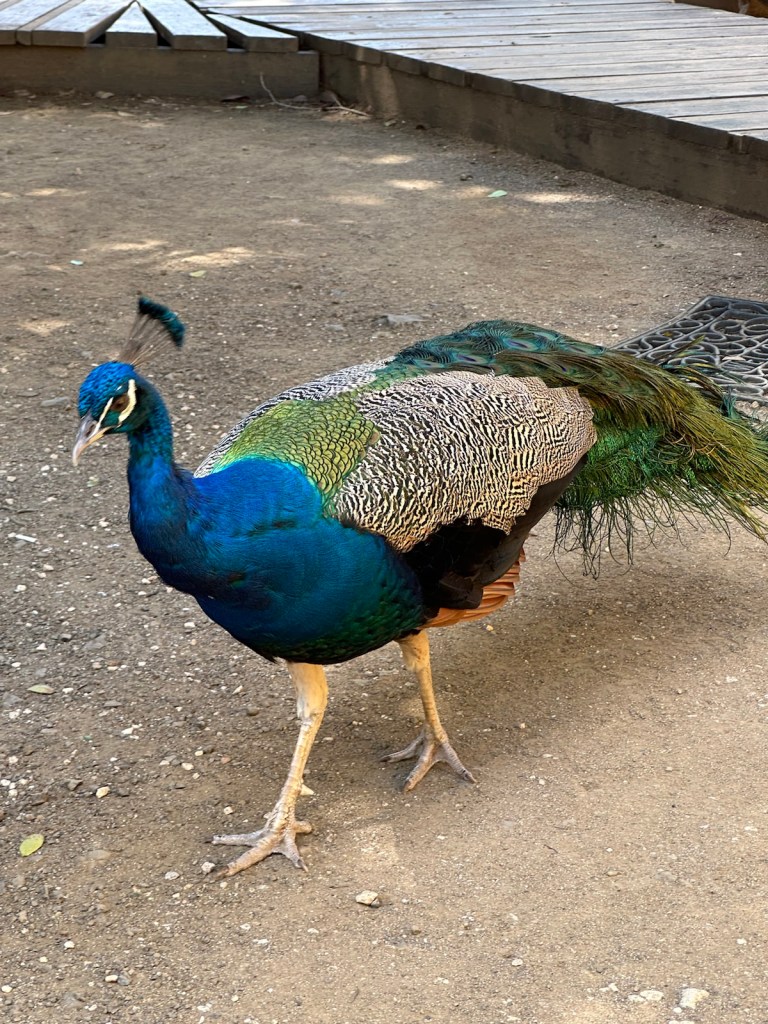
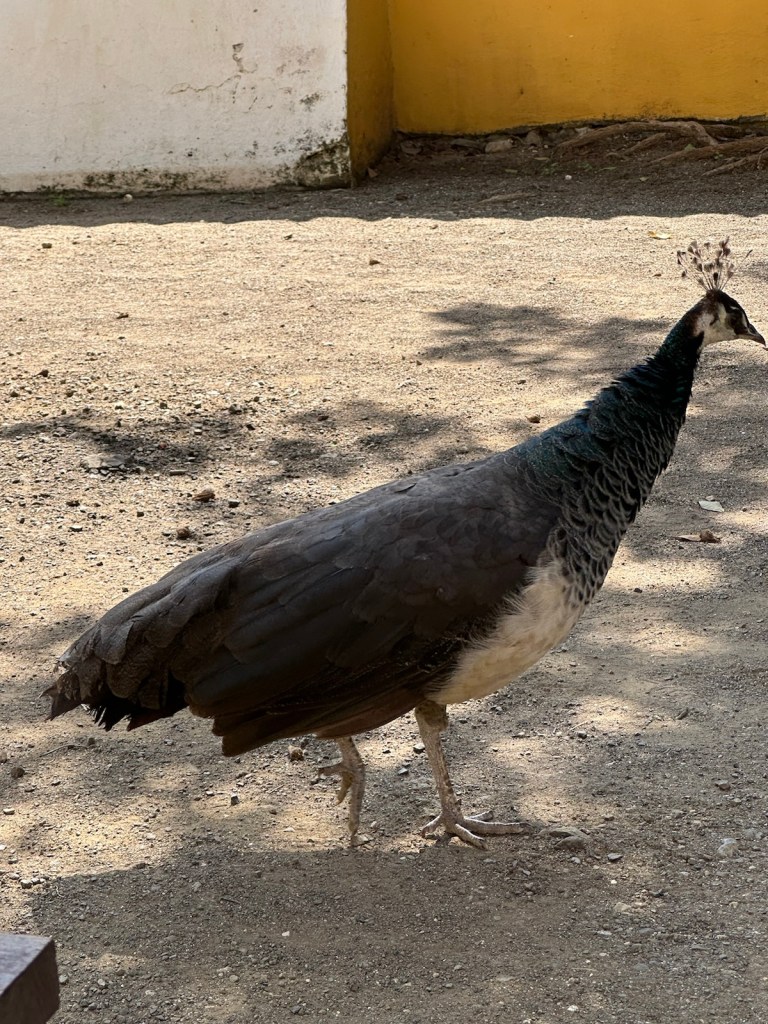
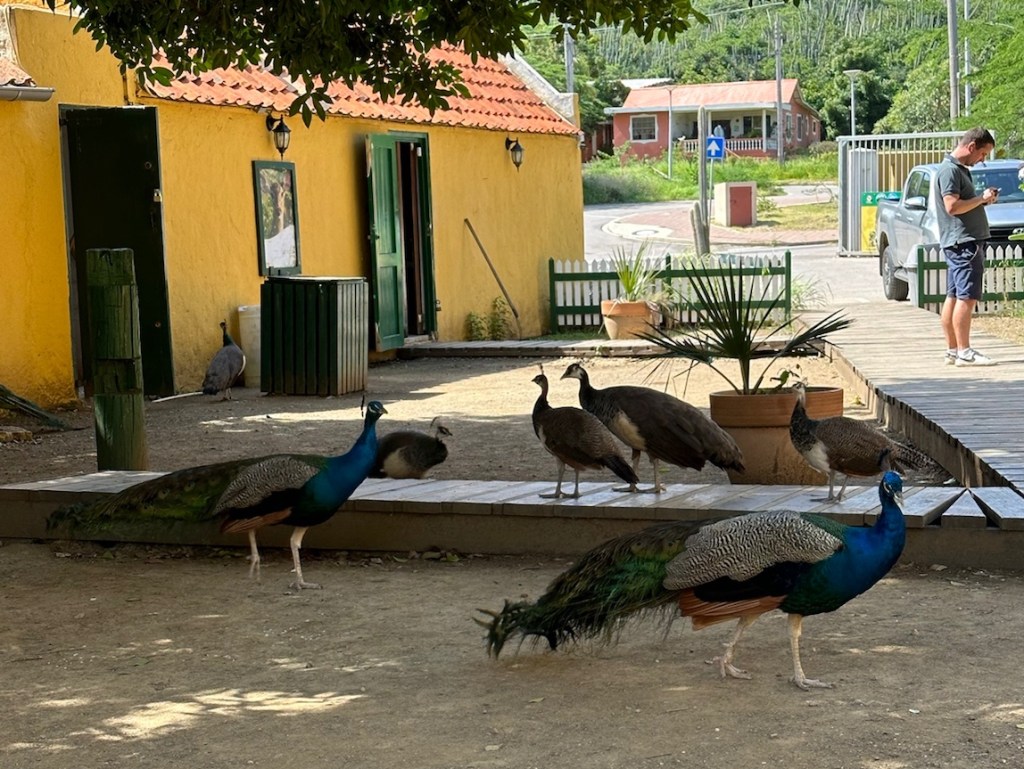
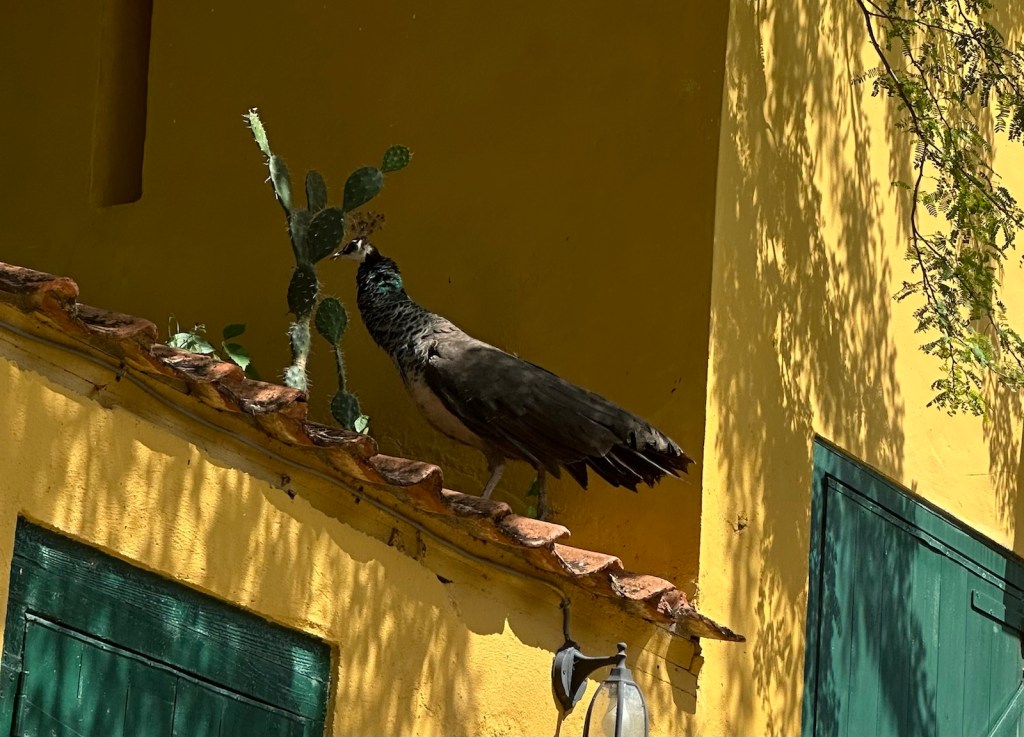
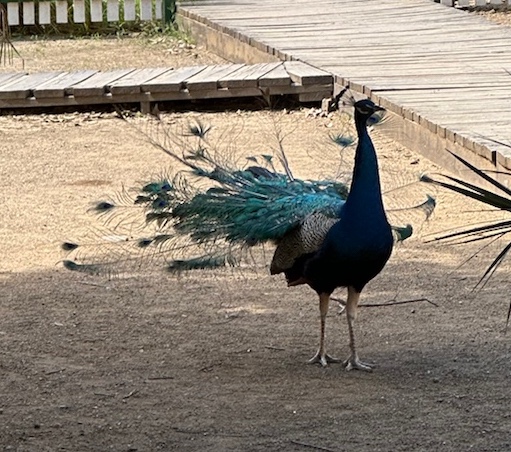
After touring Savonet Landhuis, I sat at a picnic table in the shade and started blogging. I was startled by loud birds and looked up to find that I was surrounded by about 20 peacocks.
Peacocks have a very loud high-pitched meow-like call. Males also make a rustling sound almost like a drumroll which is called a “train rattle.”
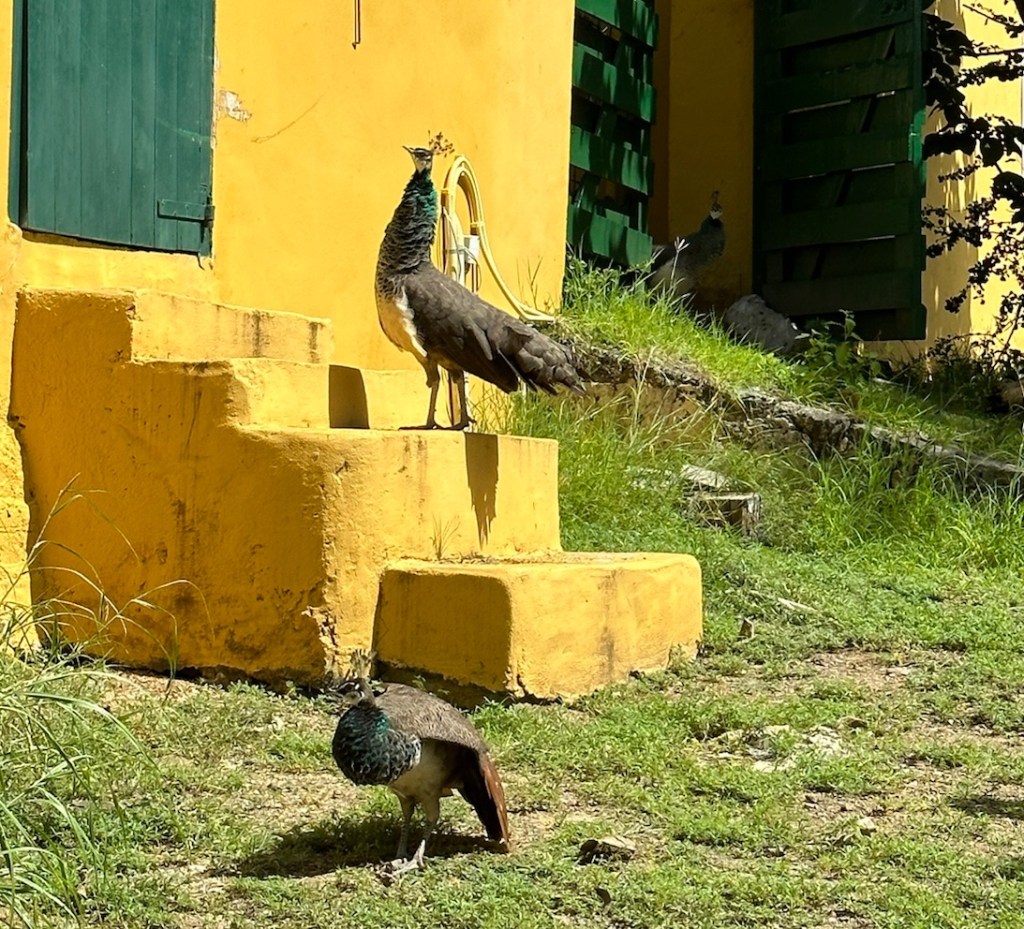
The Peahens are not nearly as pretty as their Peacock partners.
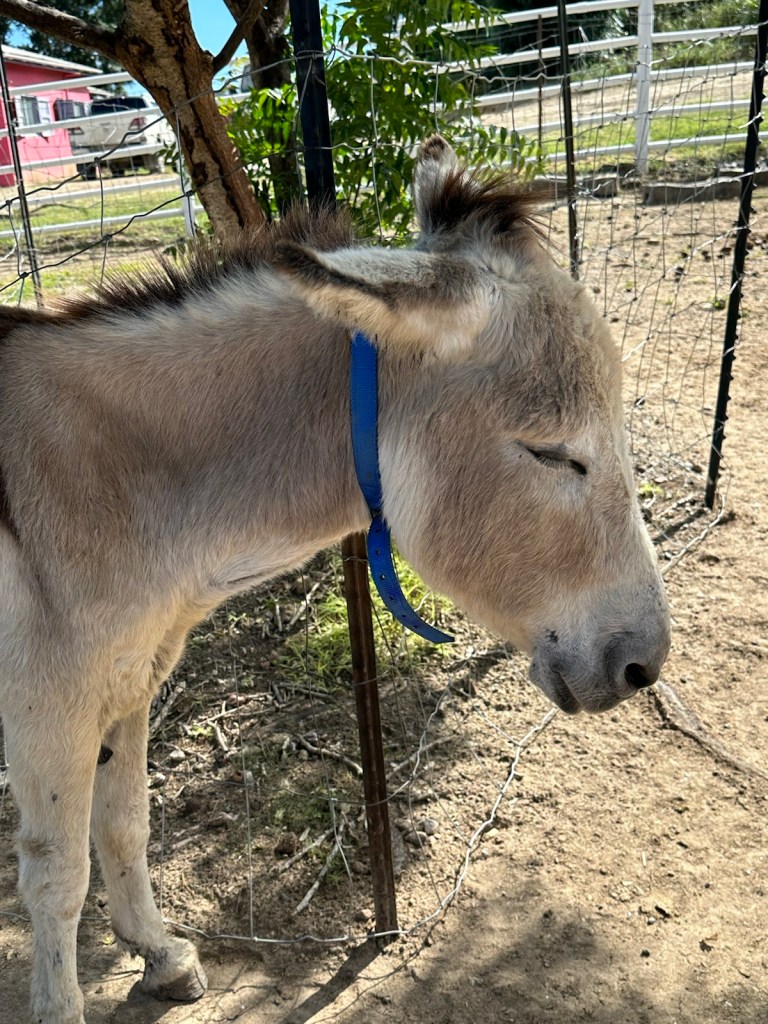
The females, called Peahens, are also loud. As I found out, they will make a high-pitched scream to alert other birds of predators like me. They will honk in response to a peacock’s display of feathers — I heard that too.A peacock gathering in the park. The peahen on the top step flew to the building’s roof …… she nibbled on a roof cactus and then started honking very loud. This guy is a little scruffy looking. I guess he deserves a honk too.The park also has a few donkeys.
David returned hours later. We didn’t realize it, but there was a small parking lot by the trail head. This would have shortened his hike by an hour or so.
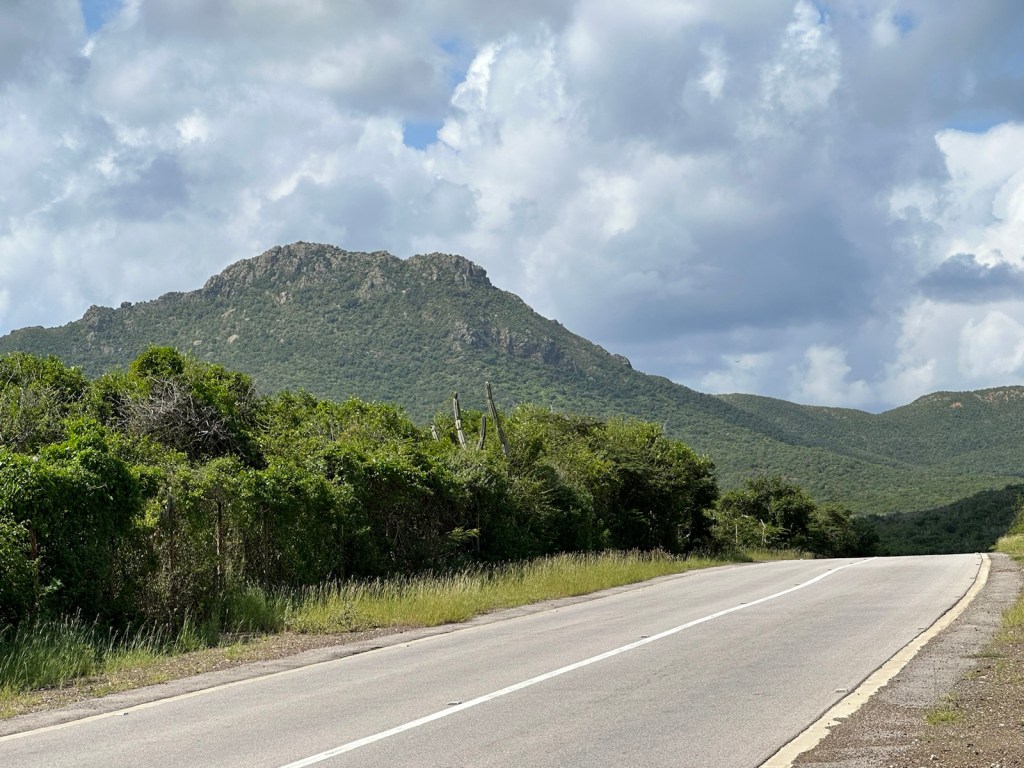
Mt. Christoffel from outside the park.
David took a few photos from the mountain. He said it was a little rough at the very top but a beautiful view.
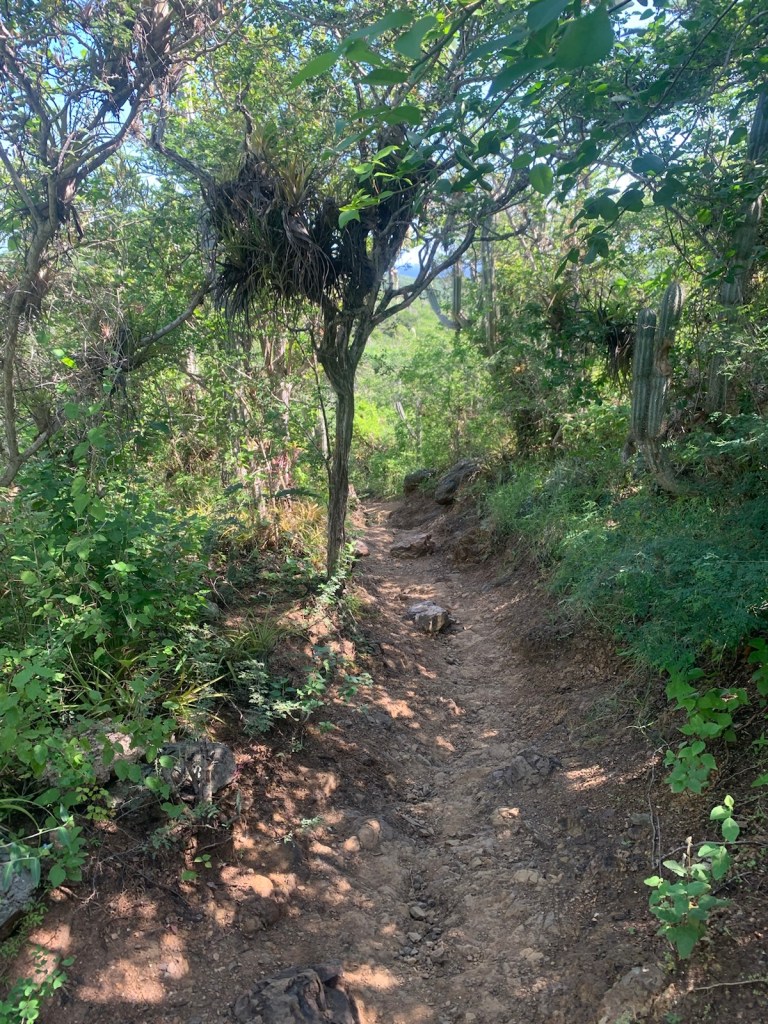
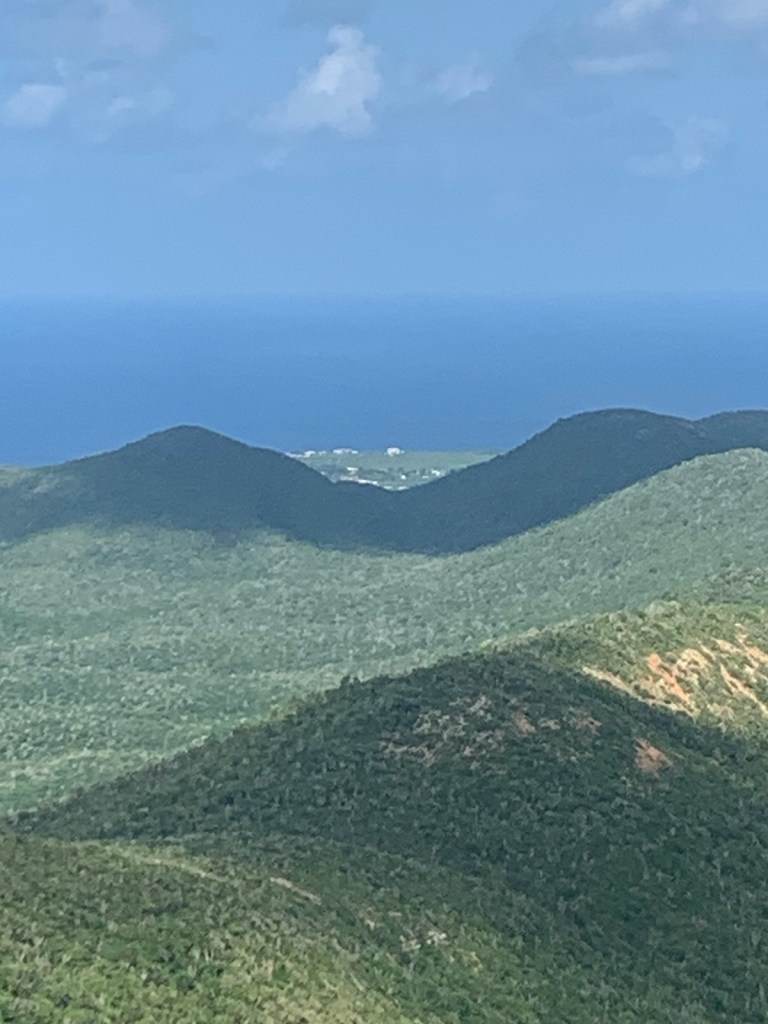
A mountain trail? Nope … David said it is a dried-up river bed which is used as the route to get to the trail head.A beautiful view of the land and sea from Mt. Christoffel.
When David returned from the hike, it was hot, humid and time to eat. We headed to one of Curacao’s long standing establishments — Jaanchie’s restaurant.
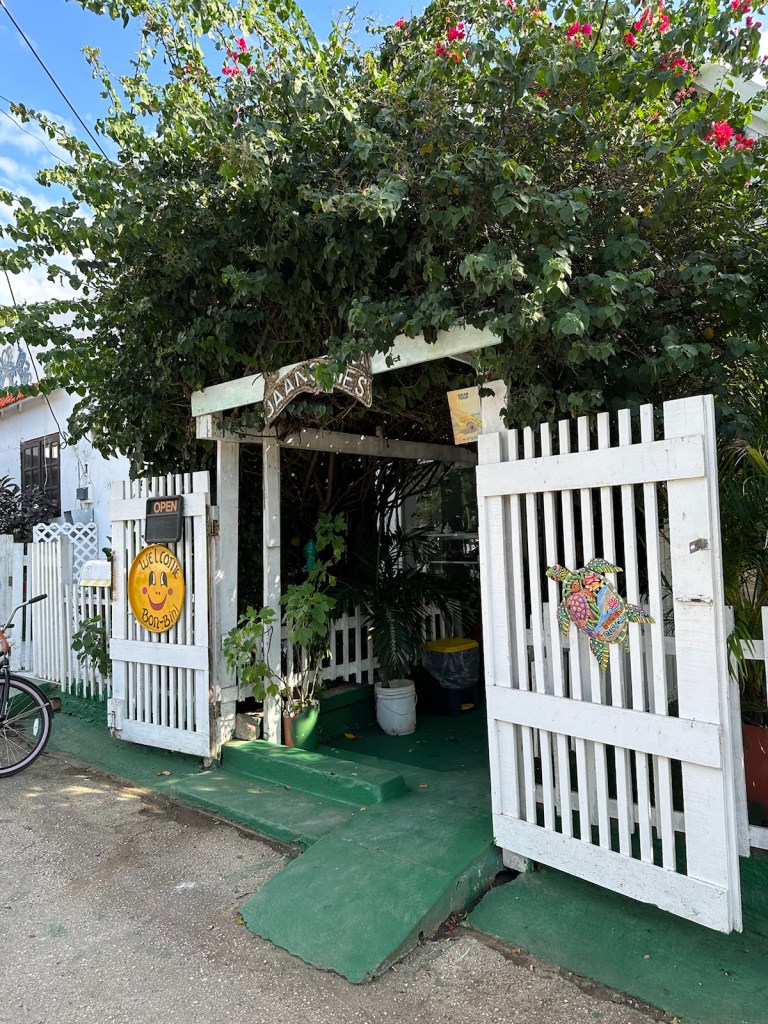
I ❤️ Jaanchie’s! This is the oldest restaurant in Curacao. Pass through the white gates and enter a different world. For starters, the place is a bird sanctuary and surrounded with gardens.
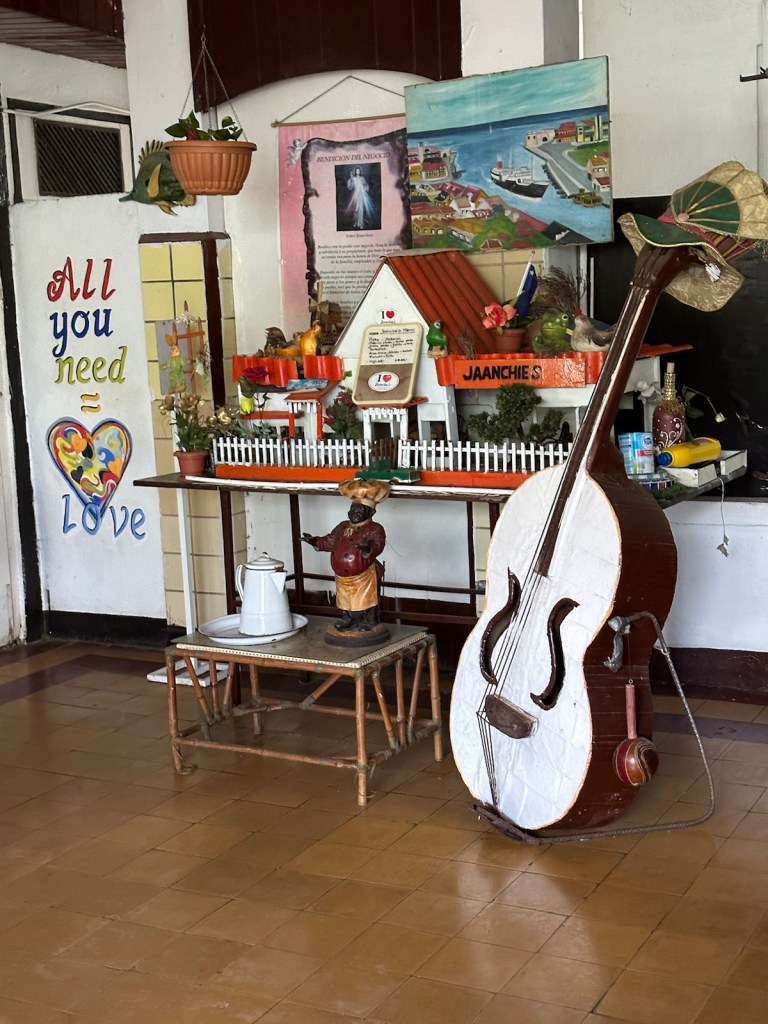
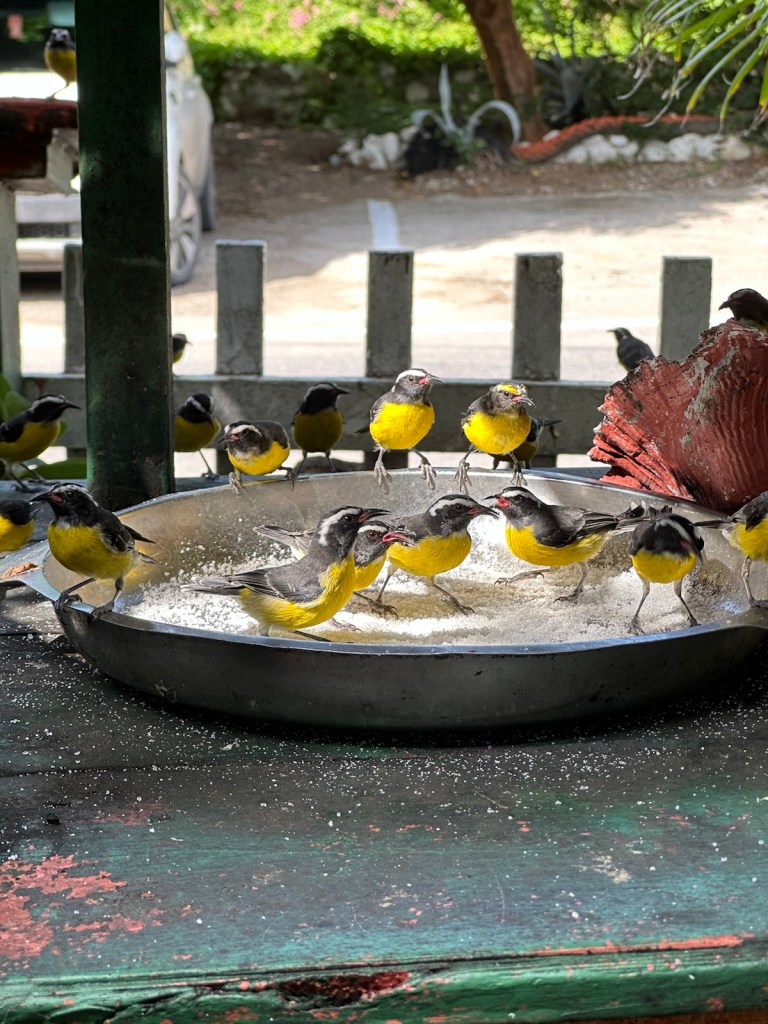
The entrance to Jaanchie’s has gates and lush greenery that lead to an old farmhouse. Interesting decor in the restaurant entrance. Dozens of Bananaquits chirping in a trough of sugar.
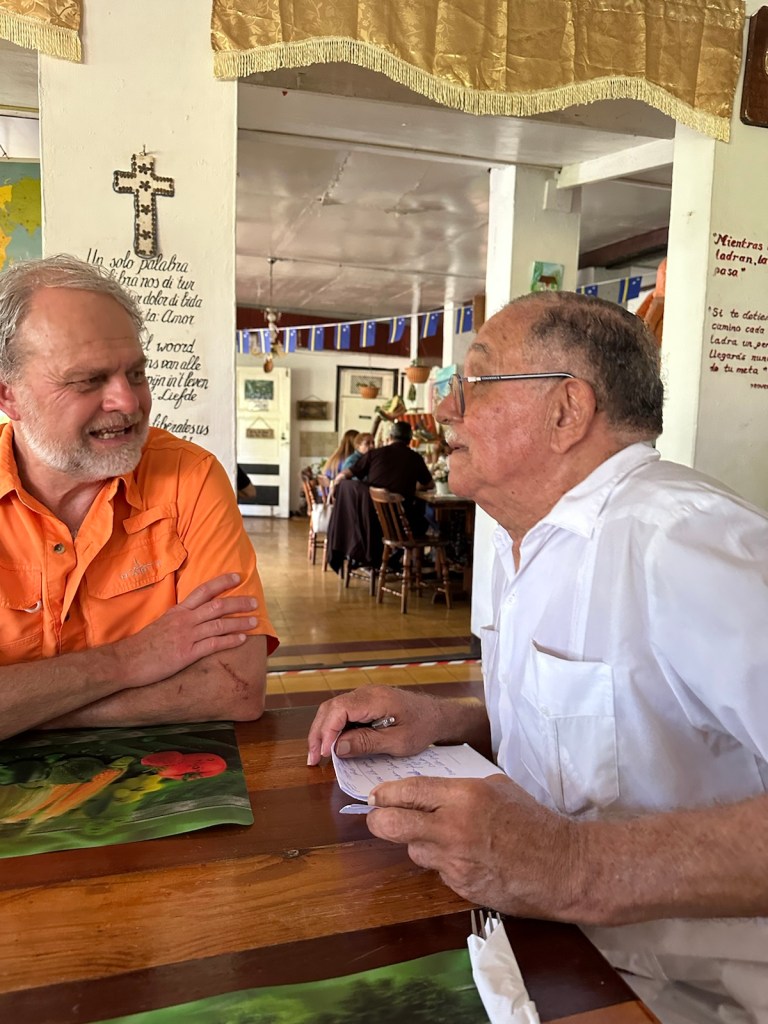
Mr. Jaanchie is the menu. He sits down at your table and tells you what’s cooking. He asks what you would like and says he can mix it up so you can try a few specialties of the island.
He also mentions that Iguana is on the menu and that it tastes like chicken but has a lot of bones. Neither David or I could bring ourselves to trying the Iguana.
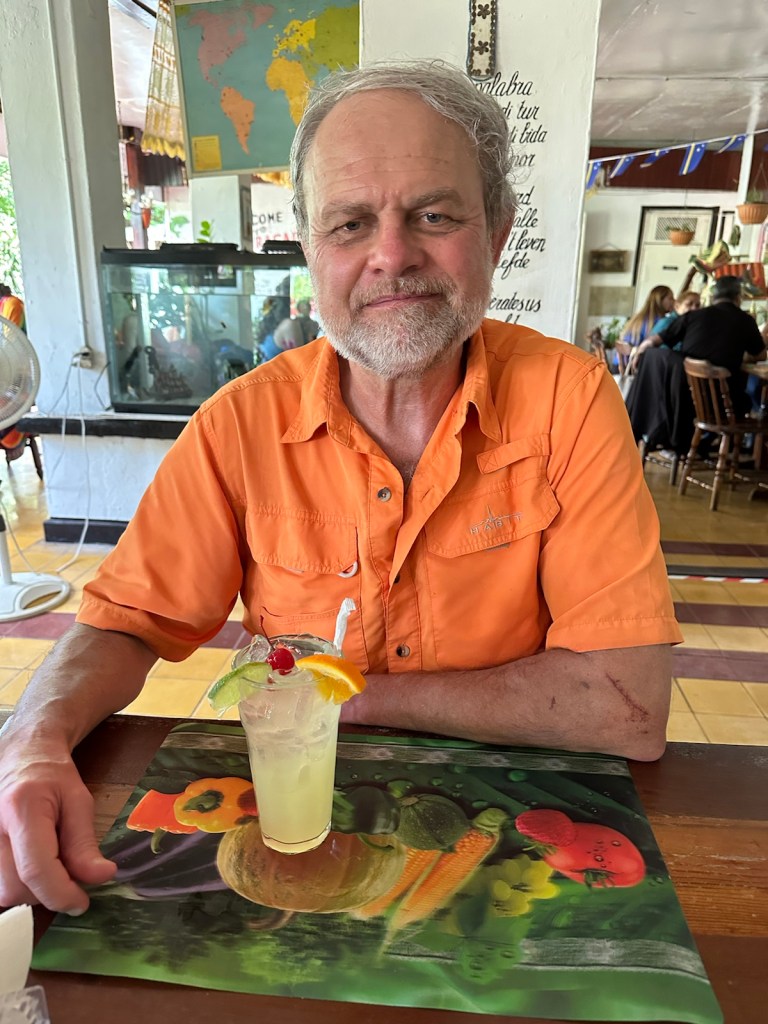
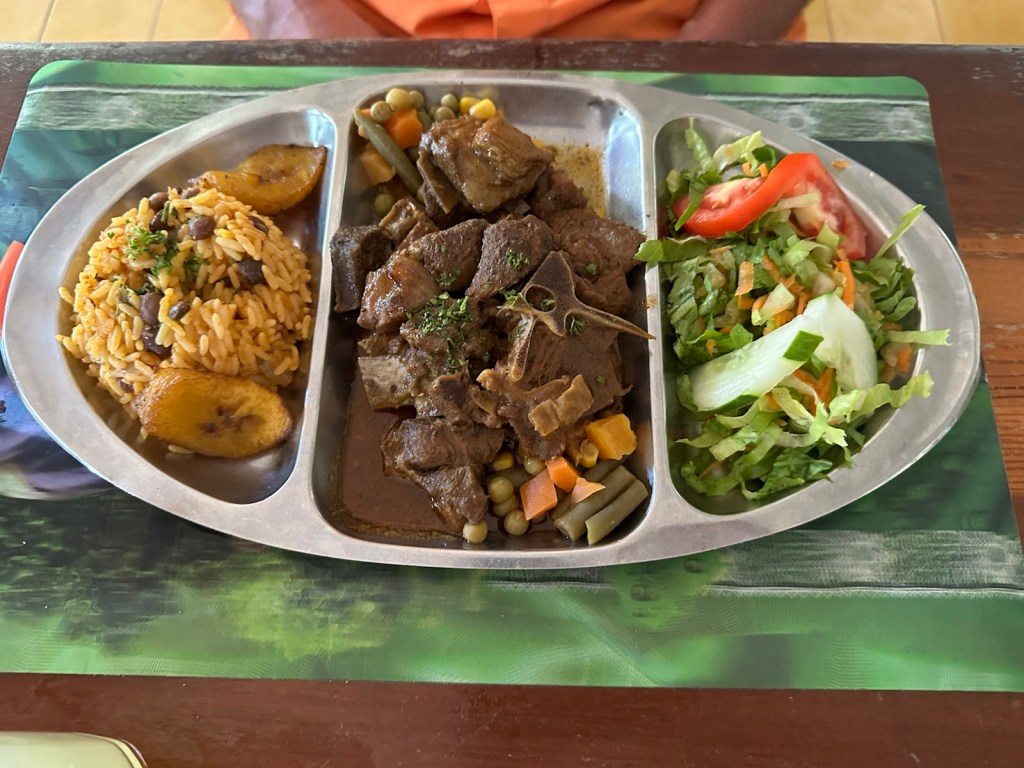
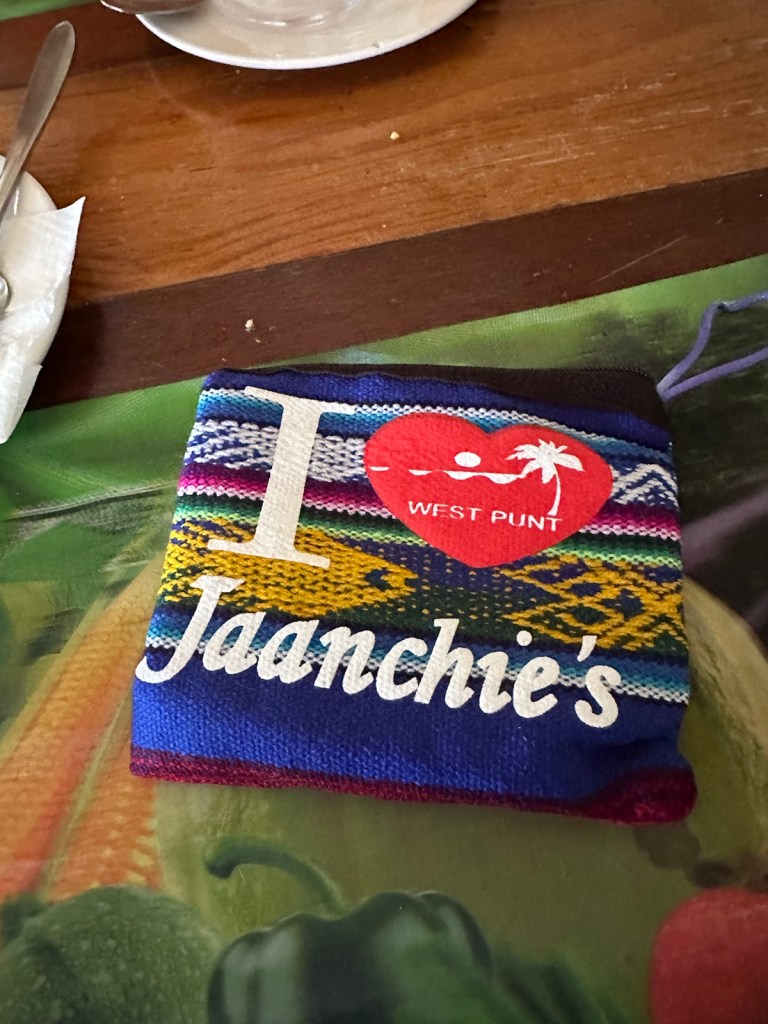
Mr. Jaanchie tells us what’s cooking. No printed menus here. Looking refreshed after climbing a mountain, David sips on lemonade.Kabritu Stoba is a goat stew accompanied with rice, black beans & plantains and salad.And just to make sure you remember your visit to Jaanchie’s, they give you a little coin-purse souvenir when leaving.
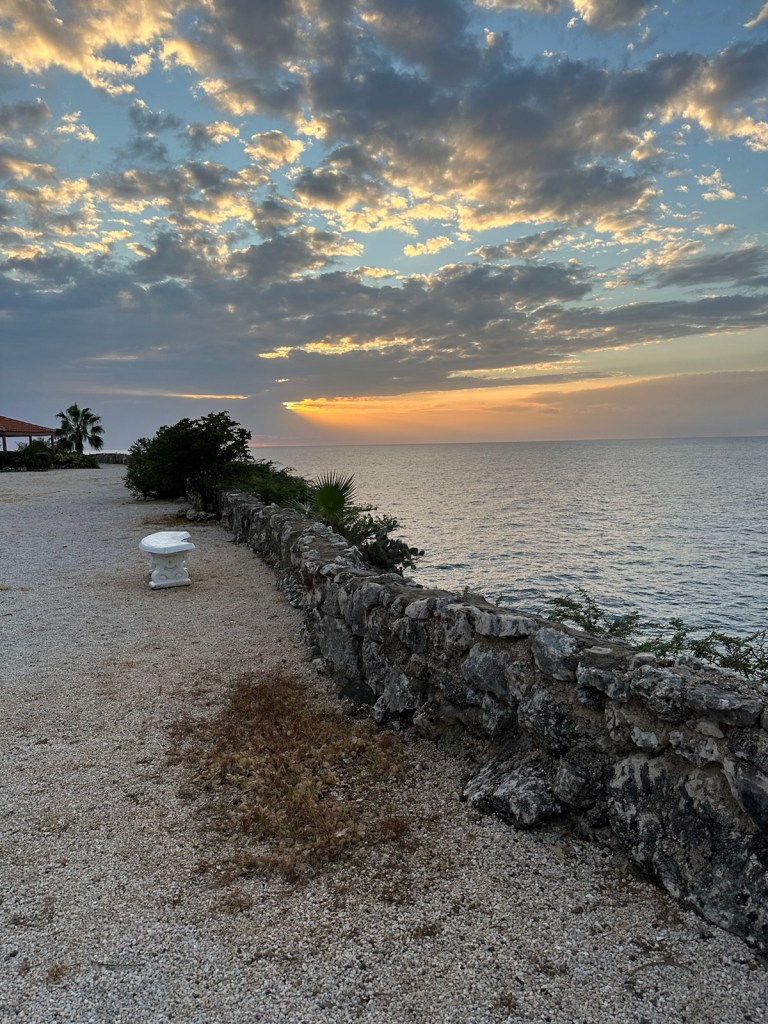
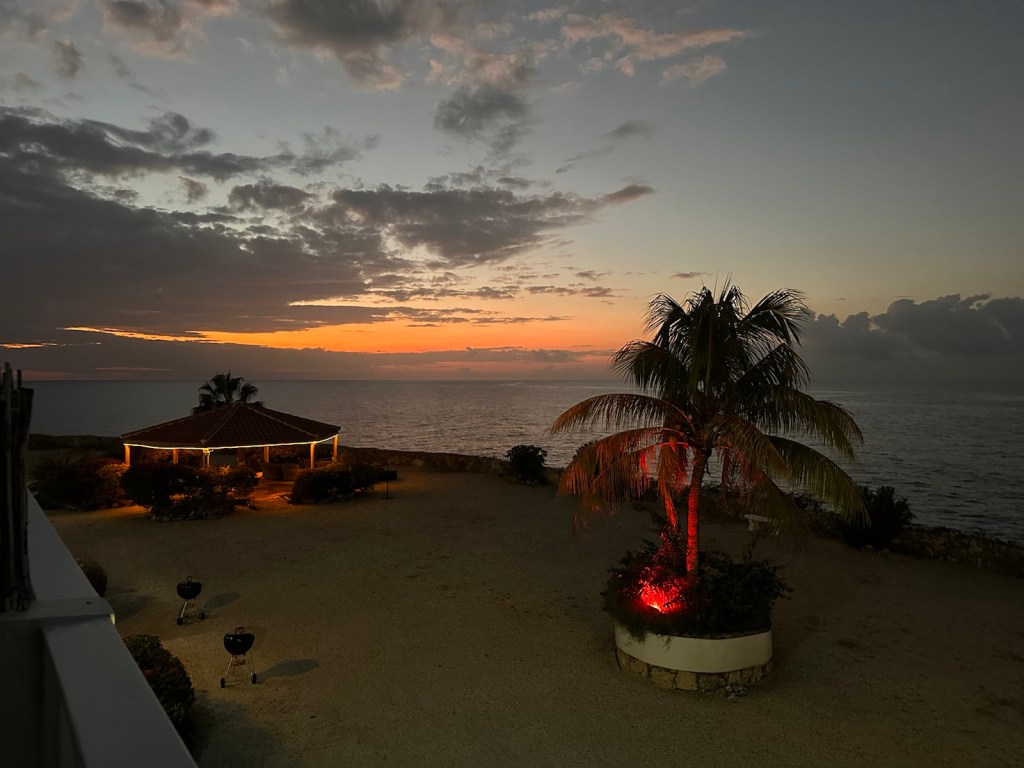
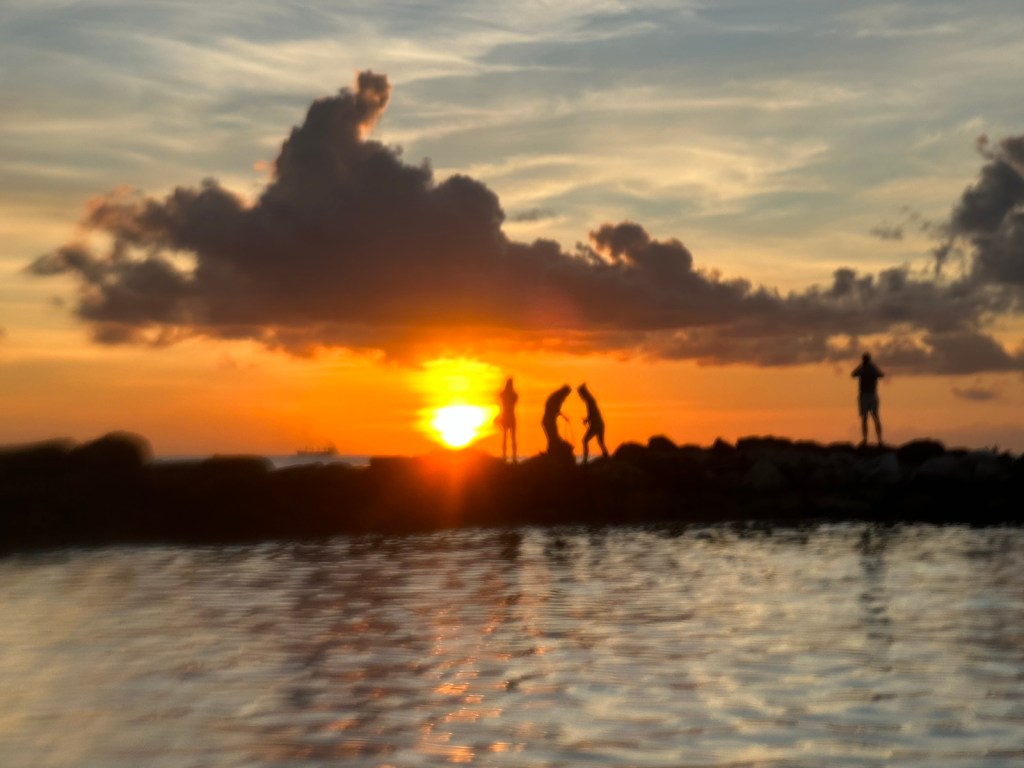
Back at our accommodations we enjoyed warm breezes while sipping rum drinks and watching one last sunset. Time to pack up the shorts, flip-flops and sunscreen.
Tomorrow we head back to Minnesota … land of 10,000 frozen lakes, a couple feet of snow, crisp cold air and countless snow emergencies declared for clearing snow from the streets.
The contrasting winter weather is a welcome change but stay tuned! Our long-time friend Peggy and I are planning an escape to the Eastern Caribbean islands of Antigua & Barbuda at the end of January. Until then, happy trails!
Today we’re moving to the west end of the island. We’ve had a great time in Willemstad but are eager to explore the quieter side of the island.
Westpunt is the western most point and mostly known for being surrounded by beautiful nature, scuba diving and shores.
The whole island from east to west is about 40 miles so it’s not a very long journey even though the roads are slow and winding. We made several stops at nature reserves, beaches and other sites of interest.
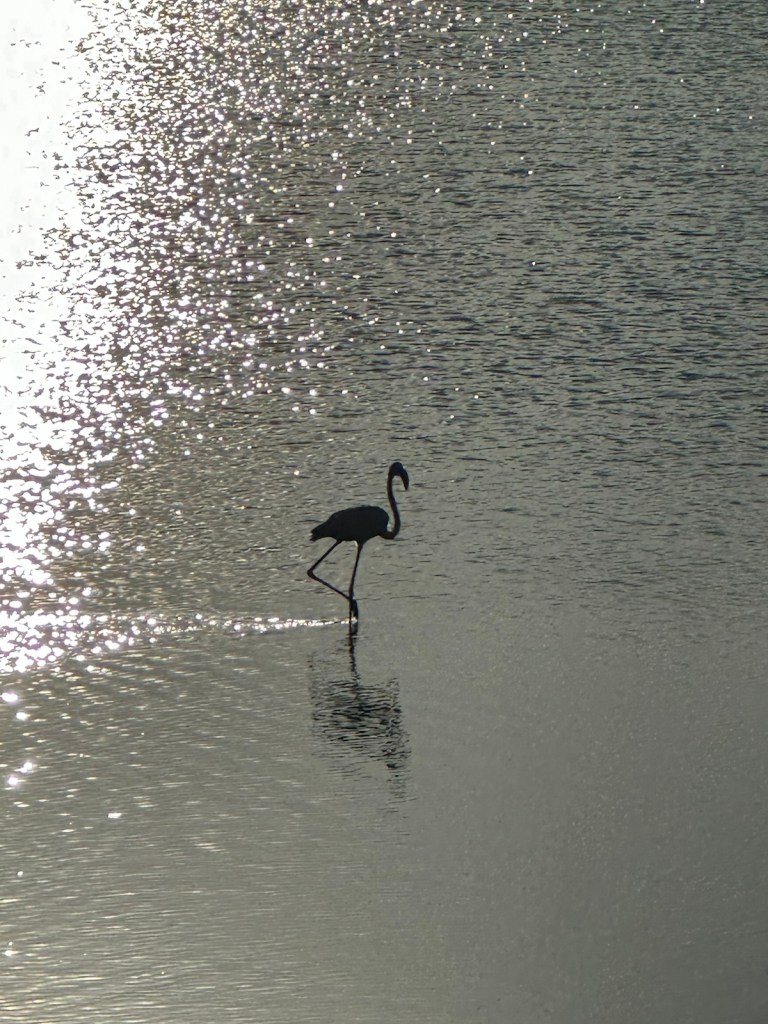
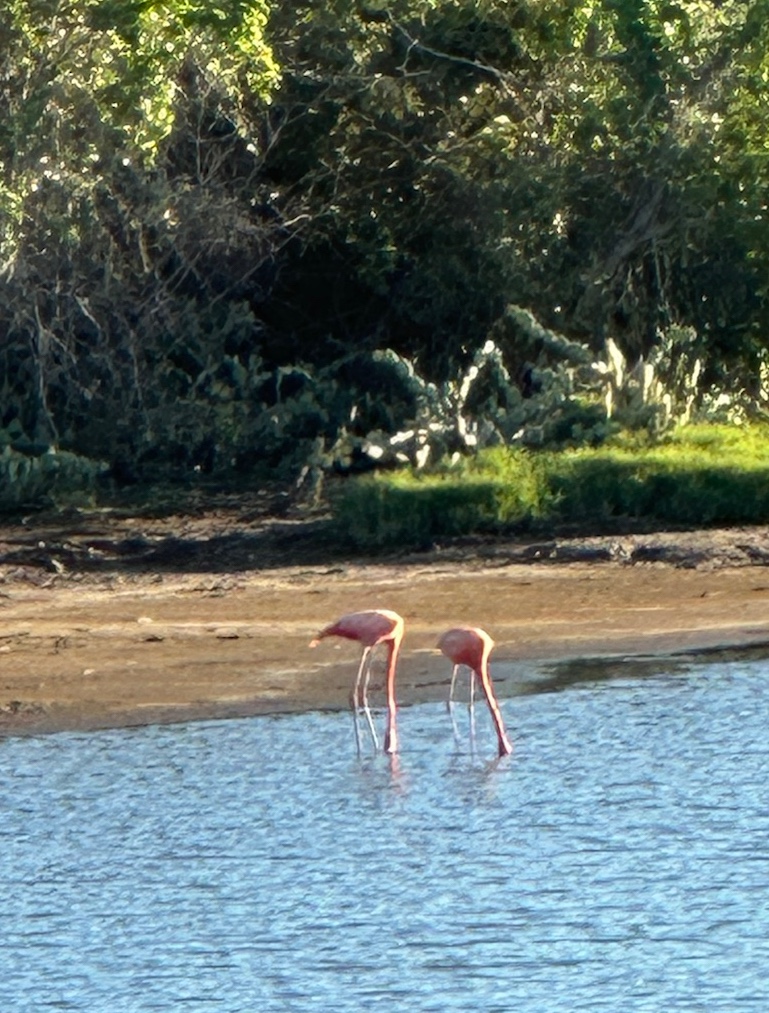
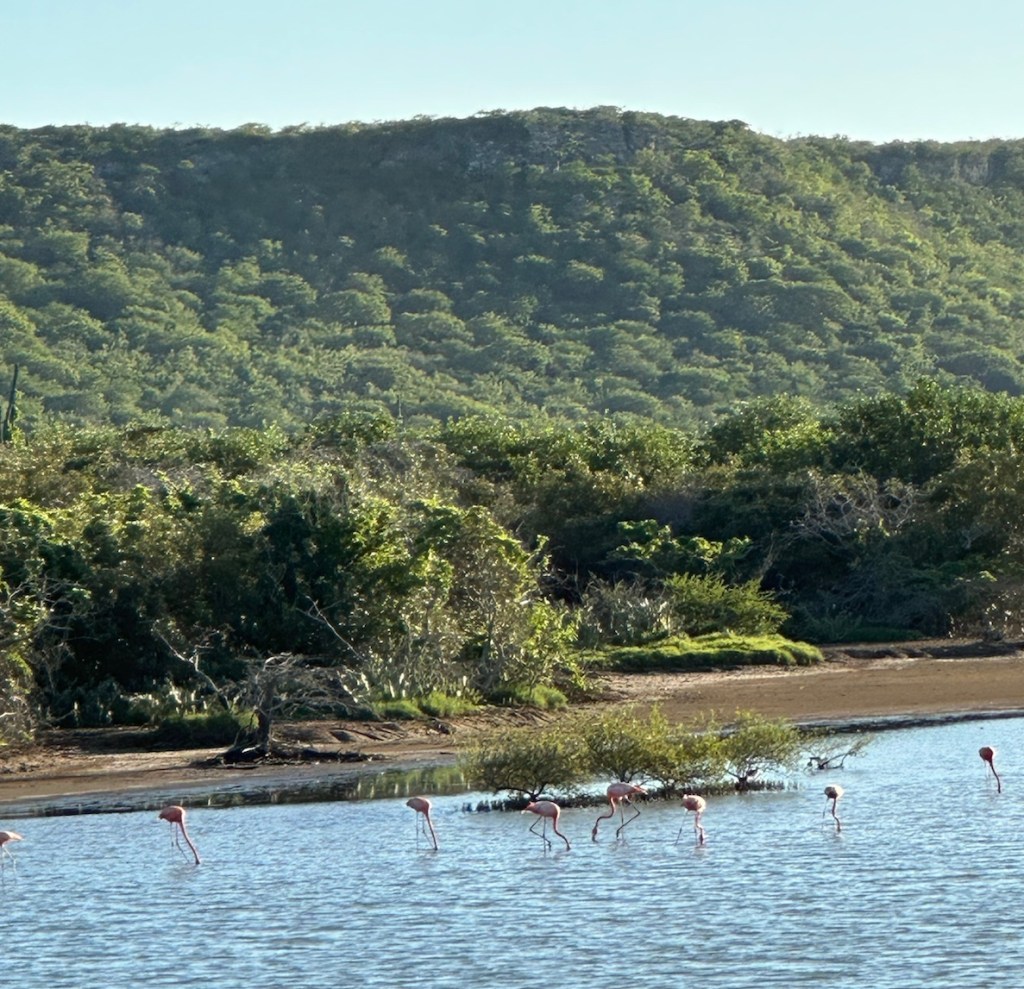
The salt flats (Salinas) near Jan Kok is where we found a Sanctuary where flamingos can be seen in their natural habitat.
The Salinas is surrounded by mud flats, shrub land and forests and is a foraging habitat for flamingos and several water birds.
The salt flats were used for salt extraction until the 1960s and salt pans are still present. The area is currently used for recreational purposes of hiking and biking as well as guided eco-tours.
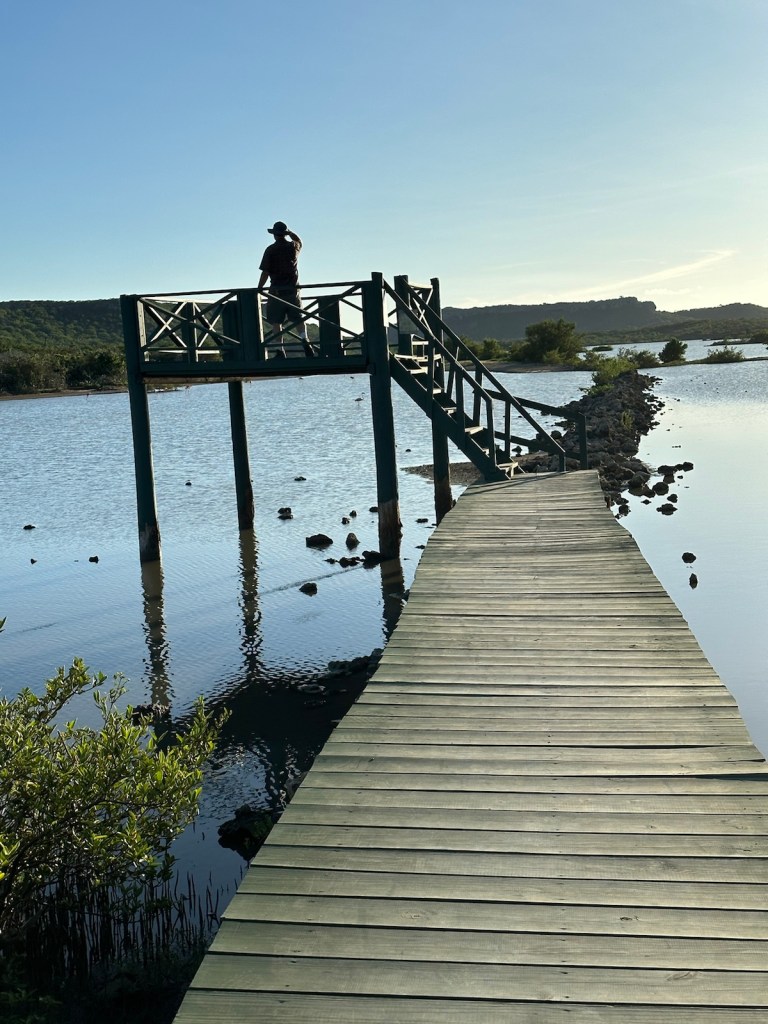
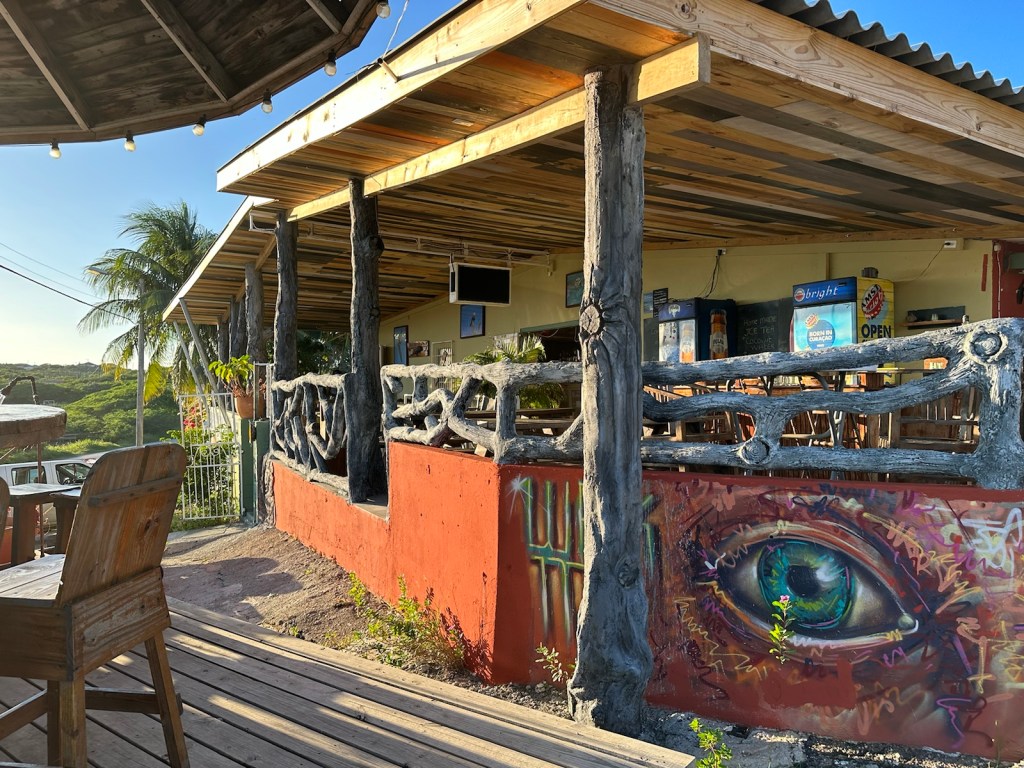
A viewing platform offers a great view of the salt flats and wandering flamingos. Flamingos can also be observed from a small restaurant across from the Salt Flats.
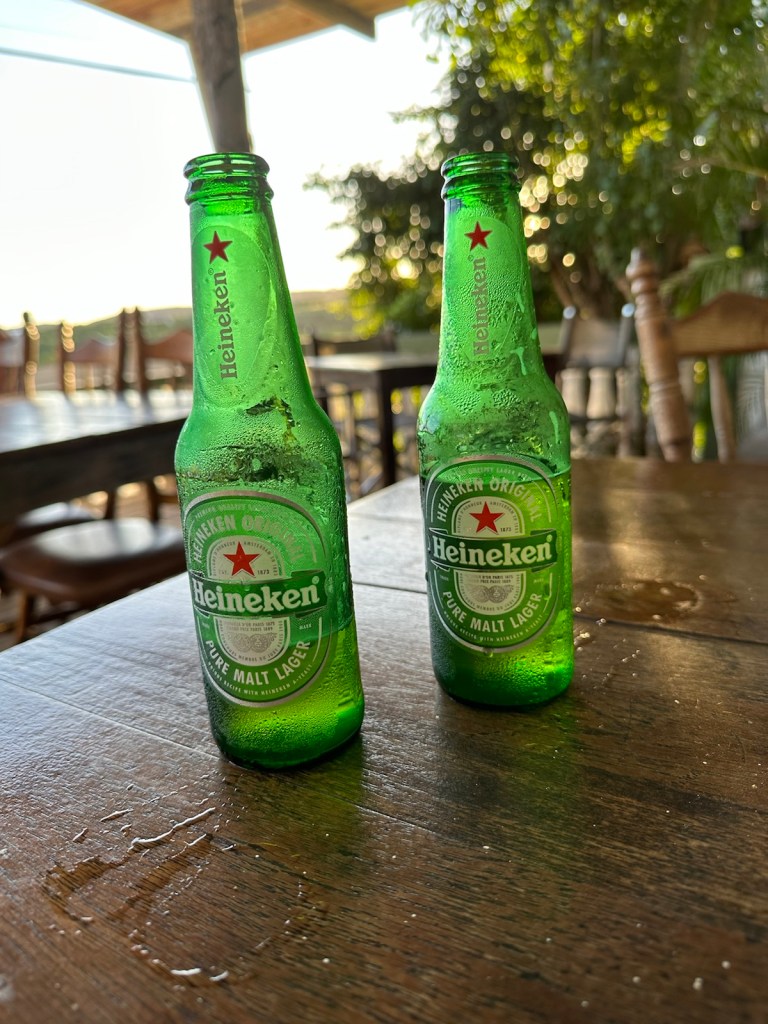
We found no tap beer, let alone Craft beer, in all of Curacao. Most places only carry Dutch brands of bottled beer such as Heineken and Amstel Bright a European Pale Lager style beer. We did find a Venezuelan beer at an isolated small grocery store. Most beer comes in small ‘pony’ size bottles. I’m guessing that the smaller size is used because normal size bottles become warm fast in this climate.
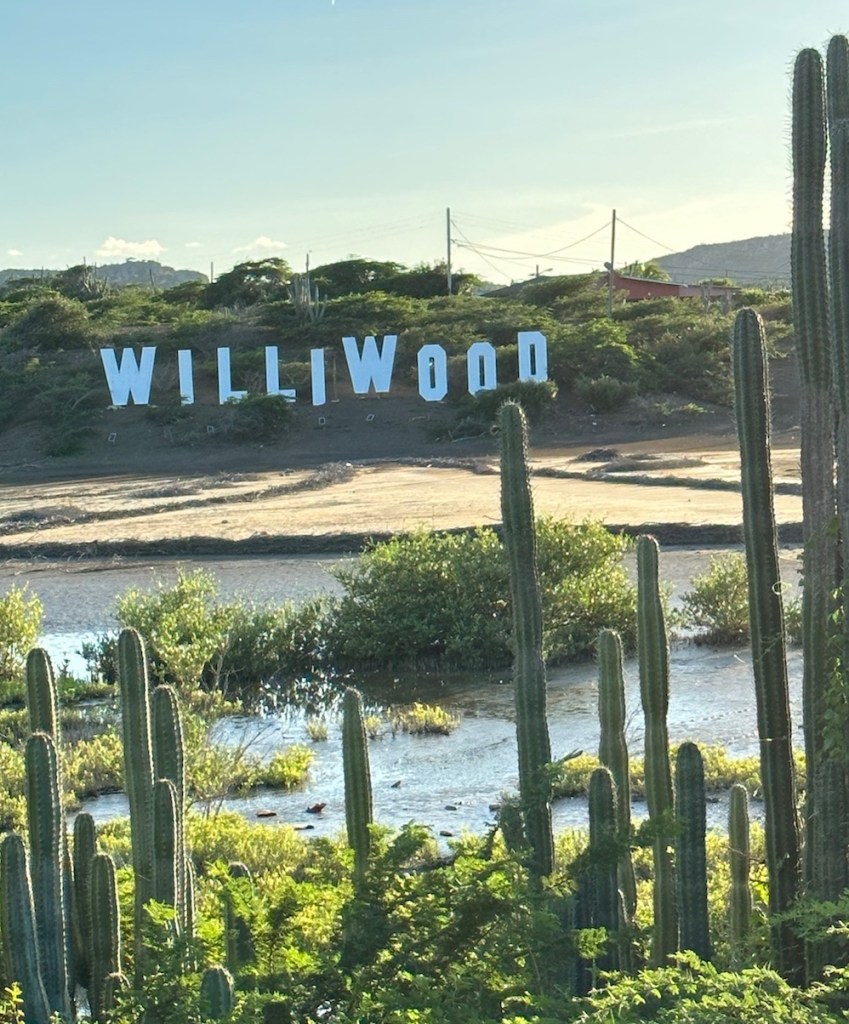
The Williwood sign (a parody of the one found in Hollywood) can be found in St. Willibrordus. The locals of the tiny tropical village were tired of being anonymous so they made the sign which changed the name.
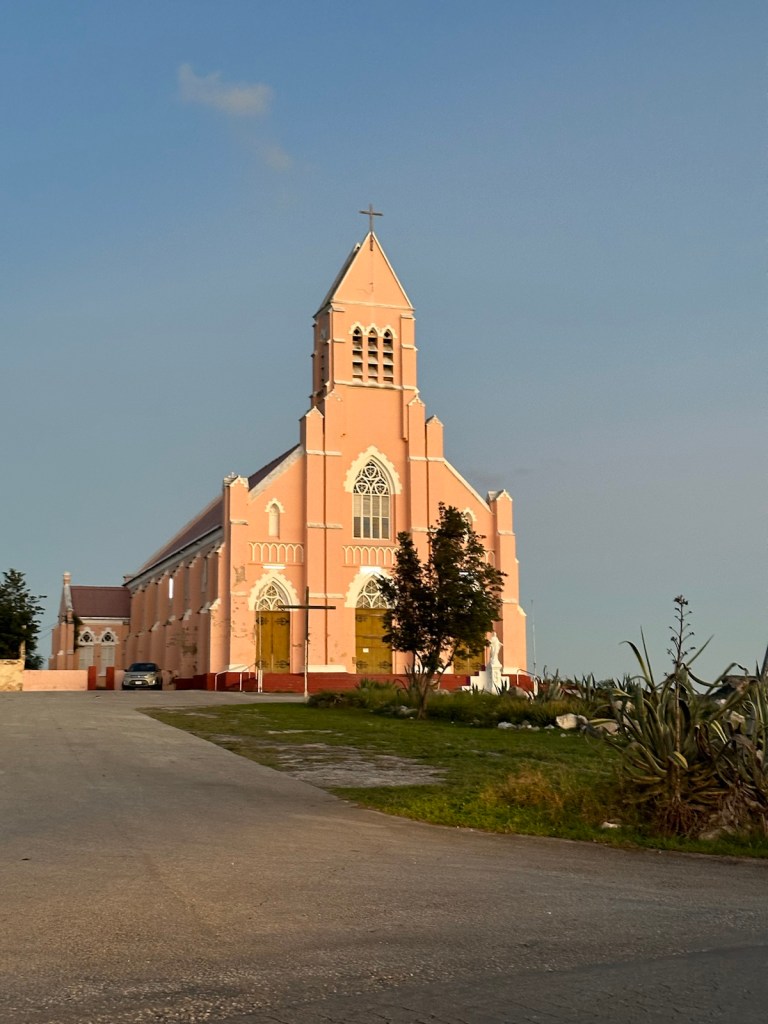
Previously, the town was known for its grand church that dates back to the 1800s but the Williwood sign has taken the spotlight as the ‘can’t miss’ attraction. In 2011, St. Willibrordus officially changed its name to Williwood.
The roadside is bordered with scrubby green bushes with lots of thorns and spikes as well as lots of cactus — it’s lush with greenery but arid with desert and cactus. We were surprised to find mosquitos here … just glad we didn’t encounter sand fleas.
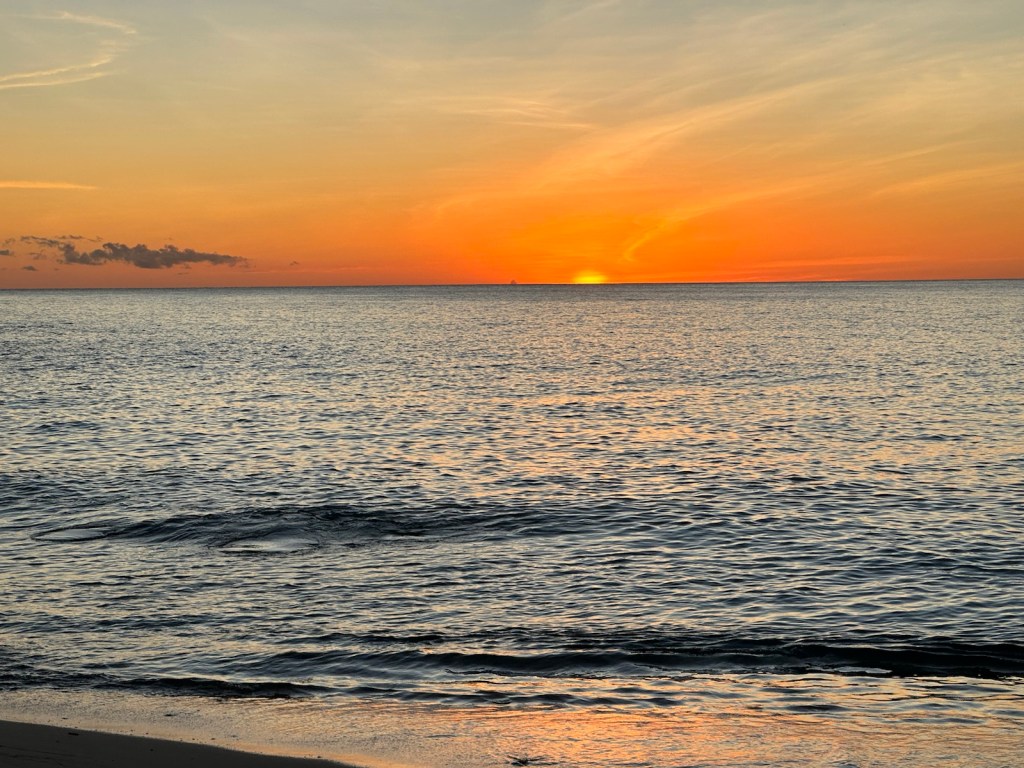
Sunset is coming and we need to find a beach. Bumpy twisty dirt roads took us to Playa Portamari and Daaibooi Baai. A handful of snorkelers and swimmers were waiting for the sunset.
Nice sandy bay with gentle waves good for snorkeling and a starting point for scuba.The colors keep changing for about a half hour after the sun sets.
We drove the rest of the way to Westpunt in the dark and on a paved road but very winding and surrounded with shrub, scrub, cactus and an occasional street light.
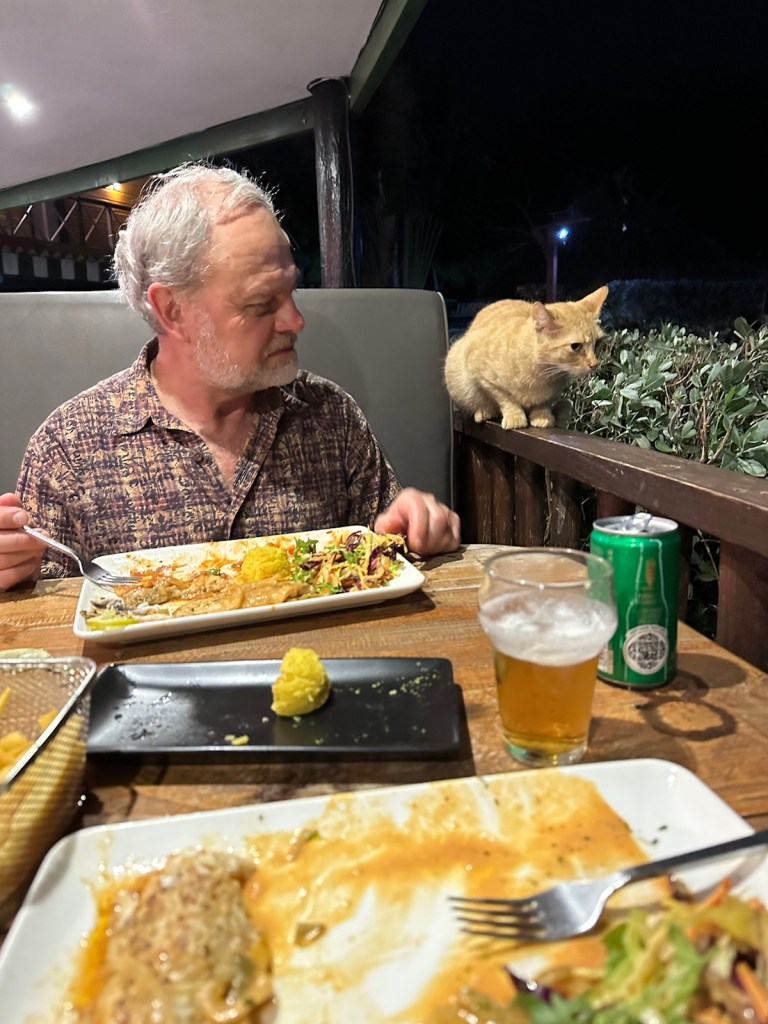
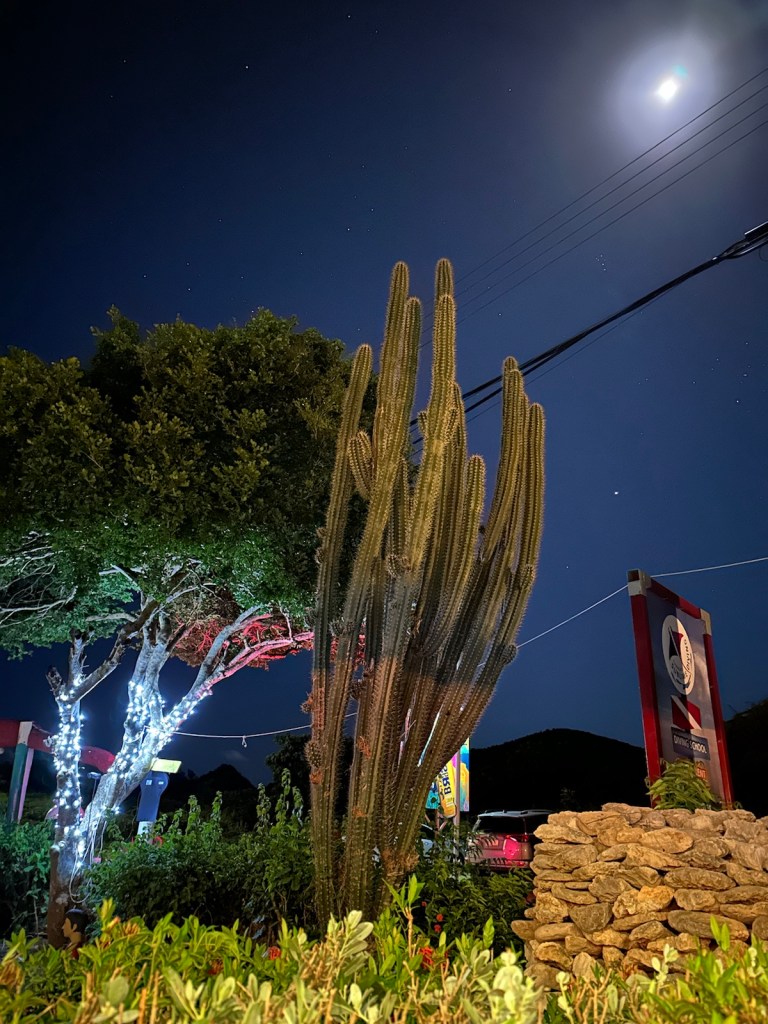
We had a late dinner (8:00 pm … considered late here on the west end.) The Cactus Cafe is next door to our accommodations. Very quiet and very decorated for Christmas. We had Barracuda and funghi (polenta) for dinner and tried their African ‘peanut with banana’ soup. It was delicious but not something I’d make at home. Reminded me of Elvis.
All of a sudden David had a purring dinner guest sitting next to him.
We have arrived at Westpunt and so has the full moon.
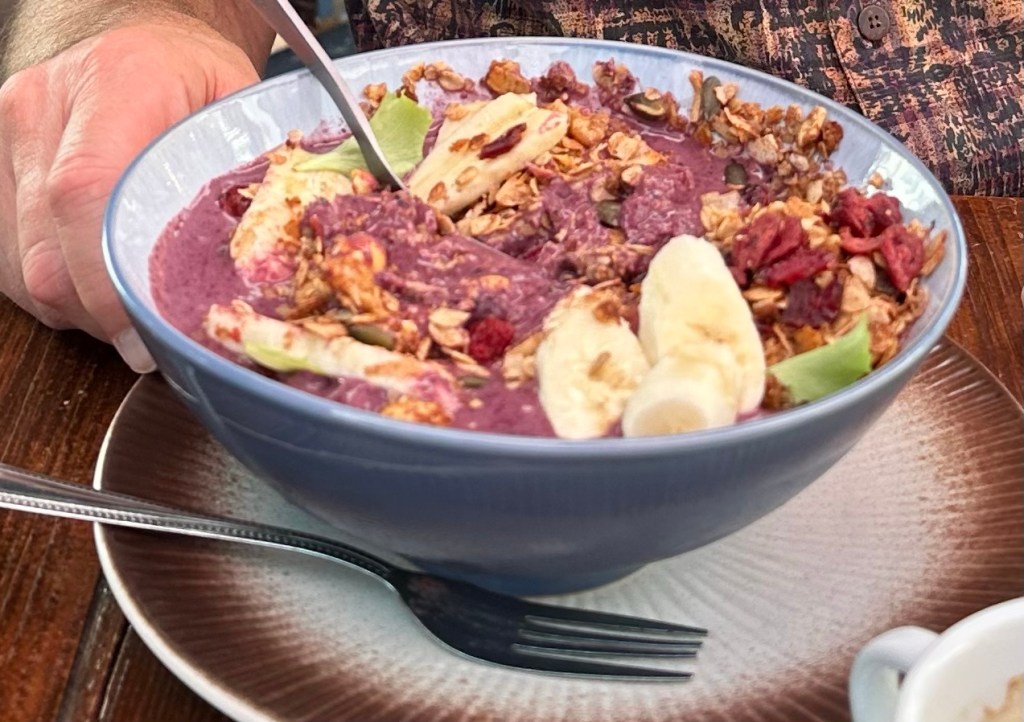
David started the day with something called the Açaí bowl. It was purple, cold and thick like ice cream. It contained fresh fruit, oatmeal milk, granola nuts and dried fruit. Very refreshing in this hot and humid weather.
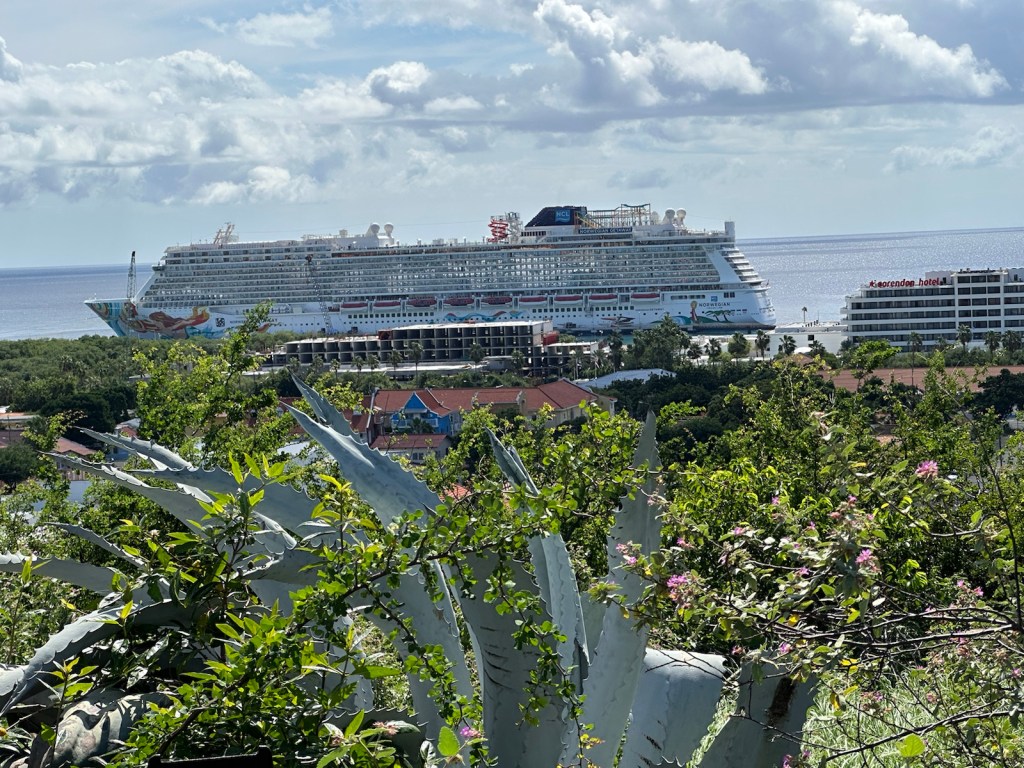
Breakfast of champions … the Açaí bowl.The cruise ships are parked just outside of St. Anna Bay. We passed by this scenic overlook as we headed to Hato caves.
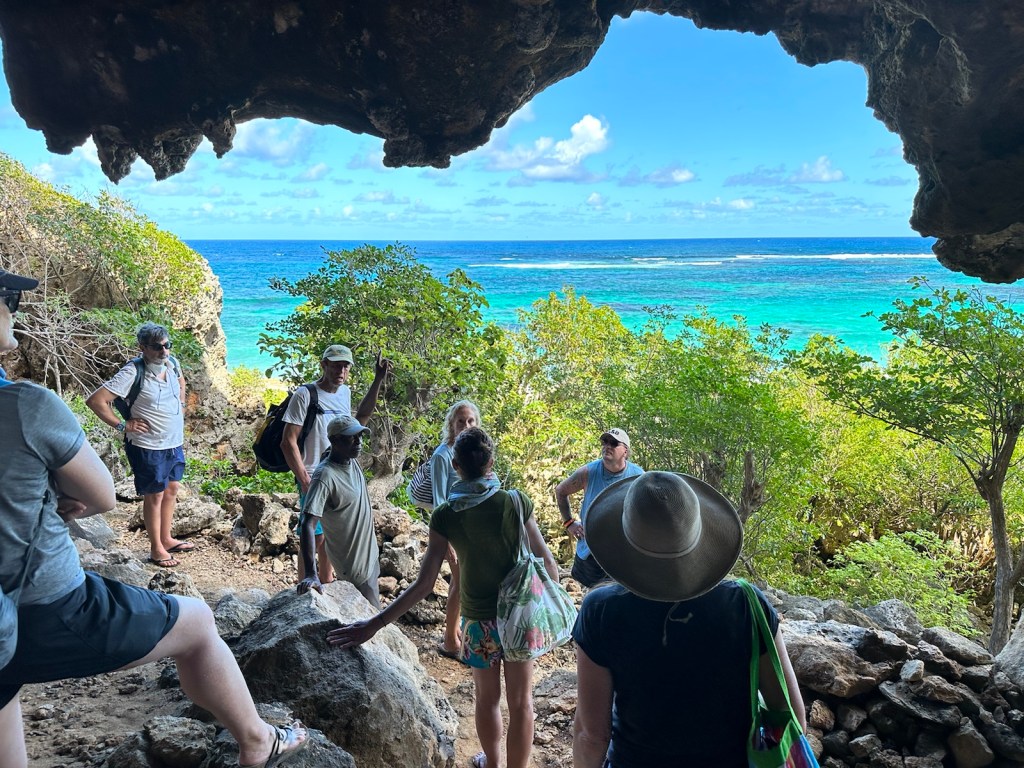
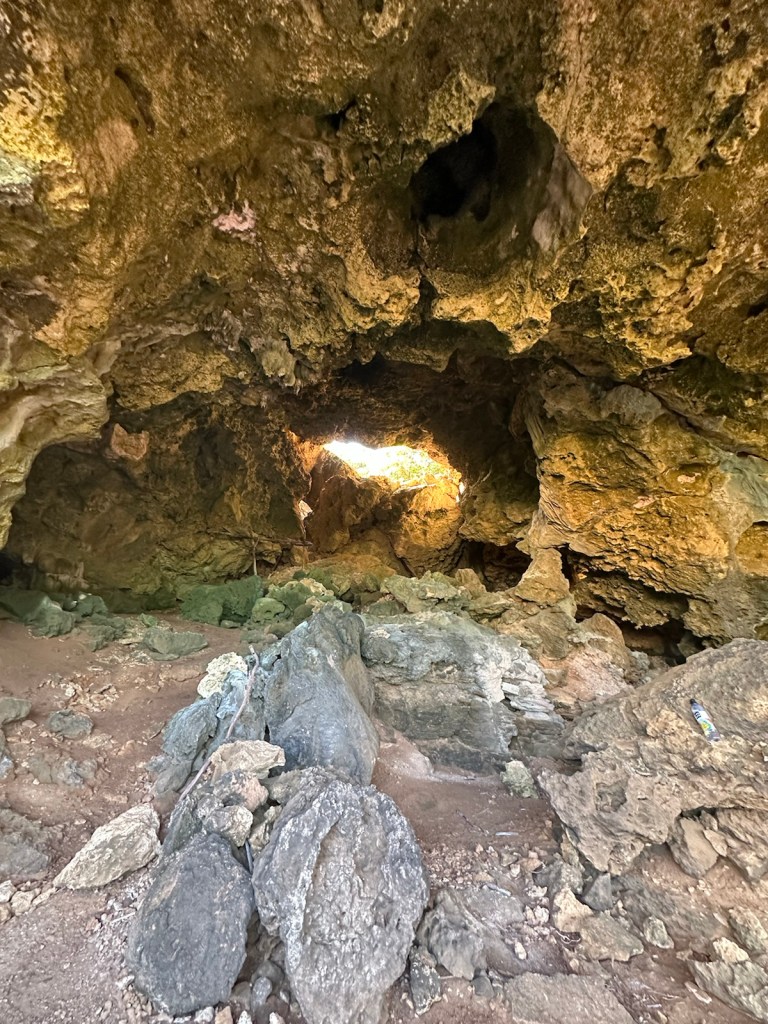
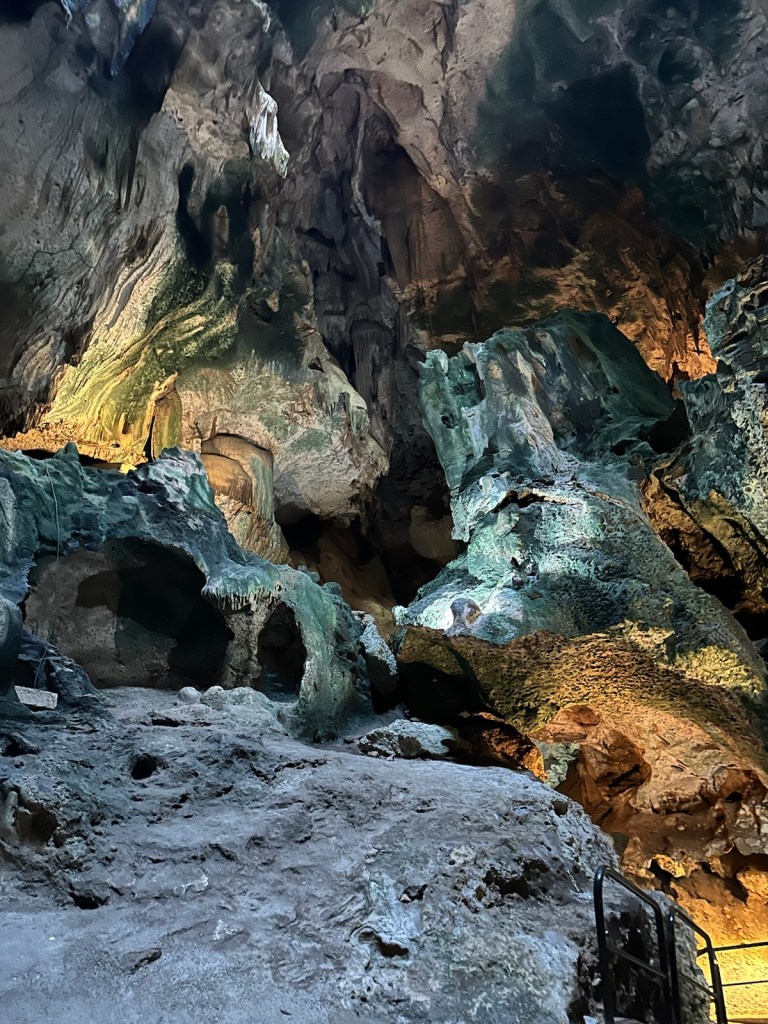
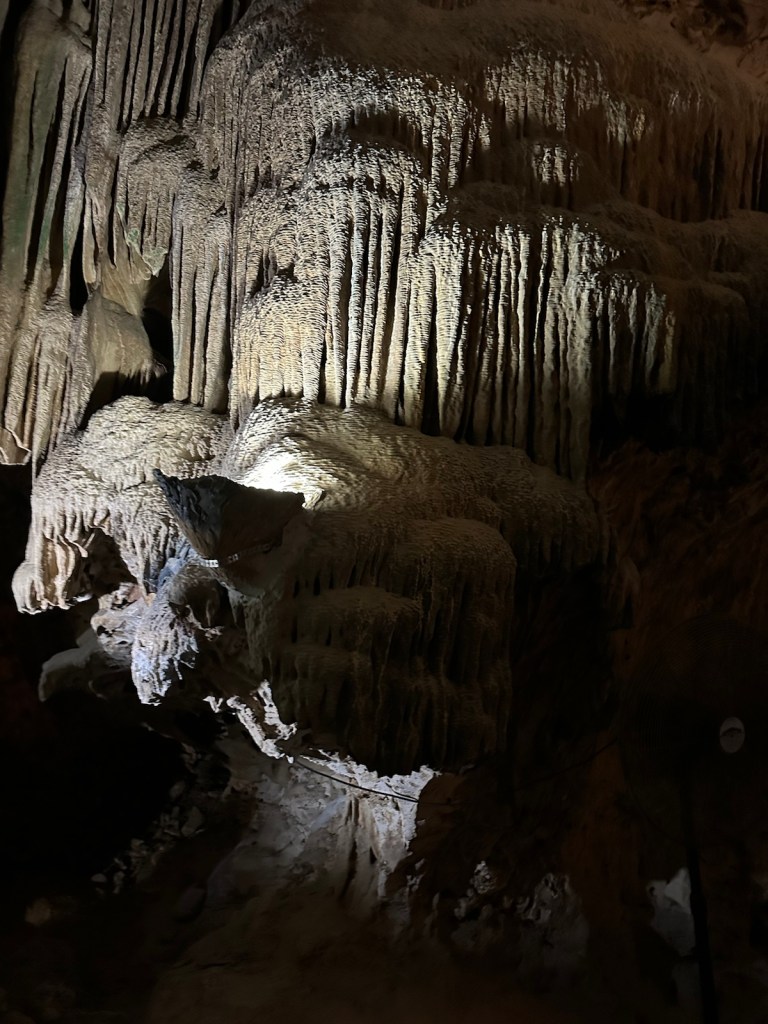
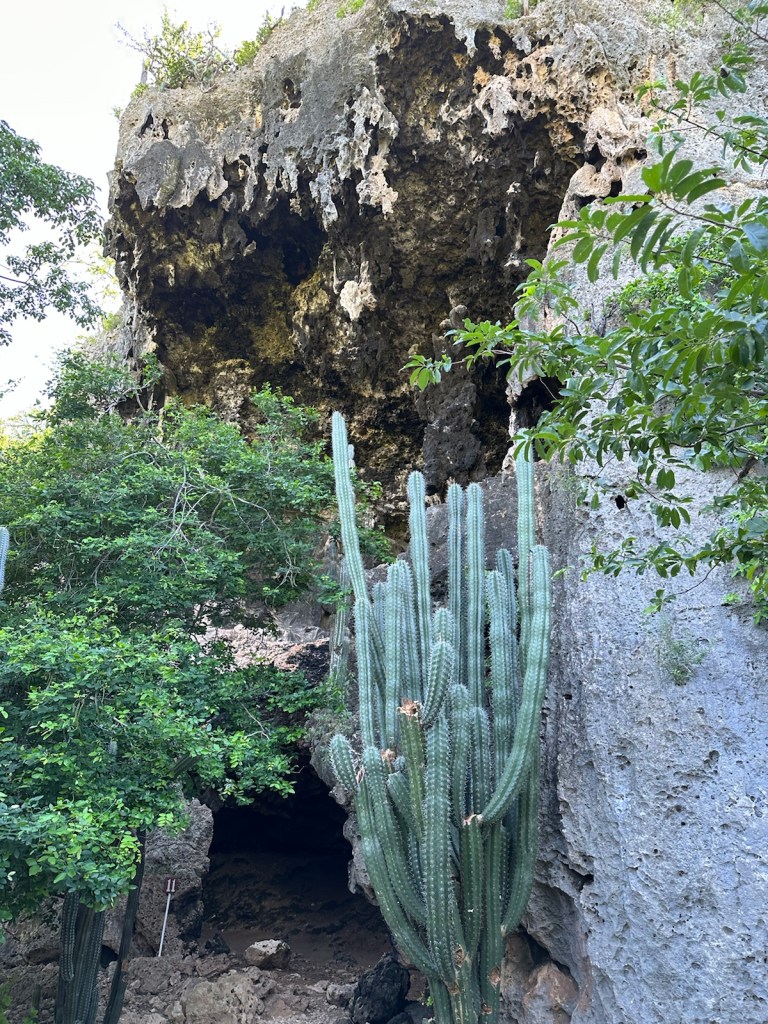
Running parallel to most of Curacao’s north coast, are cliffs that were formed 200 million years ago by the same forces that pushed the island up from the Caribbean Sea. These forces caused receding waters to percolate down through the porous limestone terrace, creating a region honeycombed with fissures and grottos. The caves are a dramatic example of this unusual geography.
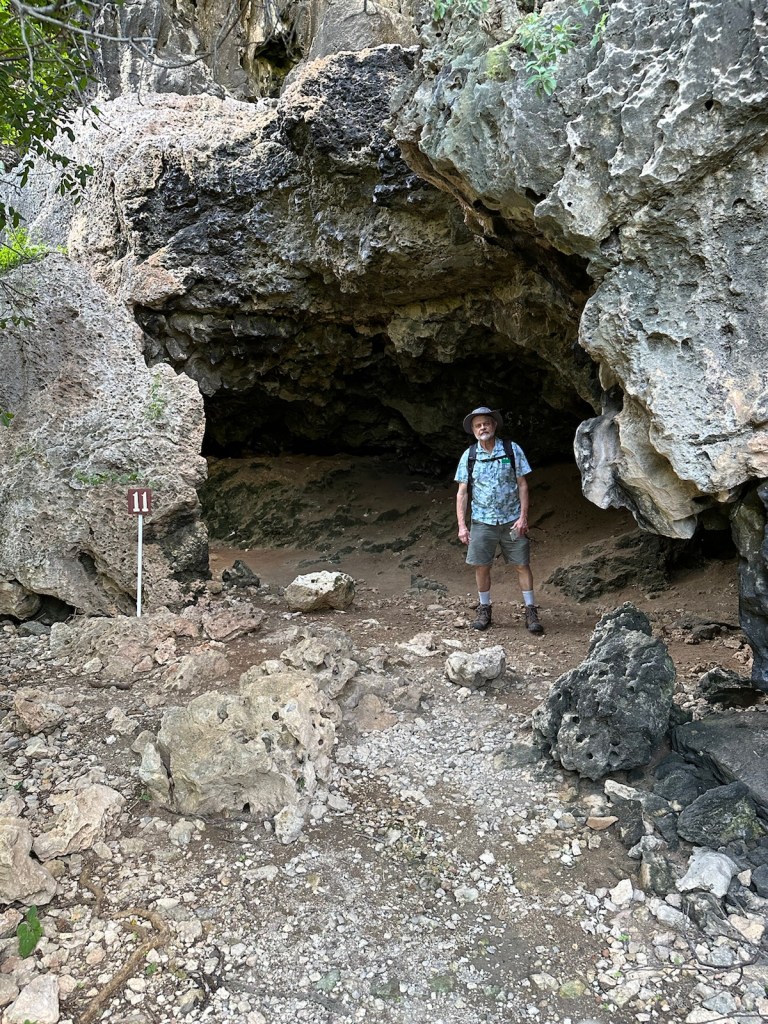
Our tour guide explained how Curacao is formed in layers going up in height, which are called ‘terraces’. Most caves on the island are found in the second terrace. The Hato Cave is uniquely found in the third terrace of the island. To reach the entrance, you need to go up about 50 steps.
At Hato, you climb up to enter the cave, not down like in most caves.
Over the years, the caves provided shelter for some of the island’s early inhabitants, the Caiquetio Indians (from Northern Venezuela) and then later to escaped slaves who used many caverns to hide from their masters. Several Indian skeletons and 1,500-year-old artifacts have been discovered there.
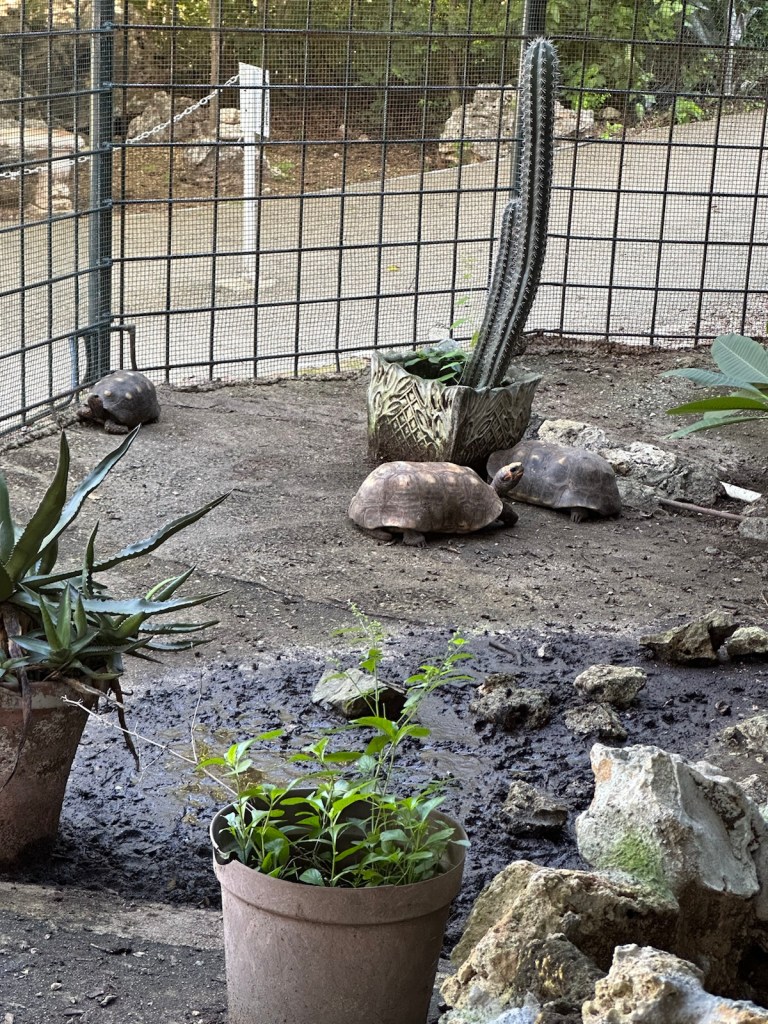
Cavernous chambers …… Stalagtites, stalagmites and fruit bats. Petroglyphs from the Indian inhabitants. Hato Cave park has a turtle exhibit. The turtles are not native to Curacao, the Indians from Venezuela brought them. The Chobolobo Landhuis is home to Senior Co Curacao distillery.
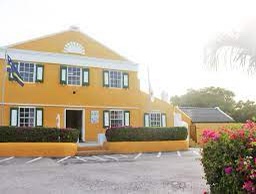
Next stop is Chobolobo and the Curacao distillery. Landhuis Chobolobo is an iconic 19th-century mansion. The property’s history is rather sketchy but never had any other use than to serve as a country residence for wealthy merchants.
Spaniards came to Curacao around the 1500 and one of the plants they brought with was the Valencia Orange. The arid climate and soil conditions changed the juicy fruit into a bitter, almost inedible produce. The project was forgotten and the Valencia orange grew wild and abandoned, not even touched by the goats.
Decades later, someone discovered that the peels of this orange contained an ethereal oil with an extraordinary pleasing fragrance. This orange is called Lahara and is indigenous to Curacao. The Lahara is inedible. However the dried orange peels are perfect for the production of Curacao liqueur and provides a unique taste.
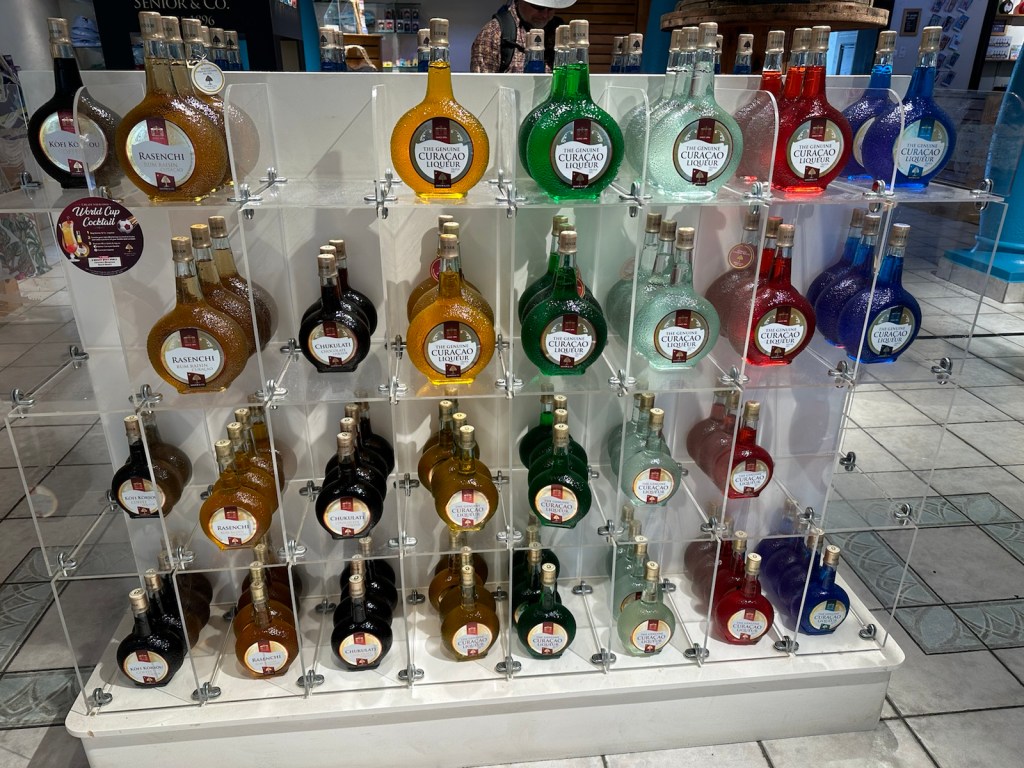
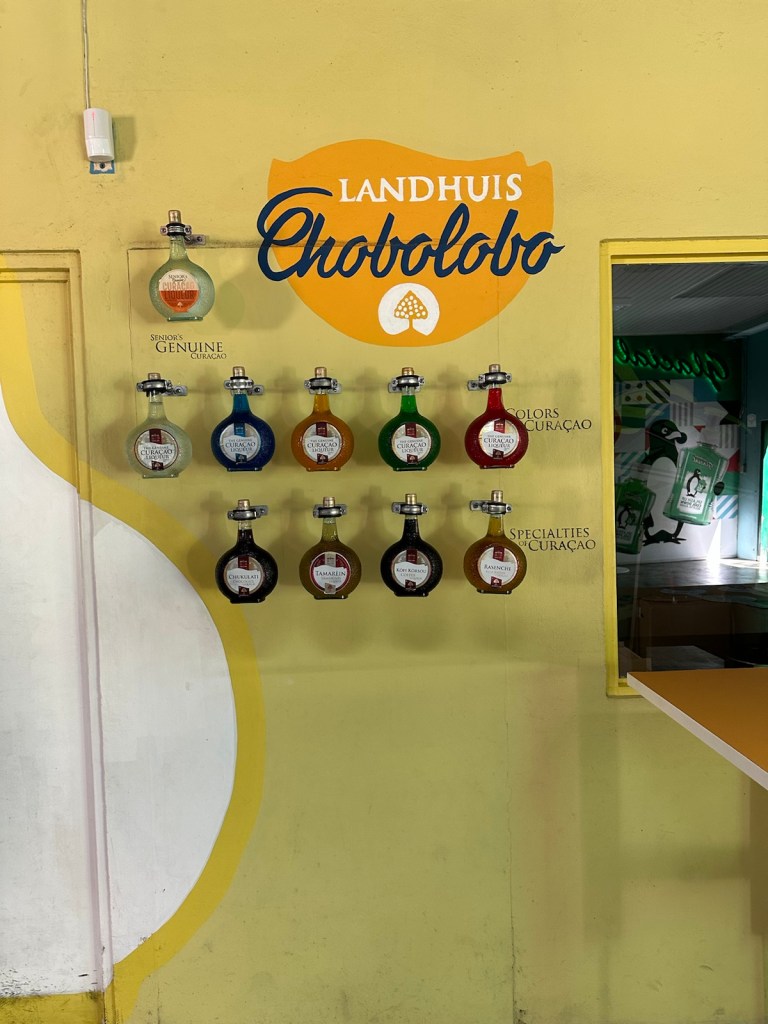
Today, Senior Co. is the only brand in the world that uses Lahara to make Curacao liqueur. The name “Curacao” is the name of a “place” and therefore cannot be trademarked. This is why there are many brands of “Curacao” liqueur on the market today. Senior also produces other liqueurs than Curacao, like a chocolate and tamarind liqueur.
Curacao has one flavor but comes in five colors … blue, orange, clear, green and red. In addition, there are other flavors such as chocolate, tamarind, coffee, rum raisin.
Since 1946, Chobolobo houses the “Senior Co.” distillery which has produced the famous Blue Curacao. True Curacao is made with the Laraha orange that only grows in Curacao. The entire process is done by hand … everything from picking the oranges, peeling and drying, mixing the recipe and distilling to bottling and labeling.
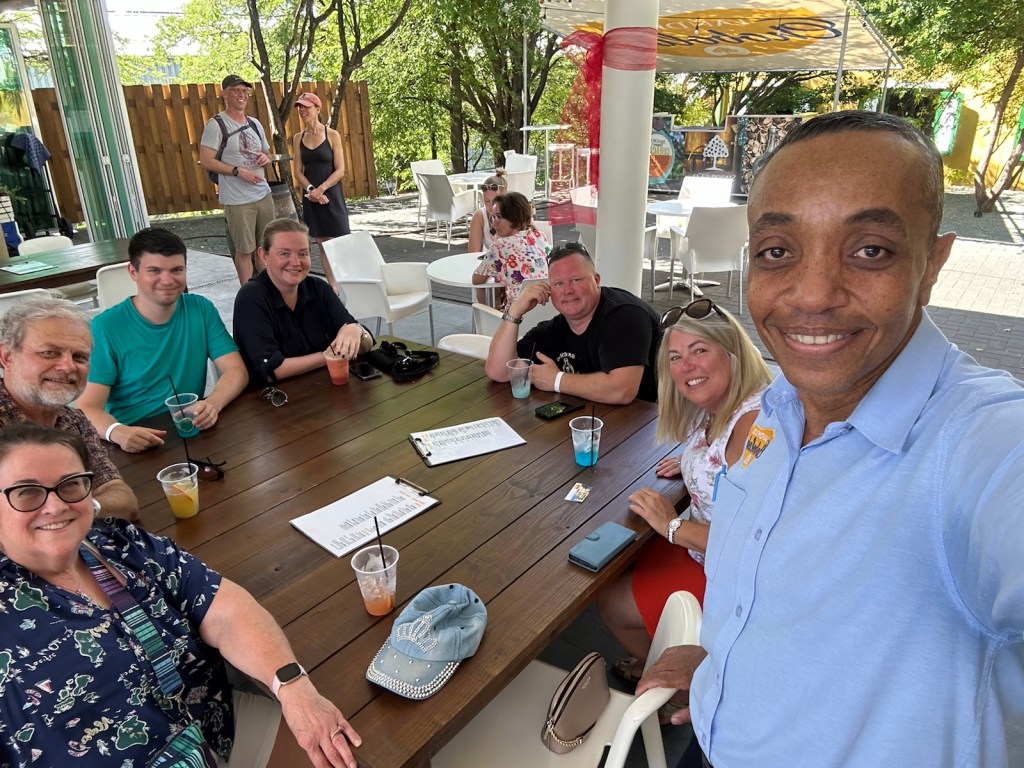
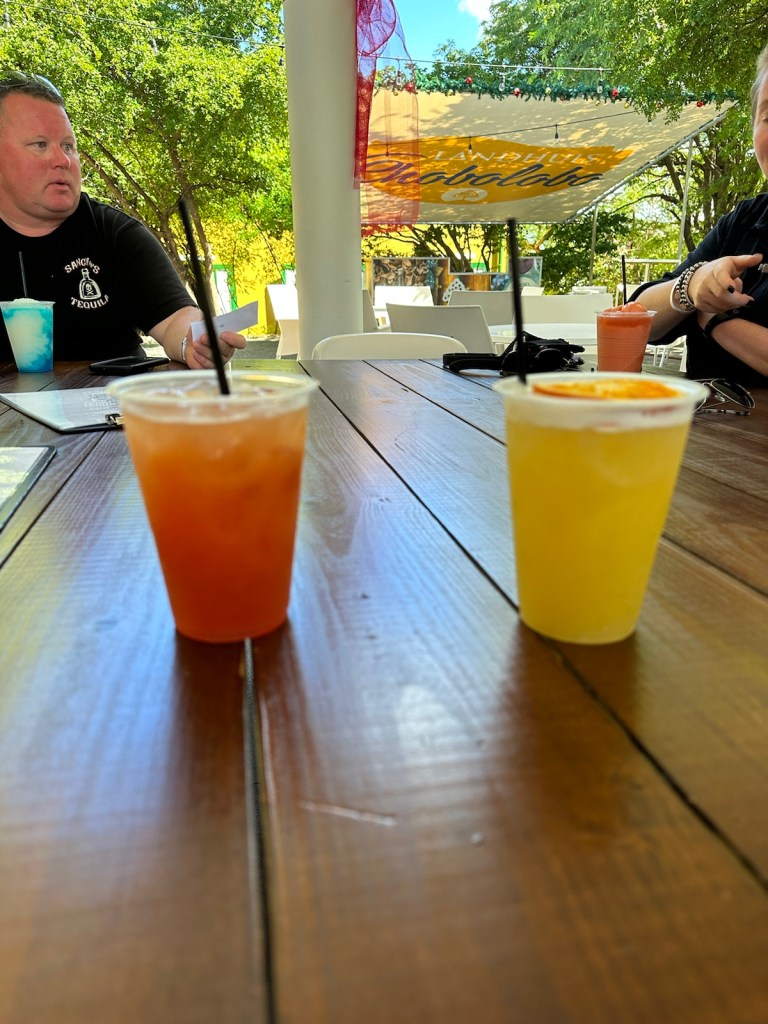
David and I along with Oliver from Switzerland; Ann Marie from Holland; Blake from Kentucky; Karen from Vancouver with our guide Ely.Ely served everyone their choice of mixed drink from the Chobolobo list. I gave the Tamarind Sunset cocktail a try and David did a Rum Raisin Mai Tai. We ended up buying a bottle of the Tamarind liqueur.
Today’s beach is Jan Thiele which is just outside of Willemstad. All decorated for the holidays, the complex includes five restaurants and three beach clubs. There is a fee for beach entrance, parking and chairs.
Our strategy is to stay away during the hottest part of the day (we are near the Equator after all). We usually roll into the beaches around 4:00 when the crowds have left and there are no charges for entrance, parking or chairs.
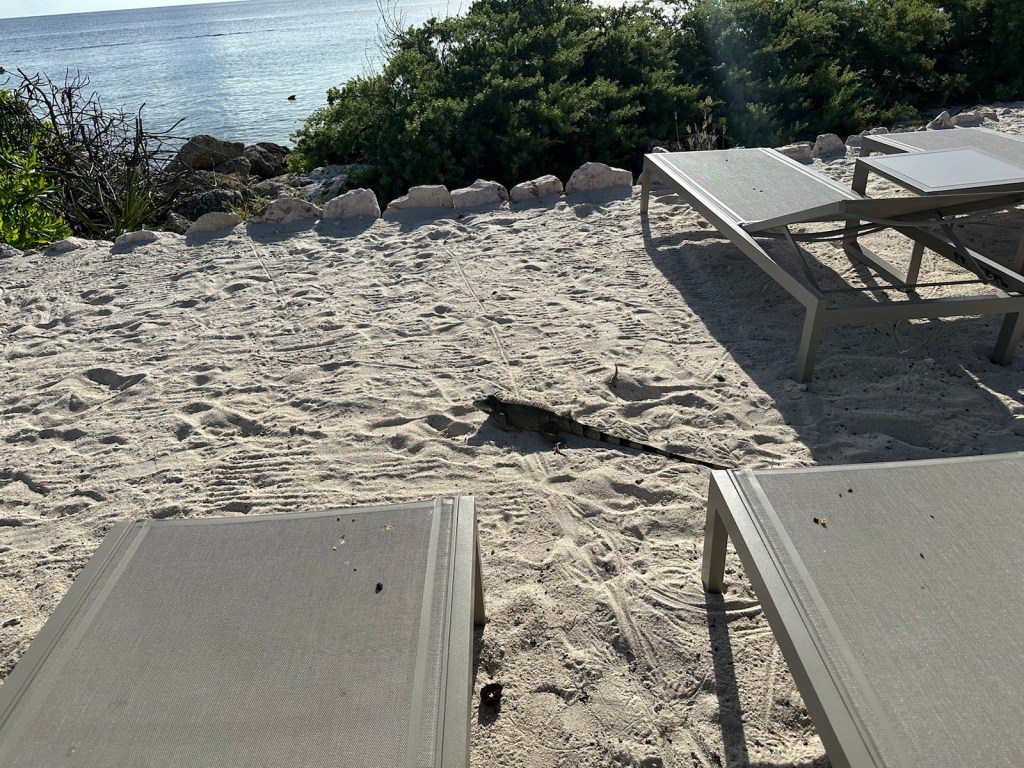
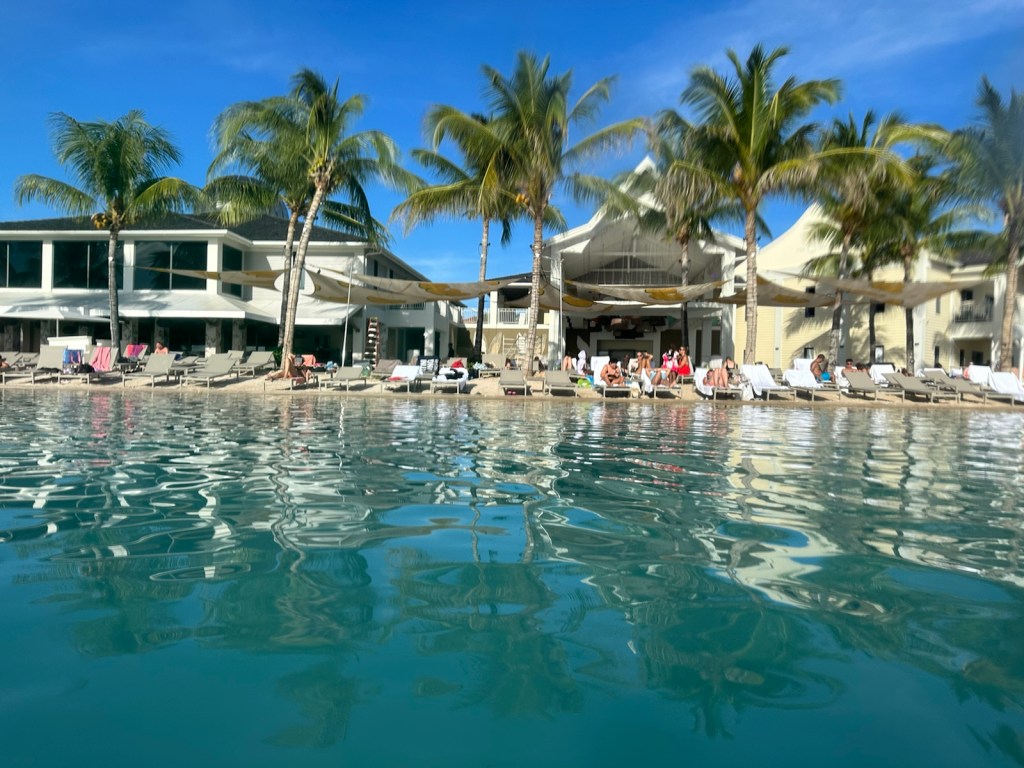
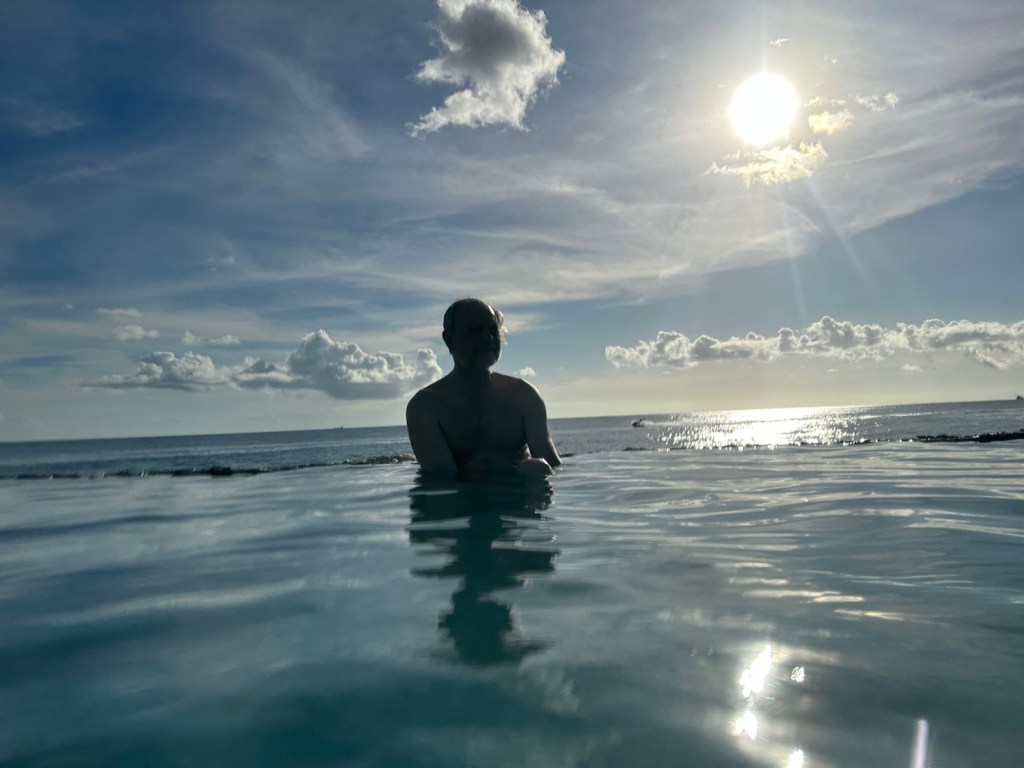
A nice size iguana roams the beach. Jan Thiele, like several of the beaches here has a large infinity pool that overlooks the rocky ocean side. The infinity pool features the view of the ocean without the waves or sandy shoreline.But for those who prefer rocky sand and waves there’s also a small beach area at Jan Thiele.Beach bars with tropical beverages match the colors of the sunset.The end of another day in paradise.
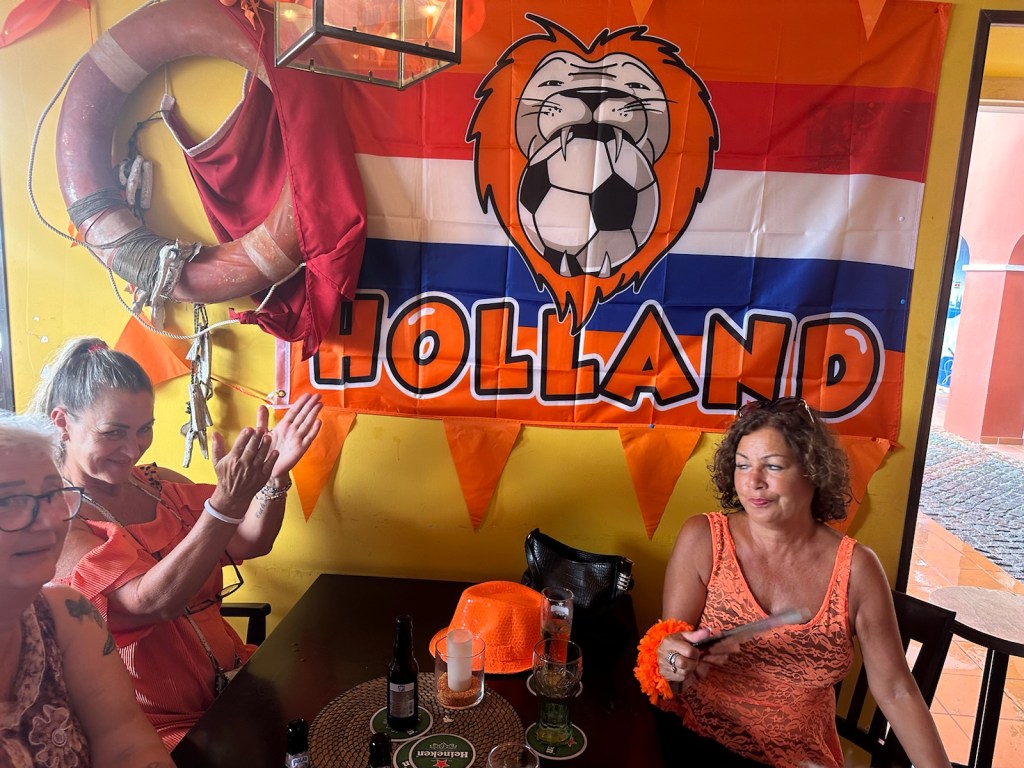
First order of the day after coffee, was to find a place to watch the World Cup Soccer match between Holland and the US.
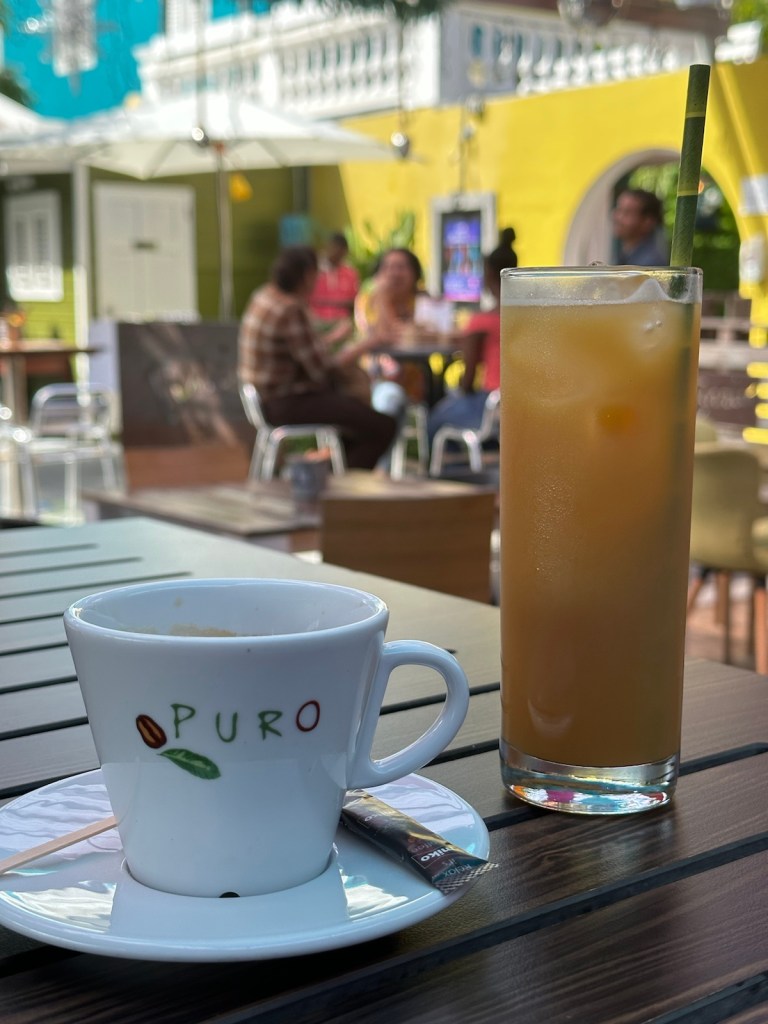
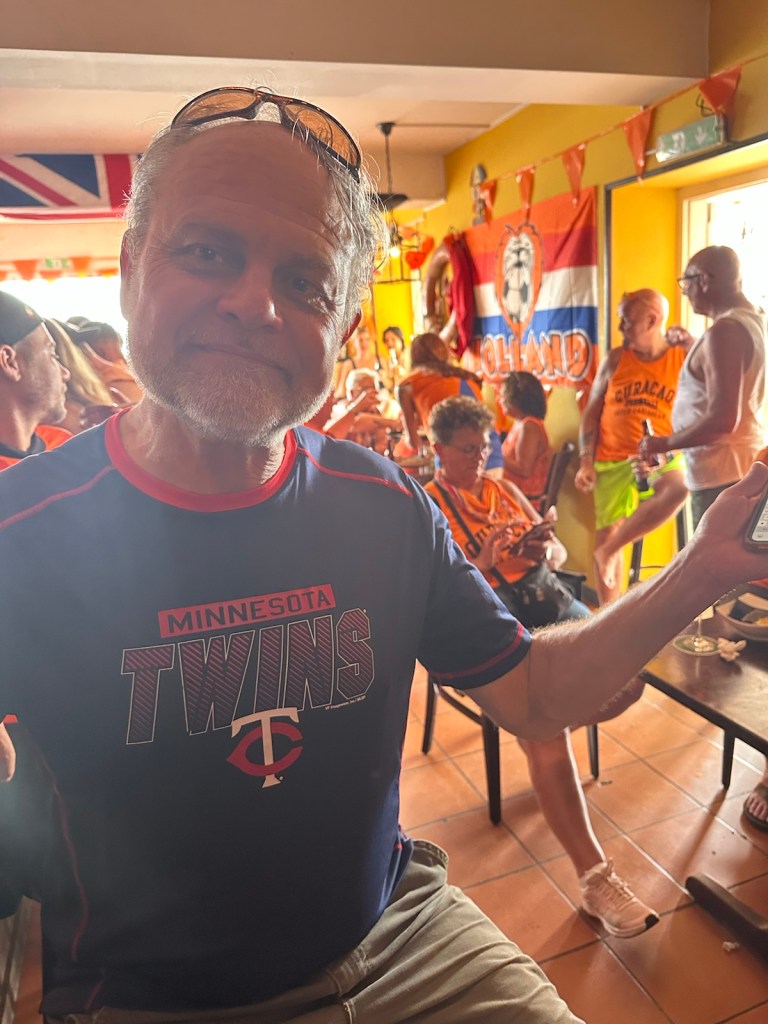
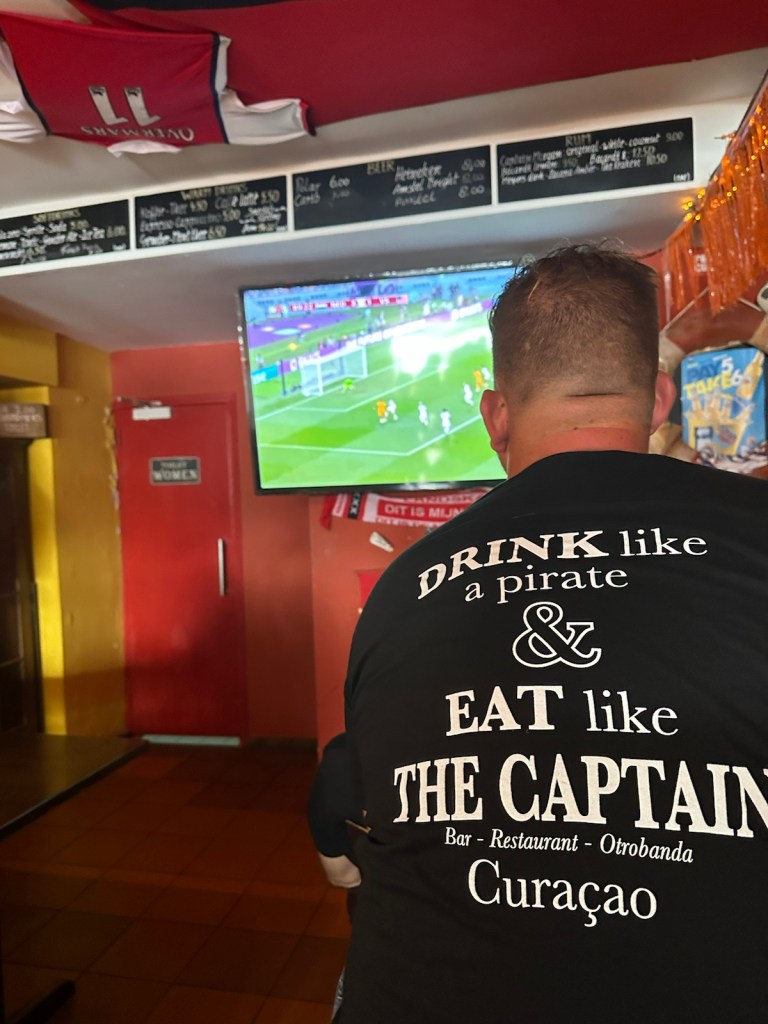
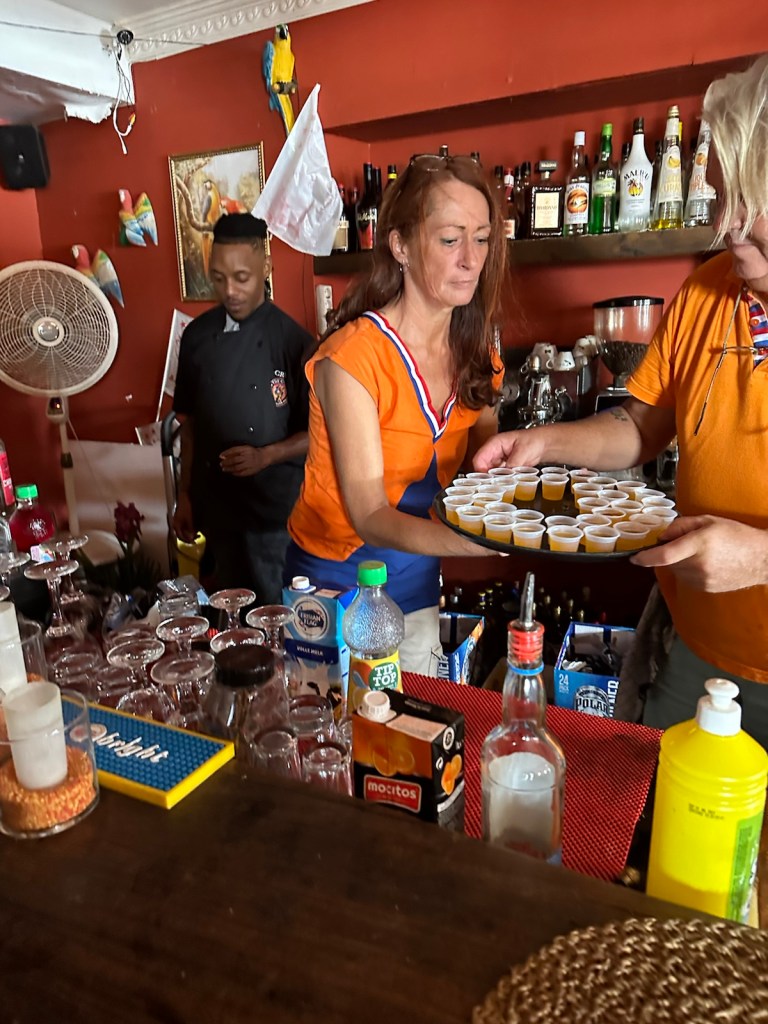
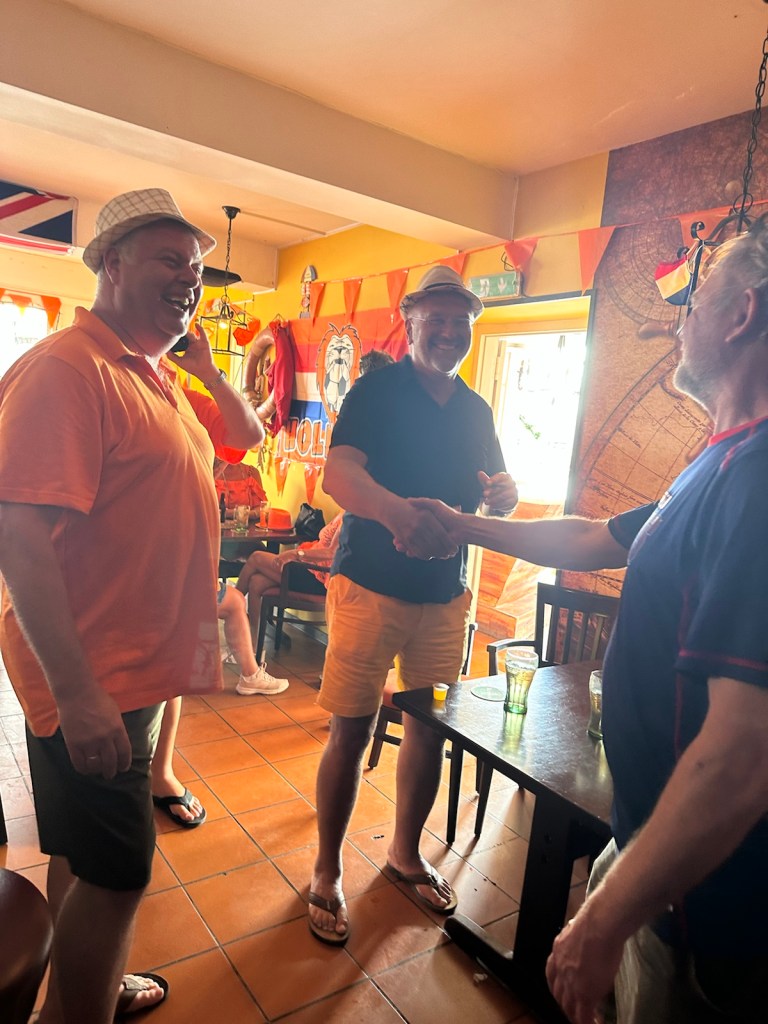
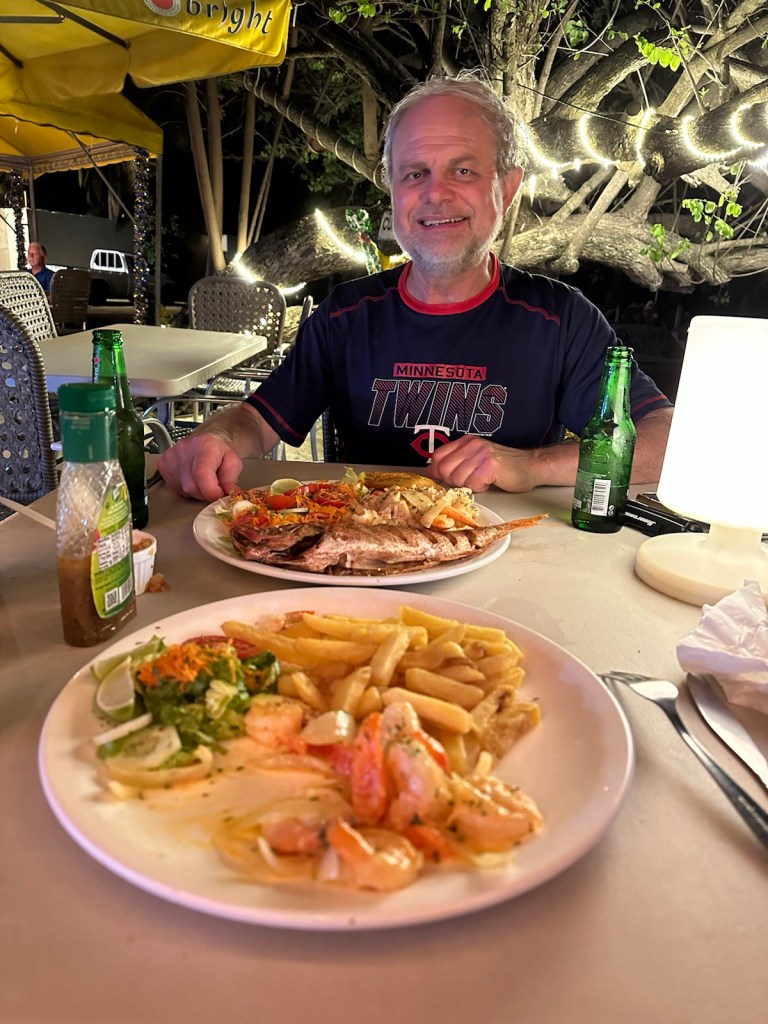
Coffee first, then soccer.David thought that wearing his Twins shirt would be an indicator that he was cheering for the US soccer team but not seriously because baseball is his preferred sport. We did find two seats at a bar that was filled with Holland fans. Everyone in the bar knew we were from the US. There was a lot of hootin’ and hollerin’ and bell ringing when Holland scored.With every Holland goal came a shot of orange rum even for the opposing fans.The US lost 3-1. David spent all day congratulating the Dutch on their win.
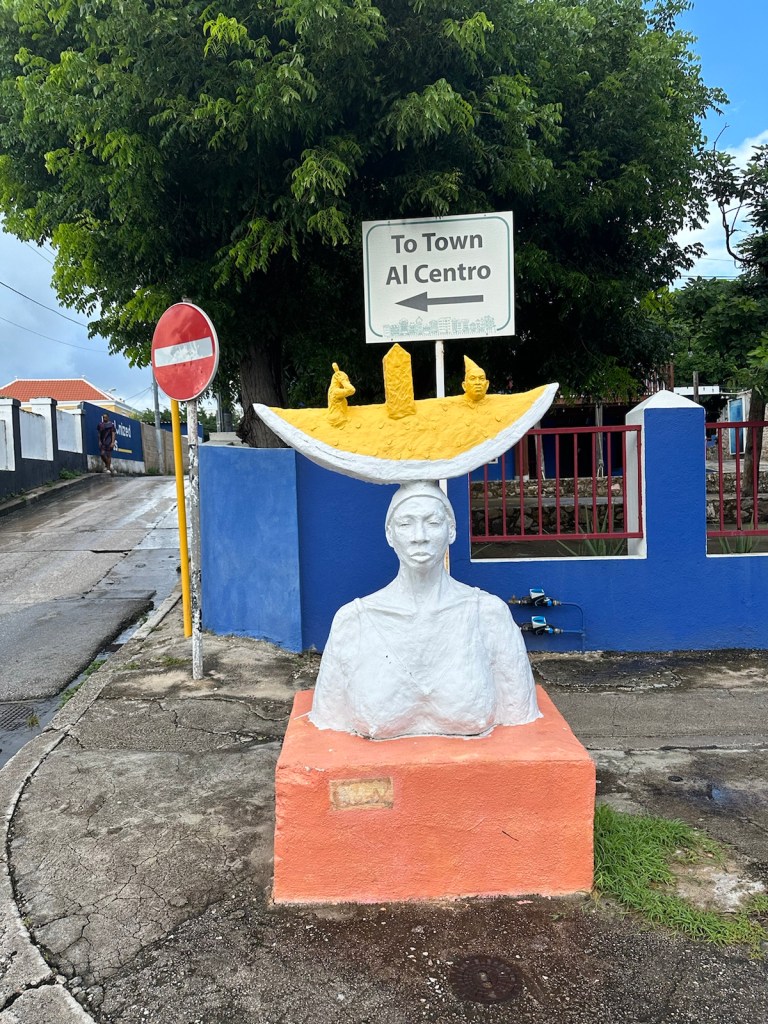
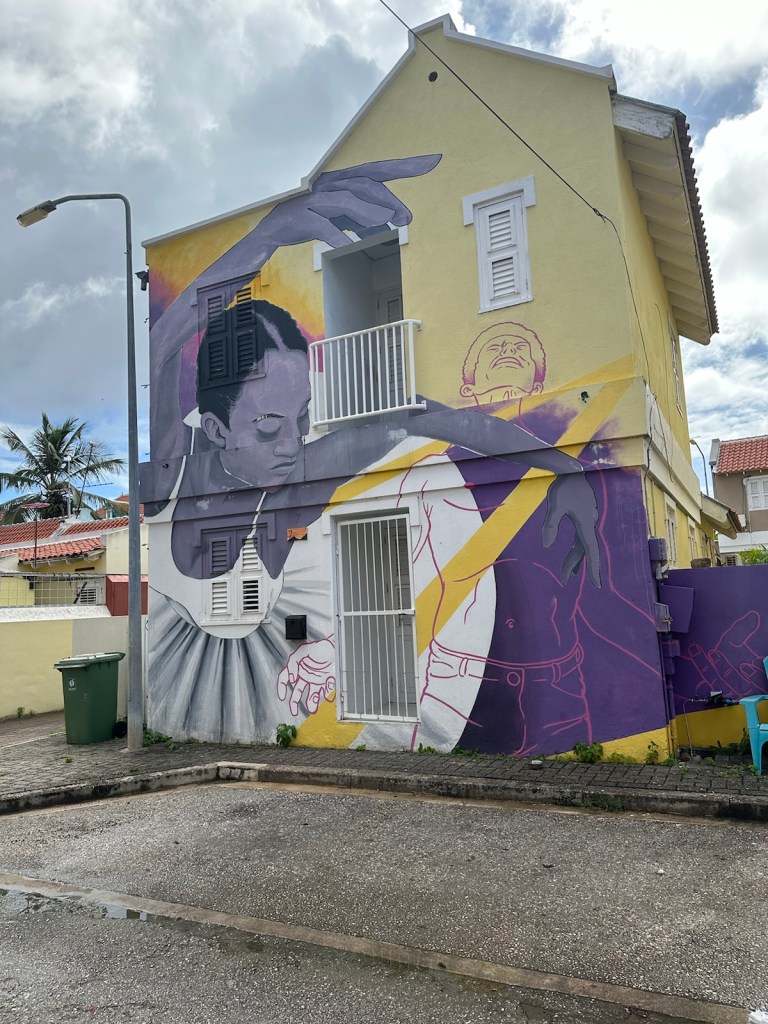
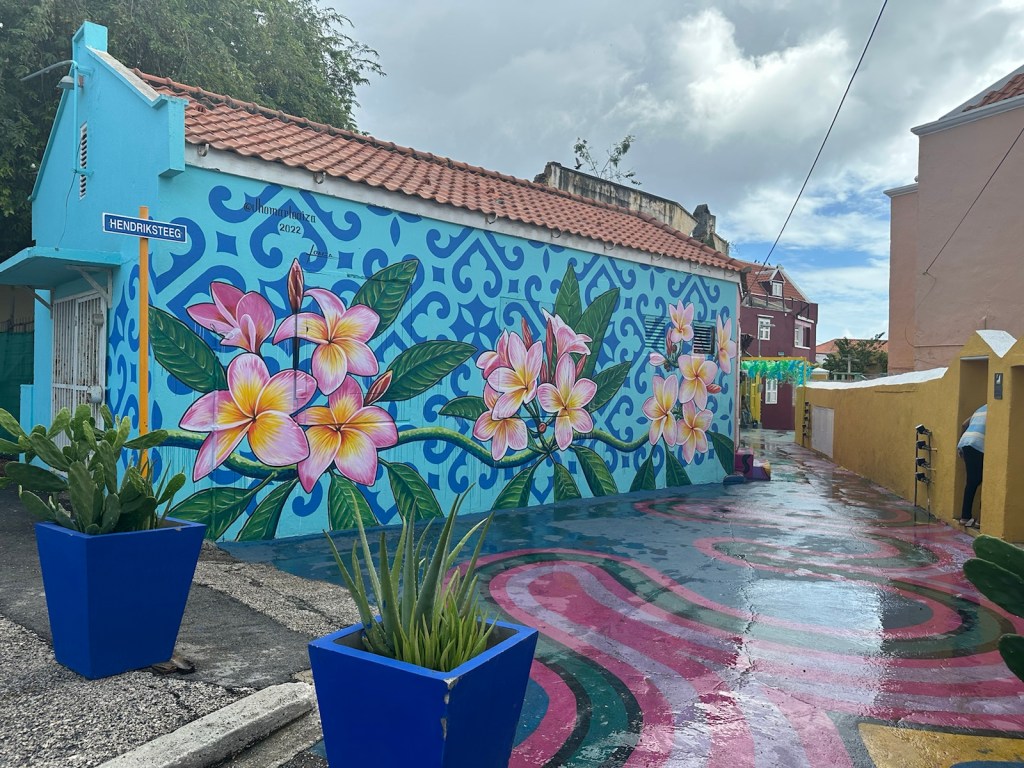
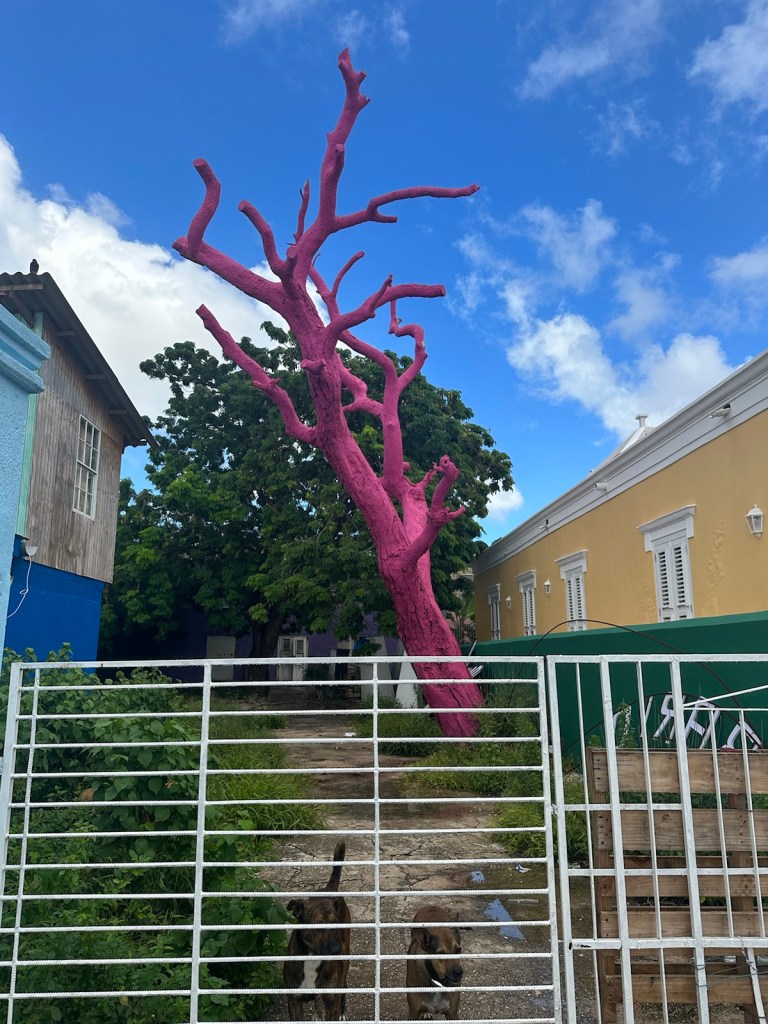
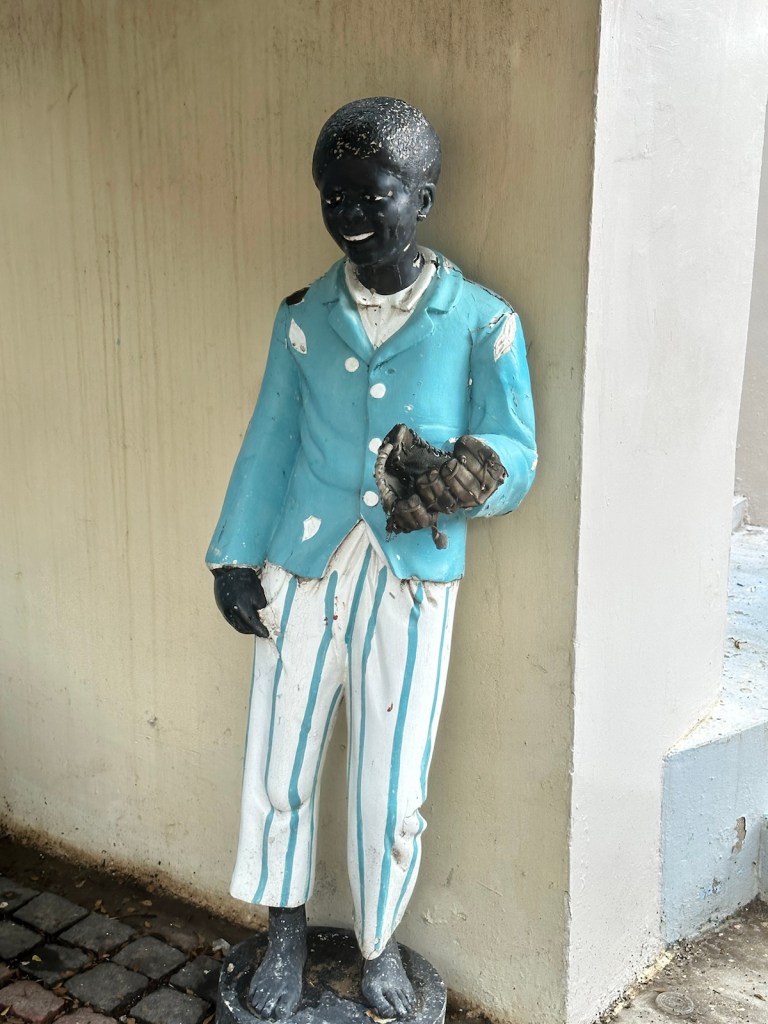
We walked through our neighborhood looking at street art. It’s everywhere in this very colorful city.
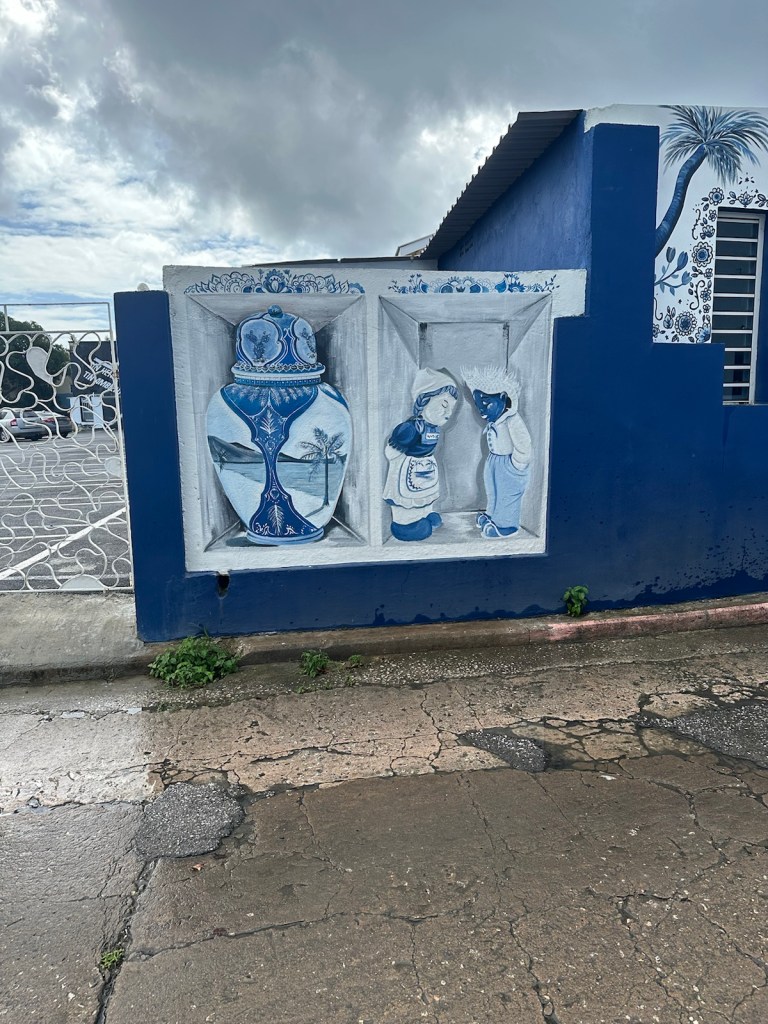
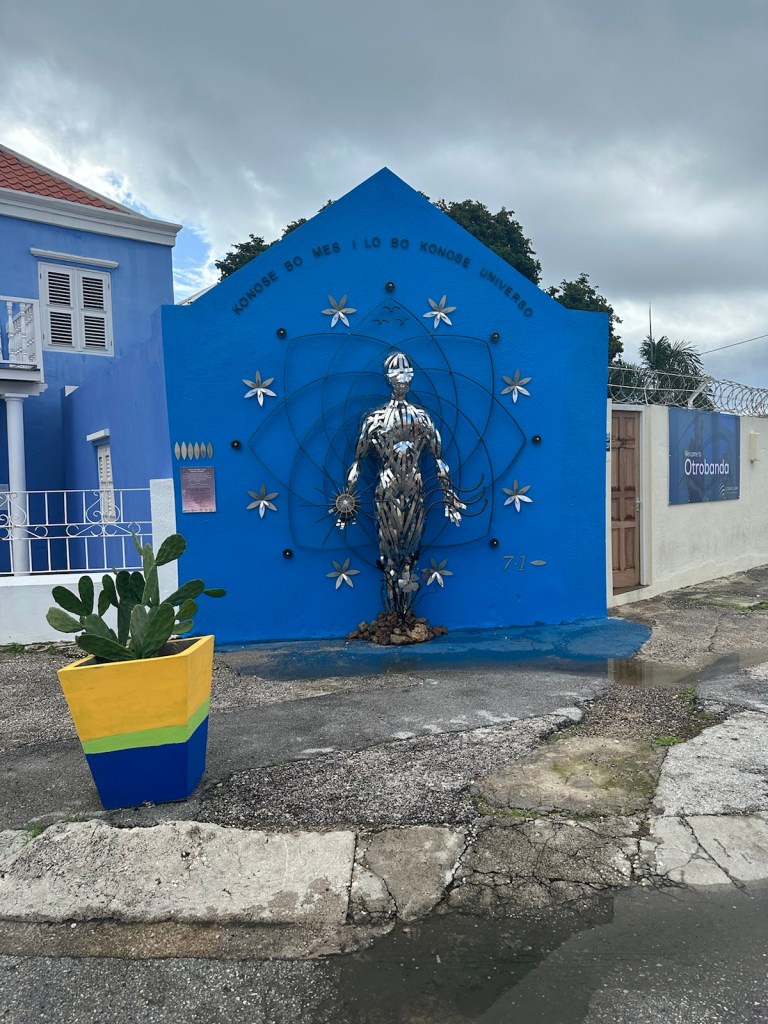
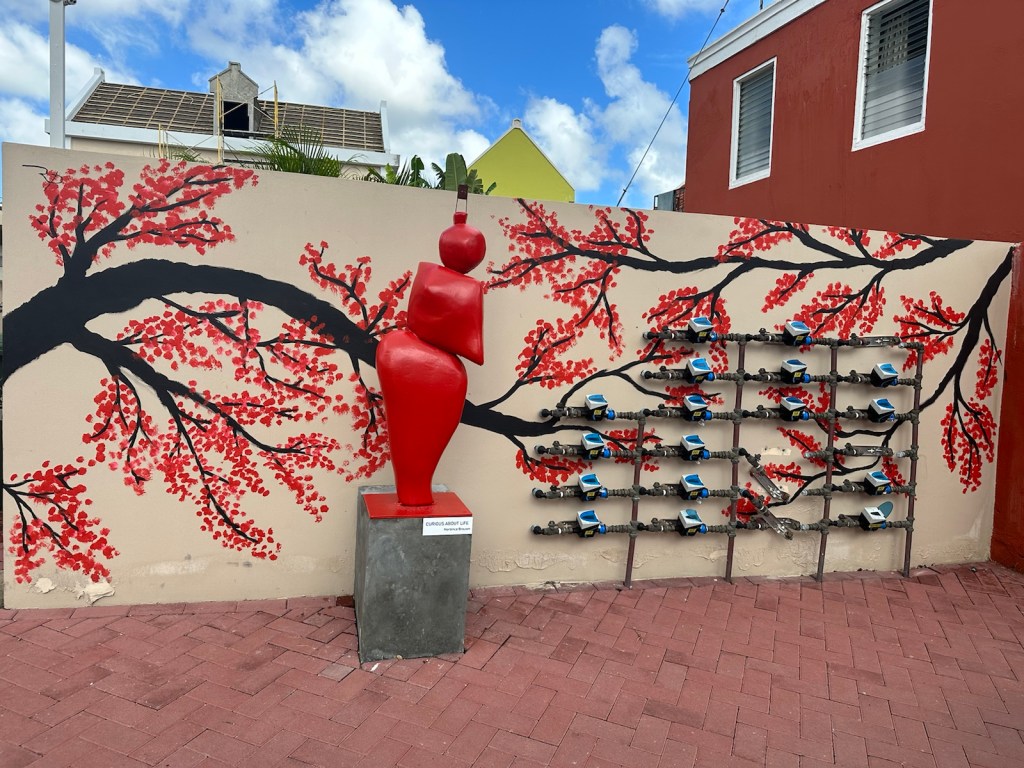
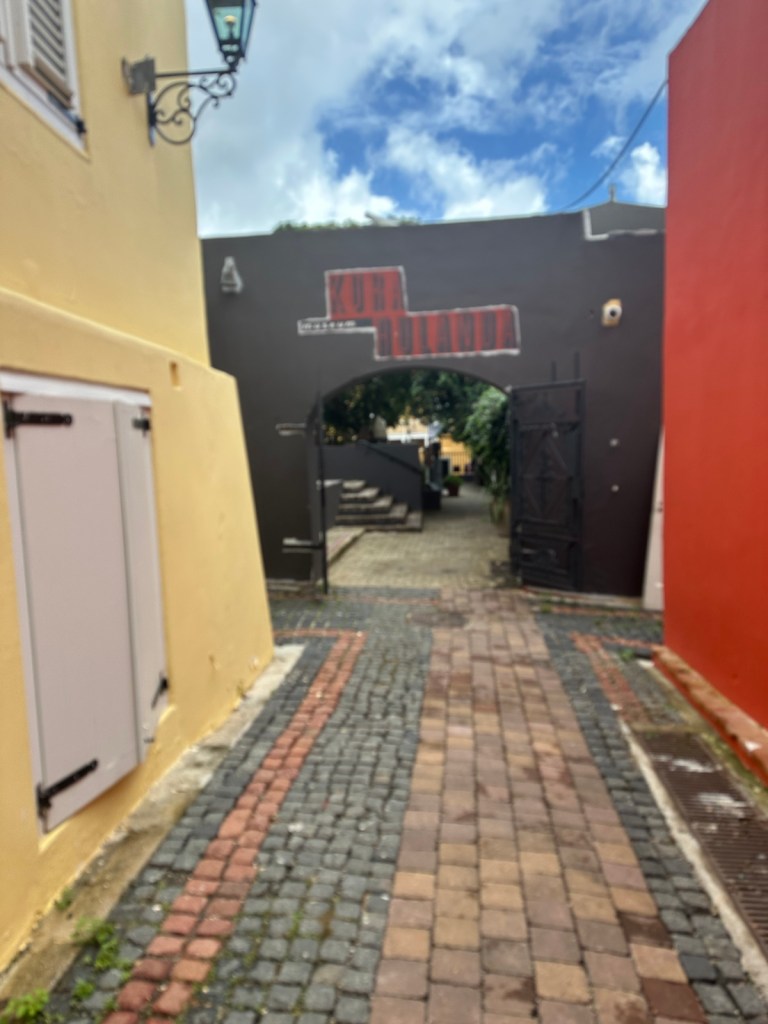
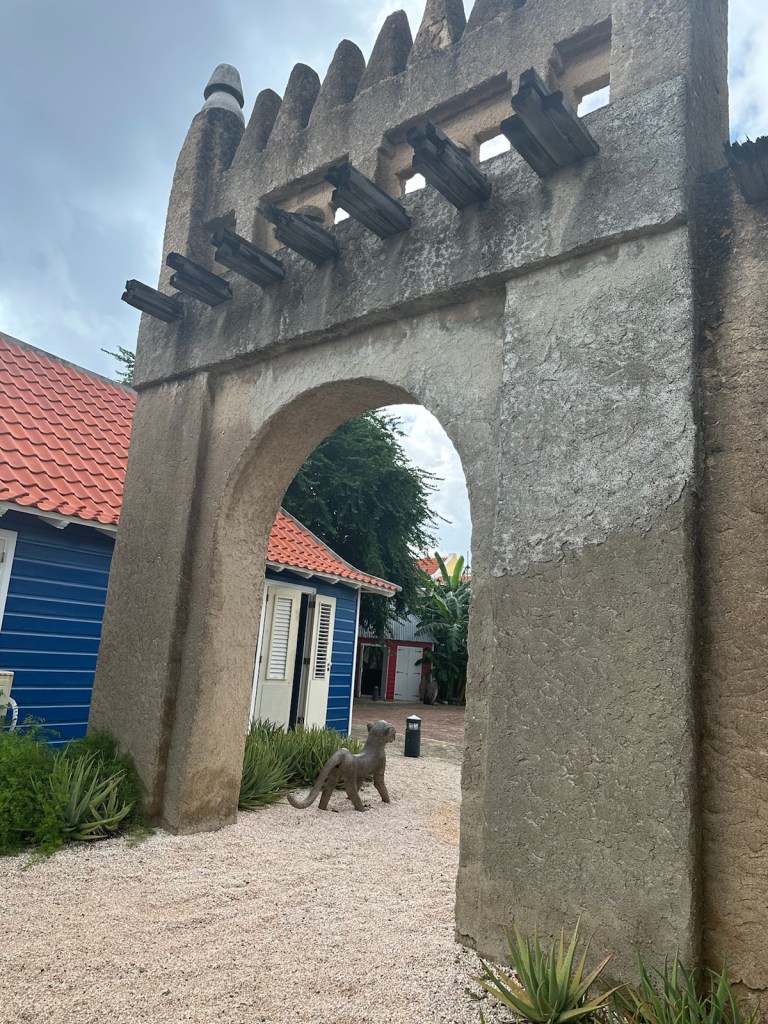
Delft Blue pottery comes from the city of Delft in the Nederlands. This mural adds a Caribbean flare.This work features a metallic sculpture On the right side of the red statue, electrical boxes are for nearby dwellings become part of the artwork.Colorful Curacao … even a pink tree.Interesting statue of a person with a baseball mit.Finally we found the entrance to the Kura Hulanda Museum.
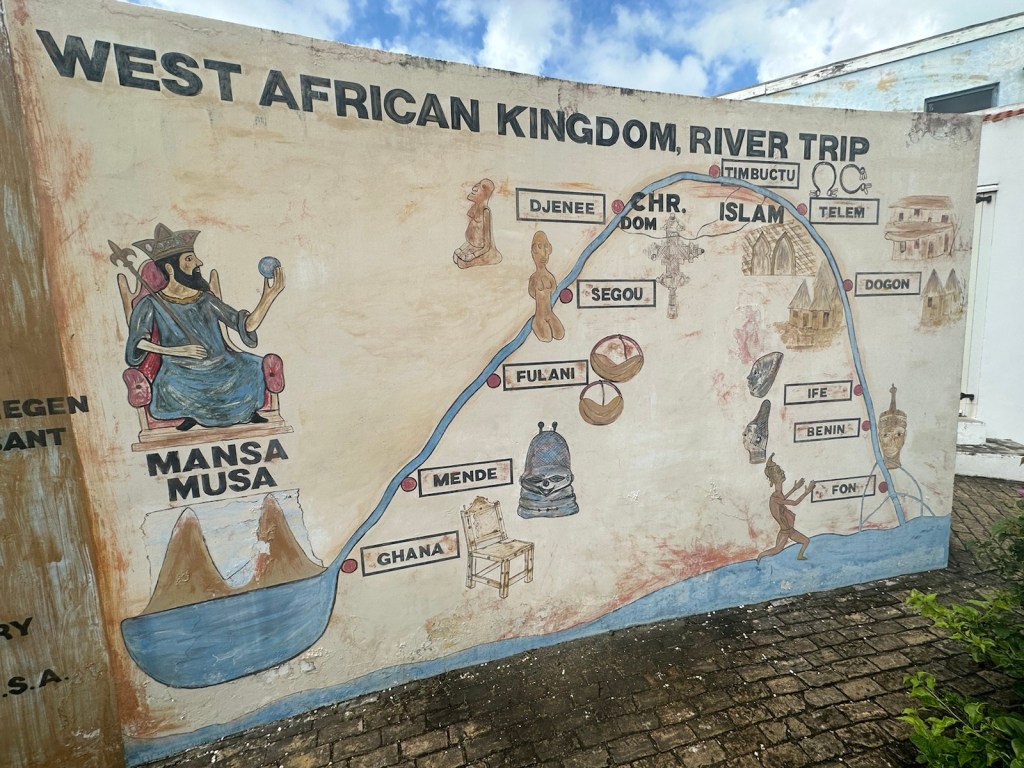
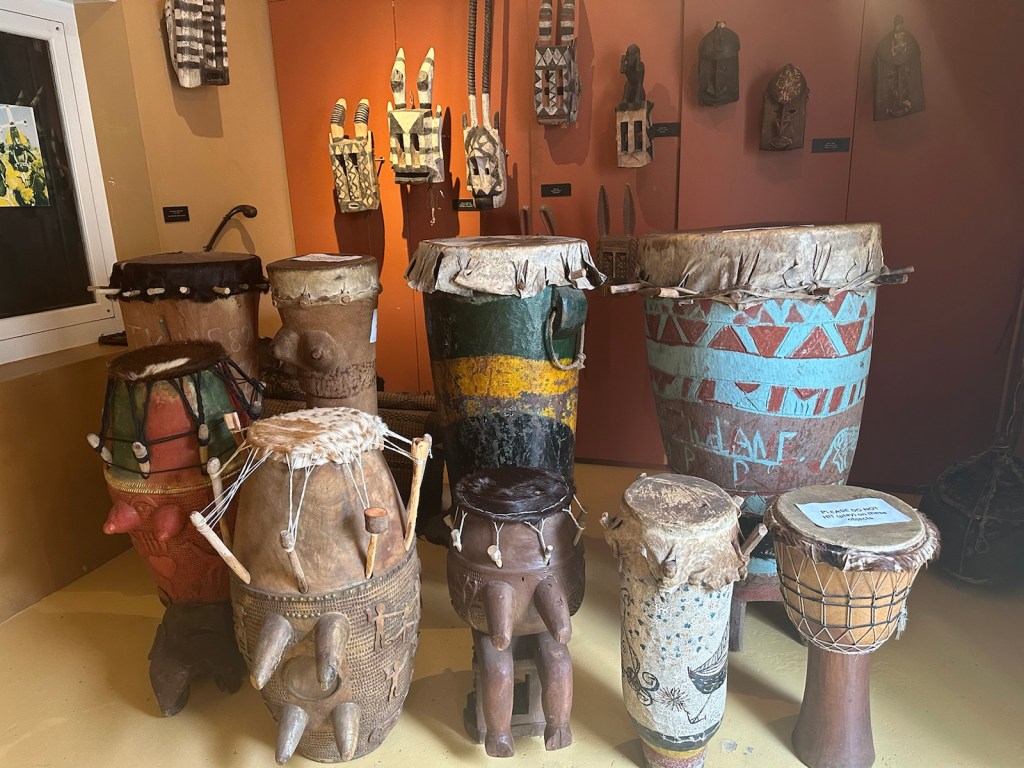
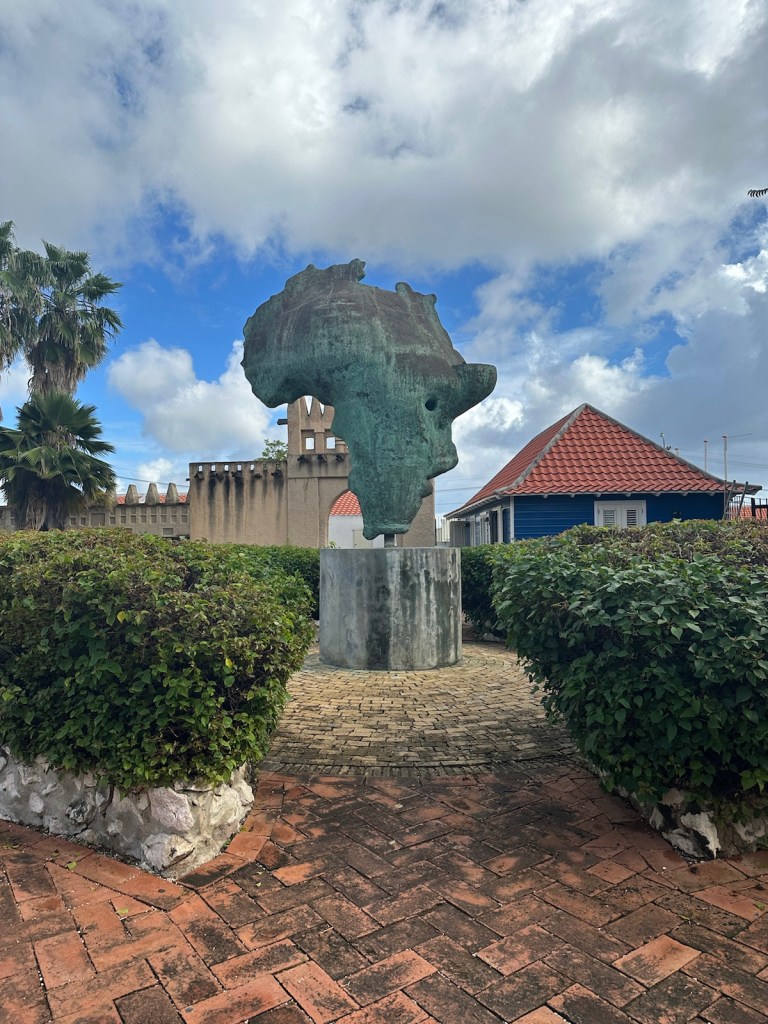
The Kura Hulanda Museum shows the turbulent period that involved the Slave trade between the Netherlands and Curacao. The museum also houses an extensive collection of African and Antillean (religious) art.
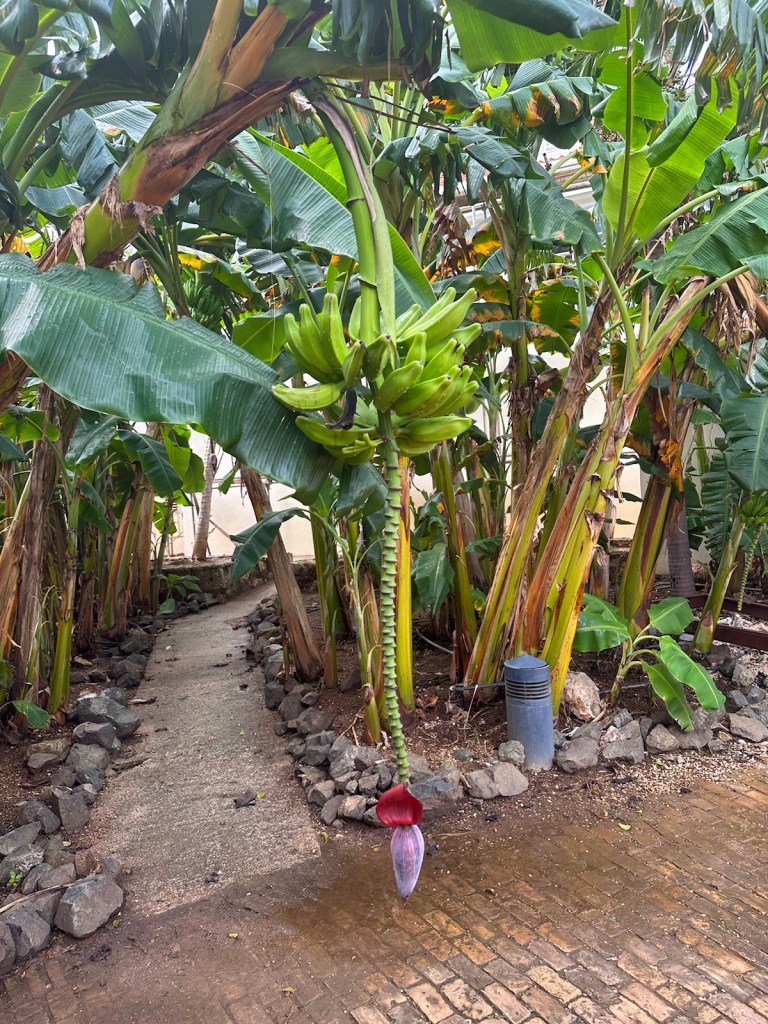
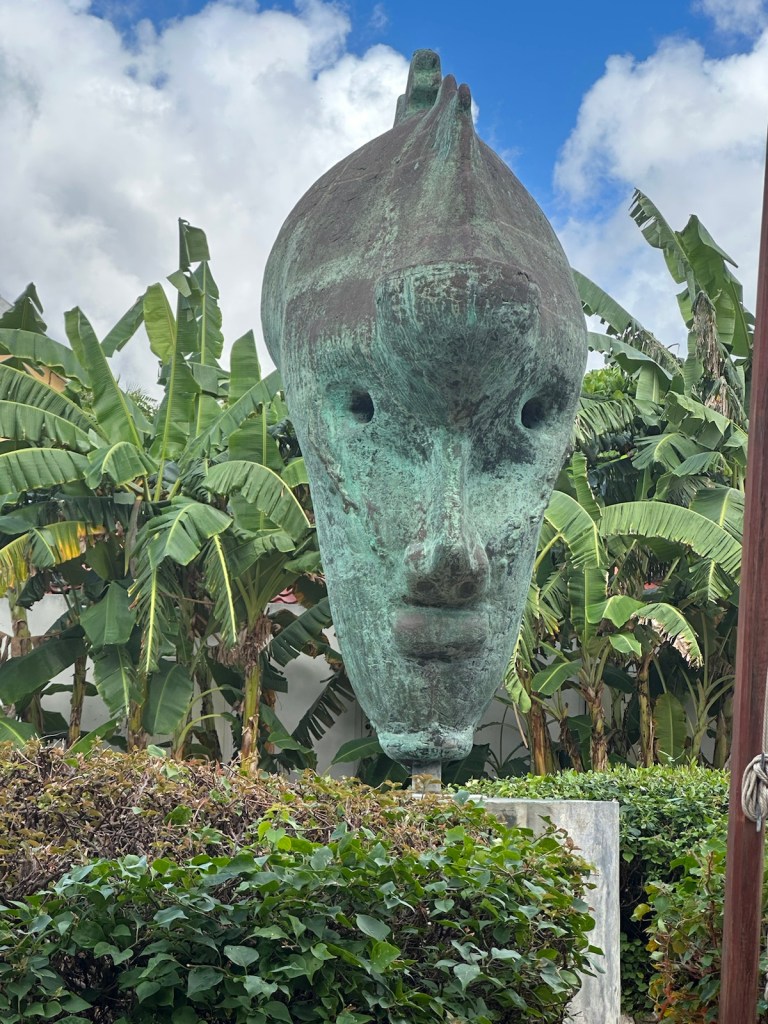
Amid the Kura Huland buildings were a variety of gardens. Banana trees are always intriguing.A sculpture of Africa is in the center courtyard and surrounded by buildings with exhibits …… From the other side, the sculpture looks like a face.
Enough walking … we jumped in the car and headed for Mombo beach. Driving in Curacao is very slow. Traffic lights seem to last over five minutes. There are long lines of cars everywhere. For excitement add the sky view over the Juliana bridge and a few one-way streets.
We had a hard time finding the beach, mostly because you can’t see it. There are blocks of dirt parking lots lining Mombo Beach boulevard. We arrived late afternoon which is when everyone leaves …therefore parking was free as were the entrance and chair fees.
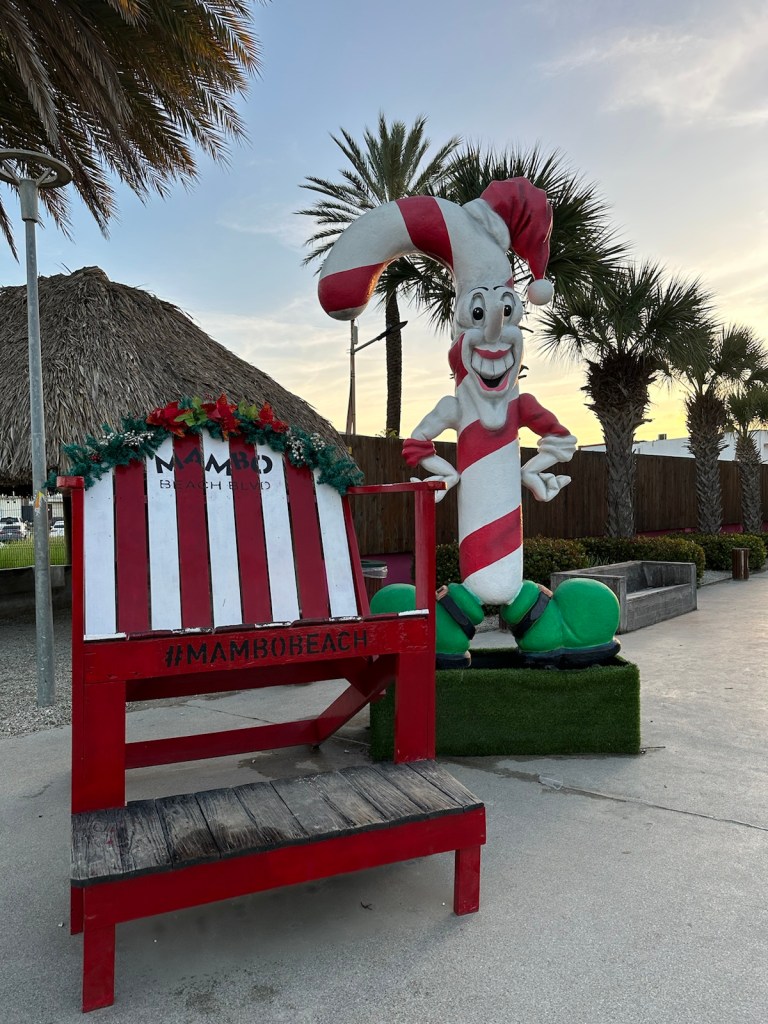
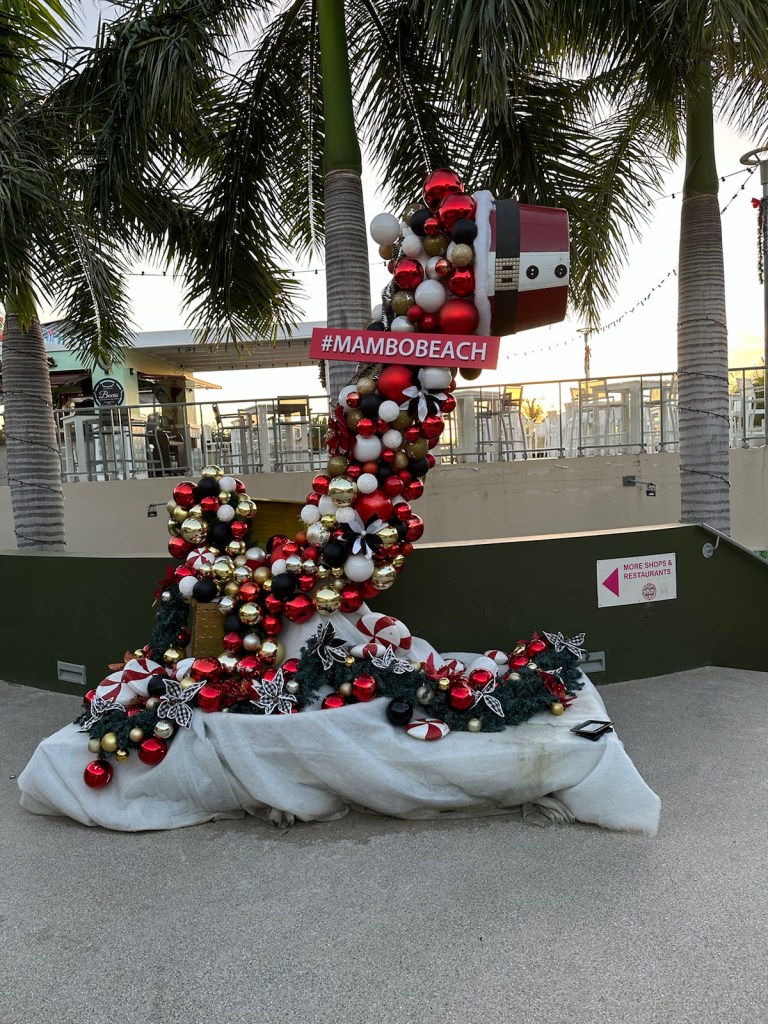
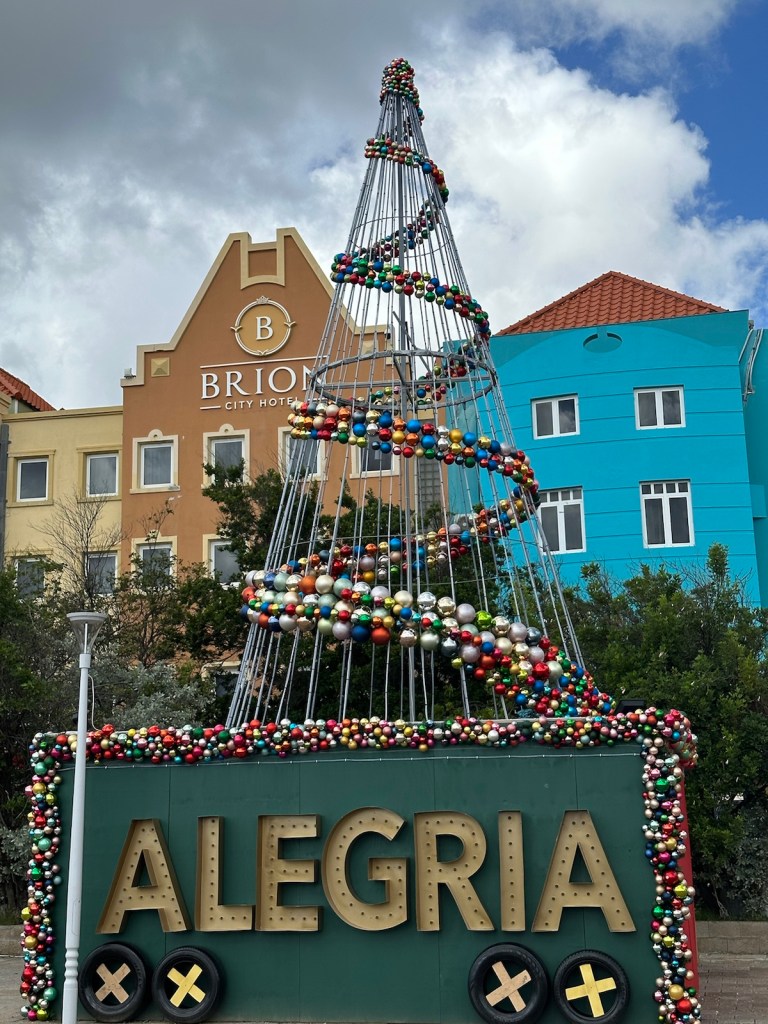
The beach entrance is decorated for Christmas.An anchor made of shiny Christmas ornaments.
We had to walk down a few flights of stairs in a mall-like building filled with shops to get to the beach. The shops, restaurants and bars were endless. We did find the beach eventually.
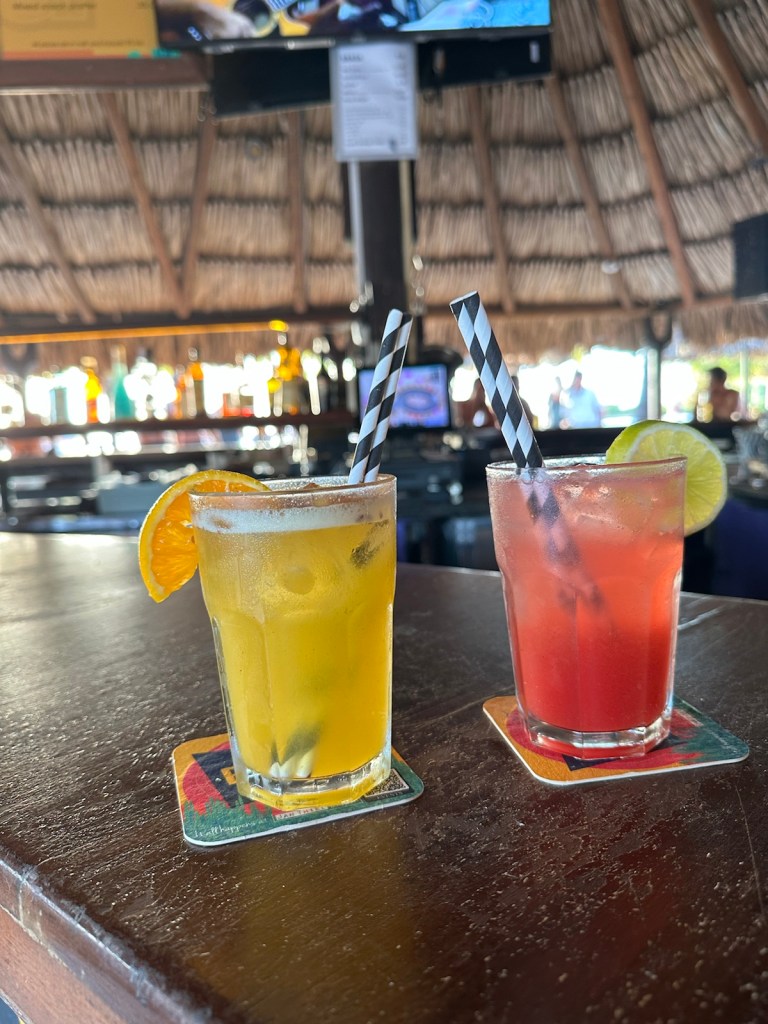
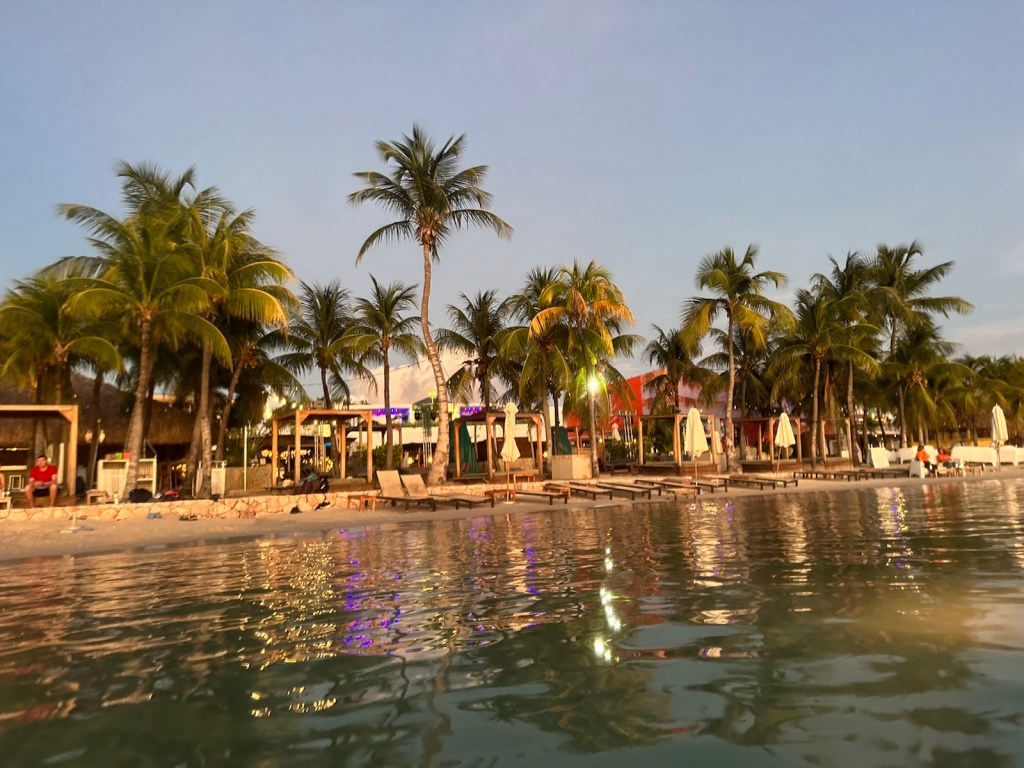
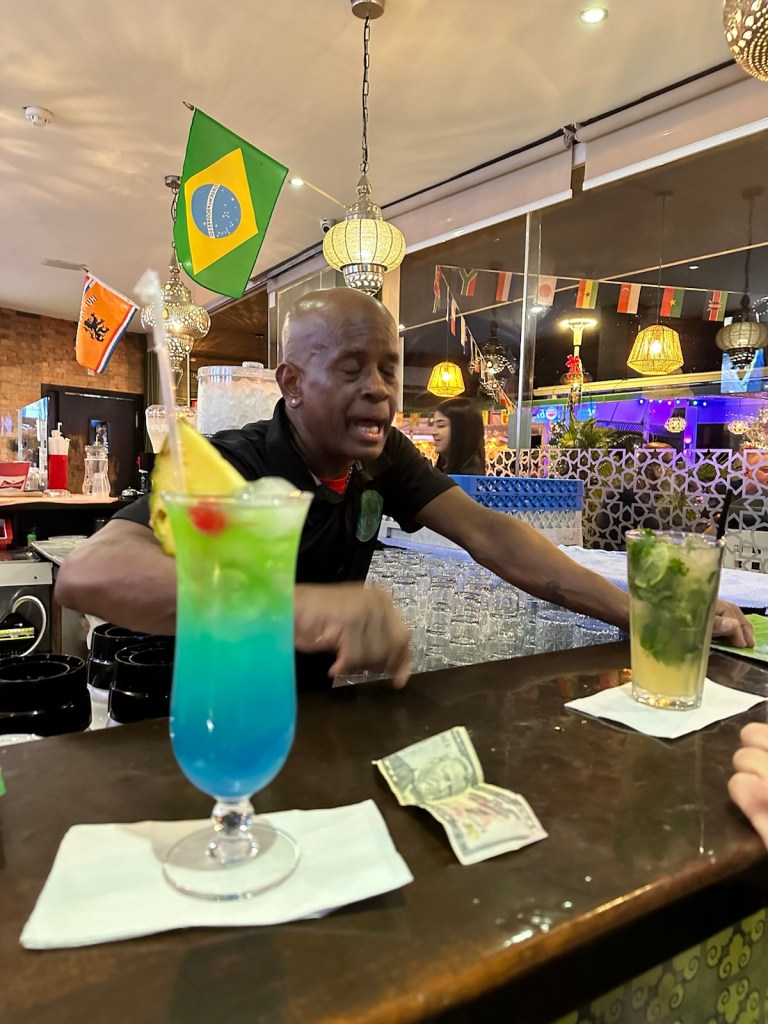
Located just a few miles from downtown Willemstad, Mambo Beach is one of the country’s most lively stretches of sand, packed end-to-end with palapas, sun beds and white-curtained cabanas. We made it in time for a dip at sunset. Very tranquil and uncrowded. All the beach bars were closed and most of the sun worshipers who had been there all day have now left.We stopped for a cocktail at the ‘Greenhouse’ on our way out. The drink on the left is called a ‘blue greenhouse’ and the other is a Caribbean Mojito.
We had dinner at the Seaside Terrace known for seafood. A lovely way to end the day.
Bon Dia! That’s good morning in Papiamento and Bon Bini means welcome. Two common phrases heard and seen all about Willemstad.
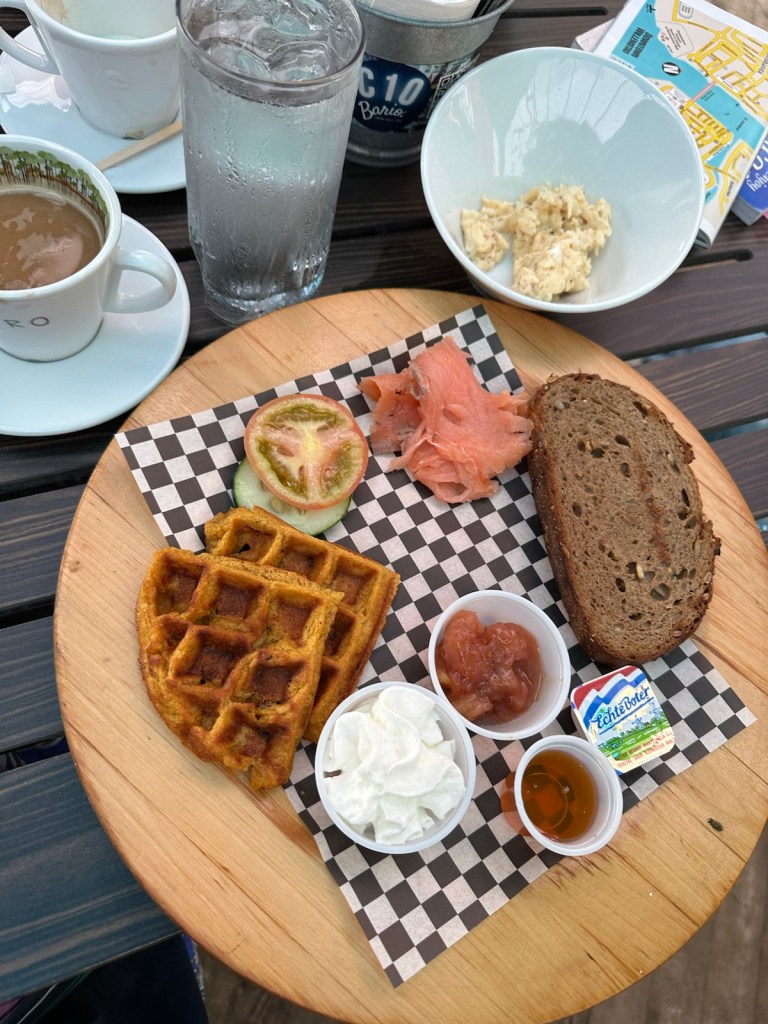
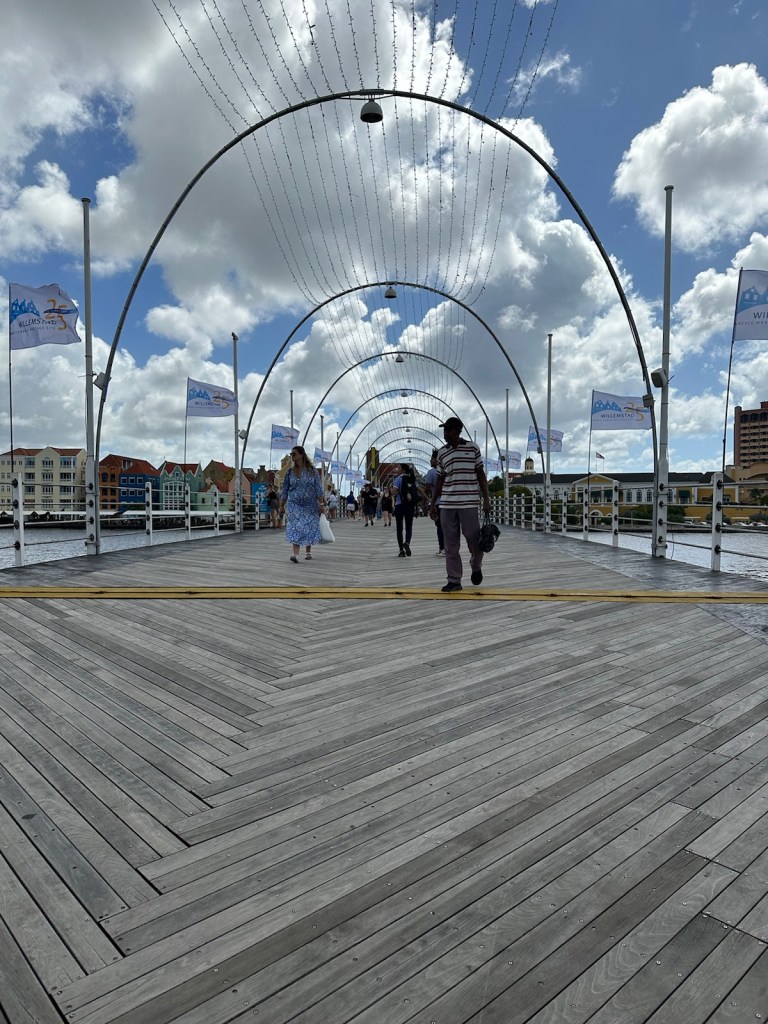
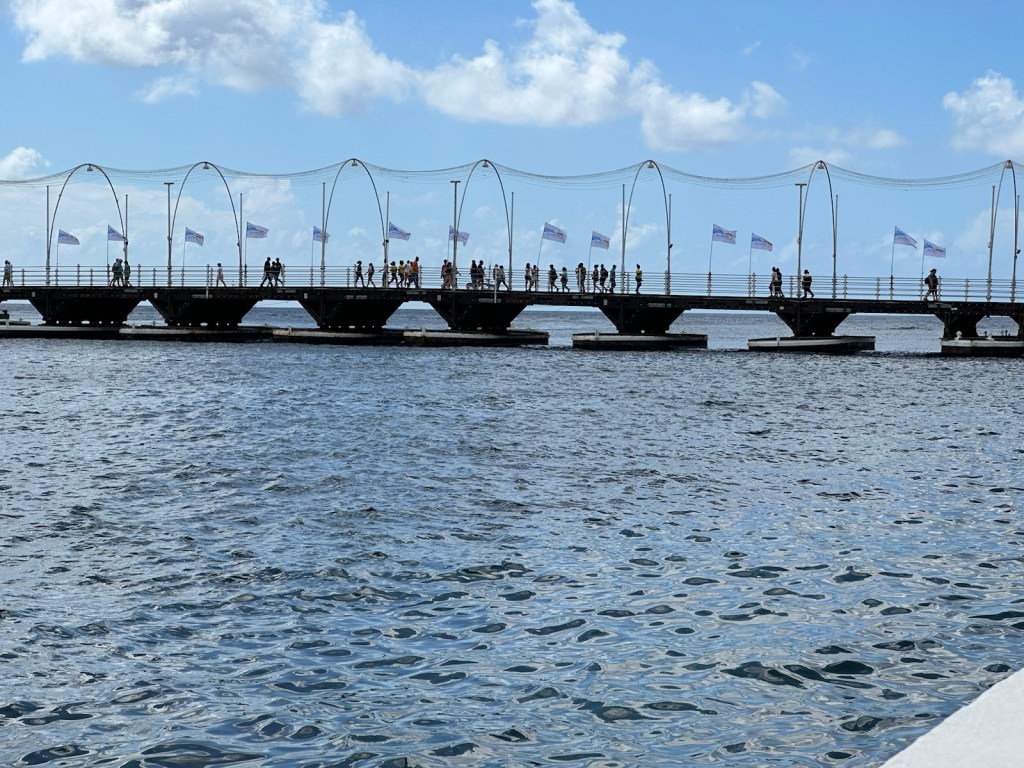
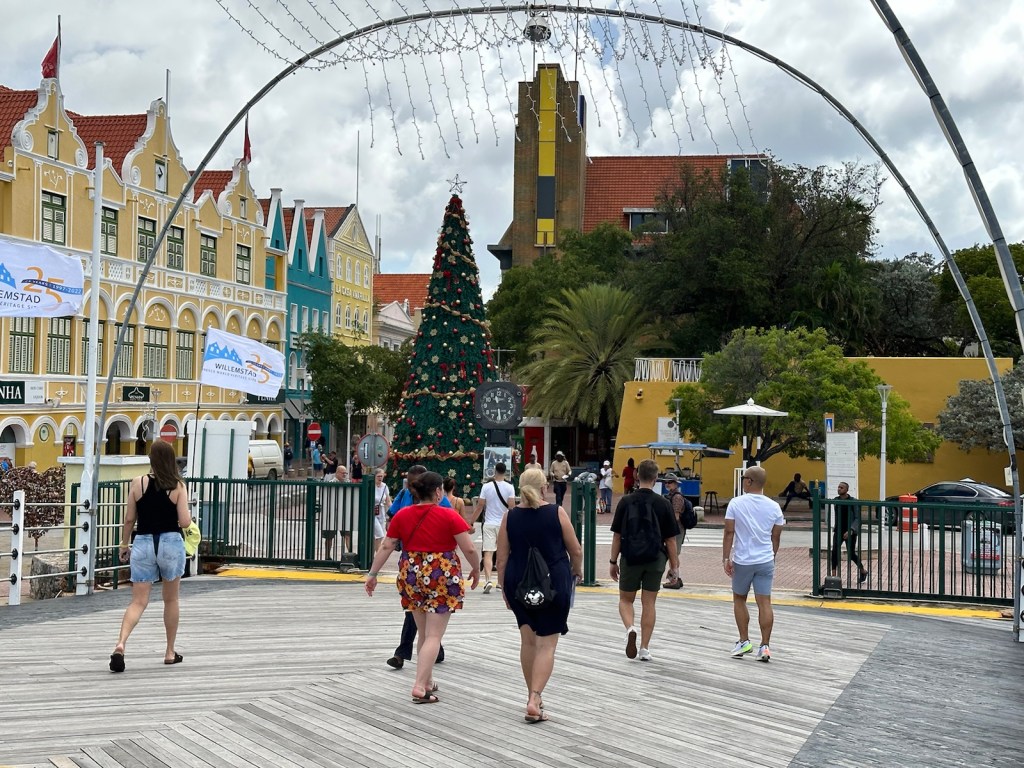
We started the day with the Bario’s Otrobanda Breakfast which included eggs with roasted bread, smoked salmon, a pumpkin waffle, yogurt bowl with fresh granola and home made banana jam.Our first walking excursion was to Punda, the oldest part of Willemstad. To get there, we crossed the St. Anna Bay over Queen Emma pontoon bridge.
The Queen Emma bridge is hinged and opens regularly to enable the passage of ocean going vessels. On the opposite end from the hinge is a small shelter where an operator controls two diesel engines with turning propellers.
When the pontoon bridge is going to open, bells and alarms go off. Gates shut off the ends so people can’t enter or leave. If you’re on the bridge, you just stay there and go along for the ride
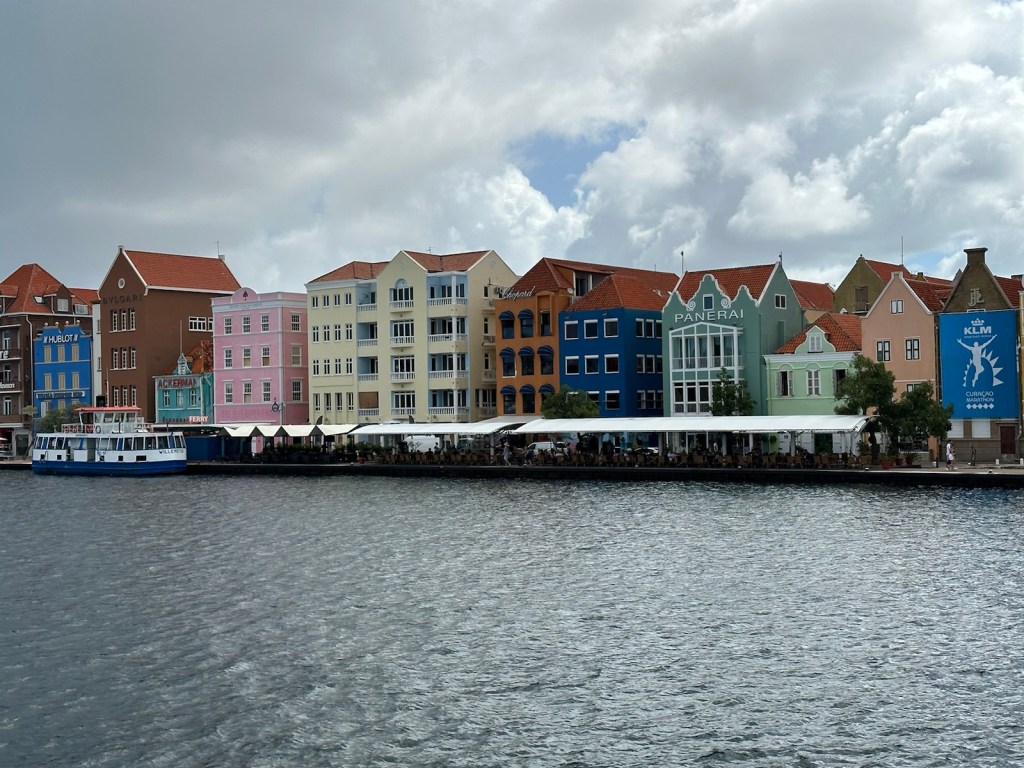
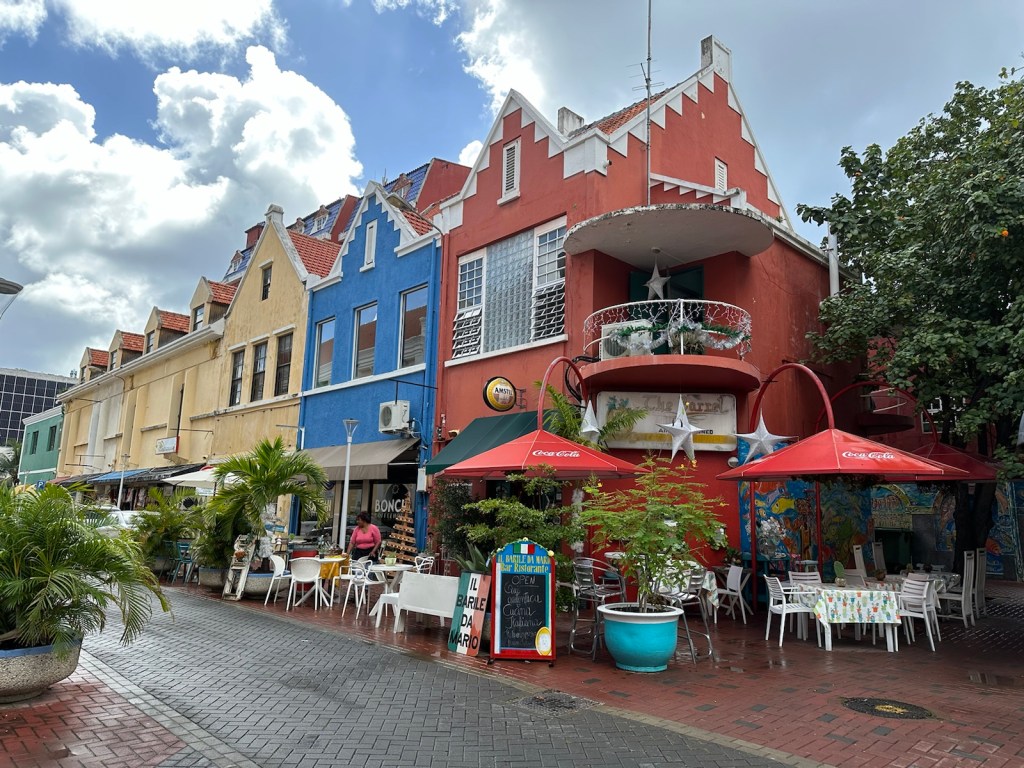
Punda is the location of the world famous Handelskade: the waterfront collection of multi-colored buildings that has become Curacao’s most characteristic image. It is one of the most known UNESCO world heritage sites.
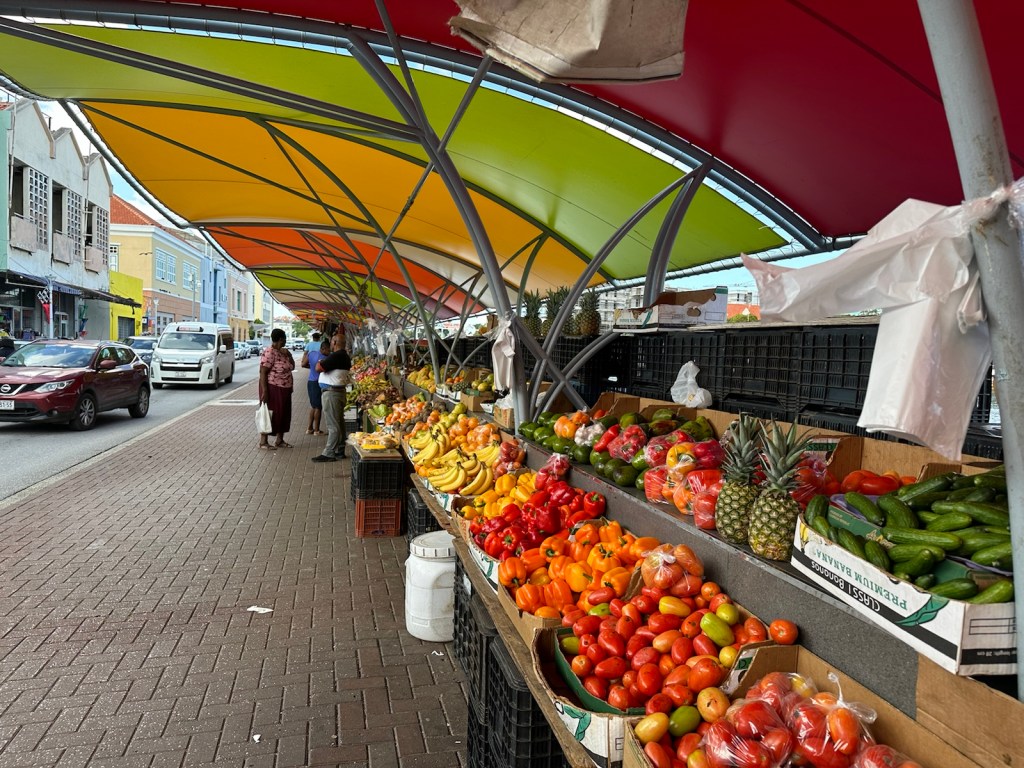
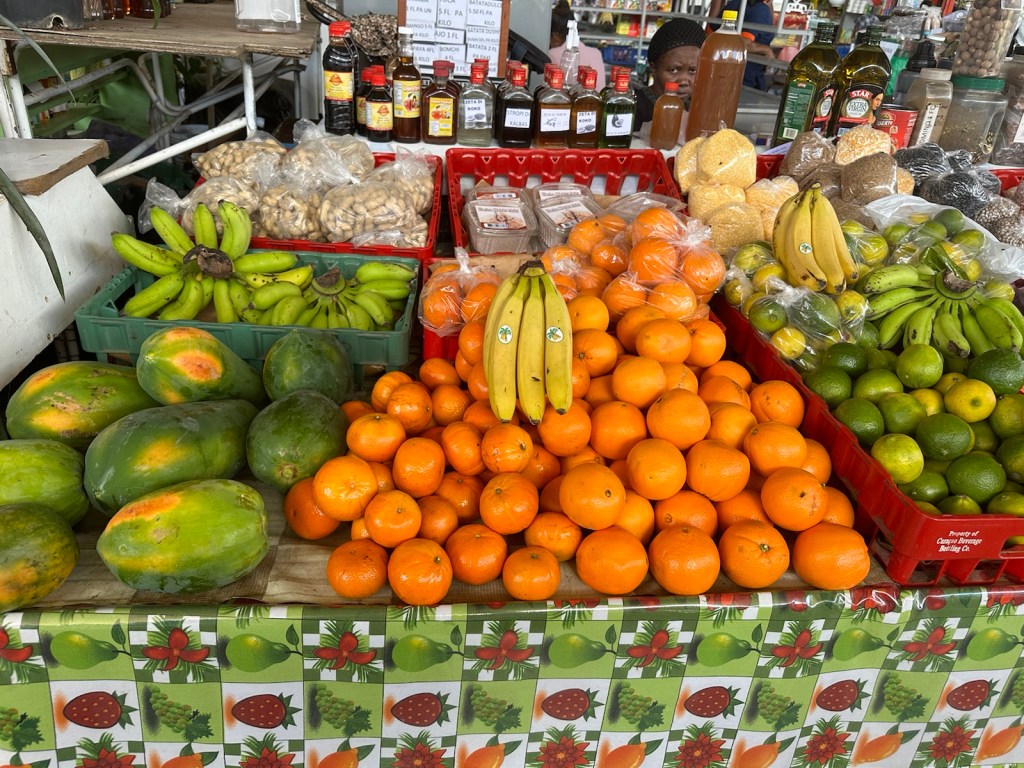
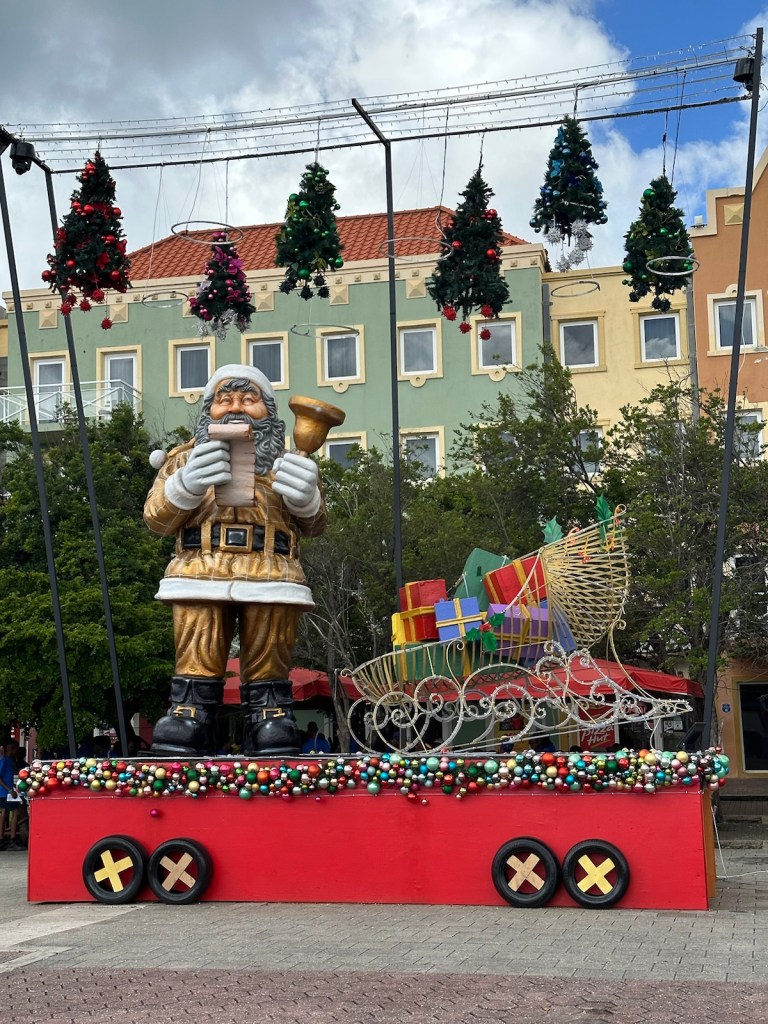
Dutch buildings in brilliant pinks, blues and yellows line the waters of St. Anna Bay. Greeting us on the Punda side is a giant Christmas tree fully decorated.Fruits and vegetables from Venezuela are sold in stalls along the St. Anna Bay. Boats arrive early morning to replenish the supply of goods … this is known as the floating market. The markets have so many colorful things to choose from — fun to look at.
The floating market is where Venezuelan merchants would dock and sell their fresh fish, produce and spices. Curacao is predominantly arid and it is near-to-impossible to grow in quantities sufficient enough to support the local market and visitors. Today’s more efficient shipping methods and larger scale grocery operation (and the difficulties in Venezuela) threaten to make this once vital market obsolete.
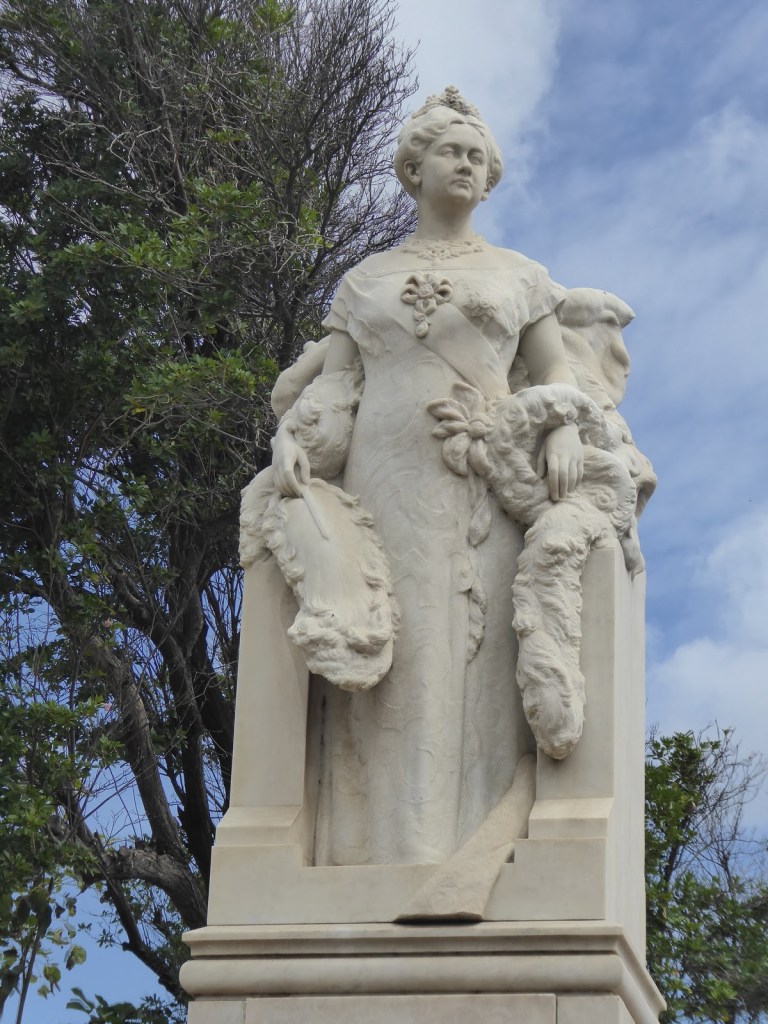
Queen Wilhelmina Helena Pauline Marie, longest reigning Dutch monarch.
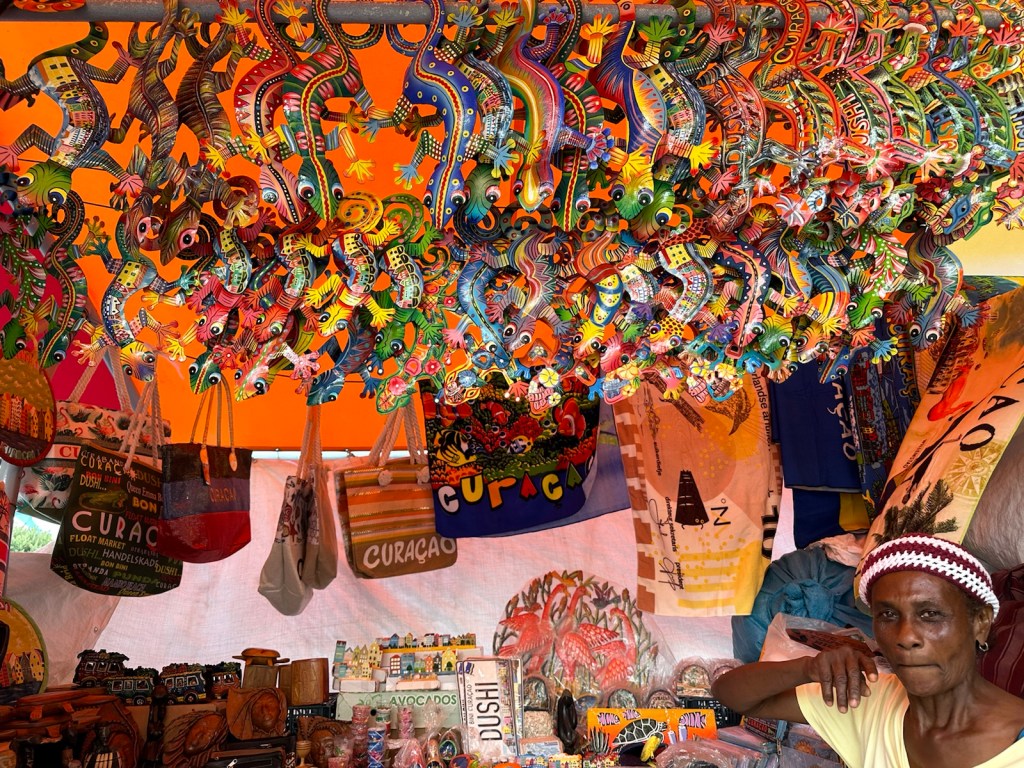
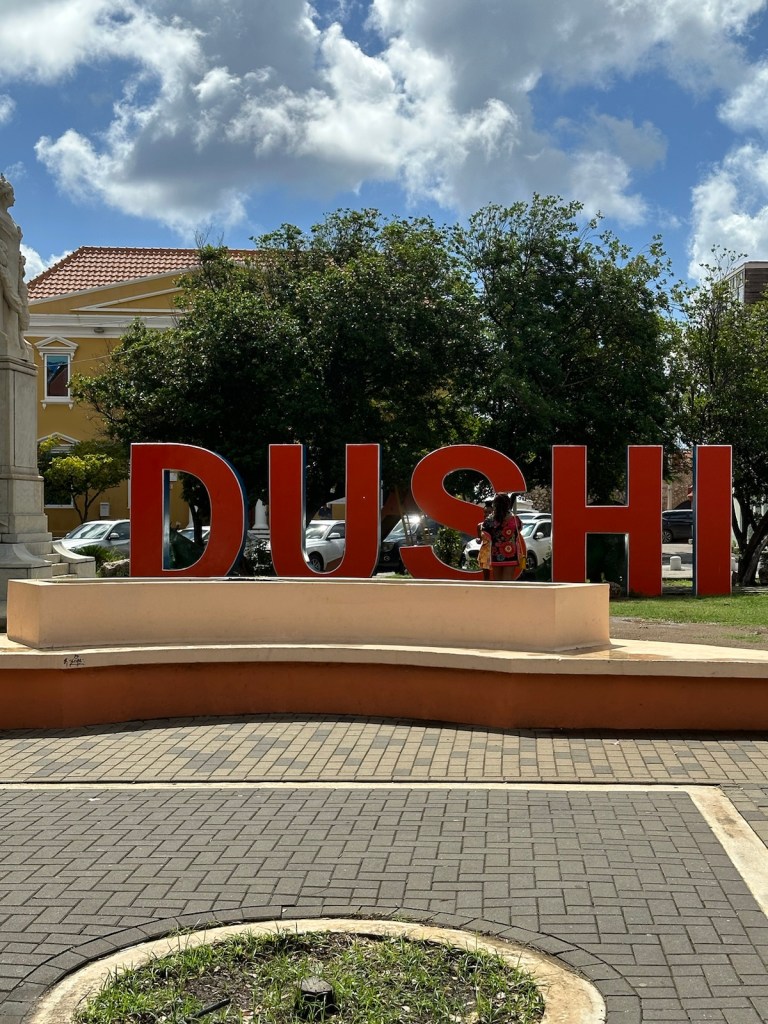
Wilhelmina Park is in the heart of Punda. This is where you will find the brightly colored signs ‘Curacao’ and ‘Dushi’ for photo-opps.
Dushi is a Papiamento word that means ‘tasty’. You see it everywhere. It comes from the Spanish word ‘dulce’ which means ‘sweet’. Biba Dushi means ‘living a sweet life’.
Next to the statue of Queen Wilhelmina is the Papiamento word, ‘Dushi’ which translates as Sweet!
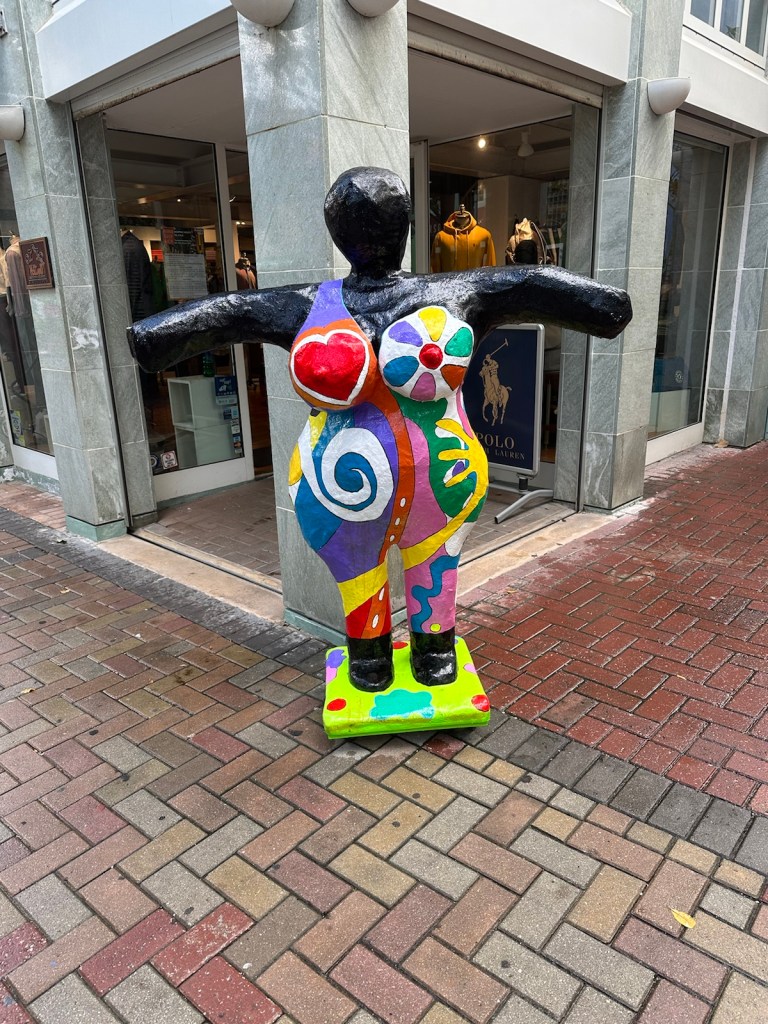
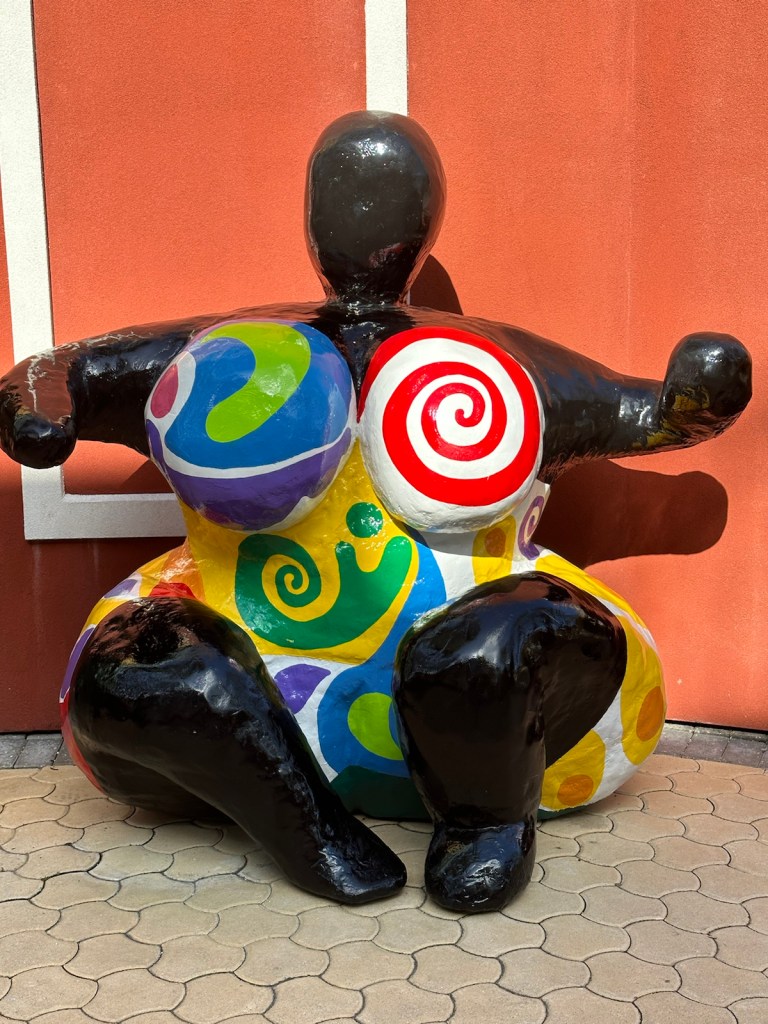
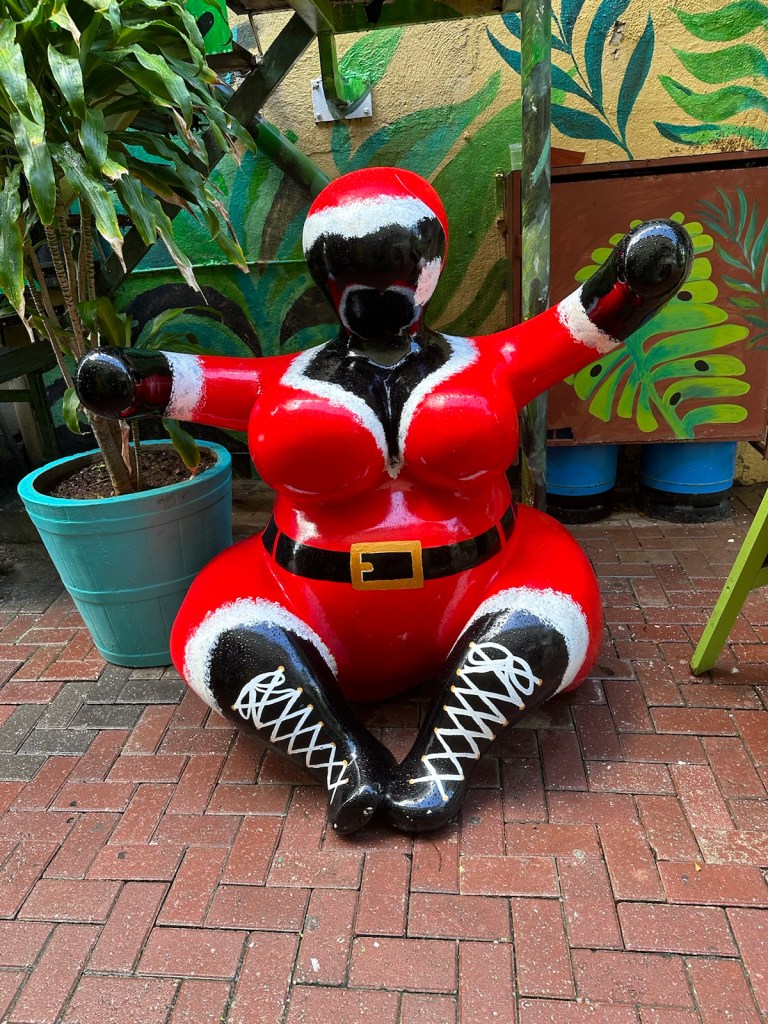
Curacao is home of the ChiChi, a well rounded Caribbean figure. She represents the vibrant, dynamic and responsible older sister. The statues are handmade and painted in bright Caribbean colors by local craftsmen and painters at Serena’s Art Factory.
Chichi is the Papiamento word for ‘big sister’.
She represents the eldest daughter of the family who binds the family together in a loving and caring way. She is a much appreciated female role model in the Caribbean community of today and a very live part of its colorful heritage.
Chichi is an expression of big love and big care.
The Chichi statues were created by a German woman named Serena Israel. When she came to Curacao, she realized there was a lack of jobs especially for women and that the island needed a souvenir that was distinctly Curacao. Serena was a seasoned mold maker. She dreamed up the idea for the Chichi dolls based on the women of Curacao. But rather than make them herself, she aimed to give the islanders something of their own: to teach them how to make the plaster dolls they inspired through an extensive trainee program with the artist herself at the helm. As the women prove themselves over time, Serena raises their pay as a form of empowerment.
Next stop, I see a building that looks like a church. So we wandered over there. It was once a synagogue but now is a public prosecutors office. I would never have guessed that.
Once a Jewish temple, now it’s the Public prosecutors office.
We wandered through the streets of Punda. More colorful buildings, coffee shops and restaurants.
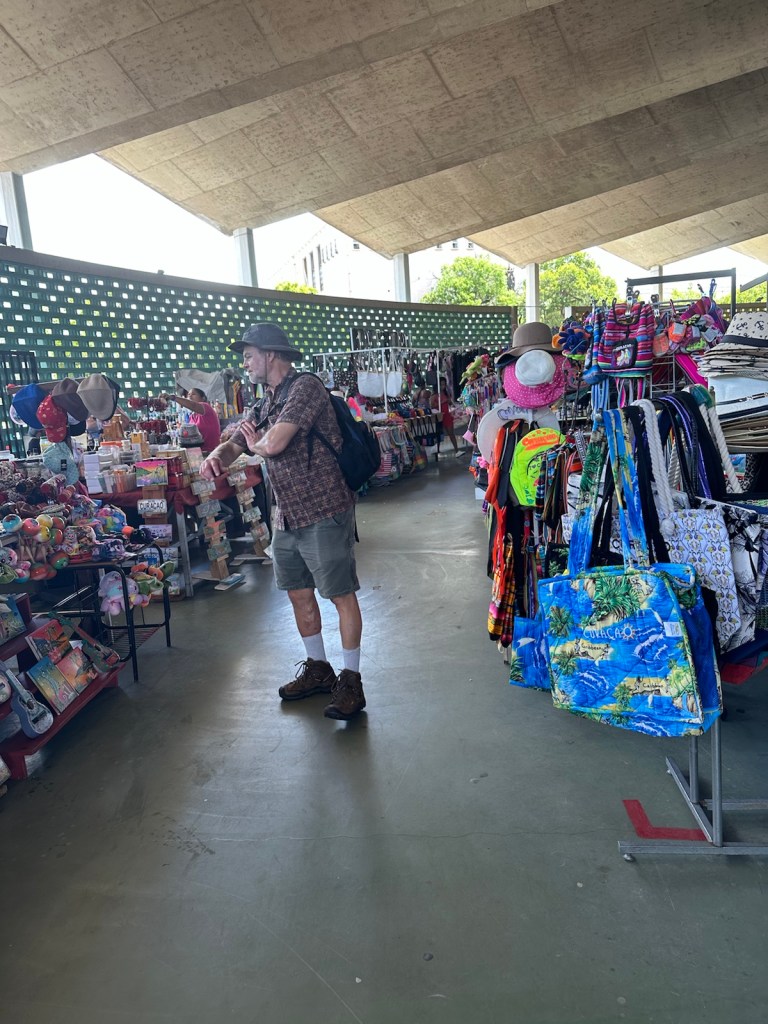
Next stop is the New Market. It’s kind of like an outer concourse of a baseball stadium and you just walk in a circle. It’s like a flea market where you can buy beauty supplies, clothes and other random things. We bought a couple beach towels. There are food vendors too.
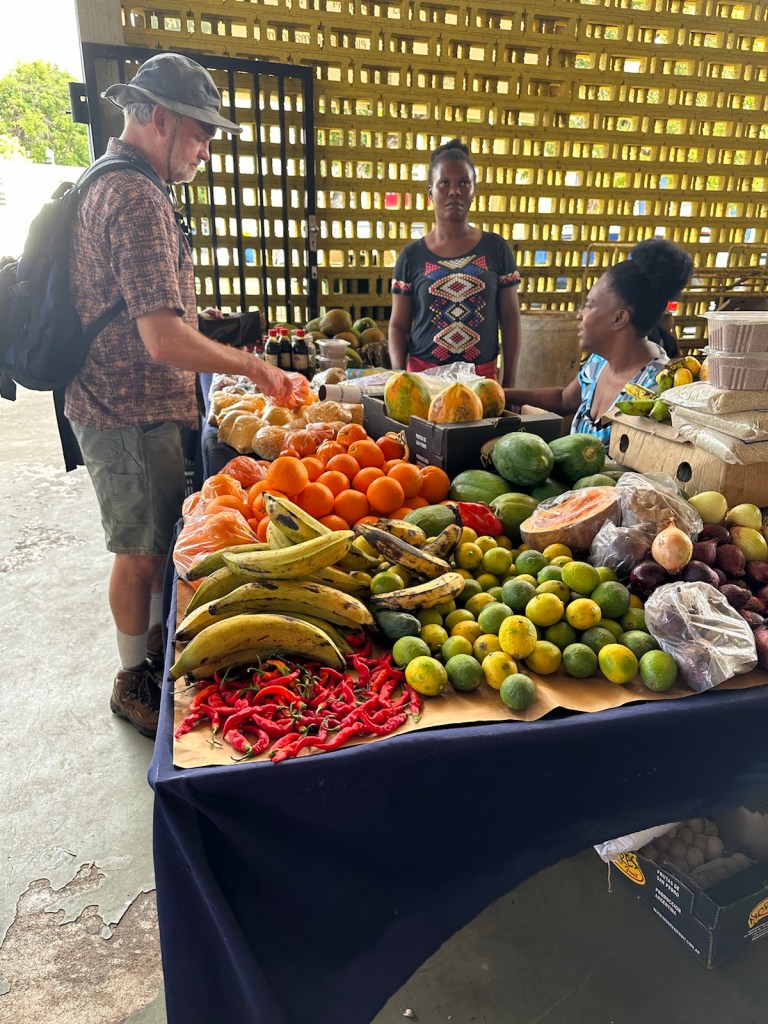
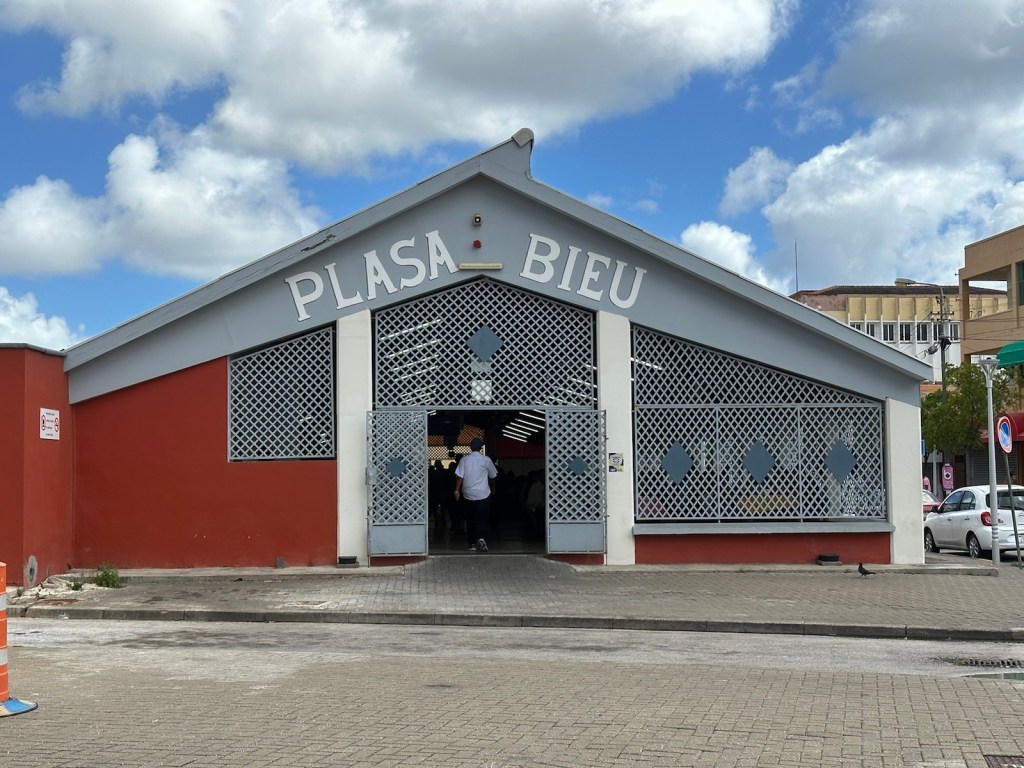
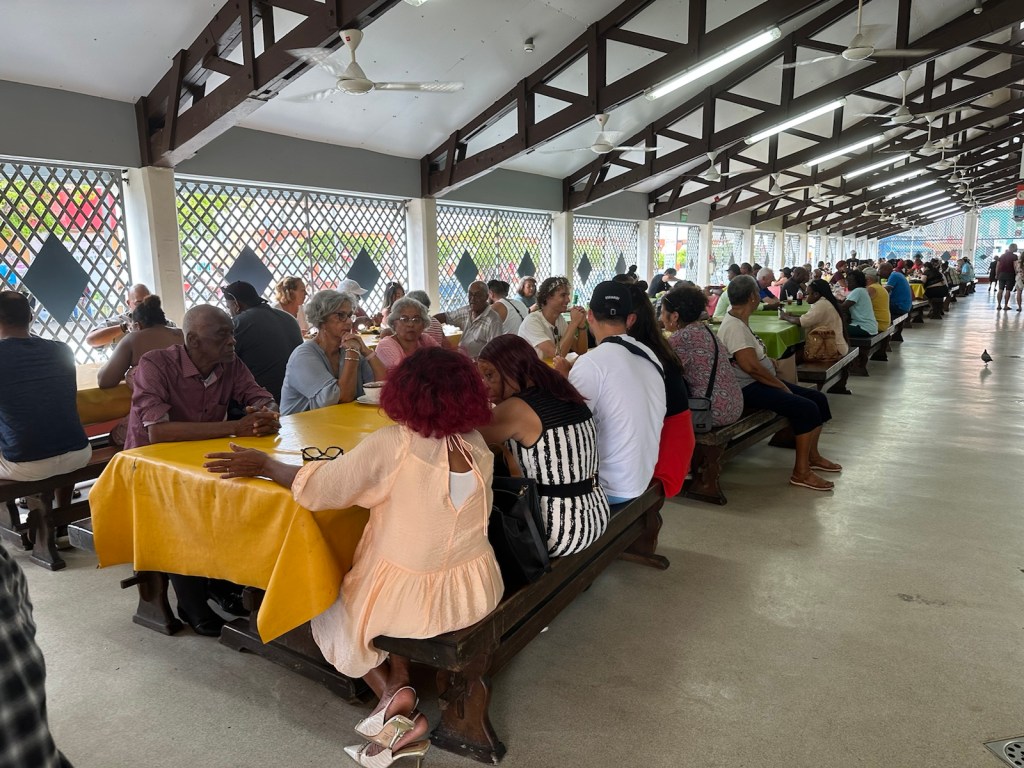
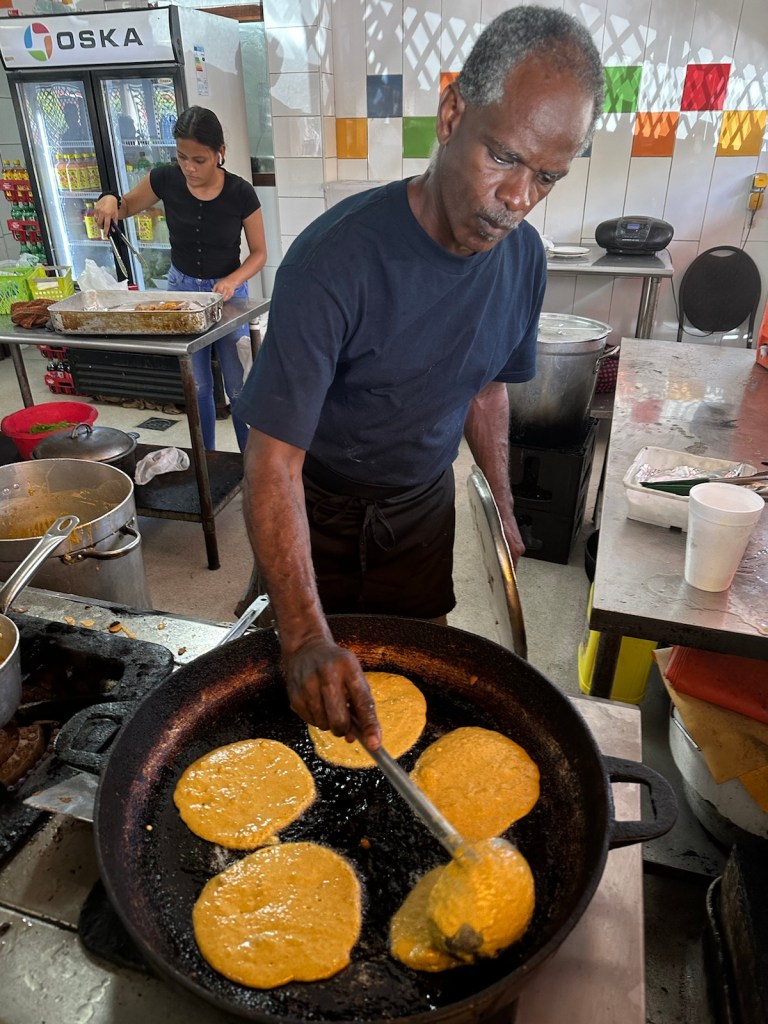
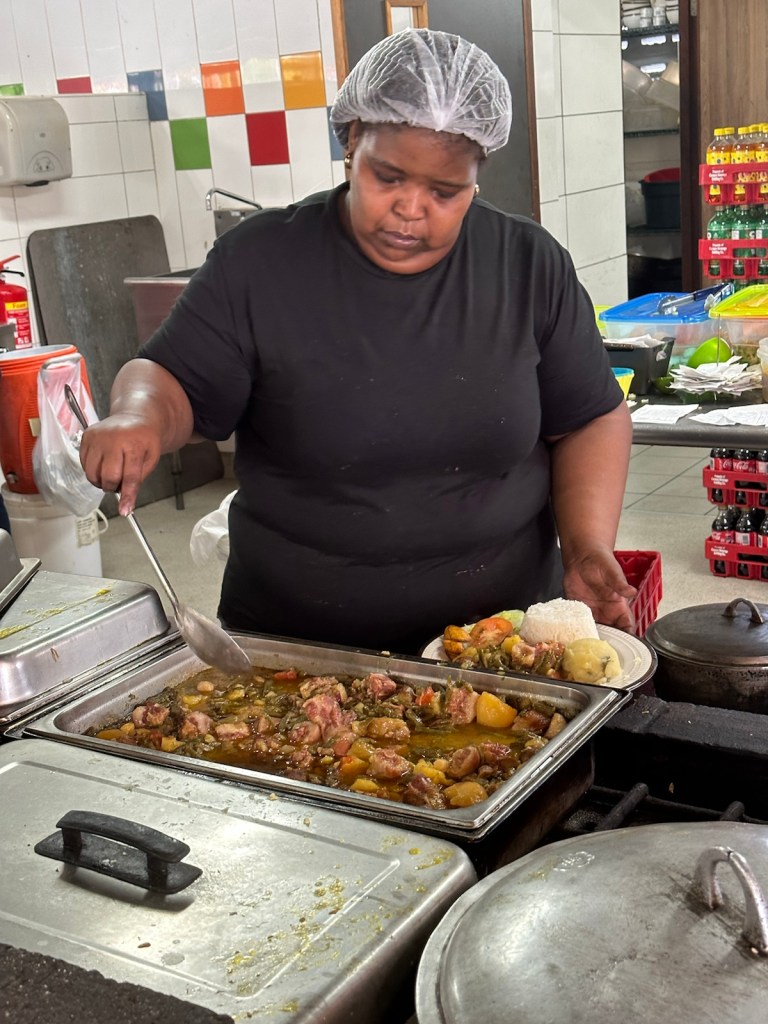
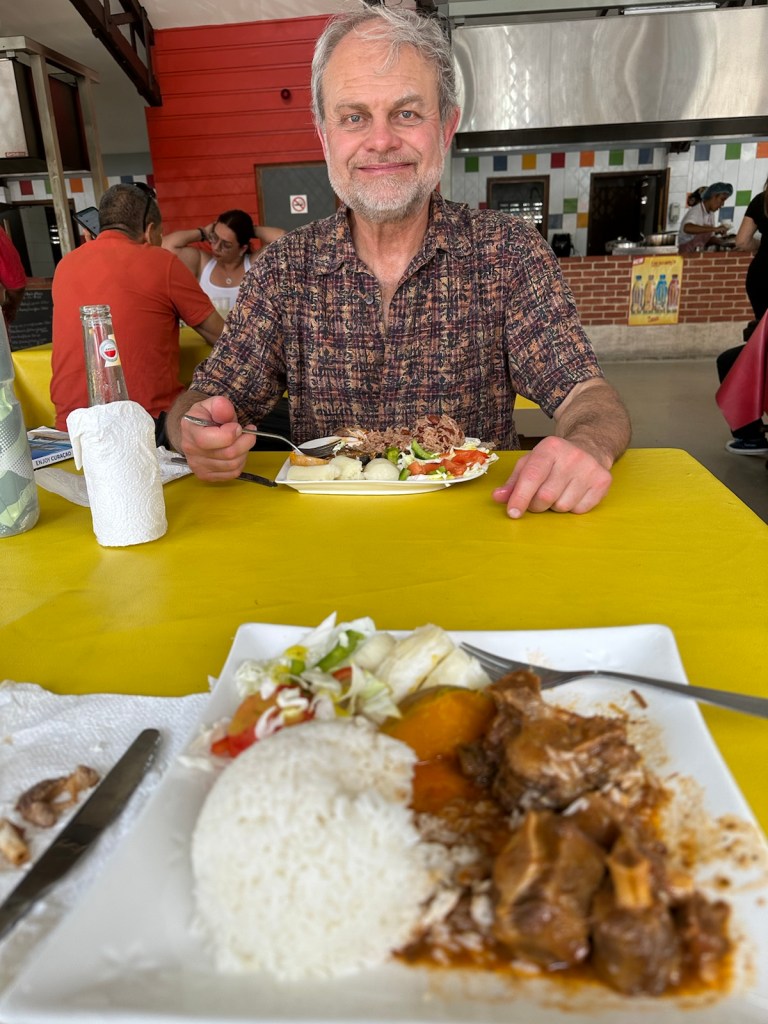
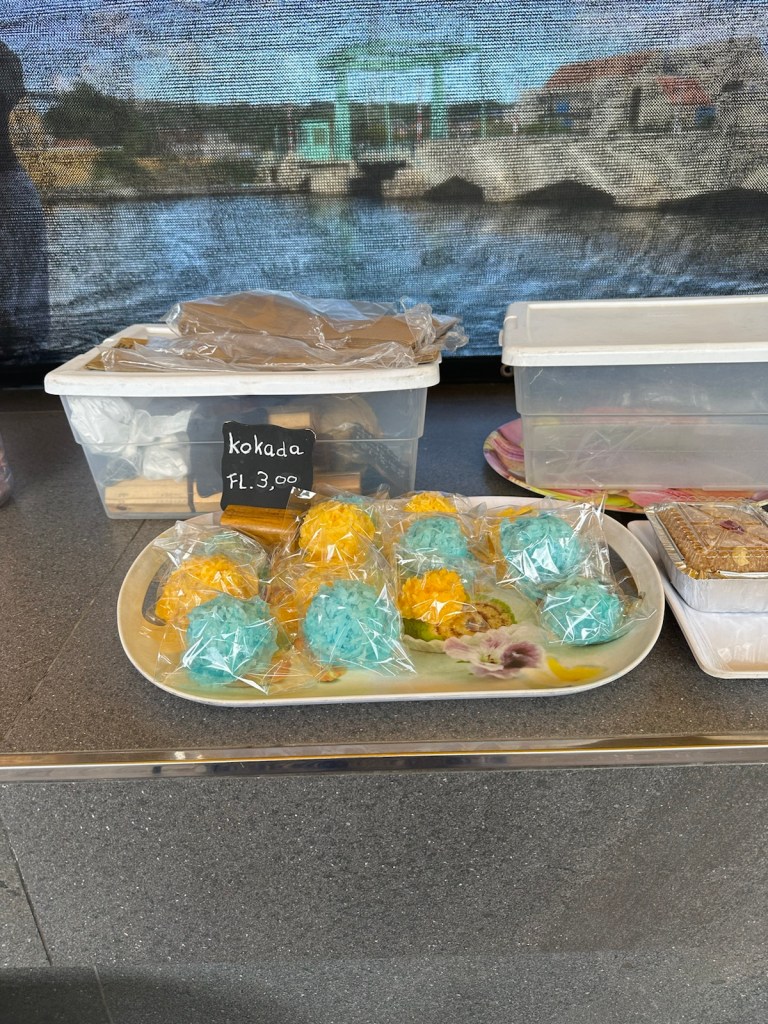
David peruses the countless items at the New Market.Lots of fruits and vegetables are sold here.I loved this little food stop. It looked like someone’s kitchen with the ladies preparing food. A nice dining room table makes customers feel at home.We stopped for a beer and to watch the World Cup soccer. The silverware drawer is where they kept the cash. Plasa Bieu is were the locals dine. It’s an airy, rustic market with picnic tables and counters serving classic Curacoan eats. Pumpkin pancakes made to perfection.Another Curacoan dish served with rice.David chose Mahi Mahi and I went with one of my Spanish favorites, Oxtail. Both were awesome.Blue and orange coconut.This is a view of the Juliana bridge which amazes me. Cruise ship used to pass under it. They are banned now because of the damage they cause to the channel.Sinter Klaus Controversy
They used to celebrate St. Nicholas Day here which is typically December 6. From my American perspective, you would put your shoes outside your door and St. Nicholas would come by and fill them with treats which would be found the next morning. It’s a little different here. St. Nicholas would arrive by boat and deliver gifts to the children. We thought it would be fun to see this … until I started reading some controversial things.
A Dutch woman explained this to us. She said countless years ago, St. Nicholas came to Curacao and bought a slave. He gave the slave his freedom. The slave, an elf-like character’s name was “Zwarte Piet” which translates as “black Pete”. Black Pete was so grateful that he told St. Nicholas he would be his helper. Typically, Black Pete was portrayed by white people in black face with red lipstick. Anyways the tradition came to a halt in Curacao with Covid. During the covid break, somebody portrayed Black Pete as a black Dutch politician originally from Suriname … in poor taste. It was racist and objectionable which made the celebration unappealing. Now instead, Curacao celebrates a children’s day on December 20th.
Trevor Noah provides Black Pete insight on You Tube.
We’re back on the Outrobunda side of the Queen Emma bridge. Lots of holiday decorations.
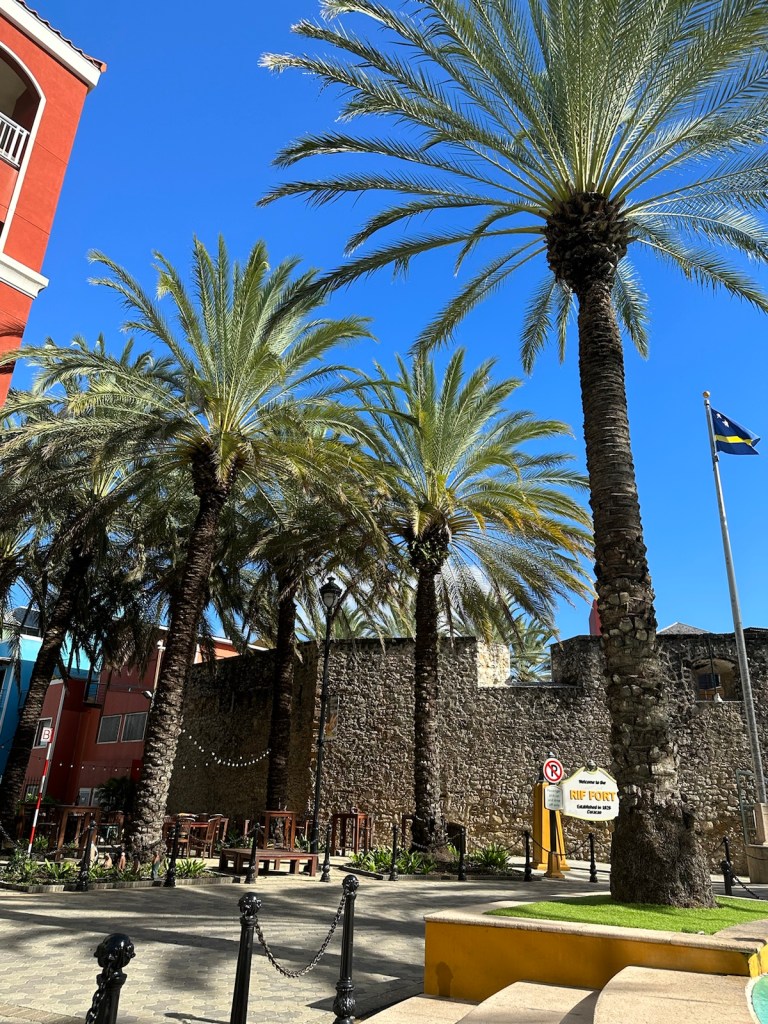
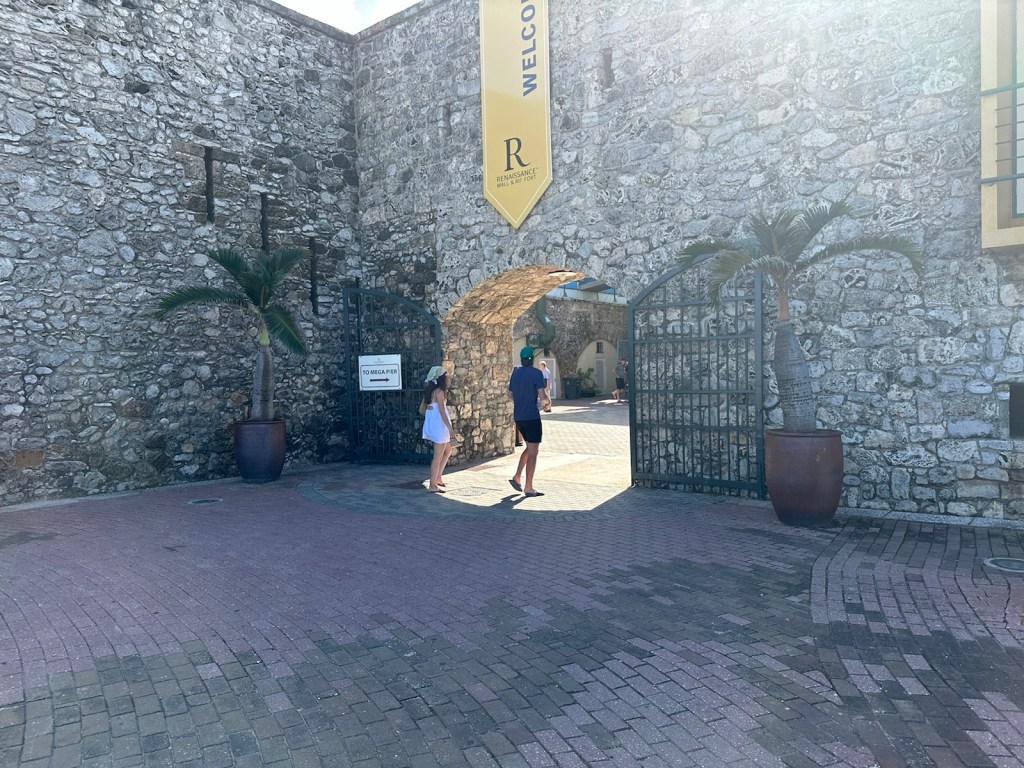
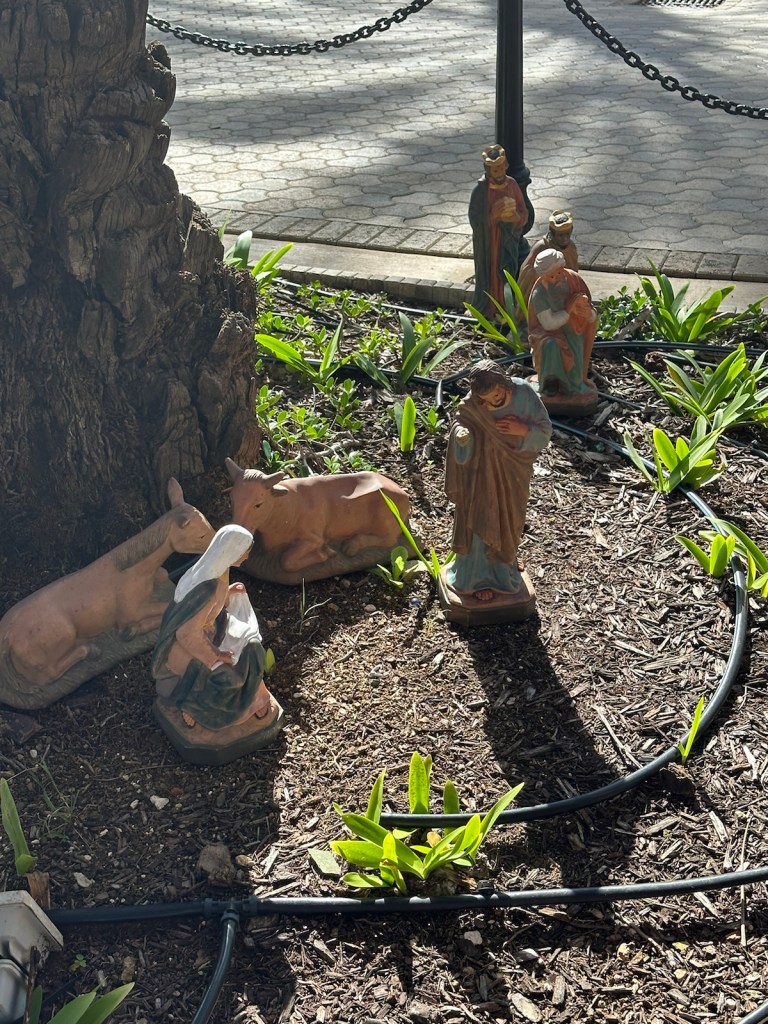
Located at the entrance of the St. Anna Bay on the Otrobanda side is Rif Fort. It was built in the 19th century to protect Curaçao from pirates and other invaders.Now Rif Fort is used as a very touristy shopping mall located near the cruise port dock.Next to Fort Rif is a decorated shopping street. A small manger scene sits beneath a towering palm tree.
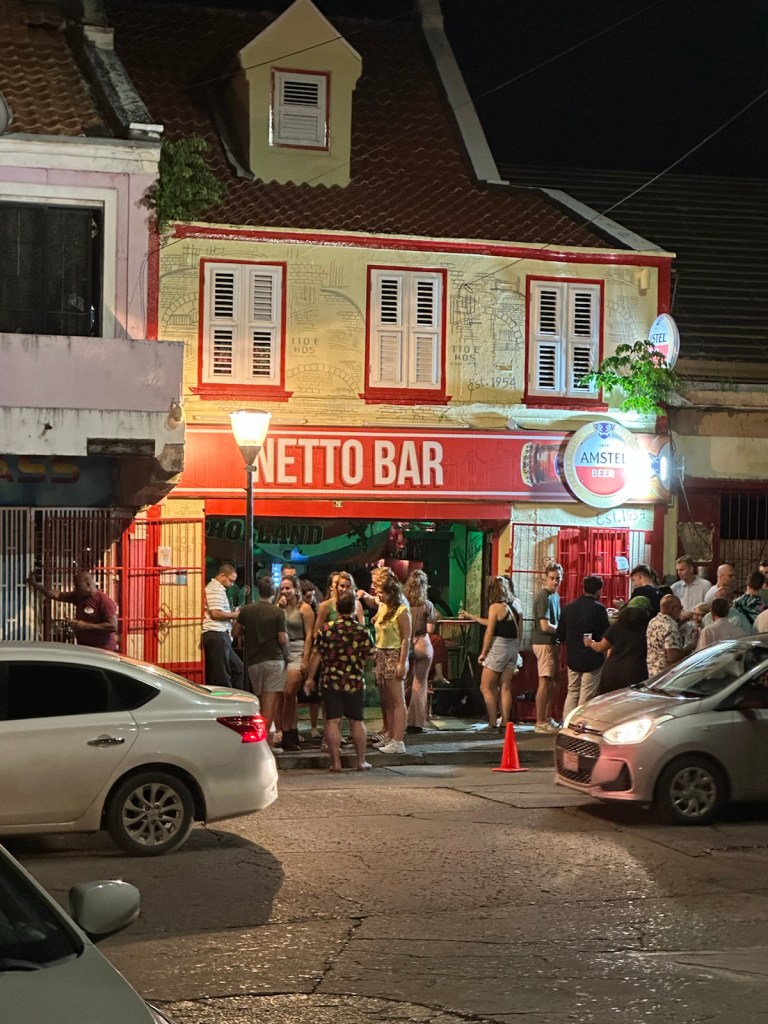
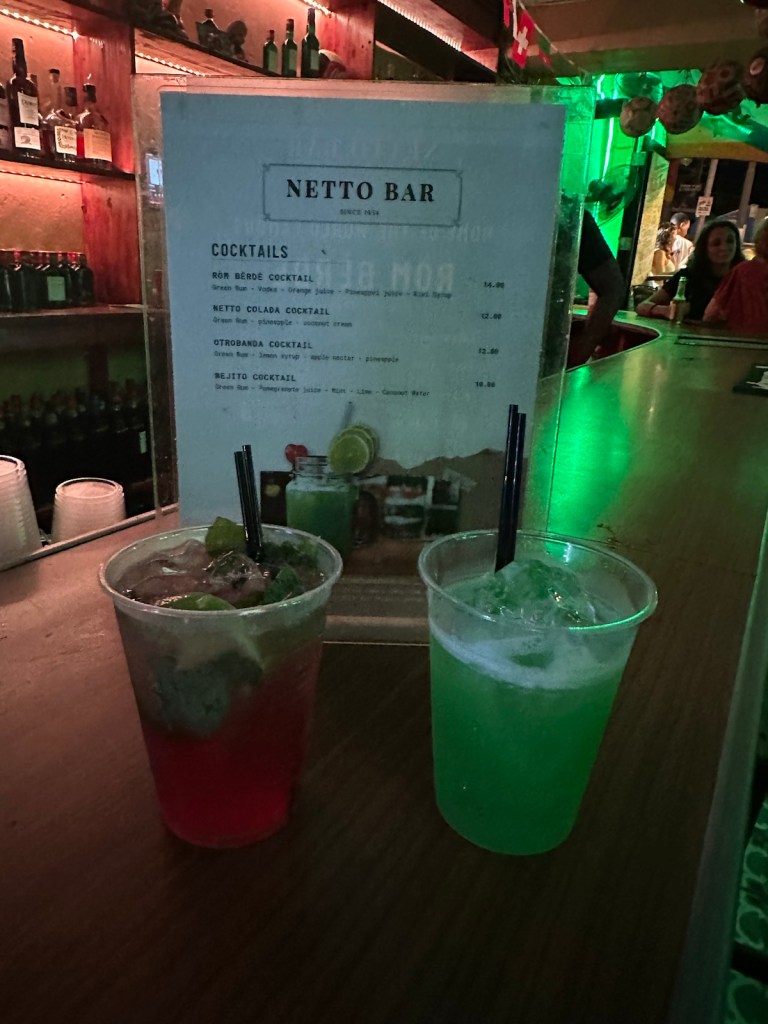
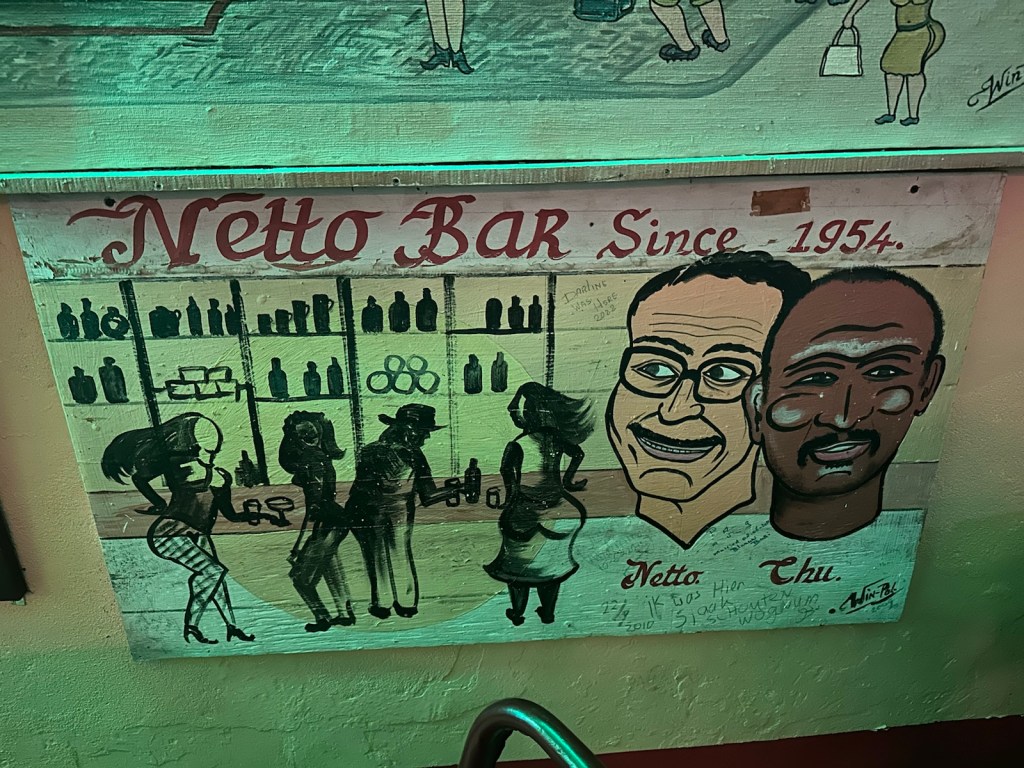
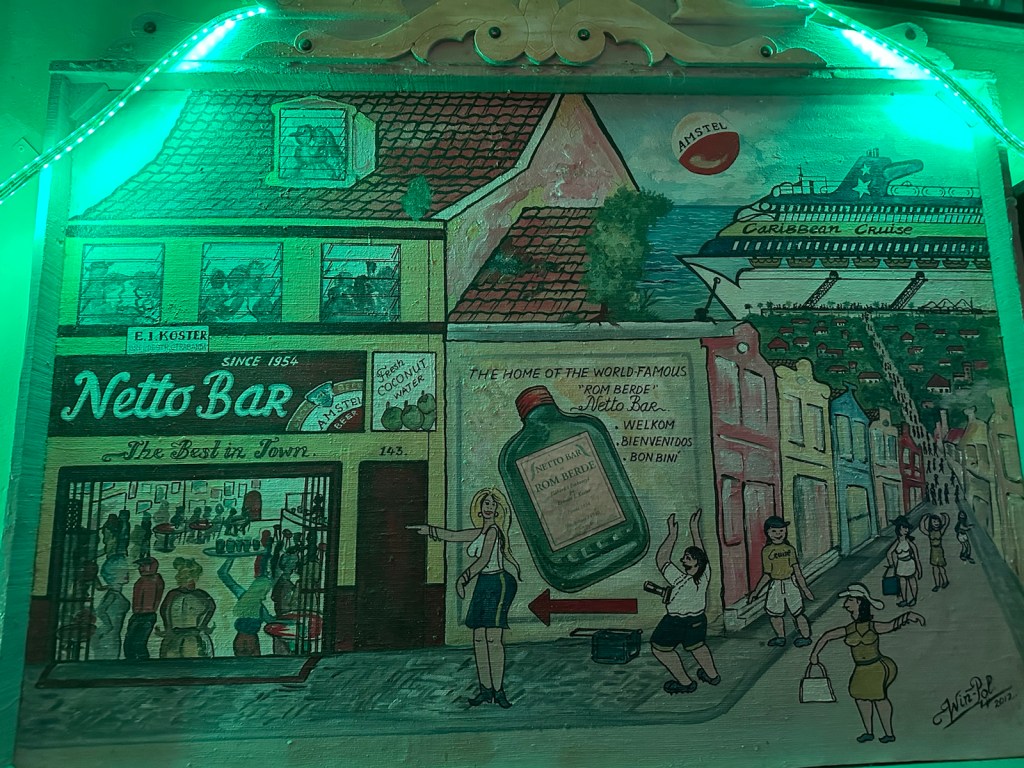
Next stop is Netto bar. It is the oldest bar in Curacao and home of the famous green rum, Rom Berde.
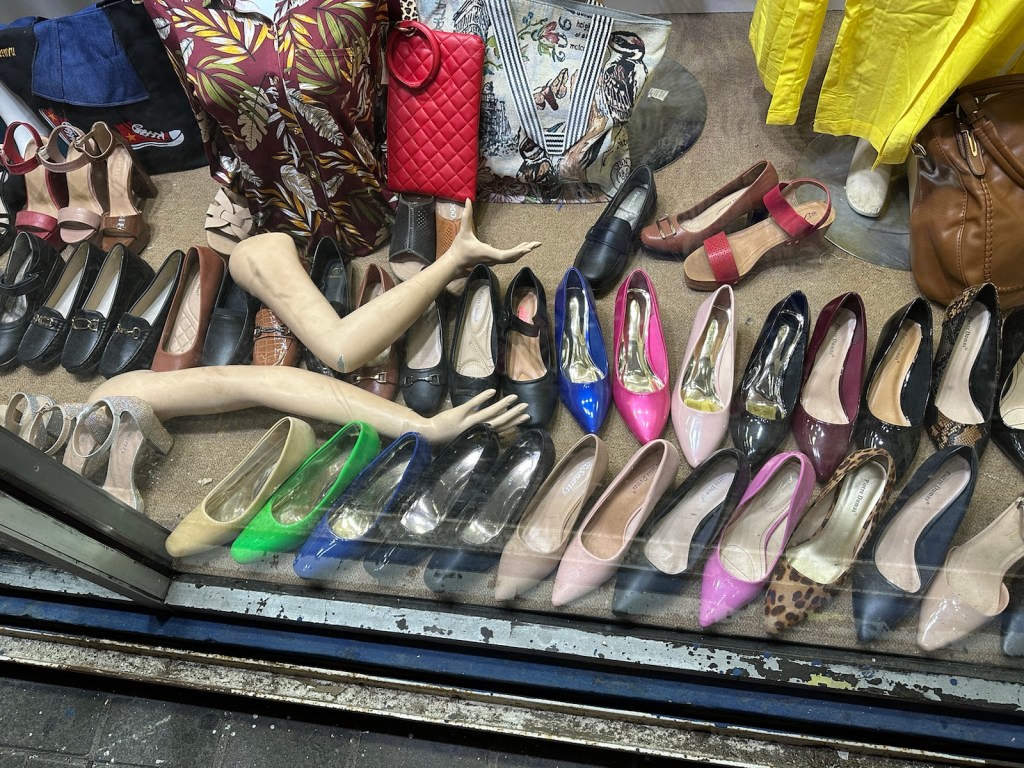
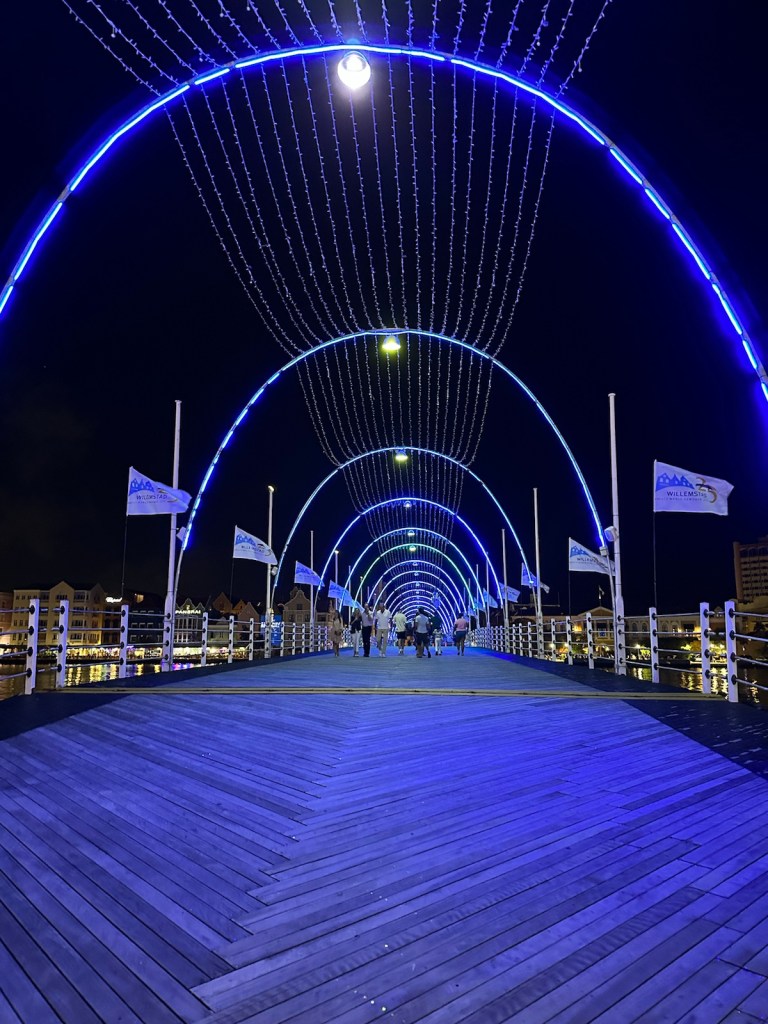
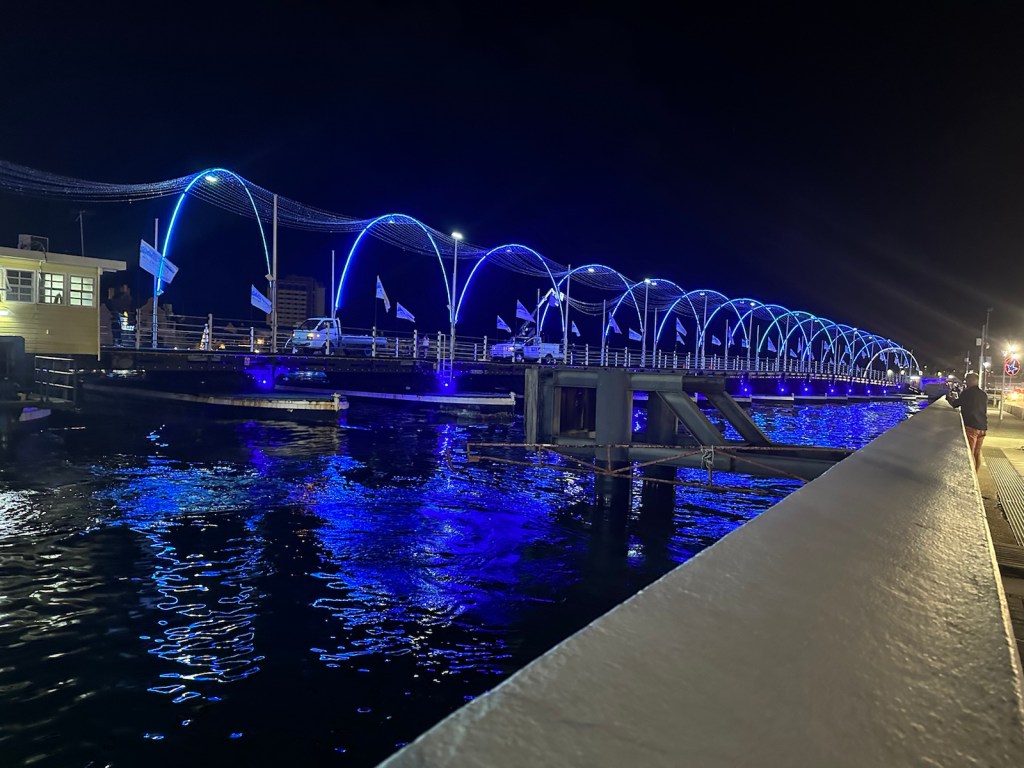
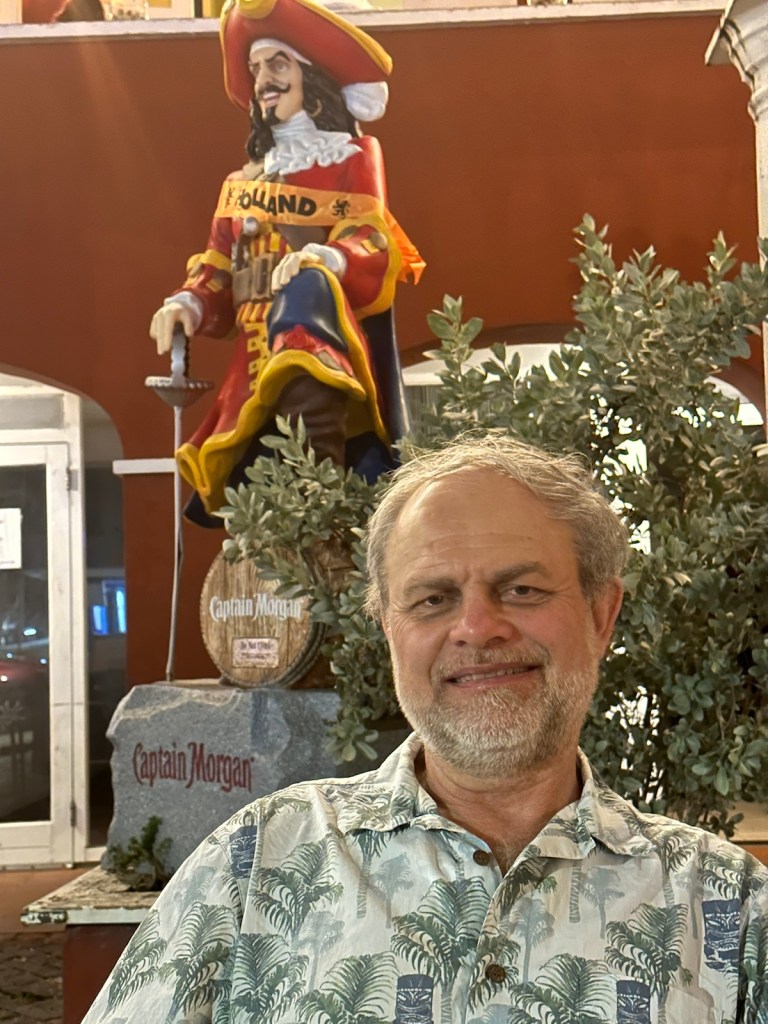
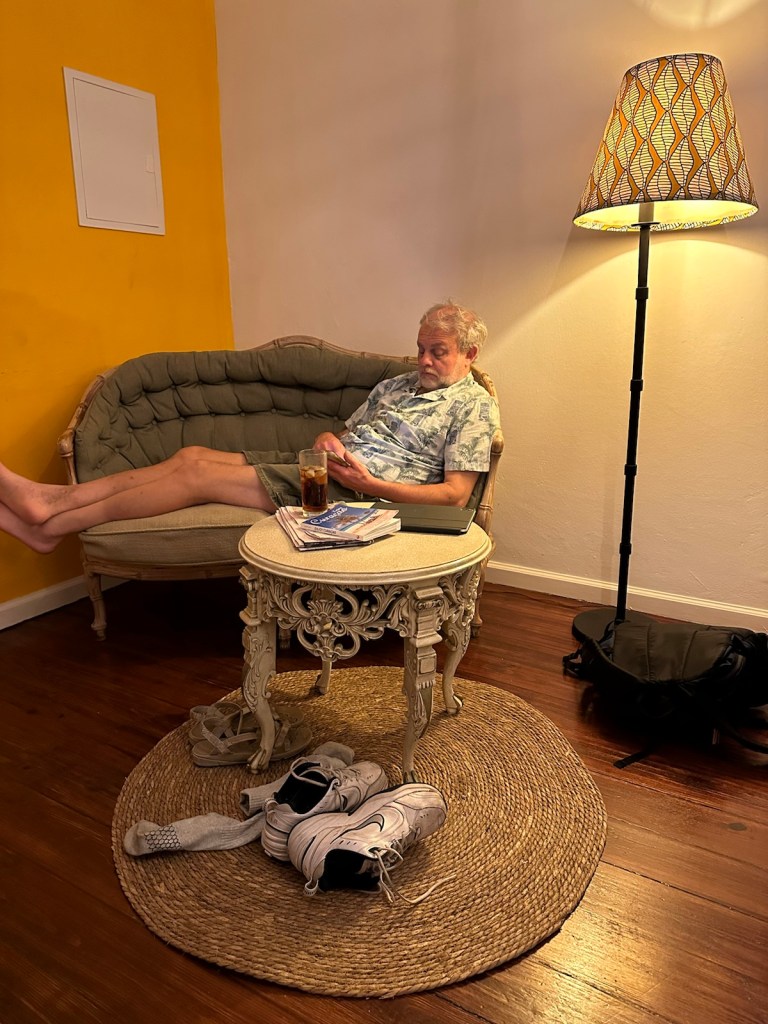
This little hole in the wall had 16 fans and 2 air conditioners blowing, yet many of it’s customers preferred standing outside.Netto bar is home of the famous green rum, Rom Berde. It reminded us of the NE Minneapolis establishment ‘Tony Jaros River Garden’, home of Minnesota’s original Greenie, a potent lime-y drink.The bar is full of pictures and paintings of idyllic Curacao and late owner, Ernesto ‘Netto’ Koster, with famous guests in his bar such as the Dutch King Willem Alexander. Down the street is a shoe store, apparently shoes cost an arm & a leg here.The Queen Emma pontoon bridge at night.A quick stop for a bite to eat on the way back to the Bario … apparently Captain Morgan is a Holland soccer fan. Holland vs US is tomorrow.Back at the Bario. Time to plan tomorow’s activities.
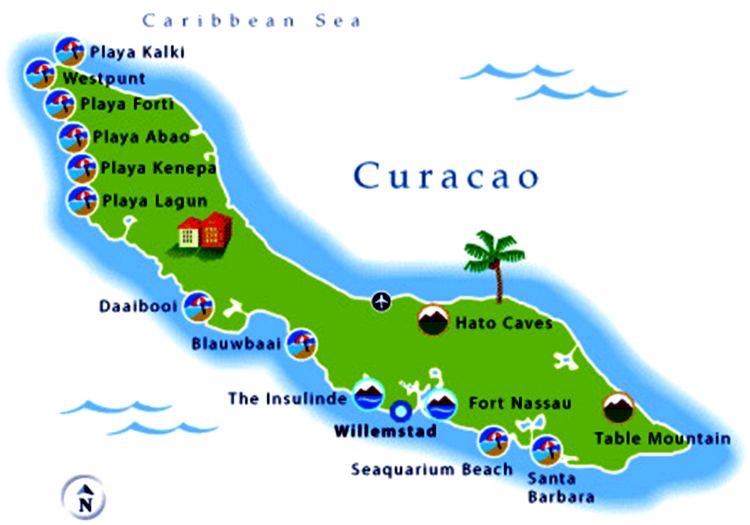
Where?? That’s the common response when I mention a trip to Curaçao. A map is needed to explain this one.
Curacao is about 50 miles from Venezuela.
Located in the southern Caribbean off the coast of Venezuela, Curaçao was a Dutch colony for a long time. Since 2010, Curacao has been an independent country within the kingdom of the Netherlands. They are in charge of their own affairs with the exception of defense and foreign policy which are managed by the Dutch. Together with Aruba and Bonaire, it forms what’s known as the ABC islands. Information taken from Enjoy Curacao.
The thought of Curacao in December is very inviting … 80 degree days, beautiful beaches, exotic birds, snorkeling with the sea turtles … exploring a place where many cultures have blended together. These pleasant thoughts were interrupted by a Minnesota reality … the sudden appearance of a snowstorm that arrived the day David and I were to depart. Beachwear and snorkel gear packed, we were planning to head to the airport in a couple hours.
I love a white Christmas but did the snow have to come today?
Our flight cancelled. This was not a good feeling. It took a few hours but I managed to shift our entire trip back by one day without incurring any additional charges. After all the re-arrangements had been made, it was kind of nice to have a little time to relax before departing.
A snowman on display at MSP airport made me anxious.
The second most common question about Curacao is, ‘how do you get there?’ And the answer is ‘through Miami’. The flight from Miami is about two-and-a-half hours long.
After completing immigration forms and going through customs, we headed for the car rental. The first thing you notice about Curacao is the humidity and then the heat.
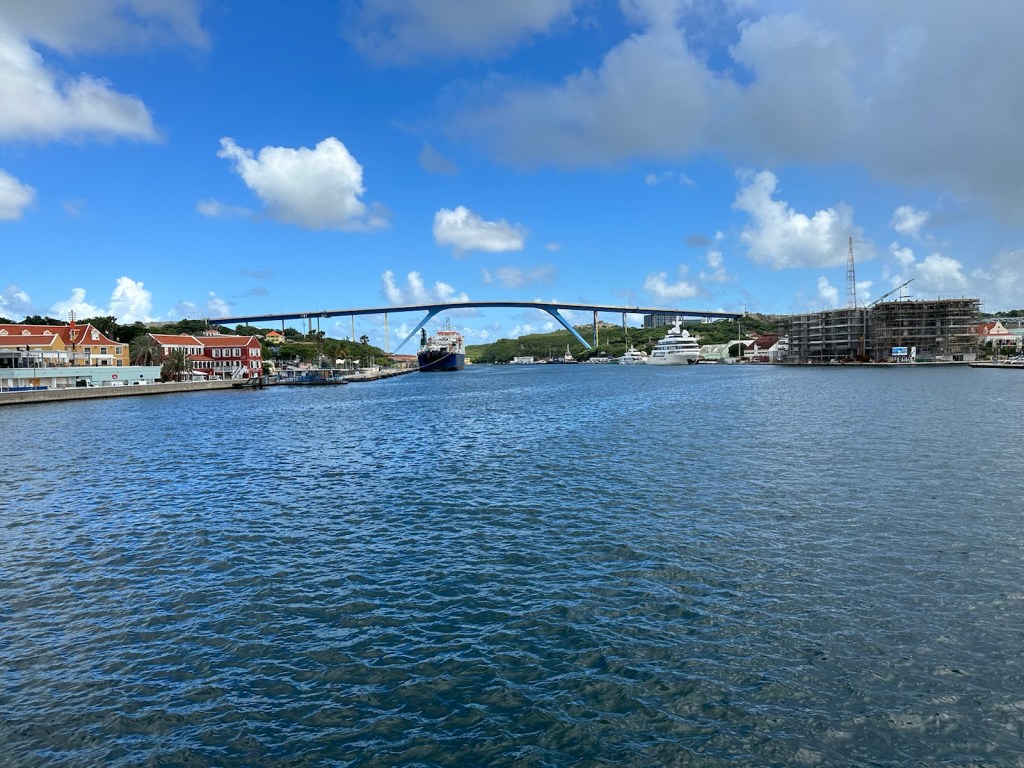
To get to our hotel in Otrobanda, we drove over the St. Anna Bay on The Queen Juliana bridge. It’s a white-knuckle steep-drive that goes straight into the sky. The bridge is high enough for the largest ships to pass under.
The first part of our trip, we are staying in Willemstad, the capital of Curacao. It’s divided in half by the St. Anna Bay. On one side there is Punda (which means ‘the Point’) and across from it is Outrobanda ( which means ‘the Other Side’).
Even though the street signs are all in Dutch, the language here is Papiamento, a Portuguese-based creole blend of African, Portuguese, Spanish, Dutch, French, English and Arawak Indian. The official languages in Curacao are Dutch, Papiamento and English.
I chose this hotel based on location. We could leave the car behind and easily walk around and Punda and Otrobanda.This hotel offered small apartments.Typically, we don’t spend much time at hotels but with this heat and humidity, it was nice to take a mid-day break when it is the hottest. No blankets here, just a sheet. The apartment has two high-speed air conditioners that cool the place in minutes. In addition to a balcony, we have an outdoor terrace at the entrance to our room. A few steps from our room is a tranquil pool with beautifully landscaped palms. The outdoor bar and restaurant are very popular with the locals and feature live music most evenings. Tonight, we enjoyed salsa, meringue and pop music. After hours of travel and getting acclimated to the heat and humidity, it was nice to kick-back and enjoy the surroundings. The Bario entertainment shuts down around 10pm and then it’s very quiet.
Next stop Pacific City! A beautiful drive down the coast and it seems to be even more remote.
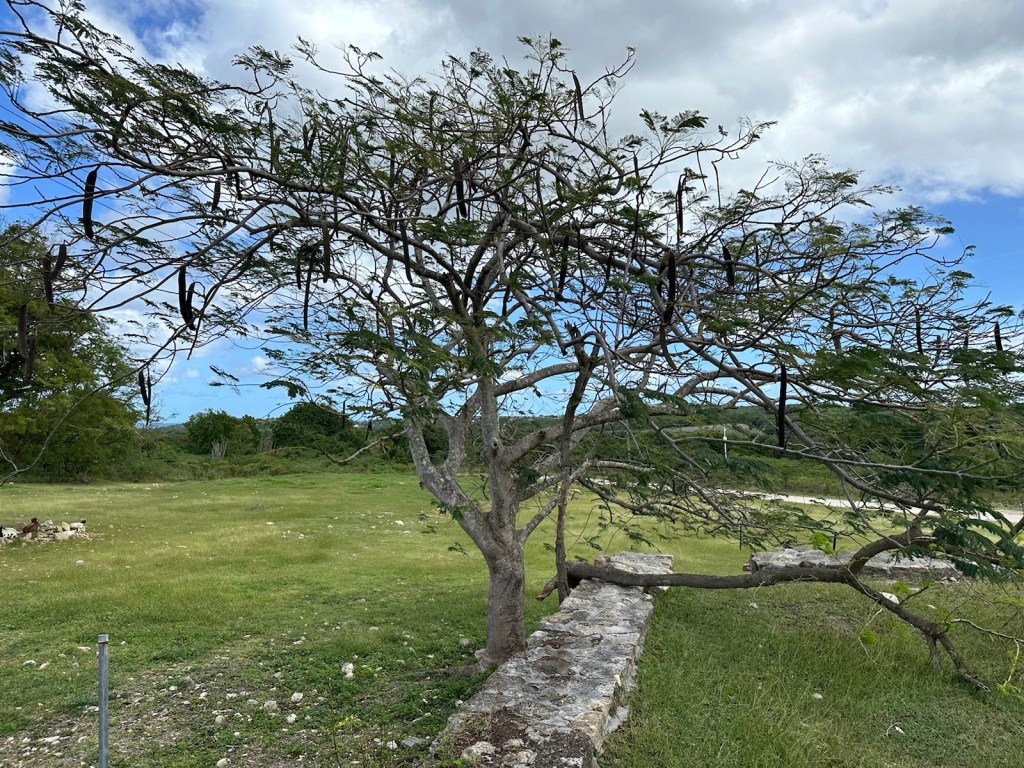
Not sure what this tree is but it is amazing to look at with its perfect symmetry and wavy branches.Here’s our rental house … with enough beds for over a dozen guests.A scenic view from our new digs. Pacific City has a haystack rock like Cannon Beach but it’s out farther and not reachable in low tide. Lots of surfers.Early sunset after a long day. Weather is looking better for beach wedding tomorrow.The house features a gourmet kitchen and my nephew James is right at home with it. He and my sister-in-law Ellen whip up breakfast for 14.Friday brings a beautiful blue sky sunny day in the low 80s. Perfect. The wedding is the focus of today and everyone is relieved that the weather is cooperating.The Minnesota contingency is on time and ready to celebrate. (Richard & Lisa missing from photo. )Guests begin to arrive for the wedding.An unforgettable ceremony …… followed by a beautiful indoor reception. A stunning sunset sneaks by as the reception rolls on. The colors of the sunset changed every few minutes. The evening ended with sparklers on the beach. Chandler & Kelly pulled off the perfect wedding.Saturday … we have a whole day open and four rental cars. Some went dune climbing, some went to Lincoln City looking for fresh seafood for dinner and some took off for wine country. Richard, Lisa, Ellen and I set out for Cape Meares for some stunning ocean views.Today’s dinner plan is for a seafood extravaganza.The dunes may look easy but provide a challenging climb and workout.So much fun to cruise the west coast with good friends Richard & Lisa. It was a beautiful drive to Cape Meares with lots of farm land and interesting terrain. A stunning wayside view in Tillamook county heading for Cape Meares.We took a break at a stone covered beach. Unfortunately, the road to the lighthouse was closed.No lighthouse … reroute. Now we’re heading for Willamette Valley which means a drive through the coast range heading toward Portland. More interesting forests with moss covered trees which at night could easily be mistaken for Sasquatch … that must be how those stories start.We arrive at Apolloni Vineyards which produces Oregon and Italian wines. The Valley is Oregon’s oldest wine region and has two-thirds of the state’s wineries and vineyards. Apolloni is a family run vineyard. Alfredo, (second-generation) shares his passion for the vineyard and the wines we were sampling.
After a little wine, we realize it’s a long drive back to Pacific City and we don’t want to miss the sunset. Back in the car and a beeline route back.
Bubba and Ellen kick back after a long day of exploring.Tonight’s chefs, cousins James, Kyle and Owen doing seafood & oyster prep for dinner. Happy hour charcuterie.Everybody on the deck … getting ready for the sunset.A beautiful view from the cavernous living room.A final sunset worthy of an awesome trip. Someone had a great idea — let’s go swimming!There they go … water was extremely cold so the swim didn’t last long. A lot of hootin’ and hollerin’ took place. And they survived with another great memory.Back to dinner prep. A seafood bisque in the works.James workin’ the grill by cell phone light.A beautiful feast. Food, family, friends … the best dinner ever!
The week ended with a bonfire on the beach and a visit from a curious creature with a big shadow. We joked about how it would be fun to come back to the rental house for a 1st anniversary celebration.
On Sunday, we packed it up and headed to Portland. Most of us were on the same flight. I rate this as a 5-star week in Portland. Oregon rocks!
Another cloudy cold day on the Oregon coast. David and I are headed to the Portland airport to pick up a few wedding guests. It was another beautiful drive through the hilly forest. No stops along the way. We were trying to arrive at the airport in a timely manner.
We planned to squeeze 5 people plus luggage into an SUV with a second airport pick-up later today for a 6th person.
Youngest son Owen shared the back seat with several suitcases. The rental car had a luggage rack but rain was in the forecast.
With our passengers in tow, we headed toward downtown making a stop for gas on the way. I pulled into the gas station and a man came up to my window and wanted a credit card. I wasn’t sure that he actually worked there and was hesitant to let go of the credit card.
David jumped out of the car and ran around to start pumping gas. The “attendant” told him that he could not do that … it was illegal. I released the credit card and the man inserted it into the pump and started filling our tank. David hovered around him and started washing the car windows which the attendant said was ok to do. I anticipated a “service charge” in addition to the gas payment but that didn’t happen. How odd is this?
We sooner (or later) realized that all of the gas stations in Oregon have attendants. There is up to a $500 fine for pumping your own gas. Oregon remains only one of two states that doesn’t allow drivers to pump their own fuel. (New Jersey doesn’t trust drivers to responsibly pump gas either.) Because of the pandemic and nationwide workforce shortage, they are considering legislation to allow for both full-service and self-service pumps.
Across from the gas station was a string of food trucks about as far as the eye could see. We were hungry but this seemed overwhelming, not to mention that we would have to find a place to leave a car full of luggage. So we passed and went downtown.
Welcome to food truck world! I don’t think I’ve seen this many food trucks in one place.We had lunch at the Portland Food Hall, an industrial-chic space with a variety of international fare.
After lunch we walked to the Lan Su Chinese Garden, a tranquil oasis in the midst of some sketchy old streets in the historic Chinatown district. It is an authentic Ming Dynasty-style garden built by Suzhou artisans that brings together art, architecture, design and nature in this 2,000-year-old Chinese tradition. It was lovely.
Lan Su Garden touts itself as a window into Chinese culture, history and philosophy, a living Chinese landscape art and a spiritual utopia.David and Owen relax in the garden’s tranquility with our long-time friends Lisa and Richard.
Walking back to the car, we made a stop at Voodoo Doughnuts — good things come in pink boxes. The flagship store is tiny and being mid-afternoon, the line was short. It was hard to choose from the large selection but we managed. The famous Voodoo Doll donut has a pretzel stake plunged through its raspberry jelly belly. The interior of the store was whimsically decorated in retro green and pink with yellow accents.
Not just for breakfast … Voodoo Doughnuts is open 24/7 serving early morning risers, the bar crowd and everything in between.Voodoo offers over 50 kinds of donuts. The Voodoo dozen makes selecting a lot easier.Yum!
Another run to the airport to pick up our oldest son Quinn who brought his “suitcase bike”. To make room in the car, Owen stayed downtown and rambled around. We reconnected for dinner at Mother’s Bistro, just down the street from Voodoo Doughnuts.
Country-chic decor with lots of chandeliers at Mother’s Bistro.
Mother’s Bistro featured home-made favorites that have been refined with classical cooking techniques … Mac & Cheese, meatloaf anyone?
This not-very-comfortable throne of a chair looks like it came from a cheese head tail-gate party in Green Bay.
The sun set early, there was a steady rain and it was dark and dreary. I tried not to think about the possibility of a beach wedding in the rain. It was a snug fit in the rental car with a half-hour ride to our suburban hotel which was near a bike trail. Tomorrow, Quinn, a bicycling enthusiast who has completed a few century rides (100 miles) was planning to bike to our Pacific City destination where we have a beach house reserved for our group of 14.
At the hotel, Quinn got busy assembling his Ritchey suitcase bike. It’s a good thing he is determined to ride the 90 miles to Pacific City even if it rains. Otherwise, we would have to figure out how to load and secure suitcases in the rack on top of the car so we would all fit. He did bring rain gear.
Voila! A full size bike that fits in a suitcase.
Quinn said he was impressed with the Portland airport because it has a bicycle assembly station. The assembly station offers a work stand with two clamps, basic tools, maps and other literature about resources in the region. The station is not only for those who travel with a bike but for employees who commute by bike.
Nationally, Oregon is #2 on the 2022 ‘Bike Friendly State’ ranking. Massachusetts ranks #1 and Minnesota is #5.
Thursday morning … Quinn is ready to roll to the coast. The rest of us were planning to take our time. We had a late-afternoon check-in at our rental house.
On the road again … next stop Pacific City.
The weather looked favorable even though it was a bit overcast and on the cool side. The wedding is scheduled for tomorrow night and we were all nervous about the beach venue. I can imagine how stressful it must be for the bride and groom. Quinn said the weather was perfect for bicycling.
Today was a rerun of most of the sites David and I had visited earlier in the week except for Cannon Beach which was too far out of the way.
On the way to Pacific City with a stop for an oyster burger at The Fish Peddler in Bay City.
It’s Monday and just after noon. My flight landed on time in Portland. My husband, David, flew from Minneapolis this morning and will be picking me up shortly. We will be attending a beach wedding at the end of the week and doing a couple airport pick-ups mid-week. The trip ends with a weekend at a beautiful rental house with family and friends on the beach near Pacific City in Cape Kiwanis. Today’s destination, however, is the coast and Cannon Beach.
Why Cannon Beach? Several people have told me how amazing Cannon Beach is with its ‘haystack’ rock. Not being a beach person, I really didn’t understand what made it so special. So curiosity won out again.
Like clockwork, David with the rental car picked me up as planned. Our road trip to the coast began via the direct route which is about 80 miles. It’s a beautiful drive through the hills covered with fir and spruce trees. There’s a couple quick-stop towns but not much more.
The sun faded slowly as we approached the coast. By the time we arrived, it was overcast, windy and a bit cold. First stop was the coastal town of Seaside, a small picturesque resort town known for its surf breaks and a 1920s style promenade.
Cold, windy and overcast … not exactly what I was dreaming about.Seaside honors Lewis and Clark with a statue on the promenade. They reached the Pacific Ocean in 1805 and set up camp north of Seaside by the mouth of the Columbia River.
Before European settlement, the land that is now Seaside was home to the Clatsop Tribe. They subsisted on a diet of seafood, game, berries, and roots. But fur traders and explorers brought diseases, and a deadly smallpox outbreak eventually killed most of the Clatsop population. By the time the Lewis and Clark arrived, just 250 members of the tribe remained.
Lewis and Clark set up a salt works where ocean water could be boiled to harvest salt. The salt was essential for curing meat. The region slowly grew, and the town of Seaside was established in 1899.
Early on, it was a place for tourists to experience the coast. Seaside had many crazy events but one stands out the most … six months after Pearl Harbor, the town of Seaside witnessed the shelling of Fort Stevens by a Japanese submarine. While there was no significant damage from the shelling, uneasiness settled over the town. Blackout rules became strictly enforced and air raid drills were held. In 1943, it was common for Seaside residents to see blimps flying over the beach, as there was a station in Tillamook to monitor the shore and search for subs. (Information from Seaside Visitors Bureau.)
During WWII, Blimps patrolled the coast searching for submarines. (Image from tillamookbayheritageroute.org).Happy to arrive on the coast, David enjoyed chowder and a beer on the beach at Seaside.
Next morning … we started down the coast to Tillamook and would return ending in Cannon beach. We wanted to save the best for last.
It’s a very scenic drive with old-growth forests and mesmerizing ocean views.
Even though the weather wasn’t the best, the views of the coastline were amazing.
Rockaway Beach’s claim to fame is the Pronto Pup which was first created here in the 1930s. A Pronto Pup restaurant topped with a giant 30-ft pronto pup complete with an 8-ft stick makes it easy to spot along highway 101. Unfortunately for us, it was closed today.
Iconic Pronto Pup restaurant in Rockaway Beach. Closed on Tuesdays. David still got a ride on the Pronto Pup.
Hard to miss the next stop just south of Tillamook … the road seems to lead to the Air Museum.
The road literally runs into the Tillamook Air Museum.Hangars A and B were built in the 40s. Hangar A was destroyed by fire in 1992. The remaining Hangar B is the largest clear-span wooden structure in the world.
This used to be a hangar for Blimps used for anti-submarine coastal patrol and convoy escort during WWII. The K-Class Blimps were 252-ft long, 80-ft high and filled with helium. With a range of 2000 miles and the ability to stay aloft for 3 days, they were well-suited for coast patrol and convoy escort. Naval Station Tillamook was decommissioned in 1948 and Hangar B has been home to the Tillamook Air Museum.
This 7-acre hangar held several blimps in its day.
Today, the museum houses a growing collection of aircraft and exhibits including over 30 restored warbirds and a large collection of rare historical wartime and aviation artifacts.
This was my favorite proto-type airplane … it has the reminiscent charm of an old station wagon.
Our favorite aircraft (which featured David’s last name … Erickson) is the Aero Spacelines Mini Guppy.
From this angle, it looks like the Mini Guppy has no nose.Mini Guppy does have a snub nose! It is a large, wide-bodied American cargo aircraft used for transport of oversized cargo. David in the cargo area of the Mini Guppy. It’s swing tail splits the body in half opening to accommodate large cargo … like another airplane. The Air Museum is so large, it has plenty of room to accommodate a collection of tractors.
Moving up the coast, time for a stop at the Tillamook Cheese factory. Designed by iconic Seattle-based architect duo, Olson-Kundig, The Creamery is made to look like a modern barn.
Flower, Tillamook’s very own award-winning show cow is the Creamery Greeter keeping a friendly eye on the guests as they enter.Many visitors enjoy having their photo taken under the watching eye of Flower, the mascot cow.
The Tillamook headquarters is built on the land of the indigenous Tillamook and other Oregon tribes. The Tillamook cooperative is made up of a group of farmer-owners. Many have been farming in Tillamook county for multiple generations.
The Viewing Gallery overlooks the production line. Employees oversee 40-lb blocks of cheese being cut, weighed and packaged.Lucy and Ethel working the line.
We filled our pockets with wrapped cheese samples, skipped the ice cream and headed out for seafood.
The Fish Peddler at Pacific Oyster in Bay City was a great place for lunch. We feasted on clam chowder and the Captain’s platter which was filled with oysters, shrimp, crab cakes, fish and clam strips.Too windy on the bay to eat outside today.
Up the coast … next stop Cannon Beach and the Haystack rock. According to the tourism info, it is one of Oregon’s most recognizable landmarks, home to colorful tide pools and diverse bird life.
From a distance, it did look like a haystack. It was low tide so we were able to walk right up to it.
From a distance, it’s a rock.The closer you get, the more interesting it looks.Smaller stacks sit next to the Haystack.
So what is this thing? It’s not a rock! It’s covered with mussels and barnacles.
It’s the remnants of a volcanic flow that came down the Columbia gorge from a super-volcano in Yellowstone about 17 million years ago.
According to the Haystack Rock Awareness Program volunteer, the lava flowed along the old Columbia River drainage system to the ocean and intruded into the soft marine sediments. Eventually with sea level changes and erosion, these bizarre formations can be seen all along the Oregon coast.
Volunteers in red jackets patrol the area and provide information about the unique habitat. The Haystack Rock is 235-ft tall but at one time before erosion set in, it was about 1000-ft tall.
ABOVE the Barnacle line is protected as part of the Oregon Islands National Wildlife Refuge, providing habitat and viewing of a wide range of seabirds. BELOW the Barnacle line is protected by Oregon’s Marine Gardens. Its protected status requires that no animal or material be removed from within 300 yards of Haystack Rock. Climbing above the barnacle line is strictly prohibited to avoid disturbing marine life and nesting birds.
There are mussels, shells, barnacles and sea creatures everywhere! The volunteer said these living organisms are waiting for the tide to come back and take them out to sea.
Beautiful starfish everywhere you look!Some of the bigger starfish were about 10” across and in shades of purple and orange.
Beautiful green sea anemones were found in shallow tidal pools. We also saw a variety of crabs of all sizes.
This barnacle and mussel community formed a circle.
And if you look up above the haystack, there are birds everywhere. The volunteer said there are 37 different species of birds living in the haystack. Early spring to mid-summer offers the most accessible viewing of Tufted Puffins in the Northwest. A wide variety of other birds make this a good bird-watch location year-round.
Over 37 species of birds call the Haystack rock their home.
Now I know what makes Cannon Beach so amazing. It’s like a living aquarium full of creatures to be discovered. With the tide, the inhabitants change and so does the Haystack Rock which is the result of a 17 million year old lava flow.
Tomorrow we’re heading back to Portland to pick up a few travelers and take a glance at Portland.
Typically on cruise ships, passengers are asked to have their packed bags in the hallway by 10:00 pm the night before. The crew picks up the bags and organizes them for disembarkment in the morning.
In the morning, everyone needs to be out of their stateroom by 9:00 am. Rather than have 5,000 guests trying to get off the ship at the same time, passengers are asked to go to their muster station where they wait until their group is called. It’s an orderly way of processing bags and passengers.
When preparing for the cruise, passengers are asked to schedule their outgoing flight for departure after 2:00 pm which allows plenty of time to get off the ship and make their way to the airport.
I was quite surprised to see that this ship was encouraging people to take their own bags off the ship and provided an early time slot for doing so. I’m not excited about schlepping my bags anywhere especially down the gangway. However, I hadn’t abided by the ship’s request and had booked my departure flight for 1:00 pm. Being a little nervous about getting to the airport in a timely manner, I was eager to leave early even if it meant lugging my luggage. Theresa’s flight wasn’t until 5:00 pm but she was eager to get moving, so we decided we would take the early departure invitation and haul our own bags.
Sally and the Golden Girls opted for the standard departure and pre-purchased passes for the shuttle bus to the airport. They had a late afternoon flight also.
I wonder if this new ‘take your bags and get off the ship’ option was the result of covid and less contact or a way to help the crew with the monumental task of clearing the ship before the monumental task of preparing for the next sailing’s passengers which would begin arriving around noon.
Early morning arrival in Seattle.
No coffee room-service this morning. Even though it was dark when we arrived in Seattle, our early morning awakening was rewarded with a beautiful sunrise over Seattle.
We were greeted in Seattle by a beautiful day with warm weather and sunshine. We bid farewell to our Alaskan cruise-ship home.
Theresa and I started our departure journey around 7:15 am. It was a short walk down the gangway and through the terminal. Out the door where a dozen taxi’s were waiting. We found one quickly, loaded our bags and jumped in. The familiarity of Seattle streets from our visit last week made for a happy ride down memory lane with a sunny day bonus.
To our surprise, we were at the airport in 30 minutes … around 8:00 am. We split the cab fare which came to $30 each — about the same price as the shuttle bus to the airport.
I went to check my bag while Theresa went to see if she could get on an earlier flight even though she had a non-refundable ticket. I never saw her again at the airport — she was able to get on a 9:30 flight. We said our goodbyes by phone.
Our Seattle-Alaska adventure had reached its final destination. Theresa was on her way home and back to reality. Where was I headed? On to the next adventure. Stay tuned. I’ll give you a hint — it’s not Spain.
Sunday morning at sea … the further south we went, the better the weather. Our challenge of the day was to see if it would be possible to find today’s Packer game somewhere on the ship.
Theresa posed with this pink tornado of a sculpture.
YES! We found the Packers vs Buccaneers game at one of the ship’s bars. It was very odd because there weren’t any Buccaneer fans and I think Theresa, Sally and I were the only Packer fans. I guess everyone else in the bar just like watching football.
Go Pack Go! Watching the Packers win at Sea.
The jewelry store was packed shoulder-to-shoulder … there was a drawing for those who purchased anything during the week.
Happy shoppers Mary and Sue waiting for the Sunday drawing.
Earlier in the week we pulled Sue into the jewelry store at the last minute to enter a drawing where you had to identify three stones … and she won — Sally had provided all the correct answers for all of us. That’s teamwork.
Life as twins … Sally provided all the correct answers and Sue won.Sally and Toni hanging out at the jewelry store.After a week of looking, Sally selected the perfect ring and necklace.
Our ship pulled into Victoria. There was an empty cruise ship next to us. The guests were probably out seeing Victoria. The ship’s big outdoor screen was broadcasting the Packer game which Terry was watching from our balcony.
Side by side … another cruise ship docked in Victoria.
Going ashore in Victoria … we had an early dinner and said goodbye to our wait staff who took good care of us all week.
Jane, Mary, Theresa, Sally, Sue & Toni with our waiter Geraldine and her assistant Jason. Before heading off to tour Victoria, we said goodbye to our room attendant Kevin. Beautiful sunset at the end of the dock between two parked cruise ships.
Oh Canada! It was so much work to correctly complete the online ArriveCAN app requirements for this short four-hour visit. The purpose was to minimize contact at customs as a Covid precaution. When we arrived, there was one custom officer who waved us through with no stopping. On previous visits, we waited in lines for them to check and stamp passports.
No waiting around at Customs. We walked in and out.
On our short visit to Victoria, we opted to see the night lights of Victoria. We enjoyed a tour narrated by a good-humored bus driver.
The last sunset … a pleasant way to end an Alaskan adventure. Tomorrow is an early departure.
Today we start the journey back to Seattle with a brief stop in Victoria tomorrow night. Plenty of activities on board during the ‘At Sea’ days. It’s not raining today but there are gale force winds rocking the boat. The closed pools were sloshing and outdoor activities were cancelled. We took a visit to the top deck. Notice Theresa and I are the only ones on the top deck??
Nobody on the running track today, even Theresa threw in the towel. Gale force winds made it challenging to be outside.The big pink bear guards the climbing wall which no one will be climbing today.
Back inside … most days the shopping floor features many bargains … winter wear, jackets, caps, watches, bags, perfume, jewelry and more. There’s usually a feeding frenzy of shoppers gathering round the counters especially early in the day.
Bargain of the day … five for the price of four.
Cruise ship food is amazing and I think on just about any cruise ship, you’ll find something appealing plus more. We loved having escargot for an appetizer on the dinner menu. Lots of steak, prime rib, seafood, and interesting things to try.
Typically, Theresa and I would order coffee and something light from room service to be delivered early like around 7:00 am. We’d follow up a few hours later with breakfast or sometimes later for lunch.
Early morning coffee and something light delivered to the room.
When it came to breakfast or lunch, we opted for the restaurant over the buffet … we like being waited on which doesn’t happen too often. Even though it’s the same restaurant, the menu changes daily.
Keeping an eye on the weather.
Today, I found something on the lunch menu that I had always been curious about but never really felt compelled to try until today … chicken & waffles. I’ve seen this down south at Waffle House establishments and never understood the logic of wrecking good chicken with waffles and syrup. Apparently my kids have had it somewhere and like it. Curiosity won out today.
Chicken and waffles … the chicken was really good. It came with gravy instead of syrup which improved my attitude about it.
Doing a little research, I found out that Chicken & Waffles is not a new thing at all. Chicken and waffles came to Los Angeles by 1931, when they were served at The Maryland, a restaurant that marketed the dish as a Southern specialty. But my research shows that Chicken & Waffles are not found in any of the ‘big name’ southern cook books. So is it really a southern thing?
In New York, the dish was served in the African-American community in Harlem as early as the 1930s in such locations as Tillie’s Chicken Shack, Richard Wells’ jazz nightclub, and particularly the Wells Supper Club. In 1935 Bunny Berigan composed a jazz instrumental titled “Chicken and Waffles”.
Since the 1970s, chicken and waffles have gained popularity in Los Angeles due to the fame of former Harlem resident Herb Hudson’s restaurant Roscoe’s House of Chicken and Waffles which has become known as a favorite of some Hollywood celebrities, referenced in several movies which spun off several more locations into a small chain.
My review of the cruise ship Chicken & Waffles … the chicken was so good I almost dumped the waffles but I knew this would be one of the few times (only time) I would try this delicacy. I’m not a fan of waffles or pancakes but will eat them if forced by some over zealous relative who loves making them. The combination of chicken and waffles with gravy was ok. I still can’t imagine eating this combination with syrup. Even if its a gravy thing it’s not something I would seek out or order instead of a good omelet or egg option. Chicken & Waffles just doesn’t make sense to me. (Historical information from 50Kitchen.com; TastingTable.com; Wikipedia.org)
Onward! Theresa and I went to the “Napkin Folding” session. It was fun and creative. Crazy to see how many people showed up to fold napkins.
Theresa showed off her napkin folding expertise.This is a perfectly folded napkin rose. Hey there … this is our friend Jackie. Every time we waited in line, there was Jackie. Every place we went, there was Jackie. She is a delightful gal from the other end of the Mississippi River … Baton Rouge.
Theresa and I also attended the “Zen Coloring” along with a few dozen other people. This was a very relaxing quiet time.
Even though we didn’t finish our Zen artwork, we felt it was worthy of being hung on our magnet wall.
Now it’s time for Bingo! I can’t remember the last time I played bingo but it wasn’t for $1000. This awesome glass room was filled with eager bingo players plus a crazy long line of people wanting to buy cards.
We had the best spot in the room … right at the bar. Immediately after Bingo was line dancing. Here we go with the Macarena!A day at sea is also a good time to kick back with a good book. Happy hour on the balcony was a little chilly. Ice cubes didn’t melt.Sally, Mary, Sue & Toni … it’s always fun to connect at dinner and hear what everyone had done during the day. Baked Alaska! One of the sweetest and best desserts served. In the theater this evening was the “Earth Harp” which had harp strings that started on stage and went to the balcony or beyond for all I know. Tonight’s towel animal was a floppy-ear bunny.
Juneau is a mountain town and a coastal community surrounded by extremely rugged terrain making it one of the most scenic capital cities in the United States. It’s so rugged, it’s virtually an island with all goods and visitors coming and going by plane or boat even though it is part of mainland Alaska.
Early morning arrival … open the curtains and be awakened by the stunning view of Juneau.
The view of Juneau was stunning with the balcony door shut. Open the door and say hello to winter weather. It was cold and damp. Dark clouds and a good breeze were sure to be followed with rain.
Ready to roll … Sally, Theresa and Sue were layered and bundled.
The weather was worse than we hoped. All excursions and outdoor activities were cancelled due to the weather. We may have missed the typhoon but this felt like payback.
There was the usual activity at the gangway but this time passengers were turning around and retreating until the weather improved … it’s a short window today, the ship was departing at 3:00 pm.
Being Minnesota tough, we took the rain and wind in stride.
It was a short walk to the main streets of Juneau and like everyone else, we ducked into the first retail option we could find. It was a very warm and welcoming woolen goods store.
No matter where we walked, we were overshadowed and overwhelmed by the mountains. They were hard to see with the sinking clouds and fog that was setting in as it started to rain harder.
With the rain, we could see several streams flowing down the mountainside.Stairway to heaven? No it just leads to the next block uphill … a secret shortcut.Housing was camouflaged in the hillside.Unsuspecting Theresa is being overshadowed by Alaskan store security … he’s just a teddy bear in disguise. Shops featured a wide range of local handcrafted items. A wall full of handcrafted drums painted with Tlinkit icons.Balcony view: The rain stopped close to ship departure time … the air was exhilaratingly fresh.
Back on the ship and hungry, we opted for the first thing we saw … pizza. Not far from the gangway is a little pizza shop. This tiny pizza factory serves 1500 pizzas per day. Watching, it was a constant flow of pizza prep with oven doors opening and closing every few minutes and a constant flow of hungry people.
Happy pizza chef said they serve 1500 pizzas daily.
No time for napping this afternoon. Going to line dancing with Sally, the dancing queen. Being a few weeks away from 87, she has boundless energy and knows most of the dances. Me … I’m not much of a dancer and could never keep up with this crowd which moved like they were at an advanced aerobics class.
The music is loud and rockin’. Electric Slide is the obvious favorite.Our dancing queen, Sally, keeps step with this fast movin’ crowd.Sally and Toni showing off their new moves.
Back at sea, the weather had calmed down and looks nice. Step through that balcony door and it’s a different story.
Being tough Minnesotans, we laughed at the weather and bought hats, scarves and gloves from the ship which had an end-of-season clearance.An after dinner stop at one of the clubs for Latin music.A towel bunny greeted us at the end of the evening, courtesy of our room attendant Kevin.
Our ship was scheduled to go to Skagway but had a last minute change substituting Icy Strait Point because of high winds in Skagway. Along with Icy Strait Point, a shuttle to the village of Hoonah was available.
Icy Strait Point is a purpose-built cruise ship port that offers activities and excursions. The port is under the authority of the Alaska Huna Totem Corporation and its Alaska native shareholders. All profits directly go to support the people and town of Hoonah.
Until 2022, only one ship could dock at Icy Strait Point. A second dock was added. (Image from Royal Caribbean)
Hoonah is located on the northwest shore of Chichagof Island across Icy Strait from the entrance to Glacier Bay. Hoonah is the principal village for the Huna Tlingit tribe that has occupied the area for centuries.
At one time, Hoonah was also home to the Alaskan Bush Family, a reality show on the Discovery channel about the Brown family attempting to survive in the wilderness, detached from modern society.
Not wanting to detach from modern society, Theresa, Sally and I went to the Vitality Spa for massages and followed it with breakfast in the dining room before disembarking to Ice Strait Point.
The ships spa offers a variety of services including massages, facials, fitness classes and more. (Image from Royal Caribbean)Off the ship and over the bridges, Icy Strait Point is a five-minute walk.The adventure center offers opportunities for whale, bird and bear watching excursions as well as zip lines, a gondola, ocean rafting and hiking. Nearby are restaurants and a beach with a few bonfires. (Image from Royal Caribbean)
The port features authentic replications of the culture and history of the Huna people and includes the completely restored salmon cannery that burned down in 1944. All proceeds from tourism in this town go back to the Huna Tlingit and the Huna Totem Corporation.
On the way to the Cannery Museum, we passed a small narrow cemetery bordered by a white picket fence and tall trees. There was no plaque or signage acknowledging the cemetery.
A very peaceful cemetery with about a dozen graves was found enroute to the Cannery complex.
All of the graves had coins either scattered on the grave or stacked on the headstone. According to the Department of Military Affairs, a coin left on a headstone lets the deceased soldier’s family know that somebody stopped by to pay their respect; a penny means you visited; a nickel means you and the deceased veteran trained at boot camp together; a dime means you and the deceased veteran served together in some capacity; a quarter is very significant because it means that you were there when that veteran died. Perhaps this cemetery was for fishermen or those who died in nearby seas.
Coins covered the headstones at this cemetery.Captain Paul E. Dybdahl Sr. was born in Trondheim, Norway and according to his head stone, he died a “Pioneer Alaskan” at 87. He must have had a very interesting life.Not sure who lives in these lovely little houses but my guess is that it’s the people who work at Icy Strait Point port.
The Hoonah Canning Company opened in 1912. It now houses stores, but also has a small canning museum mixed among the wares.
The Canning Museum is a good place to learn about salmon and how it is canned. (Image from Royal Caribbean)
Chinese immigrant workers provided most of the inexpensive labor during the early days. Men were typically recruited to work on the fishing vessels. Women were recruited to work in the canneries because they had smaller versatile hands.
This free museum educates visitors about the different types of salmon, the canning process and a variety of fishing vessels. With all the cutting and cleaning devices, it must have been a dangerous place to work
On to Hoonah which is Alaska’s largest Tlingit village. To get there from Icy Strait Point, you can either take a shuttle or walk. It lies about 1.5 miles down the road from Icy Strait Point and has a population of approximately 750 people. Oddly enough, there are eight churches of various denominations.
There are two small grocery stores and everything is flown or barged into town. Prices are high and variety of product is limited … a loaf of bread costs $10-13, a gallon of milk is $9 and a head of lettuce is $6.
There are three miles of paved road from one end of Hoonah to the other. Available year-round, Halibut have been a steady food source in the area for centuries. All five species of Salmon can be harvested in Hoonah’s waters.
The town of Hoonah will give you an excellent chance to talk to Tlingit natives and learn about their culture. We chatted with a bark weaver at one of the small stores. He told us about the hats he makes.
Dan said bark weaving is a tradition he learned from his mother. He uses strands of cedar and works to make them pliable enough to weave.
This is one of the bark woven hats made by Dan, a Tlingit local.
In the middle of Hoonah, we found a carving hut where two men were carving a totem pole. The man we spent the most time talking with told us the Tlingit community didn’t have a written language until very recently. He remembers coming home and showing his mother his written name. To the best of his knowledge his name is written as “Yandus”. All of their stories and history have been passed down orally and through art.
Yandus also told us about the expiring art of weaving Spruce root and cedar baskets which he learned from his mother. A few baskets he had made were passed down to his children as a reminder and keepsake of their heritage.
In the Tlingit society, there are two moieties, Eagle and Raven. If you are Tlingit, you are either Eagle or Raven. When you are born, you inherit the clan and crest of your mother. Your father is honored through song and dance.
Totem Poles are new to Hoonah. Yandus said they have only been carving them for about ten years. Tlingit Poles are read from the bottom to the top. In earlier days, totem poles were painted using porcupine quills for brushes; salmon eggs were used to obtain red coloring; copper was used for blue/green and bark was used for black.
The first people of the area, the Tlingits, made long canoes out of a single tree for fishing, hunting and transportation.
This dugout boat was carved by Yandus.Today, tribal members continue to journey to ceremonies and events in handcrafted dugout canoes.The Huna Indian Association tribal house features one of the first totem poles in Hoonah.Before heading back to the cruise ship, we stopped for a bite at one of the Icy Strait Point restaurants with a view.
It was a long day of exploring Icy Strait Point and Hoonah. We saw seals and a whale in their natural habitat but no bear. Even though Chichagof Island has the highest population of bears per square mile of any place on Earth, the only bear we saw was in our cabin when we returned to the cruise ship.
Our room attendant Kevin left us a cute bear made from towels.
Information taken from literature found at the Huna Indian Association Tribal House and from Glacier Bay National Park public newsletter.
First stop is Ketchikan. Located at the southernmost entrance to Alaska’s Inside Passage, the ship works its way through a network of waterways and some of the most beautiful wilderness in the world. Ketchikan is known for salmon, incredible scenery, totem poles and rain … it is the rain capital of Alaska and on average gets some form of precipitation on about 234 days per year.
It’s an incredibly scenic voyage into Ketchikan. No rain today.
Today we’re headed out on the “Deadliest Catch Crab Fishermen’s Tour”. The “Aleutian Ballad” is a fishing boat that was featured on the Discovery Channel’s “Deadliest Catch” season 2. According to its crew, the boat is the luckiest boat around having survived countless near-tragedies in the storm ravaged Bering Sea.
Before the boat’s luck ran out, the owner decided to retire the boat and retrofitted it for guests comfort and fun, with a “live” tank on deck to allow for closer viewing of the creatures brought on board. Their presentation included personal stories about the hazards and tragedies of this dangerous occupation as well as their love for the sea and fishing.
It’s a beautiful sunny day in Ketchikan … we had been hearing about a typhoon that was devastating Alaska. When asked about it, Andy, one of the crab fishing crew said that typhoon is on the other side of the Aleutian Island chain. The gulf of Alaska is protected by the Aleutian Islands. The weather so far on this trip has been incredible.
Andy, the Aleutian Ballad’s engineer, picked us up from the cruise ship and drove us to the crab boat. He and Toni walk the ramp to the boat.The Aleutian Ballad crabbing boat has been retrofitted with seating to accommodate the tour audience. In addition to learning about crab fishing it’s a bird’s eye view of the magnificient scenery. (Image from Flickr)
The crew was very genuine and dedicated to educating visitors about their fishing heritage and the local Metlakatla Indian Community located on Annette Island reservation. The surrounding waters where the tour takes place is part of the reservation. According to the Tour’s agreement with the Metlakatla tribe, all sea creatures brought aboard are returned to the water except for the rockfish which die quickly in 3-4 minutes. They are used for bait.
Throwing a rope to retrieve the king crab cage.A winch and a platform raises to help accommodate the cage.Crew member Melissa holds a King Crab that was just removed from a trap brought on the boat. She is a native of Ketchikan who has been working the tour for a few years. Ironically, she does not like seafood.Theresa is talking to a box crab, one of the many creatures passed around for guests to hold and take a good look at. A live starfish was also found in the trap.This crab trap often comes up with an Octopus who has just eaten the bait. Since the Octopi keep eating the crab bait, the crew decided to make them part of the show. Octopi have nine brains and three hearts and they camouflage well … in the tank, it looked like a large stone in the corner. The Crab boat has a snack bar that served coffee, beverages, snacks and fresh crab with warm melted butter … which was delicious. A great quick lunch.Returning to the dock we noticed the yellow lifeboats from our ship floating around like ducks. Glad to see the ship’s crew has training and practice accommodating the lifeboats. They should make it an excursion, I’d go.Close to the dock, the Asylum bar is a favorite place to get Wi-Fi and check emails. (The cruise ship charges for Wi-Fi).Darn! We have to buy a gin & tonic to get the Wi-Fi code.
Back in Ketchikan, we still have a couple hours before the cruise ship departs. On previous trips, I’ve visited Totem Bight State Historical Park and Saxman Village to explore Totem Poles. Not enough time today to do either. The streets of Ketchikan are full of shops that sell Tanzanite jewelry, furs and other tourist souvenirs.
This town depends on cruise ship tourists for its livelihood especially after two covid years when there were no cruise ships at their docks.Theresa that hat is you!New sunglasses and a few magnets later … we’re headed back to the cruise ship.Walking back to the ship, we noticed a rather large pink bear on the top deck. Bad girls sit in the back of the ship. It’s a great view as we depart Ketchikan. Goodbye Ketchikan!Next stop was the Solarium pool for an afternoon of relaxing with a book.The six of us gather for dinner at the main dining room. It’s a good time to share what we all did during the day.After dinner, everyone was tired. Sally and I finished the evening at the “Sequins and Feathers” production show.
Our ship is in and we’re ready to roll. Weeks before embarkation, we were required to download the cruise line’s app and complete required check-in information online. Also required within 48 hours was a verified covid test and receipt of a QR code with the results. Another “joyful” experience was completing the ArriveCAN app for a short little five hour visit to Victoria during the cruise. ArriveCAN had to be completed within 72 hours of embarkation on the cruise ship. At the terminal, it took minutes for the crew members to check passports, covid vaccinations, covid results and ArriveCAN verification.
The new digital requirements are the result of Covid. The purpose is to eliminate or minimize as much human contact as possible. In the old days a few years ago, the check-in would be done at the cruise terminal, not online. One of the benefits of these changes is that it expedites the process and allows passengers to get through the line and on board quicker.
Boarding in Seattle on a sunny day with calm waters. This ship holds up to 4800 passengers and has 1300 crew members that do everything from hauling luggage, preparing rooms, facilitating the many restaurants and bars to leading dance lessons and the other countless forms of activities and entertainment. After being processed through boarding procedures, we made our way to our cabins on the 8th deck.
Today we’re meeting up with the rest of our group … Mary, Toni, Sally (my mother-in-law) and her twin sister Sue. You wouldn’t believe it, but the average age of this golden foursome is around 80. Most of them have graduated from Smart Phone 101 and had a little help downloading all the cruise requirements to their phones. They are a delightful group to travel with.
The golden girls relaxing in one of the comfortable cabins. Luggage is delivered to each cabin.Our three cabins were next to each other. Our room attendant Kevin opened up the dividers so our balconies were connected. Beautiful view of Seattle from our balcony. The ship didn’t leave until late afternoon so we had plenty of time to relax and get acclimated to the ship. Lunch with a view of the Seattle yacht club.It was a busy first day with the embarkation process and finding our way around the ship. However, the view from our balcony made it all worthwhile … it was nothing but tranquility.
Back on the Hop-On Hop-Off bus. Today we’re hopping off at Seattle Center. The number one thing we wanted to see this weekend is the Chihuly museum. Like everything else, we had to buy tickets in advance and reserve a time slot.
Bad girls always sit in the back of the bus.Pike Place Market is one of the oldest farmer’s markets in the country.
Pike Place Market is a popular spot but today we don’t have time to roam its nine acres of fish tossing, deli food, artisan crafts and countless other things. In previous visits to Seattle, I have enjoyed its significant international presence. It’s easy to find French pastries, Russian piroshkis, Persian kebobs, Thai curries and much, much more.
Pike’s Place is the original farmer’s market and the center of locally sourced artisan and specialty foods. The first Starbucks can be found here. It is one of the country’s oldest and largest farmer’s markets which has welcomed over 10 million visitors since its start in 1907. It’s in the top 50 most visited tourist attractions in the world but not today for us — we are heading for the Chihuly museum.
The bus passed by two Seattle icons … the Space Needle and the Museum of Pop Culture (MoPop). The latter was designed by renowned architect Frank Gehry who also designed the Weisman Art Museum in Minneapolis. This giant typewriter eraser brings back memories of an era gone by. I wonder if millennial visitors know what this is. Sonic Bloom is the giant solar energy-generating flower sculpture by Dan Corson designed for the Pacific Science Center. It is the nation’s first science and technology center that serves as a resource for educators and fuel discovery.
Finally we have reached our destination for the day — Chihuly Garden and Glass. The centerpiece is the Glasshouse, a tall, glass and steel structure of light-filled space which holds an expansive long sculpture.
The light-filled glass and steel structure is the result of Chihuly’s lifelong appreciation for conservatories. (Image by the Chihuly photographer can.siaphotos.com)An expansive long sculpture in reds, oranges, yellows and ambers decorates the Glasshouse ceiling.
The world knows Dale Chihuly as a glass artist. Being from Tacoma, his reputation as Seattle’s most famous artist is one facet of his life. He began his career with weaving and incorporated glass shards into woven tapestries which led him to blow his first glass bubble in 1965.
This stunning display of white glass is the first item in this exhibit. Part of Chihuly’s personal collection of Northwest Coast Native American Indian trade blankets were on display.
Chihuly is credited with transforming the methods of creating glass art leading to the development of complex, multi-part glass sculptures and environmental art.
The Persian ceiling is a clear glass ceiling filled with numerous glass sculptures of varying sizes, hues, and forms. Geez Terry, we look like a couple of gawking tourists … I guess we are a couple of gawking tourists. Included in the price of a ticket is a photo taken by the Chihuly photographer. Dramatic, dynamic, and detailed, each piece is fluid yet fragile. Chihuly is credited with the development of complex, multi-part glass sculptures.
Macchia is Italian for spot … inspired to use all 300 colors in his hot shop studio, Chihuly explored unexpected color combinations with the Macchia series. Chihuly adds brightly colored spots for a speckled effect.
Macchia forms look like seashells. The largest one made by Chihuly was four-feet in diameter.The glasshouse frames one of the outdoor environmental sculptures.Citron Icicle Tower is the tallest tree in the Chihuly forest.
Opened in May 2012, Chihuly Garden and Glass is already a top tourist attraction, quickly outdoing its more established neighbors like the Space Needle as one of the most highly recommended things to do in Seattle. Our tour ended in the gift shop which offered small Chihuly pieces for $5-10K. We bought magnets instead.
Close to the Chihuly exhibit we discovered the start of the monorail. Having had glimpses of the monorail around town, we enthusiastically decided we just had to ride it.
We couldn’t resist the allure of the monorail. You don’t see them very often. (Image from Seattle attractions.)
Not knowing anything about the monorail beforehand, we discovered it is a two-minute ride with only one-stop. We felt like little kids who had just ridden the kiddie train at the zoo. We had a good laugh. Looking around, we did notice that there were a lot of kids riding the monorail.
Built for the 1962 Seattle World’s Fair, the monorail is the fastest way to travel between downtown and Seattle Center. It is the world’s first full-scale ALWEG monorail system. Alweg was a transportation company based in Germany known for pioneering straddle-beam monorails.
The best part of the monorail ride is that it curves around MoPop, the Museum of Pop Culture. (Image from Seattle Attractions.)
Speaking of MoPop, that is one stop we wish we could have done but we didn’t have enough time on this trip. The Museum of Pop Culture’s mission is to make creative expression a life-changing force by offering experiences that inspire and connect communities.
Frank O. Gehry-designed the MoPop building which is a fusion of textures and colors. (Image from Hoffman construction)
It was founded by Microsoft co-founder Paul Allen in 2000 as the Experience Music Project. It has the world’s largest collection of artifacts, hand-written lyrics, personal instruments, and original photographs celebrating the music and history of Seattle musician Jimi Hendrix and the band Nirvana.
This looks like a tornado of musical creativity. (Information and image from Seattle Attractions).
Exhibits feature pop culture, from the art of fantasy, horror cinema, and video games to science fiction literature and costumes from screen and stage.
One of the reasons we didn’t have time for MoPop was because it was Sunday afternoon. Had to find a Packer bar.
(Image from packers.com)
Buckley’s Pub was a short 4-5 blocks downhill from the Space Needle. Coincidentally, we happen to see someone wearing a Packer shirt by the Space Needle. As usual when I see a Packer fan I do a little “Go Pack Go” shout. This was a couple from Florida who just happened to be looking for a place to watch the Packer’s game. We mentioned that we were going to Buckley’s Pub which was touted on google as being a fun Packer pub. Theresa and I started wandering toward Buckleys.
Flamingo dude was part of the landscape at Seattle center. Musicians playing amplified string instruments were interspersed among the exhibits.
With Pudget Sound in the background, it was a scenic ten minute walk to Buckley’s through a pleasant neighborhood. We arrived in time to see the Seattle Seahawks lose 27-7 to the 49ers. Being an empathetic person I felt sorry for the disappointed Seattle fans at Buckley’s.
Coming from Minnesota, I see this kind of disappointment often with Viking fans, many of which are my friends. With that said, I must mention that the Vikings recently beat the Packers 23-7 at US Bank Stadium in Minneapolis. It’s all fun.
Buckley’s Pub is a neighborhood bar that attracts Packer fans on game days.
When we were seated on the Packer side of the bar, it was confusing to see someone wearing a Viking jersey sitting at the table next to us. Hoping we were at the right place, we discovered the Viking fan was from Hudson, Wisconsin (even more shameful). This misguided but very personable young man blamed it on his family of Viking fans. Nick had just moved to Seattle and reassured us that the Viking bar was elsewhere.
Packer fans are everywhere … Dillon and Abbie are from Gainesville Florida.
Shortly after the start of the game, we saw our acquaintances from the Space Needle walk through the door. We waved them over to our table. It was really fun having Packer fans to party with. Theresa and Abbie were less interested in football so there was some interesting crosstalk going on while the game proceeded. I’m good at multi-tasking so I tuned into the conversation when the game permitted.
Kindered spirits attract. Abbie is a very talented person who does graphic design, excels in pottery and is an entrepreneur. Her pottery has been promoted on Etsy but she is striving to create her own website and find other ways of marketing her creativity.
Check out Abbie’s work on Instagram at ceramic.af
Confident that the Packers were going to win, we cut out of Buckleys during the 4th quarter of the game and headed back to Chinatown. Our Hostel receptionist Jessie had recommended a nearby restaurant called Fort St. George. We were eager to try it.
We shared Takoyaki which is octopus dumplings with Tonkatsu sauce.For a main course we shared Shabu Shabu salad which has lettuce, mizuna, cucumber, and blanched thin pork slices dressed in a ginger soy vinaigrette.
Fort St. George was a lovely place with quiet ambiance. The food was touted as Japanese comfort food and it hit the spot.
Packers beat the Bears 27-10. It was another great day in Seattle.